How Much Rye Flour To Add To Sourdough Starter
Calculate rye flour, white flour, water, final hydration, rye percentage, retained starter, and feeding schedule for liquid, stiff, young, mature, and rye-forward sourdough starters.
Load a real feeding target, then adjust the retained starter, hydration, rye percentage, room temperature, and flour blend.
Full Feeding Breakdown
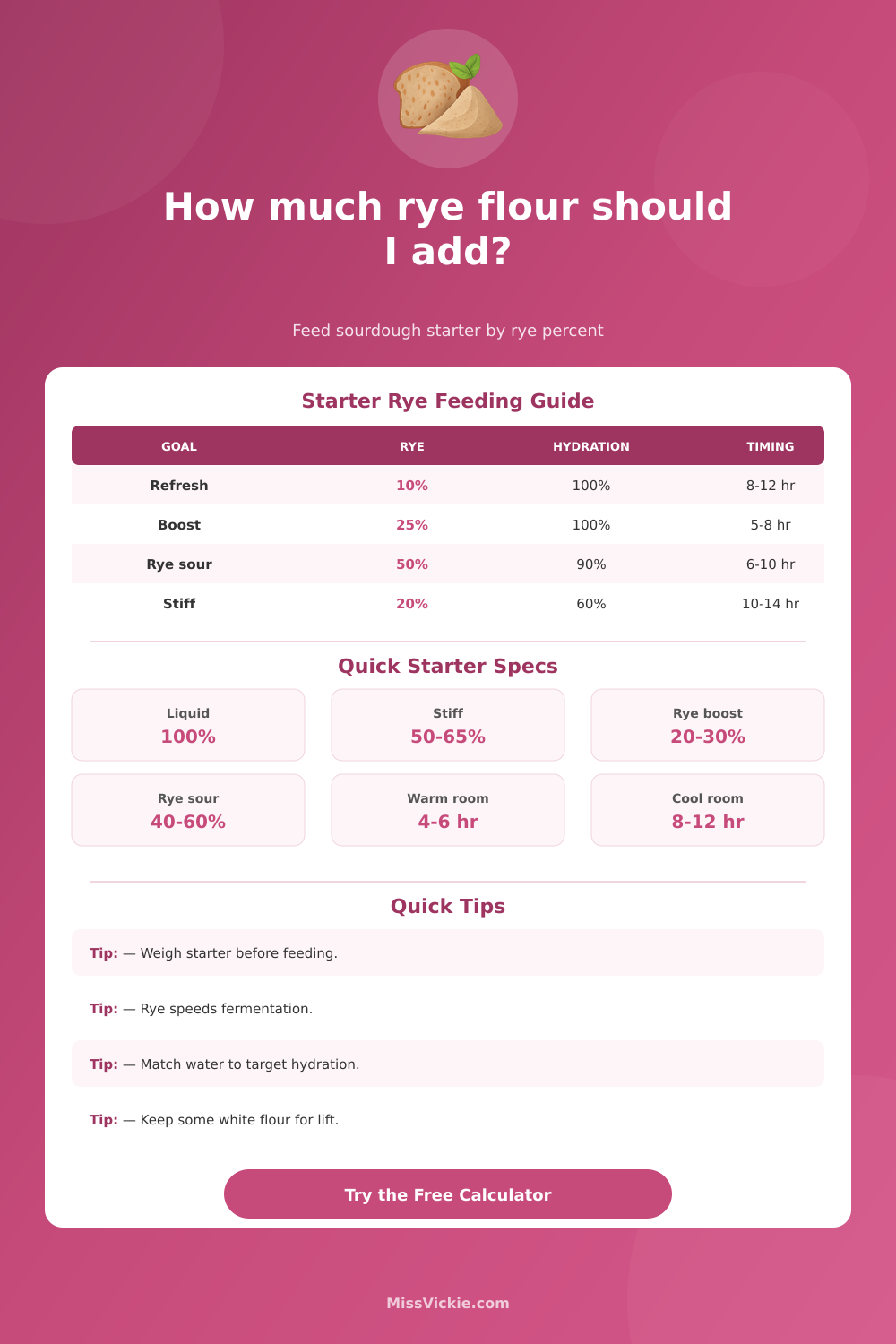
A small rye share adds minerals and aroma without changing a wheat starter dramatically.
Useful when the starter feels slow and needs a stronger rise before bread mixing.
Gives deeper acidity and faster fermentation for rye, deli-style, and seeded loaves.
Best for dedicated rye breads, but it becomes paste-like instead of stretchy.
| Target Rye In Starter | Best Use | Expected Texture | Feeding Note |
|---|---|---|---|
| 0% to 10% | Keeping a mostly white starter with a small mineral boost | Elastic, familiar, easy to judge | Use when you want rye benefits without changing the starter personality. |
| 15% to 30% | Waking a sluggish starter or building a more aromatic levain | Slightly stickier and faster to dome | Good everyday range for bakers who like rye flavor in the background. |
| 35% to 60% | Rye bread levain, seeded loaves, and tangier country bread | Paste-like, less stretchy, more aromatic | Watch the peak closely because rye can ferment quickly in a warm room. |
| 65% to 100% | Dedicated rye sour, pumpernickel-style builds, and whole rye breads | Thick paste with little gluten strength | Hydration and acidity matter more than stretch or windowpane cues. |
| Starter Hydration | Flour And Water Split | Common Feeding | Why Use It |
|---|---|---|---|
| 50% to 65% | More flour than water | Stiff levain or pasta-like rye sour | Slows fermentation, favors mild acidity, and travels well. |
| 75% to 90% | Moderately firm build | Rye sour, cool overnight levain | Rye absorbs water strongly but can still look thick at this range. |
| 100% | Equal flour and water | Daily liquid starter and most levain builds | Simple math, easy stirring, and easy comparison between recipes. |
| 110% to 125% | More water than flour | Warm quick build or very thirsty whole rye | Ferments quickly and loosens paste-like rye mixtures. |
| Room Temperature | Rye Effect | Usual Peak Window | Adjustment |
|---|---|---|---|
| 64 to 68 F | Rye still helps, but yeast activity is slower | 8 to 14 hours | Use warmer water or a smaller feed if you need the starter sooner. |
| 69 to 74 F | Balanced rise and acidity | 6 to 10 hours | Start with a 1:2:2 or 1:3:3 feeding for daily baking. |
| 75 to 80 F | Rye can peak fast and smell fruitier | 4 to 7 hours | Use a larger feed or lower rye percent for an overnight schedule. |
| Above 80 F | Acidity builds quickly | 3 to 6 hours | Feed larger, use cooler water, or move the jar before it collapses. |
| Build | Kept Starter | Target Starter | Practical Rye Range |
|---|---|---|---|
| Small jar refresh | 10 g | 50 g | 5% to 25% rye for a tidy maintenance feed. |
| Standard daily starter | 25 g | 150 g | 10% to 30% rye for activity and balanced flavor. |
| Country loaf levain | 30 g | 220 g | 15% to 35% rye for aroma without a heavy rye profile. |
| Rye bread sour | 40 g | 300 g | 40% to 80% rye for stronger acidity and rye character. |
| Large bake prep | 60 g | 500 g | 10% to 50% rye depending on the final dough formula. |
Rye flour alters behaviors of a sourdough starter because rye flour contains more mineral and enzymes than white wheat flour. The minerals and enzymes in the rye flour accelerate the sourdough starter’s fermentation process and alter acidity of the sourdough starter. Even with the same feeding ratio, the sourdough starter will exhibit altered acidity.
Bakers must understand how sourdough starter change because sourdough starter’s behavior once it is added to the dough will change accordingly. Bakers often add a small amount of rye flour to their routine feedings because a small amount of rye flour can wake up a sluggish sourdough culture. The sourdough starter has enough yeast and microbial population to perform the fermentation tasks, but the additional fuel from the rye flour improves the sourdough culture’s performance.
How Rye Flour Changes a Sourdough Starter
If the sourdough starter feels flat after a few days of feeding only white flour, a feeding of rye flour will revive the culture within the same day. The revival that occurs is the result of extra nutrients in the rye flour, not any magical property of the rye flour itself. The calculator will help you to perform the math required to determine the amount of rye flour to add to your sourdough starter based on the percentage of rye flour you would like to use and the final weight of the sourdough starter that you would like to have.
You must account for the amount of sourdough starter that you currently have on hand because the sourdough starter you have currently contains the percentage of rye flour that you used during the last feeding. Not accounting for the current amount of sourdough starter on hand might lead to you adding too much rye flour. The calculator displays the actual percentage of rye flour in the sourdough starter after rounding the numbers.
You can use this number to determine if the percentage of rye flour that you added to your sourdough starter held or drifted from the percentage that you initially added. The temperature in the kitchen impacts the fermentation speed of the sourdough starter more than many individual might expect. Rye flour ferments at a faster rate than wheat flour under all conditions.
However, the difference in the rate of fermentation is much more pronounced when the ambient temperature rises above seventy-five degrees. A wheat sourdough starter might take eight hour to reach the peak of fermentation, but a sourdough starter containing rye flour might reach the peak in only five or six hours. This faster rate of fermentation is convenient for those who would like to bake there goods on the same day in which they are prepared.
However, the faster rate of fermentation might lead to an overripe sourdough culture if the baking schedule requires the sourdough starter to ferment at a slow rate. The calculator adjusts for the impact of temperature on the rise of the sourdough starter. The hydration level of the sourdough starter interacts in a specific way with the use of rye flour.
Because rye flour absorbs water more aggressively than wheat flour, a percentage of rye flour that might feel loose in a starter that uses only white flour might end up feeling thick when rye flour is added to the sourdough starter. To combat this, many bakers find that they must add extra water to the sourdough starter to achieve the proper texture. The calculator recalculates the hydration level to show how much water should be added to the sourdough starter with the addition of rye flour.
Another factor that will impact the percentage of rye flour that should be used in the sourdough starter is whether wheat flour or liquid sourdough starter is used. Stiff sourdough starter ferments at a slower rate than liquid sourdough starter because there is less free water for the sourdough culture’s microbes to perform the necessary fermentation task. Adding rye flour to a stiff sourdough starter will result in an even slower rate of fermentation.
This slow rate of fermentation is suitable for sourdough starters that will be allowed to ferment overnight in the warm kitchen. The use of liquid sourdough starter will allow for the addition of a smaller percentage of rye flour so that the sourdough starter will reach its peak at the rate that is required to accommodate a bakery schedule. The calculator allows for both the setting of the percentage of rye flour and the target hydration level of the sourdough starter.
The room temperature of the kitchen in which the sourdough starter will sit and the baking schedule will impact the percentage of rye flour to be used in the sourdough starter. Cool kitchens will require the addition of a higher amount of rye flour than warm kitchens because the enzymes in the rye flour will assist in the slower rate of activity of the sourdough starter microbes. If the sourdough starter will be fed in the evening and baked the following afternoon, adding a modest amount of rye flour will allow the sourdough starter to reach its peak at the appropriate time.
The calculator allows for the setting of a baking schedule so that an estimated rise time can be determined. Many bakers will want to have a reserve amount of white flour on hand to incorporate into the sourdough starter, even if the sourdough starter is supposed to have the characteristics of rye flour. White flour contains properties that preserve the extensibility of the sourdough starter, while pure rye flour does not.
Using forty or fifty percent rye flour in the sourdough starter is likely to allow bakers to enjoy the benefits of rye flour without losing the structural properties of sourdough starter. The calculator will determine the amount of each type of flour that will be required once you set the percentage of the sourdough starter that will contain rye flour. This will avoid the mistake of only adding rye flour, which will result in a paste-like sourdough starter that cant support tall sourdough loaves.
One of the values of adding rye flour to sourdough starter and tracking the percentage of that flour is that it allows for the consistency of sourdough starter. If a baker finds that a certain percentage of rye flour produces sourdough starter with the rise and flavor that the baker likes, the baker can rely on that percentage of rye flour each time. The baker will eventually find that slight changes in the percentage of rye flour that is added to the sourdough starter are noticeable over time.
A sourdough starter that contains ten percent rye flour will behave differently than a sourdough starter that contains thirty percent rye flour. Each percentage level contains benefits for sourdough baking, but there is no “best” percentage for all types of sourdough baking activities. Bakers must understand the direction in which their sourdough starter is moving and the reasons for that movement.
Another benefit of the sourdough starter and rye flour percentage system is that it creates a record of the sourdough starter’s feedings. Over time, bakers will begin to associate different textures of sourdough starter with the percentages of rye flour that they have added. This knowledge will allow bakers to adjust the sourdough starter in response to changes in the weather or to changes in their baking schedule.
The calculator allows for the removal of mathematics from the sourdough starter management routine so that bakers can focus on the activities that they would like to accomplish with their sourdough starter.