Roux to Thicken Gravy Calculator
Estimate flour and fat for gravy from gravy volume, roux color, fat type, flour-to-fat ratio, stock gelatin, drippings fat, simmer time, desired nappe thickness, and serving count.
Choose a gravy situation, then fine-tune the stock body, pan fat, roux color, simmer time, and nappe target.
Gravy Roux Breakdown
| Roux Color | Typical Cook Time | Relative Thickening | Best Gravy Use |
|---|---|---|---|
| White roux | 2 to 3 minutes | Strongest, mild flavor | Milk gravy, pale poultry gravy, quick pan gravy |
| Blond roux | 4 to 6 minutes | Strong, lightly nutty | Turkey gravy, chicken gravy, make-ahead gravy |
| Peanut-butter roux | 7 to 10 minutes | Moderate, toasted flavor | Roast chicken, pork gravy, deeper holiday gravy |
| Brown roux | 12 to 18 minutes | Lower, more savory | Beef gravy, pan jus, darker roast gravy |
| Dark roux | 20 minutes or more | Much lower, intense flavor | Dark gravy where flavor matters more than thickness |
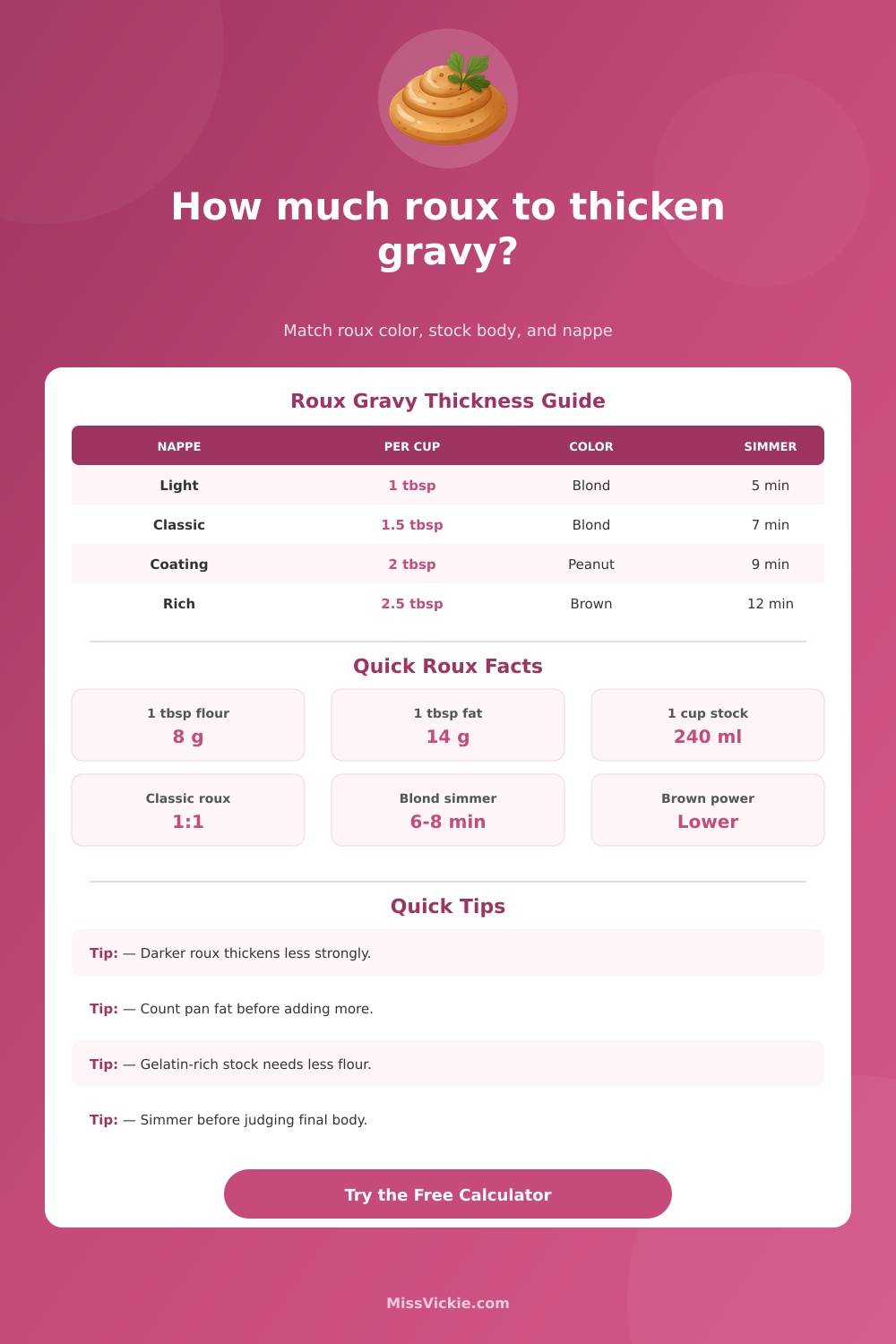
Per cup for a thin spoon coating that still pours quickly.
Per cup for standard gravy that coats meat and potatoes.
Per cup for a firm nappe with slower movement on the spoon.
Per cup for buffet holding or gravy that must cling strongly.
| Factor | Calculator Adjustment | Kitchen Reason | Practical Check |
|---|---|---|---|
| Low-gelatin boxed stock | Slightly more flour | Thin stock has less natural body once hot. | Spoon coating should be judged after 5 minutes. |
| Gelatin-rich stock | Less flour | Collagen gives a silky set as gravy cools slightly. | Rest a spoonful for 30 seconds before adding more roux. |
| Fat already in pan | Credited toward roux fat | Pan fat can hydrate flour without adding extra butter. | Separate watery drippings before measuring fat. |
| Dry flour-heavy roux | Needs less added fat | More flour per tablespoon of fat makes a paste. | Whisk harder and add stock gradually to avoid lumps. |
| Long simmer | Slightly less roux | Evaporation and starch hydration finish the texture. | Use low heat so flour taste cooks out without scorching. |
| Serving Situation | Finished Gravy | Classic Blond Roux | Serving Note |
|---|---|---|---|
| Small weeknight dinner | 2 cups / 480 ml | 3 tbsp flour plus 3 tbsp fat | Enough for 4 to 6 modest servings. |
| Family roast dinner | 4 cups / 960 ml | 6 tbsp flour plus 6 tbsp fat | Good for 8 plates with seconds. |
| Holiday gravy boat | 6 cups / 1.4 L | 9 tbsp flour plus 9 tbsp fat | Works for 12 generous turkey servings. |
| Buffet mashed potatoes | 10 cups / 2.4 L | 20 tbsp flour plus 20 tbsp fat | Use thick target if gravy sits warm. |
Making gravy seems easy, especially when you want it to coat a spoon without sliding off your plate like thick goop. But if you don’t do it right, well, there you have it. It’s typically a combination of 2 thing: what type of roux did you use? How much roux did you build? And those questions hinge on two other factors. The stock you started with and how much time you has to simmer the completed gravy.
This is where something like the above can work, as it removes guesswork (the variables you can control) and makes it into something you can start from.
How to Make Good Gravy
Fat coats starch granules, which then absorbs water without sticking together; this is what’s called a roux. How long you cook it also affect the thickness it creates, as well as its flavor. White rouxs thicken best (though have the mildest flavor) and are used in things like milk-based gravies where you’d prefer the brightness of stock to shine through. Blond roux has a mild nutiness to it, while still thickening quite effectively. This is why it make an appearance in most weeknight turkey or chicken gravy. Going darker (brown or peanut butter territory) will give you even toastier flavors. But sacrifices some of the thickening power. This is reflected in the calculator, so you don’t wind up with soup instead of gravy all because you craved a bit more depth.
So there’s a thing about fat. It matters. But not necessarily as you’d think. Saving yourself some extra butter by using actual roasting pan drippings will add flavor. Still, you’ll want to know how much clear fat you have. You also need to know how much water was in those juices. You’ll need to measure how much clear fat you actualy have after the watery juices settle, and then enter that amount into tool. That way it doesn’t double-count the fat you’ve already got in pan.
Same goes with stock gelatin: If you’re starting with a rich, homemade stock that gels when cold, it has some body. Because of this build, you don’t use as much flour to reach same thickness on your spoon. That boxed stock contain no collagen. For that reason, when you choose the low-gelatin option, calculator moves the amount up a bit.
Also, simmer time and reduction change things. Longer cooking reduces liquids and further hydrates the starches. This allows you to begin with slightly less roux and still arrive at your desired thickness. That’s what the tool adjusts for; so you don’t make it too thick before letting gravy thicken on its own.
The nappe target is just an instruction to tell the calculator how thick you want the finished gravy to be when it coats the back of a spoon. Light glaze, classic coating, thick mashed-potato style, or extra-thick buffet hold… Each take a different amount as a starting point, which then scales everything else accordingly.
Remember though, this is a beginning, not a finish line. Tweak and taste as it simmer in the pan. The serving temperature and some extra thickening after cooking will also matter. What appears soupy over high heat may prove perfect after a couple of minutes in gravy boat. The calculator accounts for this by saying that you need to add more volume to get the same thickness with a darker roux (and more importantly), some flavor that may cover up what is actually a bit thin but which you’re happy to accept.
As for the gravy, the most succesful gravies are those where you choose a roux to match the specific meal rather than trying to use the same formula for everything. Once you know what each of these inputs do, the numbers don’t feel so mysterious anymore. They begin to feel like a map that will get you where you want to go.