Rotisserie Chicken Shelf Life Calculator
Estimate how much safe refrigerated time is left for a store rotisserie chicken using purchase timing, whole or carved storage, cooling delay, fridge temperature, container seal, serving exposure, and planned leftover use.
🍗 Rotisserie Chicken Presets
Choose a real leftover situation, then adjust the purchase age, cooling delay, fridge temperature, storage method, and planned use for your chicken.
🧊 Storage Inputs
Storage estimate
Enter your rotisserie chicken details to estimate the leftover window.
Formula Breakdown
Batch Details
📌 Quick Rotisserie Benchmarks
This calculator is a conservative kitchen estimator. Discard chicken with sour odor, slime, mold, unusual color, or an unknown warm-storage history.
📊 Whole vs Carved Shelf-Life Reference
| Rotisserie State | Best Fridge Window | Why It Changes | Calculator Base |
|---|---|---|---|
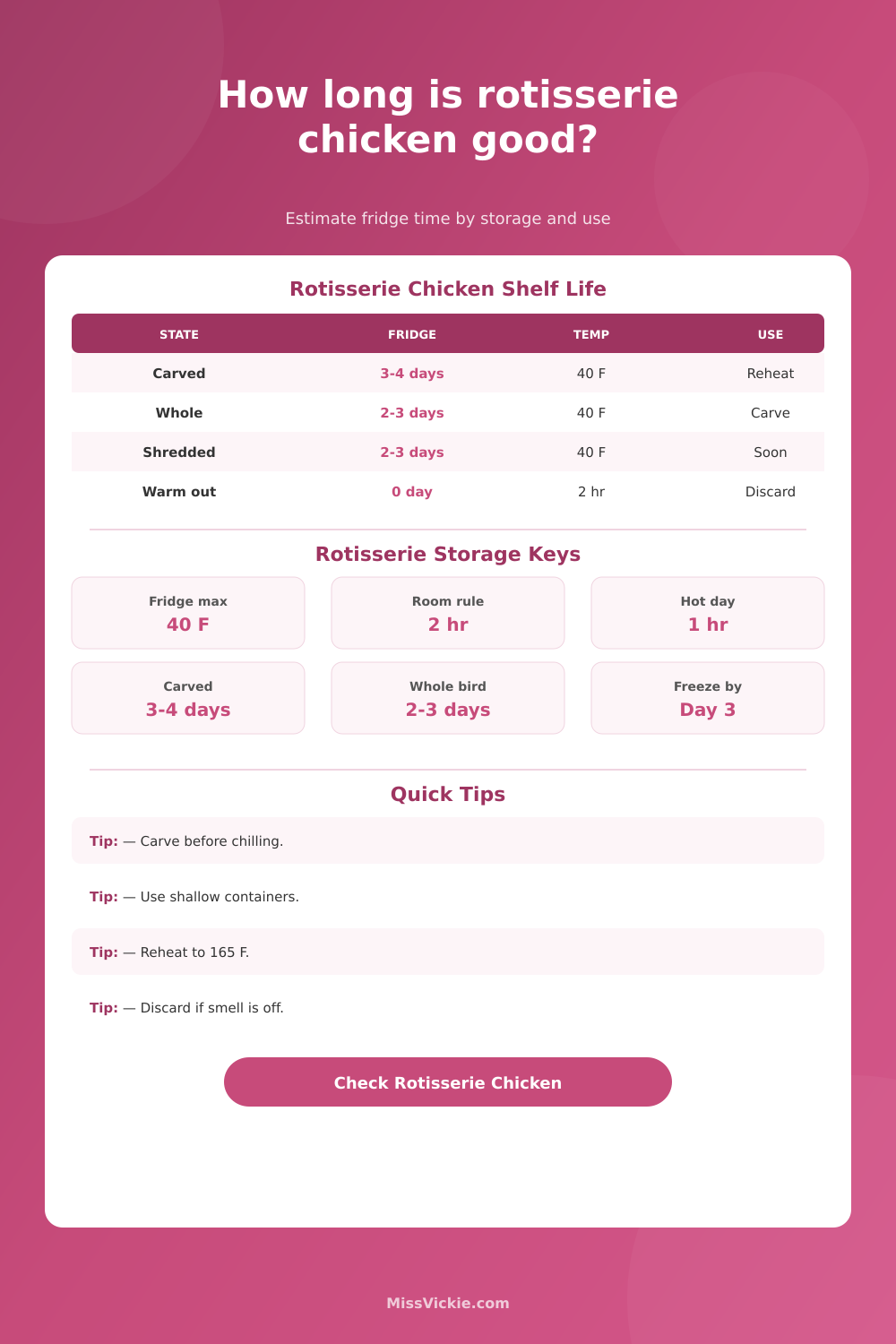
| Carved meat in shallow container | 3 to 4 days if chilled quickly | Small pieces cool fast and the date is easy to label | 96 hours |
| Whole bird kept mostly intact | 2 to 3 days for a conservative home window | The center and bones retain heat longer after purchase | 72 hours |
| Original clamshell or loose store tray | 2 to 3 days, sooner if warm when stored | Deep packaging slows cooling and catches condensation | 68 hours |
| Shredded, diced, or pulled meat | 2 to 3 days for best safety margin | More surface area and handling shorten the practical window | 72 hours |
| Chicken salad or cold filling | 1 to 2 days after mixing | Moist mixed food and cold serving need stricter use | 48 hours |
🌡 Temperature and Cooling Penalties
| Condition | Safe Practice | Calculator Effect | Kitchen Action |
|---|---|---|---|
| Fridge 34 to 40°F | Target cold holding range | No penalty or small cold bonus | Keep sealed and labeled |
| Fridge 41 to 43°F | Marginally warm for leftovers | Subtracts 18 hours | Use sooner and adjust the fridge |
| Cooling 1 to 2 hours | Still within the usual room-time rule | Subtracts 10 hours | Carve and chill promptly |
| Cooling 2 to 3 hours | Past the standard 2-hour mark | High penalty or discard flag | Do not stretch the date |
| Hot room or picnic heat | Use the 1-hour rule above 90°F | Very high penalty | Discard if timing is unclear |
🍲 Leftover Use Logic Table
| Planned Use | Recommended Age | Temperature Step | Calculator Bias |
|---|---|---|---|
| Hot plate, tacos, rice bowl, casserole | Within 3 to 4 days if stored well | Reheat to 165°F | Standard cooked-poultry window |
| Soup, gravy, curry, or sauce | Within the safe window, best by day 3 | Bring the whole dish steaming hot | Slight quality-friendly bias |
| Cold sandwich or wrap | Best in 1 to 2 days | Keep chilled until serving | Shorter window |
| Chicken salad or mayo-based filling | Use quickly after mixing | Do not leave out at the table | Strict window |
| Children, pregnancy, older adult, immune risk | Use freshest leftovers only | Heat thoroughly | Extra safety reduction |
🧾 Common Rotisserie Scenarios
| Scenario | Typical Inputs | Expected Result | Best Next Step |
|---|---|---|---|
| Same-day carved leftovers | Carved within 60 minutes, airtight, 38°F fridge | Low risk with a 3 to 4 day window | Label and use for hot meals or freeze by day 3 |
| Whole bird in clamshell overnight | Store box, still warm, whole bird, opened once | Use sooner because the center cooled slowly | Carve now into shallow storage |
| Day-three shredded meat | Shredded, opened repeatedly, fridge at 39°F | Eat soon or freeze if still normal | Use in soup or casserole today |
| Warm counter or long car ride | Over 2 hours warm, hot room, or timing unknown | Discard flag even if it smells fine | Do not taste-test |
⚖ Storage Method Comparison
Carved while fresh, divided shallow, sealed airtight, and held at 40°F or lower.
Whole bird, original clamshell, shredded meat, or leftovers opened several times.
Cold sandwiches, chicken salad, kids, older adults, pregnancy, or immune risk.
More than 2 hours warm, hot-day abuse, fridge above 45°F, slime, mold, or off odor.
💡 Rotisserie Storage Tips
On Tuesday, you pick up a rotisserie chicken for dinner. Dinner’s supposed to be cheap and easy.
THURSDAY: There’s that chicken in the back of your fridge, staring at you, half hope, half suspicion. It’s fine, right? Smells mostly fine. But there’s something off, your gut says. Don’t worry; that hesitance isn’t paranoia. That’s your brain trying to account for factors that a simple date label doesn’t capture.
How to Keep Cooked Chicken Safe
Enter the calculator above. Plug in when you bought it, how long it was cooling before you put it away, and what you stored it in. It crunches the numbers to turn a fuzzy guess into real deadline. This lets you decide whether to throw it out or heat it up without playing Russian roulette with your lunch.
People tend to screw up the first step: They think that once they plop their chicken into the fridge, it cease to age. No. Time doesn’t begin when you put plastic tub on the fridge’s shelf. It begins when the chicken leaves the store warmer than 40°F. And by the way, those bugs have been multiplying while that bird was sitting on your kitchen counter for the hour it took you to unpack the groceries. Because time spent over 40° F is the greatest risk factor for food-borne illness, the tool takes that delay into account.
Hot chicken cools slowly. Skin gets cold; that dense chunk of bone-and-meat nearby remains warm longer. This produces a thermal trap, perfect conditions for pathogen growth while we dither around waiting for the fridge to kick in. The key is understanding exactly what it is we’re measuring; and in most cases, it isn’t necessarily just the food alone but the environment that it passed through.
The game changes when you carve up the bird. Sure, it may seem convenient to just leave it whole in original clamshell package. But once you put plastic over warm food, moisture builds up on the inside and turns into liquid. This creates a damp, warm environment that causes food to spoil. By removing the meat from the carcass and laying it out into flat packages, you allow the cold air to circulate through the food far more quickly. And the math proves it: the calculator will tell you that you can safely store your carved chicken for an additional couple of days (compared to a still-whole bird in its original packaging). Yes, it’s only a few minutes of work upfront… but if you’re planning on enjoying leftovers throughout the weekend, that’s nearly always a worthwhile trade-off.
Beyond storage, though, the condition of the meat itself makes a difference. Intact pieces… Breasts or drumsticks, has less surface area than shredded or diced meats. Less surface area exposed to air equals slower deterioration of quality and lower likelihood of contamination during handling. Even worse: if you’re going to dice up that chicken and put it in a mayonnaise-slathered salad, double down on strictness. Reheating kills anything that was wrong with your leftovers; cold doesn’t help. That’s why the tool also reduces the window a lot for cold foods or those that will be served to susceptible populations (i.e., older adults or young children). It makes you realize that while a day-three leftover may be fine in a hot casserole dish, it could be risky in a sandwich.
And then there’s storage temperature, which nobody pays attention to until it’s too late. Most people has their home fridge running warmer than the ideal forty degrees Fahrenheit. At forty-four or forty-five degrees, everything inside will spoil more quickly. The calculator penalizes warmth because bacteria grows about twice as fast for every degree of heat. And it doesn’t matter how cold something is, so long as it’s not consistent: a poorly-chilled fridge full of stuff spoils faster than a well-chilled one with the same stuff. The gold standard is a shallow container in a proper fridge set to chill. The bad example is an open plate sitting on a warm shelf.
In short, there’s no substitute for your nose. If anything about the meat is different (smelly, slimy, strange color), just throw it out. So yeah, the algorithm gives you a framework to think through. It provides the time and temperature logic so you can decide how you want to play it. It takes away the guessing. It also removes the risk of throwing good food in the trash or taking extra risks. You get to decide what risks you’re willing to take. The calculator never will. Set your expectations accordingly (let the data inform your thinking)… And then go with your gut on whether or not to make the move. Treat that rotisserie chicken on Tuesday right and it’ll go until Friday. The data will tell you what you should expect. Your judgement will tell you when it’s time to pull the trigger.