Roti Calorie Calculator
Estimate plain or stuffed roti calories from flour grams, roti count, diameter, thickness, brushed oil or ghee, water absorption, cooking loss, serving size, and standard macro data.
Load a common roti style, then adjust flour, water absorption, brushed fat, filling, and serving size to match your recipe.
Roti Batch Breakdown
Macro Formula
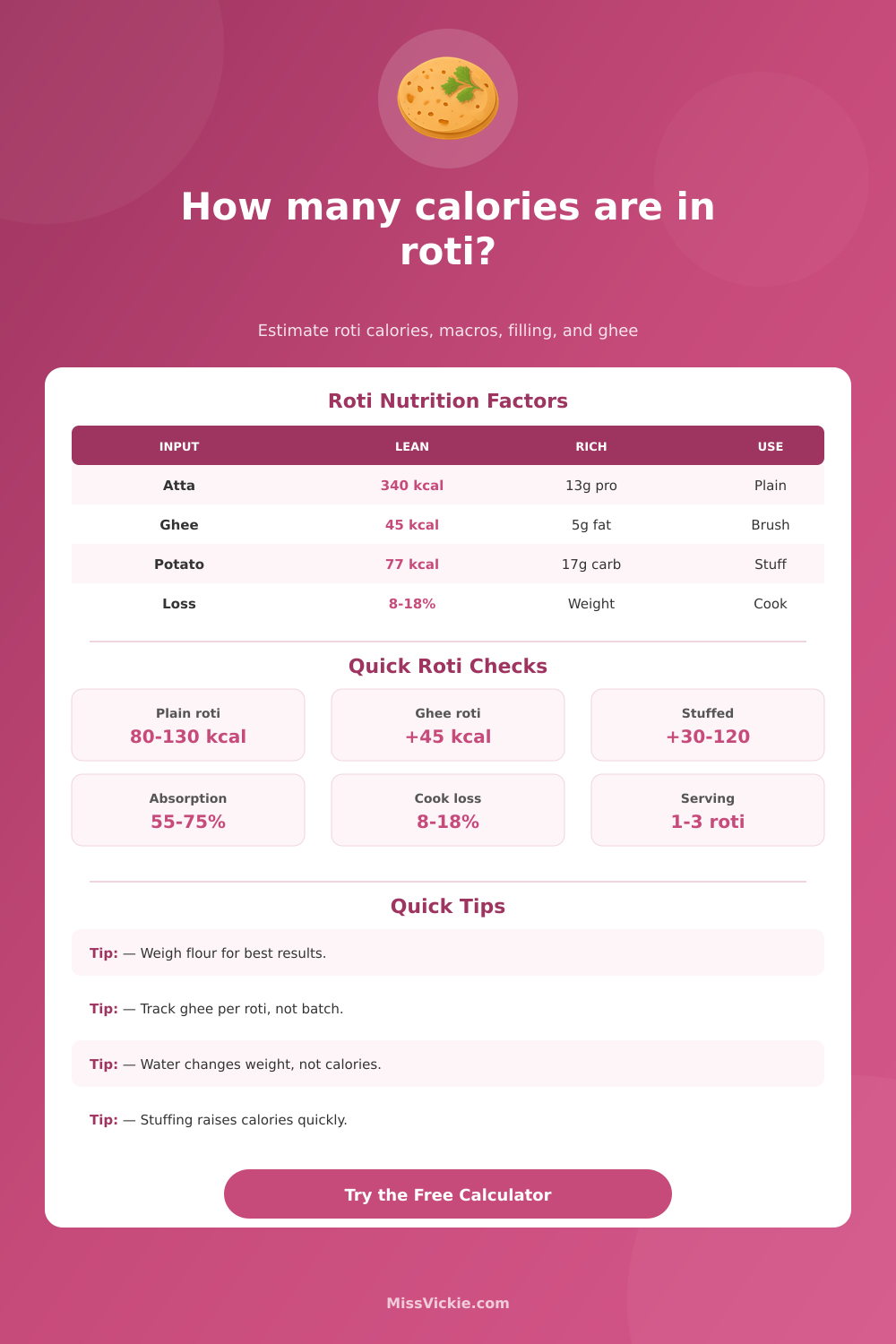
Calories are calculated from flour, brushed fat, and optional filling. Water absorption and cooking loss change final weight, but they do not add calories.
| Roti Flour | Calories | Carbs | Protein | Fat | Best Use |
|---|---|---|---|---|---|
| Chapati atta | 340 kcal | 72.0 g | 13.2 g | 2.5 g | Everyday roti and phulka |
| Whole wheat flour | 340 kcal | 72.0 g | 13.2 g | 2.5 g | Higher fiber home chapati |
| All-purpose flour | 364 kcal | 76.3 g | 10.3 g | 1.0 g | Softer restaurant-style roti |
| Bread flour | 361 kcal | 72.5 g | 12.0 g | 1.7 g | Chewier tandoori-style roti |
| Millet flour | 378 kcal | 72.9 g | 11.0 g | 4.2 g | Bajra or millet flatbread |
| Besan chickpea flour | 387 kcal | 57.8 g | 22.4 g | 6.7 g | Protein-rich missi roti |
| Mixed grain roti flour | 352 kcal | 69.0 g | 14.0 g | 3.2 g | Multigrain roti dough |
| Roti Style | Water Absorption | Cooking Loss | Typical Diameter | Texture Signal |
|---|---|---|---|---|
| Dry phulka | 58-65% of flour | 10-15% | 15-18 cm | Light, puffed, no surface fat |
| Soft chapati | 62-70% of flour | 8-14% | 16-20 cm | Flexible, lightly browned |
| Tandoori roti | 55-62% of flour | 12-18% | 18-23 cm | Chewy with dry heat loss |
| Layered paratha | 55-65% of flour | 8-12% | 15-20 cm | Thicker with brushed fat |
| Stuffed roti | 58-68% of flour | 8-15% | 15-22 cm | Final weight depends on filling |
| Add-In | Calories | Carbs | Protein | Fat | Roti Note |
|---|---|---|---|---|---|
| Vegetable oil | 884 kcal | 0 g | 0 g | 100 g | About 40 kcal per teaspoon |
| Ghee | 897 kcal | 0 g | 0.3 g | 99.5 g | About 45 kcal per 5 g brush |
| Butter | 717 kcal | 0.1 g | 0.9 g | 81.1 g | Lower fat density than ghee |
| Boiled potato masala | 87 kcal | 20.1 g | 1.9 g | 0.1 g | Common aloo paratha base |
| Paneer filling | 265 kcal | 3.6 g | 18.3 g | 20.8 g | Raises protein and fat |
| Cauliflower filling | 35 kcal | 7.0 g | 2.4 g | 0.3 g | Light gobi-style stuffing |
| Cooked dal filling | 116 kcal | 20.1 g | 9.0 g | 0.4 g | Higher-protein lentil roti |
| Onion herb filling | 40 kcal | 9.3 g | 1.1 g | 0.1 g | Low-calorie savory filling |
Many of our meals revolve around rotis, but few think about how much they weigh, or what their calorie counts are. How much fat goes into making them? What type of flour was used? Is there stuffing inside, and if so, how much? Home cooks tend to guesstimate these factors. And then is sometimes surprised by the outcome. With a calculator that accounts for actual ingredients in your recipes, those little decisions add up (whether you’re making one or a dozen servings).
The base is flour, which provide most of the protein and calories. The type of flour makes all the difference, such as switching from besan to atta. While water doesn’t add any calories, it do change how much the dough will weigh once cooked, plus its feel while being worked with your hands. Because this is a weight vs. Energy variable, the calculator include moisture in the formula as a weight variable, not an energy one. So if I’m comparing a soft chapati to a drier phulka, the math remain honest.
How to Count Roti Calories
The calories increase almost one-for-one when you brush some fat onto each roti: a thin layer of oil or ghee can add nearly as many calories as flour itself. Multiply by your meal size and it gets bigger still. Multiply by your meal size and it gets bigger still. Enter how much fat goes on each roti, and you’ll see the clear tradeoff between taste and fuel as it happens… Without needing to do multiple rounds of back-of-the-napkin math.
Stuffing works similar. Paneer contributes both fat and protein; potato masala is mostly carb. Enter weight of the cooked filling for your batch, and the calculator will redo its totals.
How diameter and cooking loss affect your results Both matter. They figure into how much raw dough survives to become a finished roti. Thicker roti retain more moisture during tawa-cooking than thinner ones (all else equal). That alters weight-per-roti despite identical flour amounts. On the page I provide typical ranges for loss and absorption based off style; they establish reasonable starting points prior to tweaking inputs to suit your kitchen.
Serving sizes add up fast; people may dismiss two rotis as nothing much, but the second roti has exactly as much filling plus the same brushed fat. The serving context field can be changed to see what happens with a different meal composition or appetite. That’s helpful on those days when roti forms the main carbohydrate part of the meal. Or that day when roti accompanies something else starchy (like rice).
But the magic is in seeing all those variables together. No need to remember multiple rules at once. As soon as you grasp how weight tracks loss and water, how calories track filling, fat, and flour, the numbers don’t feel arbitrary anymore. The decision becomes: Is that final dollop of ghee really worth it? Could of I add some vegetable stuffing and still be satisfied, but keep the meal on the lighter side? That is when clarity lets you choose what you put on your plate by design instead of just by habit every day.