🍗 MissVickie roast turkey calculator
Roast Turkey Cooking Temperature Calculator
Estimate whole-bird roast time, breast and thigh pull temperatures, and carryover for stuffed or unstuffed turkeys using convection or conventional heat.
Each preset loads a real turkey scenario with cut style, weight, stuffing, convection offset, probe zone, rest, and carve hold timing.
The calculator uses cut style first, then adjusts weight, stuffing, convection offset, pull goal, carryover, and carve hold from the selected probe zone.
Turkey Roast Results
Whole-turkey and breast-only targets update with the selected probe zone, carryover, rest, and carve hold window.
Calculation Breakdown
Use this grid to compare the main tradeoffs between whole birds, breast-only roasts, stuffing, and convection offsets before you set the oven.
Best for classic holiday centerpieces.
Cooks faster through the center.
Needs more rest and careful probing.
Trims time without drying the bird.
| Zone | Safe Finish | Typical Pull | Probe Spot |
|---|---|---|---|
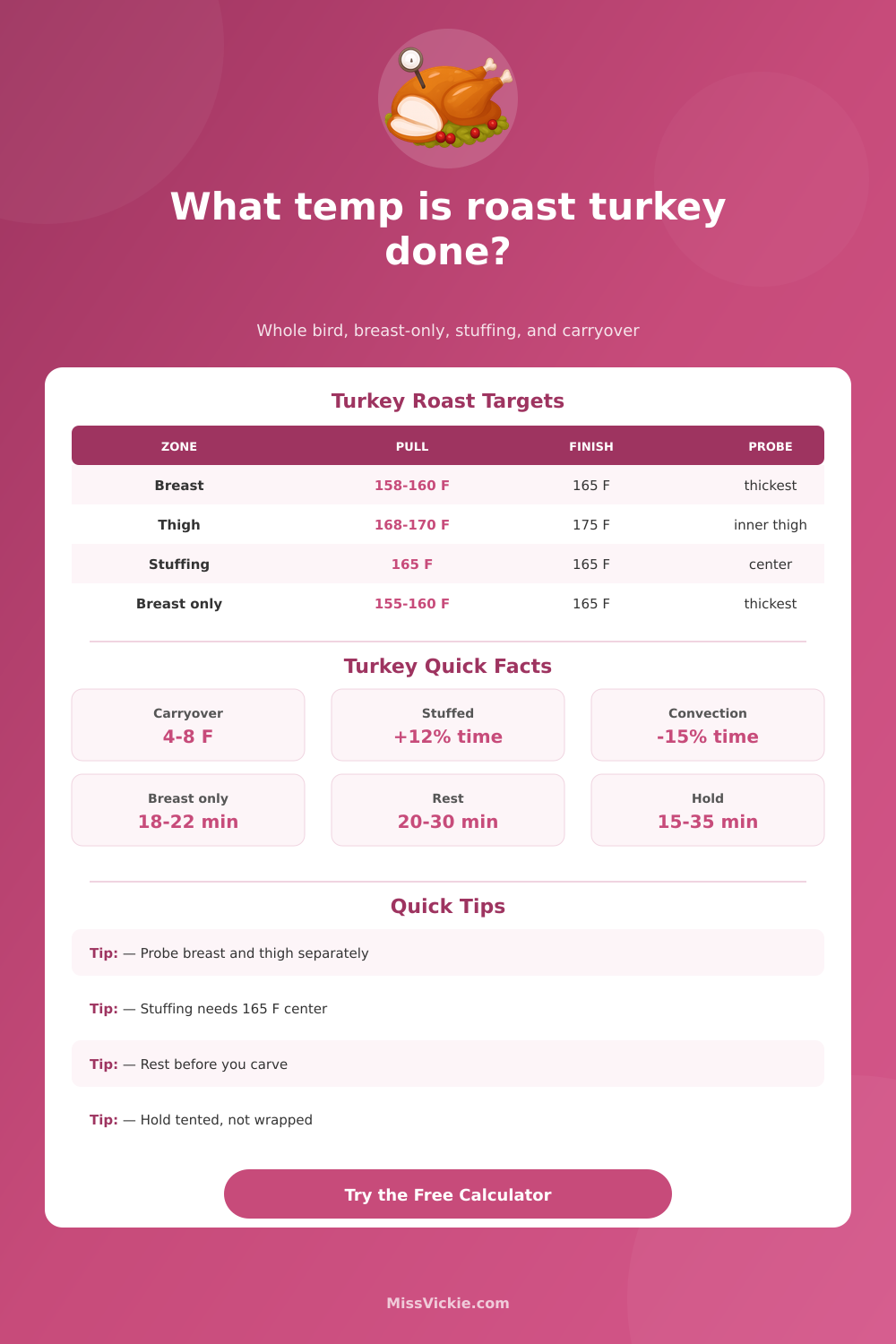
| Breast | 165 F | 158-160 F | Thickest lobe |
| Thigh | 175 F | 168-170 F | Inner thigh |
| Stuffing | 165 F | 165 F | Center mass |
| Breast only | 165 F | 155-160 F | Thickest point |
| Weight | Whole bird | Breast-only | Note |
|---|---|---|---|
| 4-6 lb | 1.5-2.25 hr | 2-2.5 hr | Small roast |
| 8-12 lb | 2.75-3.5 hr | 3-4 hr | Dinner bird |
| 12-16 lb | 3.5-4.25 hr | 3.75-4.5 hr | Holiday size |
| 16-22 lb | 4.25-5 hr | 4.5-5.5 hr | Crowd roast |
| Offset | Time Bias | Temp Bias | Best Use |
|---|---|---|---|
| 0% | Base | None | Standard oven |
| -10% | Light cut | Small drop | Even browning |
| -15% | Strong cut | Moderate drop | Most convection ovens |
| -20% | Max cut | Large drop | Use with care |
| Goal | Rest | Carryover | Use When |
|---|---|---|---|
| Juicy | 15-20 min | 4-6 F | Breast-focused |
| Classic | 20-25 min | 5-7 F | Holiday default |
| Holiday | 25-30 min | 4-5 F | Stuffed bird |
| Extra-safe | 30-35 min | 3-4 F | Tighter buffer |
These tools matter because turkey roasts best when the probe reads the thickest point, the bird gets airflow, and the breast stays protected during the rest.
Fast breast and thigh checks at the end.
Tracks carryover without opening the oven.
Lifts the bird for cleaner airflow.
Protects the breast during the hold.
To cook a turkey proper, one must take into consideration the effect of heat, mass, and time on the turkey’s internal temperature. Many people may find it dificult to cook their turkey such that the turkey is both properly cooked on the outside yet still undercooked on the inside. This issue are due to the continued cooking of the turkey after it has been removed from the oven.
Such cooking is refered to as “carryover cooking,” which occurs due to the continued transfer of heat from the outer layers of the turkey to the center of the turkey as the turkey rests after being removed from the oven. By cooking the turkey until it reaches the required internal temperature while it is still in the oven, however, one may find the turkey to be overcooked after it has rested. Therefore, one must use a pull temperature for cooking the turkey.
How to Cook a Turkey the Right Way
A pull temperature is the target internal temperature for the turkey that is several degrees lower than the final, required temperature for cooking the turkey. By using a pull temperature, the carryover cooking of the turkey will allow the turkey to reach the required internal temperature without becoming dry. Additionally, the weight of the turkey will affect the cooking process due to the fact that a turkey with a larger mass will experience a higher rise in internal temperature then a turkey with a smaller mass.
Thus, one should also adjust the pull temperature according to the weight of the turkey that will be cooked. Furthermore, one must use an appropriate probe zone when using a thermometer to cook the turkey. Many people mistakenly only probe the breast of the turkey for internal temperature; the thigh and breast portions of the turkey requires different internal temperatures.
The breast portion of the turkey is leaner than the thigh of the turkey. As a result, the breast portion of the turkey will dry out quick if cooked to too high of a temperature. The thigh portion of the turkey contains more fat, which contributes to the cooking of the thigh to a higher internal temperature than the breast portion of the turkey for it to be edible.
If the cook cooks the thigh to the same temperature as the breast portion, the thigh will be undercooked. However, if the cook cooks the breast portion of the turkey to the same temperature as the thigh, the breast portion will be dry. Additionally, the type of oven in which the turkey is cooked will impact the cooking of the turkey.
For instance, convection oven use a fan to circulate hot air around the turkey. This hot air increases the rate at which the turkey is cooked. Thus, the skin of the turkey may cook to doneness while the internal mass of the turkey has yet to reach the proper cooking temperature.
Lastly, if the turkey contains stuffing inside its cavity, such stuffing will impact how the turkey cooks. The stuffing will act as a thermal shield around the turkey which will prevent the turkey from cooking evenly. Thus, the turkey will take longer to cook to an internal temperature that will allow the stuffing to reach an internal temperature that is safe to eat.
Finally, after the turkey has cooked, it must rest for 20 minute prior to carving. During this time, the juices that have accumulated in the turkey will be able to redistribute throughout the turkey’s meat. If the turkey is carved too soon after removal from the oven, the juices will exit the turkey’s meat, drying it out.
Similarly, if the turkey is allowed to rest for 20 minutes, the turkeys meat will retain its moisture. Finally, another method that ensures that the turkey reaches the proper internal temperature is the use of a leave in probe thermometer. This type of thermometer allows for one to monitor the turkey while its cavity is still intact and its oven door is still closed.
If the cook opens the oven door to monitor the turkey with a conventional thermometer, heat will escape the oven, increasing the total time required to cook the turkey.