Roast Potato Time Calculator
Estimate oven-roasted potato timing from potato type, cut size, batch weight, oven temperature, parboil level, fat type, pan crowding, convection, rack position, and crispness target.
🥔 Roast Potato Presets
Pick a starting point, then adjust the potato, cut, oven, fat, and pan setup for the way you actually roast potatoes.
⚖ Potato And Oven Inputs
Roast potato timing
Your calculated roasting plan will appear here.
Roast Breakdown
Oven Plan
Timing Cues
📊 Roast Potato Serving Grid
⏲ Baseline Roasting Time Table
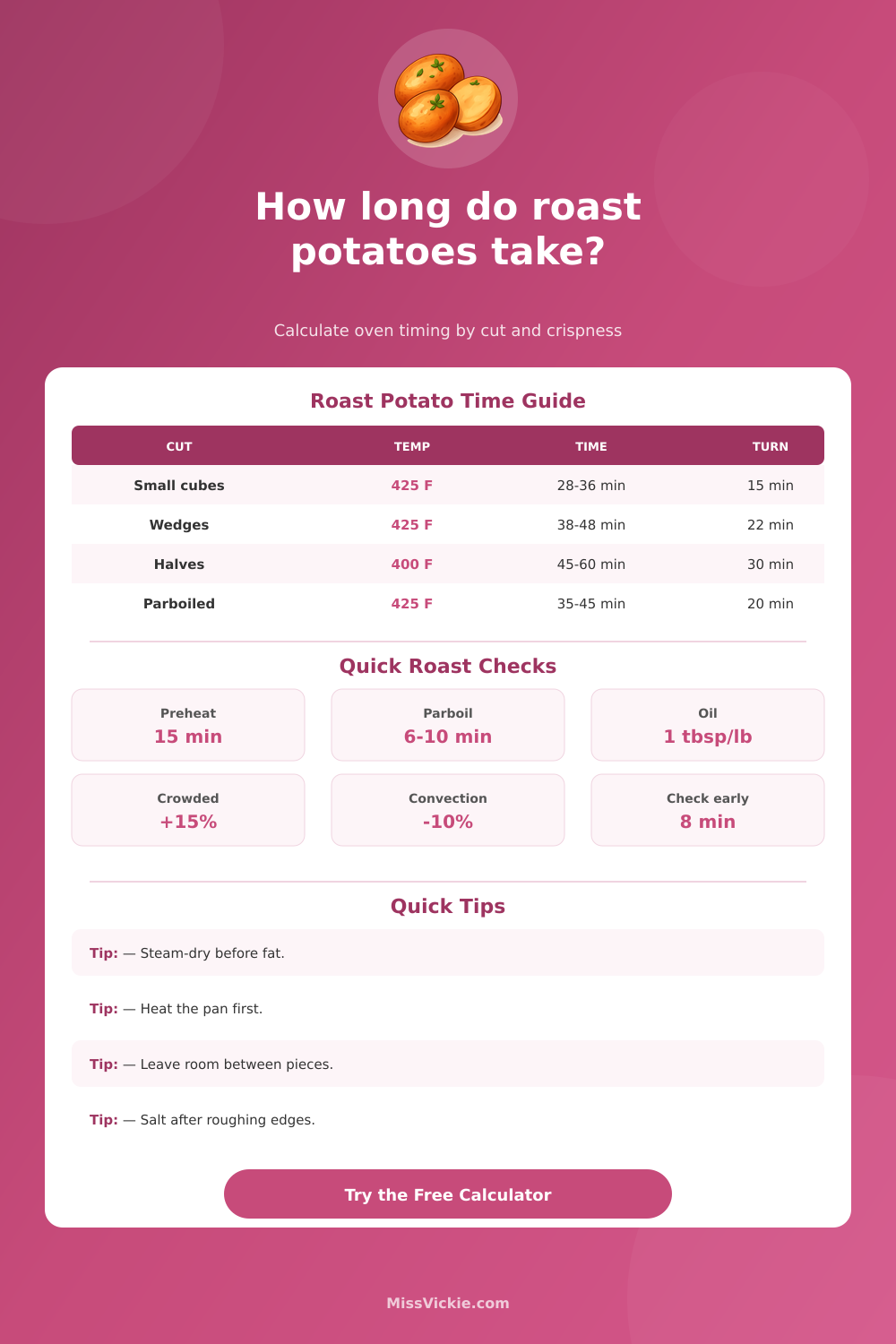
| Cut Style | Typical Size | Best Temperature | Baseline Time | Turn Point |
|---|---|---|---|---|
| Small cubes | 3/4 inch pieces | 425 F / 218 C | 28 to 36 minutes | 14 to 18 minutes |
| Medium chunks | 1 to 1 1/4 inch pieces | 425 F / 218 C | 36 to 46 minutes | 20 to 24 minutes |
| Large chunks | 1 1/2 inch pieces | 400 F / 204 C | 46 to 60 minutes | 28 to 32 minutes |
| Wedges | 3/4 to 1 inch thick | 425 F / 218 C | 38 to 50 minutes | 22 to 26 minutes |
| Halved baby potatoes | 1 inch halves | 425 F / 218 C | 32 to 42 minutes | 18 to 22 minutes |
| Whole baby potatoes | 1 to 1 1/2 inch | 400 F / 204 C | 42 to 56 minutes | 28 to 34 minutes |
| Thick slices | 1/2 inch coins | 425 F / 218 C | 25 to 34 minutes | 13 to 17 minutes |
| Small hasselback potatoes | 1 1/2 inch potatoes | 400 F / 204 C | 45 to 60 minutes | Baste after 30 minutes |
The calculator adjusts these baselines for potato variety, parboiling, pan spacing, fat, oven mode, rack placement, and crispness.
🥔 Potato Type And Prep Table
| Potato Type | Roasting Behavior | Good Cut | Timing Effect | Kitchen Cue |
|---|---|---|---|---|
| Russet or Idaho | Fluffy center, rough edges | Chunks, wedges | Slightly faster browning | Rough after parboiling for crisp shells. |
| Yukon Gold | Creamy center, steady browning | Chunks, halves | Baseline timing | Works well with olive oil or duck fat. |
| Red potato | Waxy, holds shape | Halves, wedges | Needs a little longer | Cut sides should face the pan early. |
| Baby potato | Moist, small, tender | Halves or whole | Depends on diameter | Fork checks matter more than color. |
| Fingerling | Uneven slender shape | Halved lengthwise | Slightly slower | Turn gently so skins stay intact. |
| Sweet potato | Sugary, browns early | Chunks, wedges | Lower heat, close checks | Pull before edges get bitter. |
🔥 Oven, Fat, And Pan Adjustment Table
| Variable | Faster Roast | Slower Roast | Calculator Adjustment | Best Check |
|---|---|---|---|---|
| Parboil | Rough, fluffy edges | Raw dense centers | About -10% to -22% | Steam-dry before oiling. |
| Fat | Duck fat or neutral oil | Very little oil | About -4% to +10% | Look for sizzling at the pan. |
| Pan spacing | Single layer with gaps | Crowded two-layer pan | About +0% to +28% | Moisture on the pan means delay. |
| Convection | Fan or air roast | Weak standard oven | About -12% to +14% | Check color 8 minutes early. |
| Rack and pan | Preheated metal pan | Glass baking dish | About -7% to +12% | Lift one piece to check bottom color. |
🍽 Common Batch Comparison
Medium chunks, one pan, about 35 to 45 minutes at 425 F.
Use two pans or expect extra time from steam and crowding.
Fluffy edges roast faster but need a hot pan and dry surface.
Convection shortens time, especially for cubes and wedges.
📘 Roast Potato Reference Amounts
| People | Side Portion | Generous Portion | Fat Needed | Pan Suggestion |
|---|---|---|---|---|
| 2 people | 12 oz / 340 g | 1 lb / 450 g | 1 tablespoon | Quarter sheet pan |
| 4 people | 1 1/2 lb / 680 g | 2 lb / 900 g | 2 tablespoons | Half sheet pan |
| 6 people | 2 1/4 lb / 1 kg | 3 lb / 1.4 kg | 3 tablespoons | One large or two small pans |
| 8 people | 3 lb / 1.4 kg | 4 lb / 1.8 kg | 4 tablespoons | Two half sheet pans |
| 12 people | 4 1/2 lb / 2 kg | 6 lb / 2.7 kg | 6 tablespoons | Two to three pans |
💡 Timing Tips
Roasting potatoes is not a skill. It’s about physics. No matter how many expensive spices you throw in there, your roasties will turn out like mush. You must dry them first. Also, don’t over-crowd the roasting tray. This isn’t where it pays to get fancy with flavouring; timing’s what counts.
This is where gadget above comes in. It does all that tricky stuff. It takes into account everything from oven fan strength to the condition of the potato edges while letting you concentrate on temperature.
The Science of Perfect Roast Potatoes
First: What did you cut? Why? Because thicker pieces takes longer for their interior to get heated up. If it’s small cubes of potato, they’ll cook fast, meaning they’ll spend most of their time being brown, rather than steamed. If they are large chunk or even whole baby potatoes, they’ll brown slowly. They require more cooking time at a lower heat to ensure that their insides softens while their outsides don’t burn. Whatever you choose, the algorithm will tweak the baseline settings accordingly.
All you have to do is honestly answer question: How did you chop these? Rough edges cook faster than smooth ones because more surface area meets the hot air. This is something that most home cooks forget… And then wonder why potatoes turned out burnt on one end, but raw in the other. With parboiled ingredients, it’s another story. Parboiling in boiling water softens the interior starches, meaning oven doesn’t need to work as hard to cook through the middle. That leaves more time to brown.
There’s a caveat: If any of those boiled items arrive on the pan wet, they’ll roast but they won’t brown, they’ll just steam. Because water boils at 212 degrees Fahrenheit, it’s a no-go; until all the water evaporates, the food can never be hot enough on its surface to brown. Crispiness hinges on making sure they’re bone dry after draining. This pattern is shown in the inputs where specifying raw (dense) centers instead of rough edges means longer cooking times.
Good roast potatoes don’t crowd each other. If one touches another, they trap moisture between them. That steam then cooks the neighboring piece slowly (as in “gently,” as in “like a steamer basket”) instead of aggressively (as in “roasted”). In those areas, you’ll quickly lose texture and color. Contrary to what you may imagine, spacing realy matters.
As chart on the page demonstrates, a packed pan adds at least 15 percent to the overall cooking time, sometimes much more. Even if it takes longer, it’s well worth using a second tray to get distinctly better results when every piece has space to breathe.
The type of oven also comes into play. In conventional ovens, it’s mainly conduction (via the pan) and radiant heat; in fan ovens, there are convection fans that move away boundary layers and speed up browning. So the timer drop noticeably if you’re using a fan oven. Check early; with standard times, it’s easy for the edge to get burnt before middle reaches doneness.
Rack placement also makes a difference. For crisping bottoms, lower racks works best, putting the spuds nearer to the heating element. The tops brown faster on upper racks but run the risk of drying out smaller bits.
The type of fat matters. Beef dripping (or duck fat) will have a richer texture and a higher smoke point different than an oil like olive, so that you can get a bit closer to the fire before it burns. It’s also a much better conductor of heat than open air. A good rule of thumb: a tablespoon per pound as a base for coating but not drowning.
Last but not least: Believe your eyeballs, not the timer. The calculator provides an average target range. Your potatoes might be older or younger, and your oven could run hot or cold. At the earliest turn-in time the calculator suggests, reach in and pull out one potato. Examine its underside. Is it dark and craggy? Close. Is it still pale? More time. Gently flip it, exposing the soft underside.
Use this tactile check to bridge the gap between calculation-based theory and what’s happening right in front of you, literally inches from your fingertips, in the kitchen. Avoid thinking about each exact minute; instead, get a sense for when they’ll be just right. When they’re all uniformly colored and textured, you’ve done it.
And that’s where the math comes in: Understanding how the elements (heat, moisture, space) relate will make the timing feel less rigid and more intuitive. Eventually, you won’t even watch the clock, you’ll look into the pot and see the potatoes. Shift the focus and transform a decent side-dish into something people remember.