Roast Pork Shoulder Cooking Time Calculator
Estimate pork shoulder roasting time from weight, bone-in or boneless setup, oven temperature, slice or pull target, stall strategy, rest time, and cooked yield shrink.
Choose a realistic oven-roasted shoulder plan, then adjust the weight, bone setup, finish target, stall handling, rest, and yield assumptions for your roast.
Your pork shoulder roasting plan
Oven time, stall allowance, pull target, rest, and cooked yield update from your inputs.
Timing Breakdown
Yield and Target Breakdown
| Oven Temperature | Slice Target | Pull Target | Best Use |
|---|---|---|---|
| 225 F / 107 C | 45 to 60 min/lb | 85 to 105 min/lb | Deep bark, long stall, very relaxed schedule |
| 250 F / 121 C | 38 to 52 min/lb | 70 to 90 min/lb | Classic low oven pulled pork shoulder |
| 275 F / 135 C | 32 to 45 min/lb | 58 to 75 min/lb | Balanced tenderness, bark, and dinner timing |
| 300 F / 149 C | 28 to 38 min/lb | 48 to 62 min/lb | Quicker oven roast with wrap option |
| 325 F / 163 C | 24 to 34 min/lb | 40 to 55 min/lb | Sliceable roasts or covered pan shoulder |
| 350 F / 177 C | 20 to 30 min/lb | 36 to 48 min/lb | Fastest plan, check tenderness early |
| Finish Goal | Pull Range | Texture | Best Service |
|---|---|---|---|
| 165 F firm slice | 160 to 163 F | Firm roast pork, sliceable but not shreddable | Plated roast with gravy or pan juices |
| 180 F tender slice | 174 to 177 F | Moist slices with some connective tissue softened | Sunday roast slices and sandwiches |
| 190 F chop tender | 184 to 187 F | Chunkable shoulder with stronger chew than pulled pork | Chopped pork, rice bowls, and stews |
| 200 F pulled | 193 to 196 F | Mostly shreddable with good moisture retention | Classic pulled pork and sliders |
| 205 F very soft | 198 to 201 F | Very soft pull with higher shrink and longer rest value | Soft tacos, buns, and sauced trays |
| Factor | Typical Change | Why It Matters | Calculator Use |
|---|---|---|---|
| Bone-in butt | About 5 to 8% slower | Bone adds mass but helps protect the center | Adds time and slightly raises carryover |
| Boneless tied roll | About 4 to 8% slower than loose boneless | Round tied shape makes the center deeper | Adds time but improves uniform slices |
| Wrapped at 160 F | Shortens stall by 35 to 50% | Foil limits evaporative cooling | Reduces stall minutes and softens bark note |
| Covered pan | Fastest tenderizing path | Moist heat braises while roasting | Reduces stall and increases cooked yield |
| Heavy open rub | Longer bark-setting phase | More surface evaporation before the stall clears | Adds moderate time for unwrapped roasts |
| Higher shrink | Less finished pork | Fat, collagen, bone, and moisture leave the edible yield | Controls cooked yield and servings estimate |
Reliable for pulled pork because the shape and fat seams stay forgiving through a long cook.
Trims and portions neatly, but tied roasts can cook slower through the center.
Often leaner with more connective tissue, so it benefits from lower heat and patience.
Less bark, more braise-style tenderness, and a gentler path for sliceable shoulder.
| Raw Shoulder | 65% Yield | 60% Yield | Approx Sandwich Servings |
|---|---|---|---|
| 4 lb raw | 2.6 lb cooked | 2.4 lb cooked | 8 to 10 portions at 4 oz |
| 6 lb raw | 3.9 lb cooked | 3.6 lb cooked | 14 to 16 portions at 4 oz |
| 8 lb raw | 5.2 lb cooked | 4.8 lb cooked | 19 to 21 portions at 4 oz |
| 10 lb raw | 6.5 lb cooked | 6.0 lb cooked | 24 to 26 portions at 4 oz |
| 12 lb raw | 7.8 lb cooked | 7.2 lb cooked | 28 to 32 portions at 4 oz |
For pulled pork sandwiches, 4 ounces cooked pork per bun is a common planning portion. Hearty plates may need 6 to 8 ounces cooked pork per person.
Roast pork shoulder cooking require careful timing to ensure the roast pork shoulder is cooked to the perfect doneness. The cooking time will determine whether the roast pork shoulder is dry or juicy. Many cooks add roast pork shoulder recipe mistakes with the cooking time because they dont account for all the variable that can affect the cooking time.
These variables include the weight of the pork roast shoulder, whether the pork roast shoulder has a bone in it, the cooking temperature of the oven, and the desired texture of the roast pork shoulder after it is cooked. One of the variable that must be accounted for is the weight of the roast pork shoulder. The heavier the roast pork shoulder, the longer that it will take to cook.
How Long to Cook a Roast Pork Shoulder
A four-pound roast pork shoulder will take less time to cook than a ten-pound roast pork shoulder. However, the cooking time do not necessarily increase in relation to the weight of the roast pork shoulder. Roast pork shoulders that are larger in size will retain heat in the center of the roast pork shoulder.
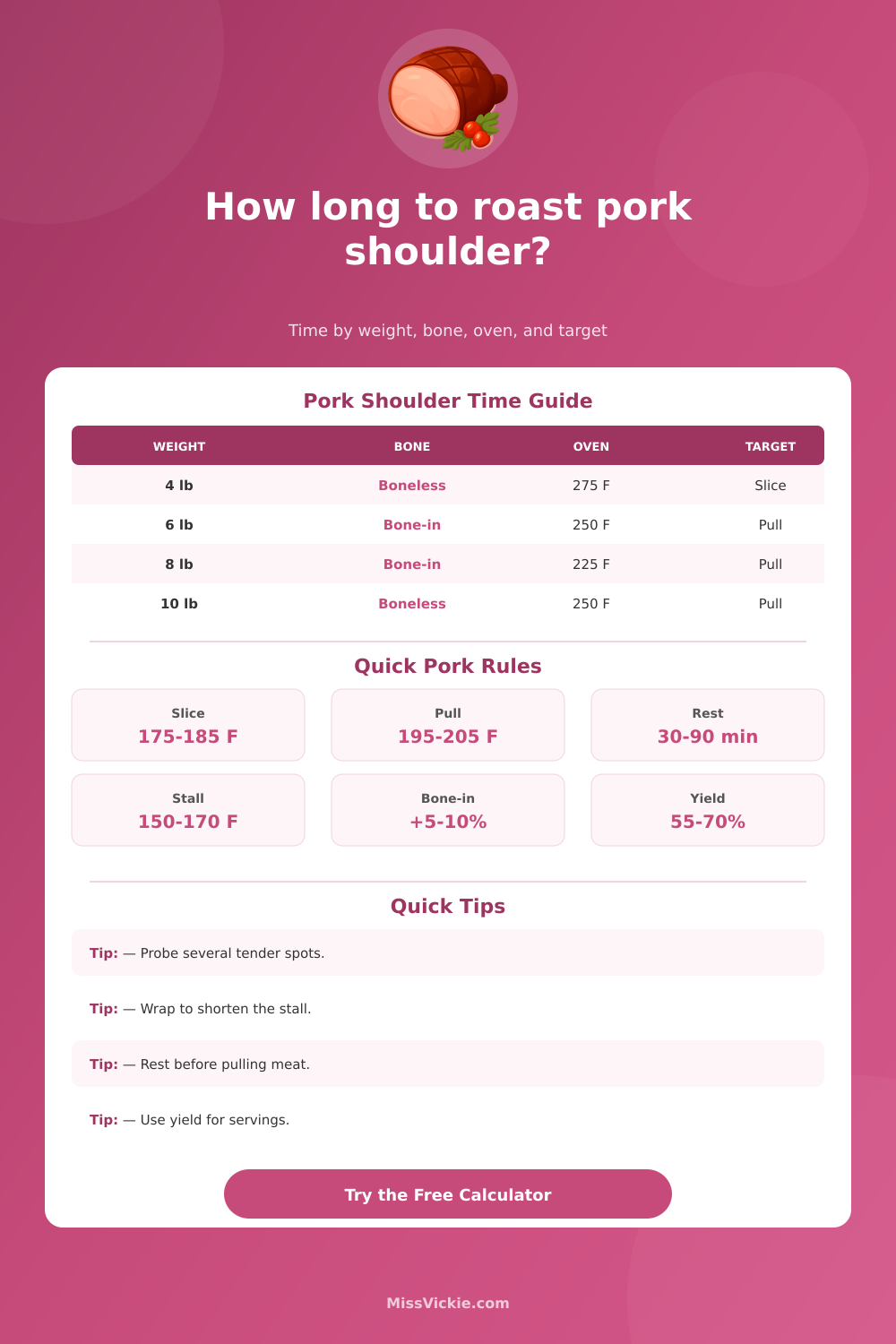
Additionally, larger roast pork shoulders will experience a longer stall window in which the internal temperature of the roast pork shoulder will remain the same between one hundred fifty and one hundred seventy degree because of evaporative cooling. Therefore, cooks must use a calculator to determine the time needed to cook their roast pork shoulder based off the weight of the roast pork shoulder once that roast pork shoulder reaches eight pound because the rate at which it will cook change at that weight. The presence of a bone in the roast pork shoulder will affect the time needed to fully cook the roast pork shoulder.
The bone will allow the surrounding roast pork shoulder to cook more gently so that it will not overcook. However, the weight of the bone will allow the roast pork shoulder to take five to eight percent longer to cook than a boneless roast pork shoulder of the same weight. Additionally, if the cook ties the roast pork shoulder into a roll, it will cook more evenly across the roast pork shoulder.
However, the center of the roast pork shoulder may take longer to cook to reach the target temperature because the round shape of the roast pork shoulder does not allow it to shed heat quickly. Another variable that will impact the time needed to cook a roast pork shoulder is the cooking temperature of the oven. If the desired cooking temperature of the oven is low temperatures, around two hundred twenty-five or two hundred fifty degrees, it will allow the fat and connective tissue within the roast pork shoulder to render.
Additionally, using these temperatures will result in a deeper bark of the roast pork shoulder. However, the cooking time will be longer at these temperature. Using higher oven temperatures will shorten the cooking time for the roast pork shoulder.
However, higher cooking temperatures may prevent the collagen from the roast pork shoulder from properly breaking down. If the collagen does not break down, the roast pork shoulder will reach the target cooking temperature but may not be tender enough to eat. The target temperature that the roast pork shoulder must reach will also impact the time that it must cook in the oven.
If the roast pork shoulderr is to be sliced, then it should be cooked to an internal temperature between one hundred seventy-five and one hundred eighty degrees. However, if the cook cooks the roast pork shoulder as pulled pork, the target internal temperature should reach between one hundred ninety-five and two hundred five degree to allow for the collagen in the roast pork shoulder to convert. Therefore, the higher the target internal temperature, the longer that the roast pork shoulder will cook.
Additionally, the higher the target internal temperature, the more difficult it will be to achieve this target if the roast pork shoulder is cooked unwrapped. Coooks have a choice of whether to wrap the roast pork shoulder or to leave it unwrapped. If the cook wraps the roast pork shoulder, it should be wrapped between one hundred sixty and one hundred seventy degrees to shorten the stall in which the temperature of the roast pork shoulder will remain between one hundred fifty and one hundred seventy degrees.
However, wrapping the roast pork shoulder will soften the crust of the roast pork shoulder. Alternatively, leaving the roast pork shoulder unwrapped will preserve its bark, but it will take longer to cook the roast pork shoulder. Additionally, cooking the roast pork shoulder in a covered pan will allow the roast pork shoulder to cook faster because of the moist heat that will be released into the roast pork shoulder.
However, using a covered pan will prevent the roast pork shoulder from rendering a specific texture on its bark. Another factor that should be considered is the resting of the roast pork shoulder once it is removed from the oven. A well-wrapped roast pork shoulder can be left in a cooler for one hour or more without the internal temperature dropping below a safe temperature.
This resting period will allow the cook to account for the possibility of the roast pork shoulder cooking either earlier or later than expected. The resting time should therefore be accounted for in the planning of the meat. Another variable that must be accounted for is the yield of the roast pork shoulder after it is cooked.
The roast pork shoulder will lose some of its weight due to the rendering of the fat and moisture in the roast pork shoulder. The roast pork shoulder will yield between thirty and forty-five percent of its raw weight when cooked. Therefore, the weight of the roast pork shoulder should be considered in determining if the roast pork shoulder will be enough to feed the number of people that will be fed.
For instance, a seven-pound bone-in roast pork shoulder will yield around four and a half pounds of roasted roast pork shoulder. Every roast pork shoulder does not have the same variables. For instance, a picnic roast will contain more connective tissue than a Boston butt roast pork shoulder.
Additionally, a roast pork shoulder that is tied into rolls will cook differently than a roast pork shoulder that is in loose, boneless pieces. Therefore, a seven pound roast pork shoulder may take between four and seven hours to cook to the target internal temperature. Therefore, cooks should use a thermometer to determine the tenderness of the roast pork shoulder because the temperature of the roast pork shoulder does not indicate the tenderness.
Planning the internal temperature and the weight of the roast pork shoulder will eliminate the guesswork that cooks may otherwise have to perform to determine the time needed to cook the roast pork shoulder to an acceptable temperature. It’s something you should of done before you start.