Risotto Rice Per Person Calculator
Plan dry risotto rice, broth, wine, Parmesan, butter, add-ins, leftovers, and cooked yield for appetizer bowls, sides, main courses, and hearty dinner servings.
Choose the closest risotto meal, then adjust guests, serving style, rice variety, enrichment, add-ins, broth ratio, wine, and leftovers.
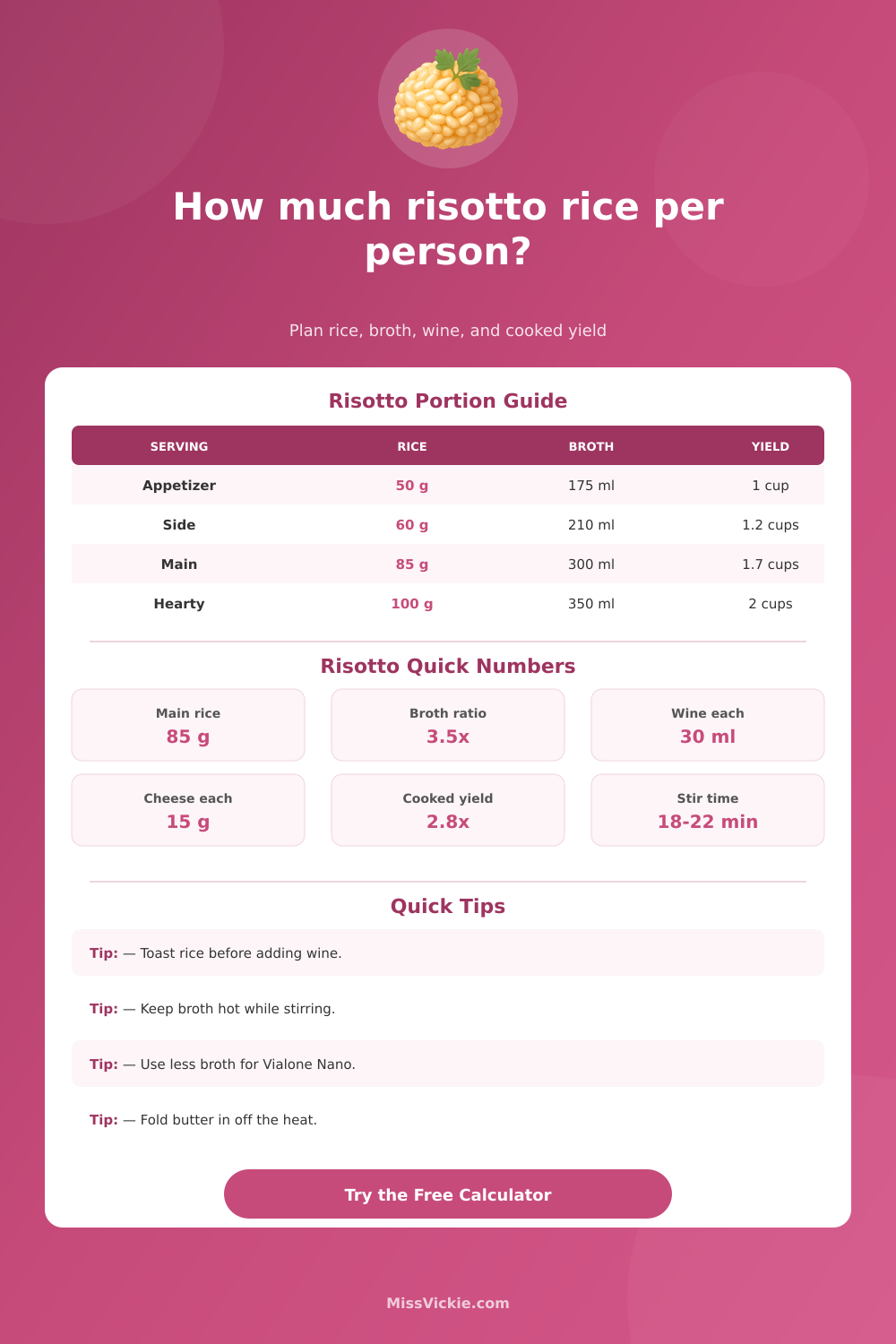
| Serving style | Dry rice per person | Cooked risotto estimate | Use this when |
|---|---|---|---|
| Small tasting course | 35 to 40 g | About 3/4 cup cooked | Risotto is one of several plated courses. |
| Appetizer or first course | 45 to 55 g | About 1 cup cooked | Served before meat, fish, salad, or dessert. |
| Side dish | 55 to 65 g | About 1 1/4 cups cooked | Risotto shares the plate with a main protein. |
| Main-course bowl | 80 to 90 g | About 1 2/3 cups cooked | The risotto is the main item on the table. |
| Hearty main serving | 95 to 105 g | About 2 cups cooked | Use for large appetites or fewer sides. |
| Kids or small bowls | 35 to 50 g | About 3/4 to 1 cup cooked | Smaller portions for children or a mixed-age table. |
| Rice variety | Typical broth ratio | Cooked yield from dry rice | Texture note |
|---|---|---|---|
| Arborio | 3.4x to 3.7x | About 2.8x by weight | Creamy, accessible, and forgiving for home risotto. |
| Carnaroli | 3.5x to 3.9x | About 2.9x by weight | Holds shape well and tolerates longer stirring. |
| Vialone Nano | 3.1x to 3.4x | About 2.6x by weight | Absorbs quickly and makes a softer, flowing risotto. |
| Baldo | 3.3x to 3.6x | About 2.75x by weight | A good middle ground for creamy rice dishes. |
| Roma or superfino | 3.4x to 3.8x | About 2.8x by weight | Good for baked or looser risotto styles. |
| Brown short-grain | 4.3x to 4.8x | About 3.2x by weight | Needs more liquid and a longer cooking window. |
| Finish style | Parmesan per person | Butter per person | Best for |
|---|---|---|---|
| Light finish | 8 g | 4 g | Vegetable risotto, seafood, or a lighter first course. |
| Classic finish | 15 g | 8 g | Most Parmesan risotto and mushroom risotto bowls. |
| Rich finish | 22 g | 12 g | Restaurant-style texture with glossy mantecare. |
| Cheese-forward | 28 g | 10 g | When cheese is a major flavor, not just seasoning. |
| Dairy-free finish | 0 g | 0 g | Use olive oil and starchy broth to finish creamy. |
Per person gives aroma without making the risotto sharp.
Classic per-person finish for main-course risotto.
Stir in off heat for a glossy texture.
Rest the pan briefly before serving.
| Group size | Appetizer rice | Main-course rice | Broth for mains | Cooked main yield |
|---|---|---|---|---|
| 2 people | 100 g | 170 g | 600 ml plus reserve | About 3 1/3 cups |
| 4 people | 200 g | 340 g | 1.2 L plus reserve | About 6 3/4 cups |
| 6 people | 300 g | 510 g | 1.8 L plus reserve | About 10 cups |
| 8 people | 400 g | 680 g | 2.4 L plus reserve | About 13 1/2 cups |
| 12 people | 600 g | 1.02 kg | 3.6 L plus reserve | About 20 cups |
| 25 people | 1.25 kg | 2.13 kg | 7.5 L plus reserve | About 42 cups |
| Add-in style | Add-ins per person | Rice adjustment | Portion note |
|---|---|---|---|
| Plain Parmesan risotto | 0 g | No change | The rice carries nearly all of the portion volume. |
| Mushrooms | 45 g | Reduce rice slightly | Cook mushrooms first so they do not water down the pan. |
| Peas or asparagus | 35 g | Reduce rice slightly | Good for spring sides and lighter main dishes. |
| Roasted squash | 60 g | Reduce rice more | Dense vegetable pieces make bowls feel bigger. |
| Shrimp or seafood | 70 g | Reduce rice slightly | Add near the end to avoid overcooking. |
| Chicken or sausage | 80 g | Reduce rice more | Turns risotto into a fuller one-bowl meal. |
| Greens and herbs | 25 g | Small reduction | Wilted greens add freshness without much bulk. |
| Mixed vegetables and protein | 90 g | Largest reduction | Useful when risotto is part rice dish, part main bowl. |
The Rice: It’s time to stir up some rice, but how much? You want it to be creamy, never gloppy, but you aren’t sure how much to guess at in the pot. With a calculator, all you need to do is determine what kind of servings you’re making, and it does the rest of the work for you. You won’t have to guess as you cook. No more fretting over measurements, just get to stirring, that’s all the calculator asks.
But the key is to decide whether you want the risotto as a main dish or as a small tasting course. Selecting the main course option in the tool will increases the amount of rice to match (the grain has to carry the entire dish). Many people don’t appreciate just how much that difference make. Portions are insufficient if you make a side into a main. Portions is excessive if you make an appetizer into a main. See the reference table for how dry weight converts to cooked volume for each instance.
How to Use the Risotto Calculator
The other thing it takes into account: What else is in the bowl? Rice starch makes plain Parmesan risotto satisfying. A few shrimp, a handful of mushrooms, a pile of squash will alter the dishs balance. They’ll absorb some of the rice and add flavor. They will also take up room, without anyone being the wiser, a little bit of rice goes further. The tool lets you input add-ins so that your broth-to-rice ratio stays right, even if you add things like vegetables that could water down the pan. It helps prevent a dish from tasting overly watery; that is, a risotto that tastes more like vegetable water then anything else, because there’s too much stock, and not enough grain.
How much liquid gets absorbed also depends on the rice itself. Most of us use the same stuff from the grocery store: arborio. But there are others like carnaroli, which stay intact while being stirred for longer. There is also vialone nano, which soaks up the liquid quicker, resulting in a slightly mushier texture that I believe some enjoy. The calculator takes this into account without you needing to remember the absorption rate of each type of rice. All you have to know is what size jar you purchased and your desired texture. This is a minor point, but it saves you from either having a bottom full of soup or a center of uncooked rice.
Finally, don’t overlook the extras, which are where many home-made risottos go wrong. The cheese-and-butter enriching function lets you dial in your amounts. To help balance seafood, try finishing light; it won’t overwhelm subtle tastes. Richer finish, more stir-ins near the end? Glossy goodness. To get a cohesive result, not a puddle of separated grease and grains, the tool factors in all your liquids plus fat to make sure everything holds together. You need starch and fat bonding to the rice, not separating out.
Lastly, consider any leftovers. It’s good to make extras for lunches, and that means a little more broth up front. If you use medium heat, the liquid will evaporate fast and once the wine cooks away there won’t be enough liquid to top off with water. Having some reserve buffer on the settings should of prevented this last-minute panic. Many folks overlook this aspect: they figure how much should get me home, without considering the fact that wider pans lose liquid faster than narrower ones.
Risotto isn’t as much about accuracy as it is rhythm. You want to gradually release starch from the grains so the liquid forms a sauce from within, rather than just swimming in liquid. The boundaries are provided by the calculator. It’ll tell you how much rice to weigh out and how much stock to hold at the ready. After that it’s all about feel. Use those figures as a starting point. Rely on what you see when things start to look just right. Then, don’t let the rice cool off when serving. What used to be a scary guessing game becomes a sure thing come dinnertime.