MissVickie leftover rice planner
Rice Reheating Time Calculator
Estimate reheating time for cooked rice by rice type, cooked amount, reheating method, moisture added, fridge or frozen start, container depth, stirring pattern, cover style, and target steam temperature.
🍚 Rice Reheating Presets
Pick a common leftover rice situation, then adjust the amount, depth, water, stirring, and target temperature. This calculator is for cooked rice that was cooled and stored safely.
🧮 Rice, Amount, Moisture, Depth, and Temperature Inputs
Your Rice Reheating Plan
Enter your rice details to estimate a reheating window.
Calculation Breakdown
Rice Handling Plan
📌 Quick Rice Reheating Benchmarks
Check the middle of the rice, not just the steamy edges.
Most plain fridge rice needs a small splash before reheating.
Shallow layers reheat faster and reduce cold pockets.
Use safely stored cooked rice within a short leftover window.
📊 Rice Reheating Tables
| Method | Best For | Base Timing | Moisture Style | Stirring Cue |
|---|---|---|---|---|
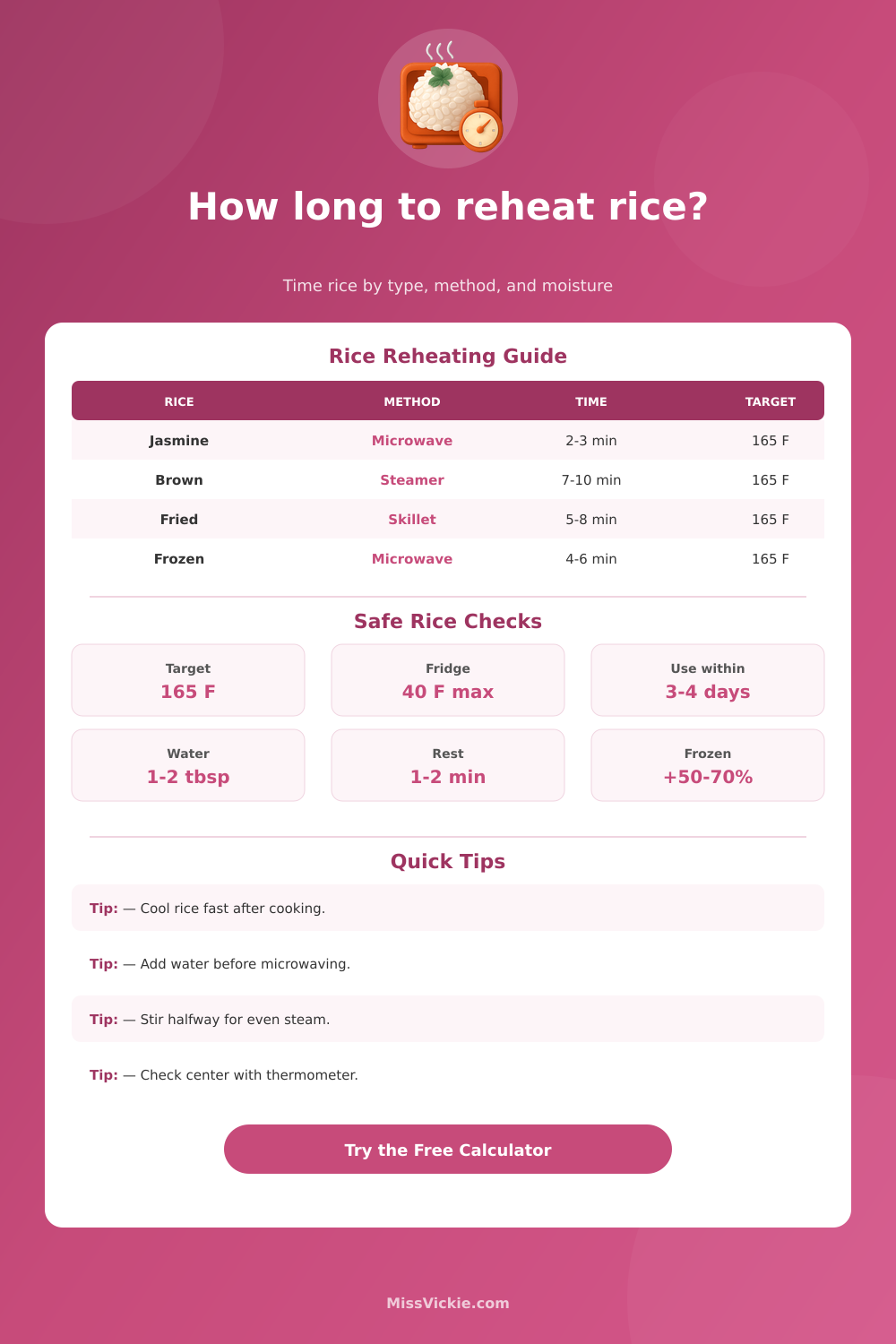
| Microwave with vented cover | Bowls, meal prep, most plain rice | 70 seconds per cup, then rest | 1 to 2 tbsp water per cup | Stir halfway, check center |
| Skillet or wok | Fried rice, loose rice, sauced rice | 4 to 8 minutes depending on batch | Small splash or oil, not a puddle | Toss often until steaming |
| Steamer basket | Sticky rice, clumped rice, gentle reheating | 7 to 12 minutes after steam starts | Steam supplies moisture | Flip packet or loosen once |
| Covered oven dish | Large trays and family portions | 16 to 30 minutes at moderate heat | Cover tightly with a measured splash | Stir once when edges steam |
| Rice cooker re-steam | Several cups of plain rice | 10 to 18 minutes on warm or steam | Add water to dry grains | Fluff before serving |
| Rice Type | Cup Weight | Moisture Need | Texture Risk | Best Method |
|---|---|---|---|---|
| White long-grain | About 158 g per cooked cup | Moderate | Dry edges | Microwave or rice cooker |
| Jasmine or basmati | About 150 to 158 g per cup | Moderate-low | Fragrant grains can break | Vented microwave |
| Brown rice | About 195 g per cooked cup | Higher | Firm centers | Steamer or covered bowl |
| Sticky rice | About 180 g per cooked cup | Low added water | Gummy if flooded | Steamer packet |
| Fried rice | About 180 g per cooked cup | Low water, more tossing | Soggy if covered too long | Skillet or wok |
| Container Depth | Heating Effect | Recommended Stirring | Typical Adjustment | Practical Fix |
|---|---|---|---|---|
| Under 1 inch / 2.5 cm | Fast, even heat | Fluff once | Shorten slightly | Spread rice in a wide dish |
| 1 to 1.5 inches / 2.5 to 4 cm | Standard leftover bowl | Halfway stir | Use base timing | Vent cover to build steam |
| 1.5 to 2.5 inches / 4 to 6 cm | Warm edges, cooler center | Stir twice | Add 15 to 25 percent | Break clumps before heating |
| Over 2.5 inches / 6 cm | Cold pocket risk | Stir twice and rest | Add 35 percent or more | Split into two shallow dishes |
| Safety Check | Target | Why It Matters | What To Do |
|---|---|---|---|
| Cold storage | 40 F / 4 C or colder | Slows bacterial growth after cooling | Refrigerate promptly in shallow containers |
| Leftover age | 3 to 4 days | Quality and safety both decline | Freeze extra rice for longer storage |
| Reheat temperature | 165 F / 74 C | Standard safe leftover reheating target | Check deepest spot with a thermometer |
| Room-temperature rice | Under 2 hours | Rice can form heat-stable toxins if mishandled | Discard if storage history is unsafe or unknown |
Times are estimates for cooked rice. Use a thermometer when safety matters, especially with deep containers, frozen rice, takeout rice, or mixed rice dishes.
⚖ Method Comparison Grid
Best for 1 to 4 cups when rice is covered, moistened, stirred, and rested.
Gentle steam revives sticky, brown, and clumped rice without scorching.
Direct heat and frequent tossing keep grains separate and avoid sogginess.
A covered shallow dish works for trays, but stirring and thermometer checks matter.
💡 Rice Reheating Tips
There’s a certain type of nervousness that arises when you’re looking into your Tupperware at the remnants of a cooked batch of rice. In theory, leftover rice should be delicious, but in reality, it tends toward either scorched or rubbery. And the outcome hinges on two thing: heat distribution and moisture management.
More than anything, this has to do with knowing what happens to starch as it heats and cools. Here’s how it works scientificly: When you cook your rice grains, they soak up water and expand, and then when they cool down in the fridge, they become more rigid. It’s a thing called retrogradation. Specifically, amylose molecules tightens up their structure to squeeze water out and make the rice hard.
The Science Behind Heating Leftover Rice
You’re not uncooking the rice; it’s already cooked. You’re attempting to undo that hardening (crystallization). You do this by using gentle steam to let the grains plump back up without squeezing out any more water. That’s why people go wrong: They blast the rice with high heat, when what you want is to steam it back to life.
So long as you plug-in your exact configuration, though, it does all the math for you (see the calculator at the top). And unlike most home cooking scenarios, where you just wing it (“Does 2 minutes sound about right? Or should I go longer?”), it thinks about things that matter much more then you realize: how thick is the layer of rice in whatever container you’re using?
Heat travels slow across solid objects; if you’ve got a takeout box with three inches of tightly-packed rice, the very middle of that pile are going to be cold as ice, even if everything around the perimeter is steaming hot. Spread that same volume over a wider, shallower dish and you change how it works: You now have far greater surface area exposed to heating element. The calculator accounts for this shape and dimension stuff, so you don’t get lukewarm centers.
This part’s about the moisture, too: Because dry rice will be drier once it’s done, add just a splash of broth or water to help get things steaming inside the pot during heating up. Not enough, and the grains will still be tough; too much and they’ll turn soggy. The type of rice will tell you how to judge that scale, and the calculator tells you how much for each type.
The hulls of brown rice retain their bran layer, which means they needs slightly longer and more moisture to plump up than other more delicate types like jasmine. Fried rice typically has eggs and oil mixed in, though, so a hot skillet with a bit of direct dry heat is better than steam trapped inside it. Knowing what kind of leftovers require what technique ensures that no matter the approach, they come out neither hard nor soggy.
Safety must also be considered here. Unlike most leftovers, leftover cooked rice present a special hazard: the ability for bacillus cereus spores to survive cooking. If the rice is left standing at room temp for extended periods, these spores will germinate into toxin-producing bacteria… Which will not be destroyed by reheating. That’s why the tool so heavily stresses beginning with properly refrigerated rice that has been stored for no more than three or four days. Perfect execution won’t help if the rice was stored poorly.
Reaching the ideal temperature of 165F will kill off whatever bacterial growth happen while cooling and storing; however, it doesn’t reverse toxins generated by overnight exposure to air. Microwave heating is not uniform; there are hot spots, cold spots, and stirring is critical for evening out the temperature. About halfway through cooking, you fluff it with a fork to break apart clumps and allow steam into those denser pockets inside. A tiny bit of mechanical work result in a massive textural reward: consistent, fluffy rice. Based off your microwave’s wattage and size, this tool tells you when to stop and stir.
In short, heating up rice is about as much of a science as you can get, but it also requires careful attention and lots of patience. With experience you’ll be able to adjust accordingly (type of rice, amount of water, depth), moving away from guessing and towards consistent results. It’s all about getting the rice back to what made it good in the first place: having texture without being soggy, and hot without burning.
It isn’t a bad idea to do a quick temperature check with your thermometer in the middle of the deepest section of whatever you’re heating. You should of not taken a bite until each grain is back at that safe, steaming sweet spot.