Rice Per Serving Calculator
Plan uncooked rice, cooked yield, water, leftovers, and nutrition for sides, bowls, main dishes, meal prep, and gatherings.
🍚 Rice Serving Presets
Choose a common rice plan, then fine-tune the rice type, appetite level, meal role, water texture, and leftover servings.
⚖ Rice Plan Details
Rice plan
Your rice amounts will appear here.
Batch Breakdown
Cooking and Leftovers
📏 Current Serving Snapshot
📊 Nutrition Cards
Nutrition estimates are based on plain cooked rice per calculated serving. Added butter, oil, broth, coconut milk, sauces, and mix-ins are not included.
🥘 Cooked Rice Portions by Meal Role
| Meal Role | Cooked Rice Per Person | Dry Rice Estimate | Best Use | Planning Note |
|---|---|---|---|---|
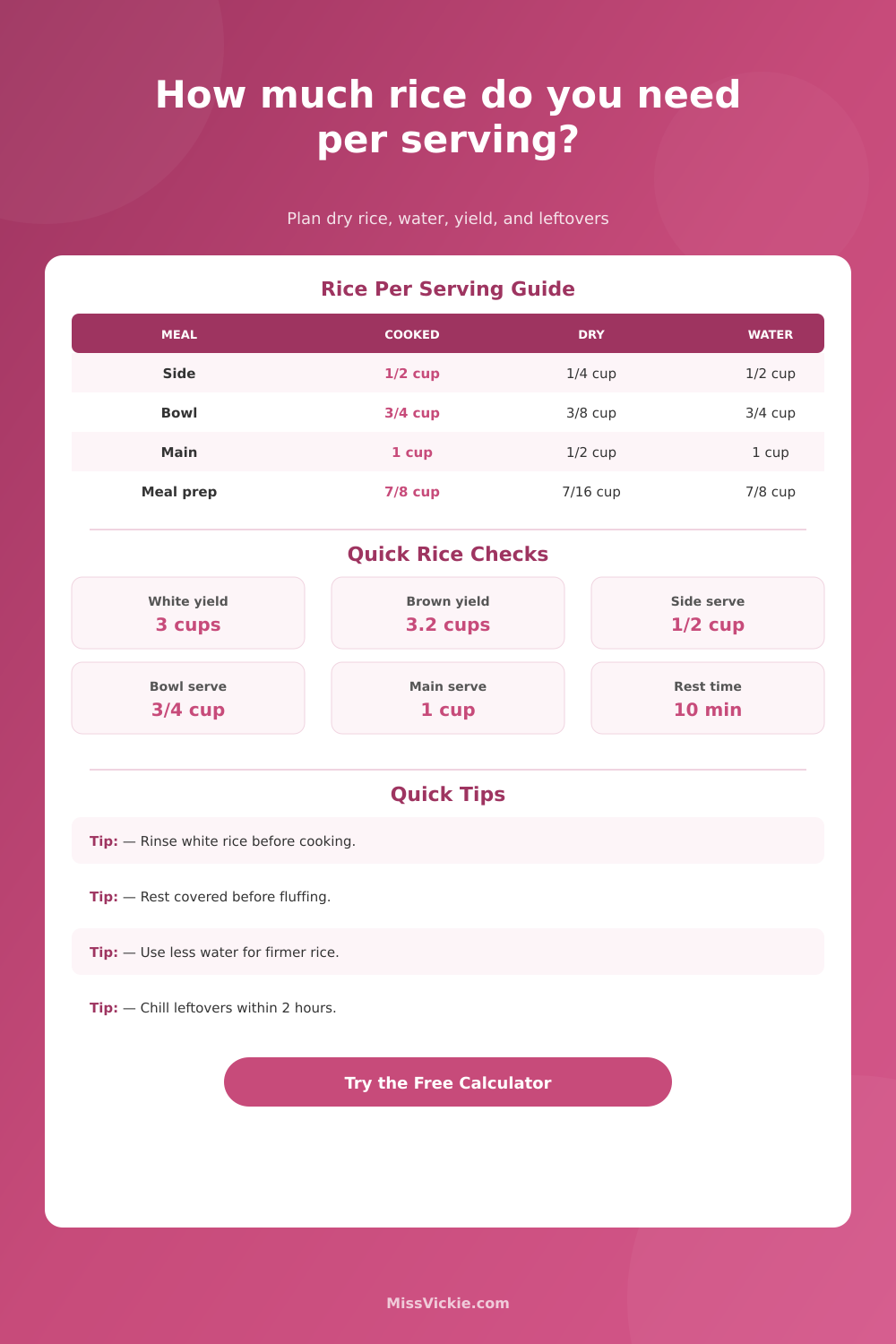
| Small side | 1/3 to 1/2 cup cooked | About 2 to 3 Tbsp dry | Meals with bread, potatoes, or several sides | Choose light appetite if rice is not the main starch. |
| Standard side | 1/2 to 2/3 cup cooked | About 1/4 cup dry | Weeknight dinners, curries, beans, and stir-fries | This is the safest default for mixed-age groups. |
| Rice bowl base | 3/4 to 1 cup cooked | About 1/3 to 1/2 cup dry | Bowls with vegetables, protein, and sauce | Use hearty appetite for athletic or very hungry eaters. |
| Main starch | 1 to 1 1/4 cups cooked | About 1/2 cup dry | Rice-forward dinners and simple plated meals | Plan extra if seconds are likely. |
| Meal prep | 3/4 to 1 cup cooked | About 1/3 to 1/2 cup dry | Lunch boxes and make-ahead meals | Cool portions quickly before refrigerating. |
📝 Rice Yield and Water Reference
| Rice Type | Approx Dry Weight Per Cup | Cooked Yield From 1 Cup Dry | Stovetop Water Per Cup Dry | Common Rest Time |
|---|---|---|---|---|
| Long-grain white rice | 185 g / 6.5 oz | About 3 cups cooked | 1 3/4 to 2 cups water | 10 minutes covered |
| Jasmine rice | 180 g / 6.3 oz | About 3 cups cooked | 1 1/2 to 1 3/4 cups water | 10 minutes covered |
| Basmati rice | 190 g / 6.7 oz | About 3 cups cooked | 1 1/2 to 1 3/4 cups water | 10 minutes covered |
| Brown rice | 195 g / 6.9 oz | About 3 1/4 cups cooked | 2 1/4 to 2 1/2 cups water | 10 to 15 minutes covered |
| Sushi or short-grain rice | 200 g / 7.1 oz | About 2 3/4 cups cooked | 1 1/4 to 1 1/2 cups water | 10 minutes covered |
| Arborio rice | 200 g / 7.1 oz | About 3 cups cooked | 3 to 4 cups liquid added gradually | Serve soon after cooking |
| Wild rice blend | 170 g / 6 oz | About 3 1/2 cups cooked | 2 1/2 to 3 cups water | 10 minutes covered |
| Parboiled rice | 185 g / 6.5 oz | About 3 cups cooked | 2 to 2 1/4 cups water | 5 to 10 minutes covered |
Use package directions when they conflict with this table. Rice age, pan width, altitude, burner strength, and lid fit can shift water needs.
🍽 Common Batch Amounts
| Group Size | Side Dish Dry Rice | Bowl Dry Rice | Main Starch Dry Rice | Expected Cooked Yield |
|---|---|---|---|---|
| 2 people | 1/3 to 1/2 cup dry | 1/2 to 2/3 cup dry | 2/3 to 1 cup dry | 1 1/2 to 3 cups cooked |
| 4 people | 2/3 to 1 cup dry | 1 to 1 1/3 cups dry | 1 1/3 to 2 cups dry | 3 to 6 cups cooked |
| 6 people | 1 to 1 1/2 cups dry | 1 1/2 to 2 cups dry | 2 to 3 cups dry | 4 1/2 to 9 cups cooked |
| 12 people | 2 to 3 cups dry | 3 to 4 cups dry | 4 to 6 cups dry | 9 to 18 cups cooked |
| 25 people | 4 to 6 cups dry | 6 to 8 1/2 cups dry | 8 1/2 to 12 1/2 cups dry | 19 to 38 cups cooked |
| 50 people | 8 to 12 cups dry | 12 to 17 cups dry | 17 to 25 cups dry | 38 to 75 cups cooked |
💡 Rice Planning Notes
RICE: There’s a certain kind of stress that accompanies making rice for other people. Not stress over timing or seasoning. Stress over volume. Too little? Too much left over? Usually it’s never realy the recipe itself; it’s the math. Home cooks tend to use their gut as a guide, guessing that a cup is enough for everyone. Great if there’s only one person, not great if there is four. Let the calculator work out the math of how much will be needed based off appetite and amount produced. Then you don’t need to remember it yourself.
So, let’s get this out of the way: Rice expands a lot. Uncooked long grain white rice expands to about three cups when cooked. Brown rice is an exception. This type require longer cooking time and soaks up more water. Enter the tool. It take all of that structure into account. Choose your rice variety and it will adjust amount of water and dry weight.
Why Use a Rice Calculator?
And then there’s the role of the meal. Is it a rice bowl (where the grain is the main focus) or is it a small serving of rice on the side of some curry at dinner? That make a difference for budgeting and portion control. There’s also a secret variable: how hungry people will be! Are you serving children, light eaters, or a bunch of hearty eater? Adjust accordingly on the calculator. Want to have leftover fried rice for later in the week? Add an additional serving or two for leftovers. If you’re planning to use it for stir-fry, cold day-old rice is perfect… Firm but not stuck together, and makes better stir-fry then freshly cooked. (Freshly cooked tends to stick together.) Know your end game. Then figure out the right amount to start with.
One size does not fit all when it comes to water ratios. For example, brown rice requires more water than jasmine rice. And, if you’re rinsing your rice until the water is clear, you’ll have less starch (and thus change the texture of your cooked rice). That will affect how much water it absorbs (ever so slightly). The tool takes into account whether you soak your rice beforehand or not. Then it estimates how much water to use based on what texture you prefer.
The serving size calculator figures in nutrition estimates for your result. If you follow macros, for example, this can be handy. Rice (even plain) are primarily carbs with a small amount of protein and zero fat. When you mix it up with something like coconut milk or oil or butter, that all change dramatically. By calculating just the base grain, it keeps an accurate number you can use to compare against other grains, keeping the baseline information valuable and applicable.
And, yes, it takes into account how you’re going to cook it. If you use a rice cooker, it holds onto more steam than if you just leave it in an uncovered pot on the stove top. If you use a pressure cooker, well then the whole timing thing is different. Depending on what kind of cooking you plan to do, the calculator tweaks the recommendations accordingly. It also alerts you to the importance of resting time. Resting time is important for texture reasons. After bringing it to temperature, let it stand (covered) for several minutes so the moisture can spread out. Otherwise, you get wet middles and dry outside bits.
On the page, there’s also a reference table for each kind of rice that will give you an immediate sense of how much yield to expect. It is useful for checking yourself, though not as good as the calculator which adjusts specifically for appetite size and group size. The table numbers is averages. Yours won’t be the same. The calculator connects the dots from general information to your specific meal plan. It translates guesswork to a final list of measurements.
Storage is a practical concern. If rice isn’t cooled rapidly and stored, it goes bad rather fast. To help avoid that risk, the tool allows you to plan for leftover storage and prompts the right safety tip: cool leftovers ASAP and store in shallow containers. The tool even calculates how many container you’ll need. That makes your meal-prep efforts organized.
Rice isn’t so much an art as it is a matter of basic addition. How many? What type of rice are you cooking? Are these guys big eaters or lightweights? Knowing that, you know the rest. You just have to do it. If you get the proportions correct, no one leaves hungry and no food goes to waste. And that’s where most folks should of fallen down. They think about the taste and not about the serving size. Do the math first. Then everything falls into place. Full table, empty pot: that’s the idea.