Rice Per Person for Curry Calculator
Calculate rice for curry by guest count, rice variety, curry richness, main or side serving, dry-to-cooked yield, water ratio, buffet buffer, leftovers, serving cup size, and starch balance.
Pick a real meal scenario, then fine-tune the guests, rice variety, curry style, portion role, buffet buffer, leftovers, serving cup size, and starch balance.
Your Curry Rice Plan
Adjust the fields to calculate dry rice, cooked rice, water, scoop count, and leftovers.
Portion Breakdown
Cooking Breakdown
| Rice Variety | Dry Cup Weight | Cooked Yield | Water Ratio | Curry Match |
|---|---|---|---|---|
| Basmati rice | 185 g | 3.0 cups | 1.5 cups | Indian curries, dal, korma |
| Jasmine rice | 185 g | 2.9 cups | 1.4 cups | Thai coconut curry, red curry |
| Long-grain white rice | 185 g | 3.0 cups | 1.75 cups | Everyday chicken or vegetable curry |
| Sona masoori rice | 180 g | 3.1 cups | 2.0 cups | South Indian curries and sambar |
| Short-grain white rice | 200 g | 2.6 cups | 1.25 cups | Japanese curry and thick sauces |
| Brown basmati rice | 190 g | 3.4 cups | 2.25 cups | Meal prep and hearty curry bowls |
| Parboiled rice | 185 g | 3.2 cups | 2.0 cups | Buffets, trays, and holding pans |
| Cauliflower rice blend | 110 g | 2.0 cups | 1.0 cups | Lower-carb curry plates |
Yield and water ratios are practical kitchen planning values; your pot, rice age, rinsing, and lid fit can shift the final texture.
| Group Size | Side Rice | Main Rice | Buffet Rice | Typical Dry Rice |
|---|---|---|---|---|
| 4 guests | 3 cups cooked | 4 cups cooked | 4.5 cups cooked | 1 to 1.5 cups dry |
| 6 guests | 4.5 cups cooked | 6 cups cooked | 6.75 cups cooked | 1.5 to 2.25 cups dry |
| 8 guests | 6 cups cooked | 8 cups cooked | 9 cups cooked | 2 to 3 cups dry |
| 12 guests | 9 cups cooked | 12 cups cooked | 13.5 cups cooked | 3 to 4.5 cups dry |
| 25 guests | 18.75 cups cooked | 25 cups cooked | 28 cups cooked | 6.5 to 9.5 cups dry |
| 50 guests | 37.5 cups cooked | 50 cups cooked | 56 cups cooked | 13 to 19 cups dry |
| Curry Style | Rice Change | Why It Changes | Serving Note |
|---|---|---|---|
| Light dal or broth curry | Minus 8 percent | More sauce volume fills the plate | Use smaller scoops first |
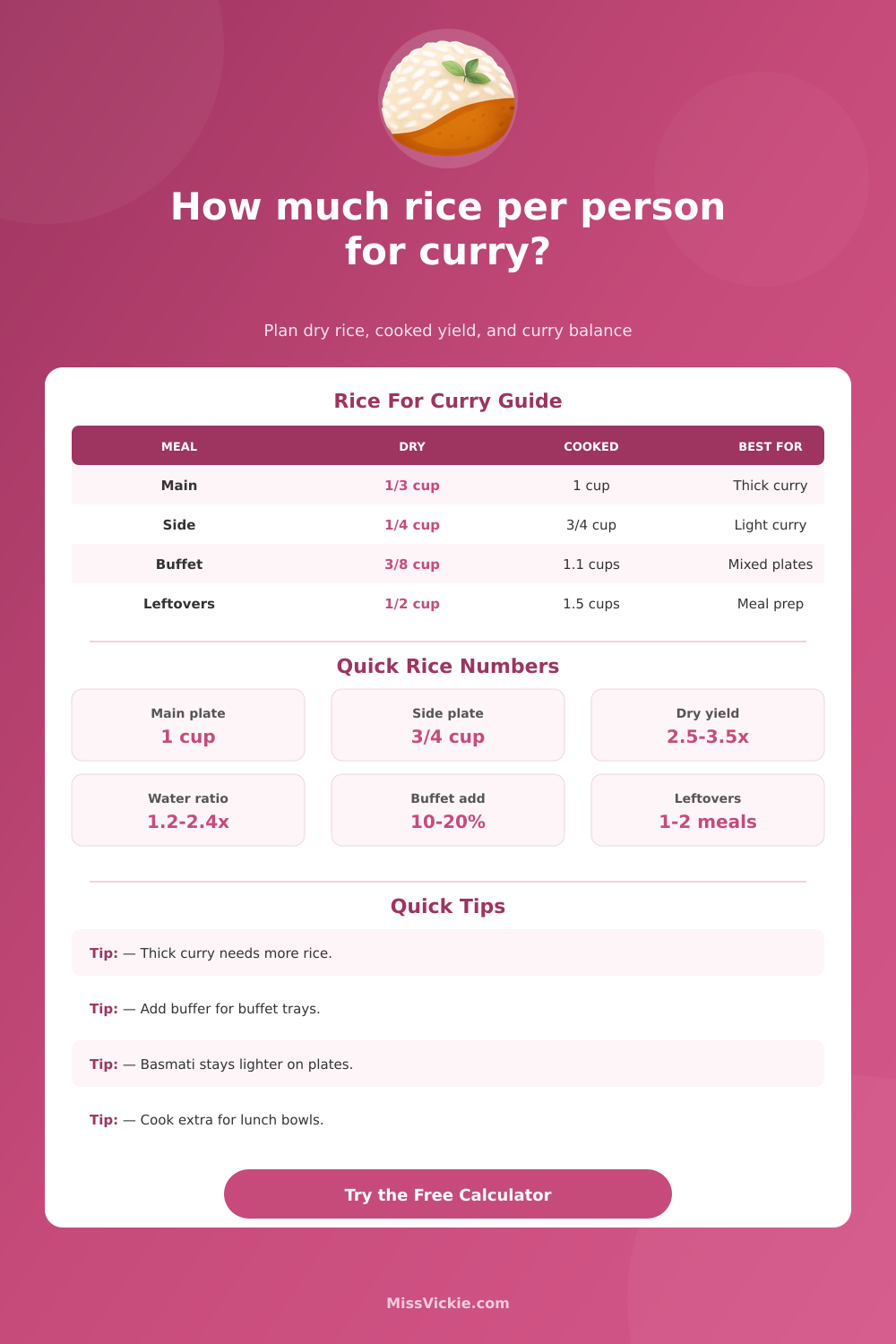
| Everyday curry | No change | Balanced sauce and protein | Plan 1 cup cooked per person |
| Coconut or butter curry | Plus 8 percent | Rich sauces pair with extra rice | Keep grains separate and fluffy |
| Dry curry or sabzi | Plus 12 percent | Less sauce means rice carries the meal | Add raita or chutney if needed |
| Thin soup-style curry | Minus 12 percent | Guests spoon more broth than rice | Serve rice in bowls |
Use when curry is served without naan, roti, potatoes, or noodles.
Best for most curry dinners with a salad, bread, or light side.
Use when breads, fried snacks, potatoes, or multiple sides share the plate.
Use for comfort bowls, thick curry, or guests who return for rice seconds.
| Cooked Rice | Dry Rice | Water Range | Holding Vessel |
|---|---|---|---|
| 6 cups | 2 cups dry | 3 to 4 cups | 3-quart pot |
| 12 cups | 4 cups dry | 6 to 8 cups | 5-quart pot |
| 24 cups | 8 cups dry | 12 to 16 cups | Full rice cooker |
| 36 cups | 12 cups dry | 18 to 24 cups | Hotel pan |
| 60 cups | 20 cups dry | 30 to 40 cups | Two hotel pans |
There’s always an element of worry about making food for people. It’s generally focused around the fact that you’ll run out of something; in your case: rice. Hours is spent marinating meat, coaxing flavor from spices, and then it all goes down the drain because there wasn’t enough rice, or it was underdone. Ideally, the curry is served with the right amount of grain as a base; neither drowning in more than necessary nor hidden behind a heap of carb.
Home cooks can intuitively feed a few, but freak out when feeding a crowd. Guessing doesn’t work with unpredictable expansion (depending on rice type or pot fit). Feed 4? How much rice do I need for butter chicken? Enter the number of guests and rice style into the calculator and it does the math for you, saving you the guesswork: Does this cup of basmati make enough grain to serve all these people?
How Much Rice You Need
What if people scoop generously or want seconds? The calculator factors in stressful variables, such as determining an appropriate portion size. It breaks them down so you know how much rice will expand. Then it adds a buffer since people inevitably scoop up more then their fair share at a buffet.
Different rice produce different results. Brown and other short-grains is denser and absorb more water. Basmati triples in size after cooking. If you are serving a dish with not much sauce (dry curries), you will need more rice. For those who’ll spoon food onto their plates, the calculator doubles portion size for drier dishes, as diners will consume some just to sop things up.
Conversely, a hearty stew needs a solid bed, but a runny dal allow less grain, since liquid itself becomes the meal. But what about buffets? That’s a different ball game, as hungry people stand up and scoop differently. No way can you regulate serving size at a self-serve line. If you have an enthusiastic eater who sucks down the tray before anyone else has touched it, no big deal: they don’t have to be embarrassed.
A 10-20% cushion for uneven scoops + seconds is all it takes to buy yourself peace of mind in the rush, without needing a huge second batch that will go cold. If tomorrow’s lunch is on the docket, include leftovers into the original plan. Cooked extra rice now tastes better (starches firm up) and will save time later. For fried foods, chefs like to reheat their rice anyway because it holds shape more better than freshly cooked grains. Planning to include leftovers will make the first dish a generous one. And there’ll be enough for lunch the next day.
Most folks don’t know: Water ratio’s key. Too little water makes the center hard, and too much makes it mushy and clumpy. Age also factors in how much water is required. Older rice might require just a touch more so it’ll plump up. Some rices holds their own better with less water (parboiled); others maintain fragrance without getting soggy (jasmine).
Know your grain and how its texture holds up against weight of your sauce. Keep in mind what else will be on the table when determining amounts. If serving with potatoes or naan/roti, you might make smaller servings of rice. That way, you’re not piling all those carbs into just your bowl. It’s important to spread out the starches among several elements so that no single thing become the focus of a dish. It limits your portions while still allowing each guest to adjust the texture of their plate.
This is a planned meal, after all: each element serves its part. Rice with curry is all about volume, and expectation. How many grains do you need to balance out the sauce? Too little and there’s not enough; too much, and it swamps everything else. Get the ratio right, though, and the curry glows on a perfect background. It looks effortless (though it took some math).
Thorough preparation makes great dinners for lots of people seem easy.