Cocoa Powder in Red Velvet Cake Calculator
Balance cocoa powder with flour or batter amount, cocoa alkalinity, acidity, red color strength, batter pH, cake size, and leavening so the cake stays red, tender, and gently chocolatey.
Choose a starting point: each preset loads a real red velvet situation with flour or batter amount, cocoa type, acid source, color target, pH, cake size, and leavening style.
| Cocoa Type | Typical pH | Suggested Range | Red Velvet Effect |
|---|---|---|---|
| Natural unsweetened cocoa | 5.2 to 5.8 | 2.6% to 4.2% of flour | Best classic red velvet balance because acidity supports color and soda lift. |
| Natural dark cocoa | 5.3 to 6.0 | 2.3% to 3.8% of flour | Gives stronger cocoa flavor, but the crumb turns darker sooner. |
| Dutch-process cocoa | 6.8 to 8.1 | 2.0% to 3.4% of flour | Smooth taste, weaker acid reaction, and a more muted red tone. |
| Black cocoa blend | 7.5 to 8.5 | 1.0% to 2.2% of flour | Use sparingly; it can push red velvet toward maroon or chocolate cake. |
| Raw cacao powder | 5.5 to 6.5 | 2.2% to 3.8% of flour | Fruitier and sharper, so acid and sugar balance matter more. |
| Half Dutch, half natural | 6.1 to 6.8 | 2.3% to 3.6% of flour | A compromise when you want smooth cocoa without fully muting the red. |
| Batter Condition | pH Zone | Cocoa Move | Leavening Move |
|---|---|---|---|
| Classic buttermilk and vinegar red velvet | 5.2 to 5.8 | Natural cocoa at about 3% to 4% of flour | Baking soda can handle much of the lift with modest powder support. |
| Bright red color target | 5.0 to 5.6 | Keep cocoa moderate and avoid black cocoa | Do not overdo soda, or the batter may brown and dull. |
| Dutch cocoa or low-acid liquid | 6.2 to 7.4 | Use less cocoa or add acid support | Rely more on baking powder because soda has less acid to react with. |
| No added red coloring | 5.0 to 5.7 | Natural cocoa only, restrained amount | Use enough acid for color, but avoid a sharp sour finish. |
| Deep cocoa red velvet | 5.7 to 6.3 | Higher cocoa is fine, but expect darker red | Balance soda with powder to avoid excess browning. |
| Cake Size | Batter Target | Typical Flour | Classic Cocoa Start |
|---|---|---|---|
| Two 6-inch layers | 3.4 cups / 815 ml | 170 to 210 g | 5 to 8 g cocoa |
| Two 8-inch layers | 6 cups / 1.42 L | 260 to 330 g | 9 to 13 g cocoa |
| Two 9-inch layers | 7.5 cups / 1.77 L | 300 to 390 g | 10 to 16 g cocoa |
| 9 x 13 sheet cake | 10 cups / 2.37 L | 410 to 520 g | 14 to 21 g cocoa |
| 24 cupcakes | 6 cups / 1.42 L | 260 to 330 g | 9 to 13 g cocoa |
| Three 10-inch layers | 15 cups / 3.55 L | 630 to 780 g | 22 to 31 g cocoa |
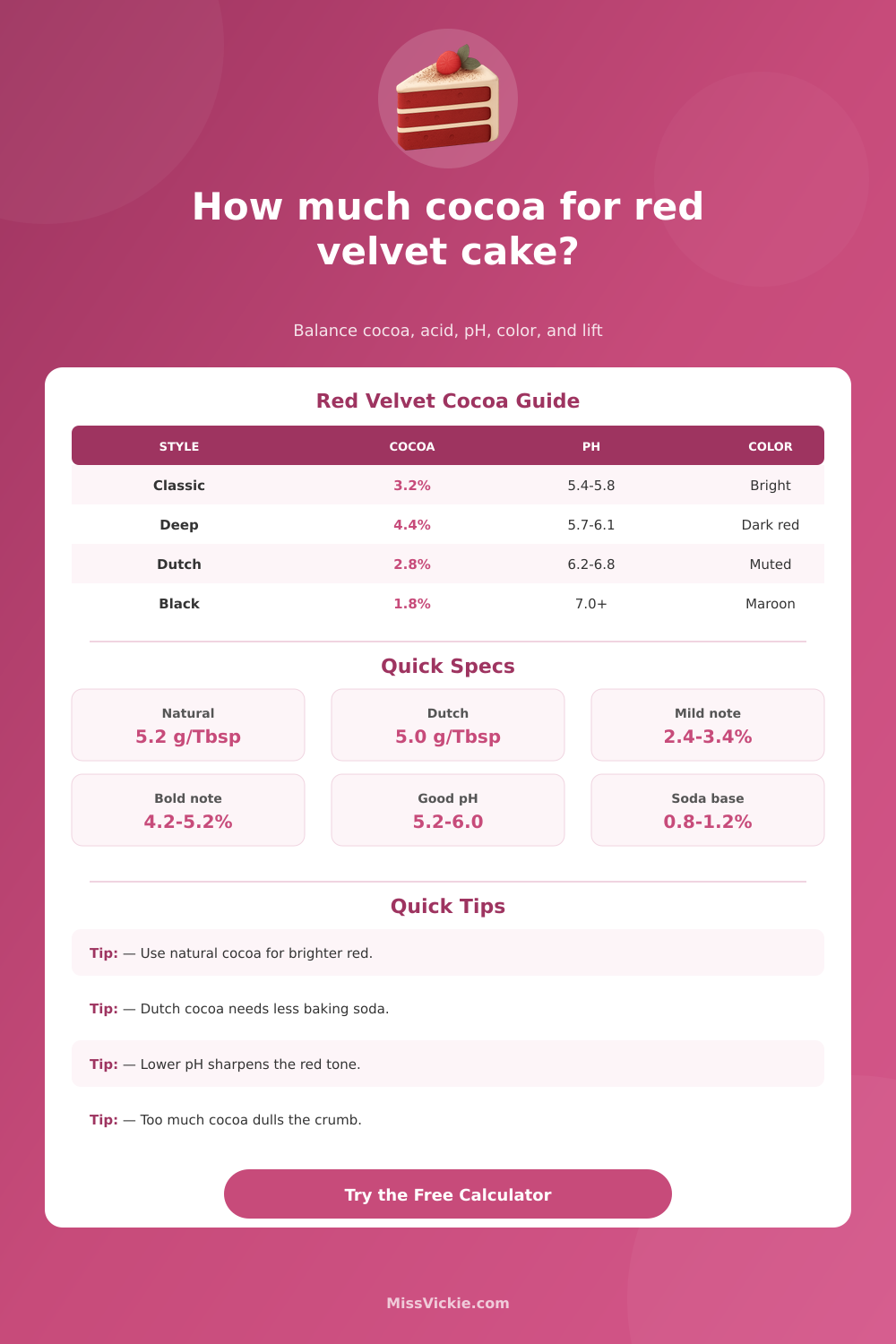
Cocoa is a component of red velvet cake, and the amount of cocoa that are present will determine the flavor and the color of the red velvet cake. Using too little cocoa will make the flavor of the cake taste more like a vanilla cake, while using too much cocoa will change the color of the cake to brown instead of red. Beyond its role in flavor and color, cocoa are important for another reason: that cocoa adds flavor to the cake, changes the acidity of the batter, and interact with the leavening agents contained within that batter.
Many people encounter difficulties with red velvet cake when the color of the cake isnt red, and often due to the amount of cocoa that does not balance with the other ingredient of the cake. The amount of cocoa that is needed to make red velvet cake is dependent upon several factors. For instance, one factor is the amount of flour that will be contain in the cake.
How to Use the Cocoa Calculator for Red Velvet Cake
Other factors is the type of cocoa that you should use, the amount of acid that will be contained in the batter, and the size of the pan in which the cake will be cook. The acidity of the cake batter impacts whether or not the color of the cake remain bright red or becomes muddy. The type of cocoa that is used also contains different amount of acidity.
For instance, natural cocoa is acidic and will help to brighten the red color of the cake, but alkali has treated Dutch process cocoa to make it more basic in its component, and using this type of cocoa will reduce the red color of the cake. Black cocoa powder is even more alkaline than Dutch process cocoa, which will also dull the red color of the cake. The cocoa calculator is a tool that allow individuals to calculate the amount of cocoa that will be needed for their red velvet cake.
To utilize the cocoa calculator, you must first enter the amount of flour or the total volume of the batter. In addition to the amount of flour and the total batter volume, the type of cocoa and the source of the acid within the cake must also be entered into the calculator. The capacity of the pan in which the cake will be cooked must also be entered into the calculator.
The capacity and the depth of the pan will impact the taste of the cocoa within the cake; deep pans will hide the taste of cocoa more readily than shallow pan. Based off the inputs provided for each of these factors, the cocoa calculator will provide an amount of cocoa that should be use to prepare the cake, it will display the percentage of cocoa relative to the amount of flour, and it will calculate and display the amount of leavening agent that should be used in the cake. The amount of cocoa will impact the amount of baking soda that is needed in the cake.
As the amount of cocoa increase, the acidity of the cake batter will increase as well. Thus, more baking soda can be used in recipes with higher amount of cocoa. However, if there is less acidity to the batter, baking powder can be used as an alternative to baking soda.
Such relationships between the amount of cocoa to the type of leavening agent are display for individuals using the cocoa calculator. Additionally, another variable in the calculation of the amount of cocoa that should be used is the source of the acid. For instance, buttermilk and vinegar contain the acid necessary to the red velvet cake recipe, but yogurt and sour cream also contain acid in a thick texture.
Using a liquid with low amount of acidity, such as plant-based milk, will lead to a cake with a dull red color. Another factor that affect the taste of the cocoa is the size of the cake and the depth of the batter into the pan. For example, baking a small cake will result in a taste in the baked good that is more reminiscent of cocoa than baking a large cake.
The cocoa calculator consider these differences in size and depth, as well. While the cocoa calculator cannot replace the need for individuals to taste the batter to determine the proper amount of cocoa to be used, such a calculator will help to eliminate errors before the baking process begin. Thus, after the cocoa calculator provides the measurement for the cakes ingredients, the amount of cocoa can still be adjusted prior to baking.
However, the goal in using the cocoa calculator is to ensure that the major relationship between the cocoa, the acid, and the leavening agents are accounted for prior to beginning the baking process.