Red Sauce Per Pound Of Pasta Calculator
Scale an all-purpose red sauce for dry pasta by pounds, puree-to-crushed ratio, garlic oil base, simmer reduction, pasta shape cling, pasta water, spice level, meatless add-ins, sauciness, and serving size.
Pick a real pantry red sauce situation, then adjust the tomato texture, garlic oil, reduction, pasta water, shape, spice, and meatless add-ins.
Your red sauce plan
Calculated for 1 lb dry pasta.
Tomato And Sauce Breakdown
Finish, Cling, And Serving Notes
| Red sauce style | Finished cups per lb | Puree direction | Best pasta use |
|---|---|---|---|
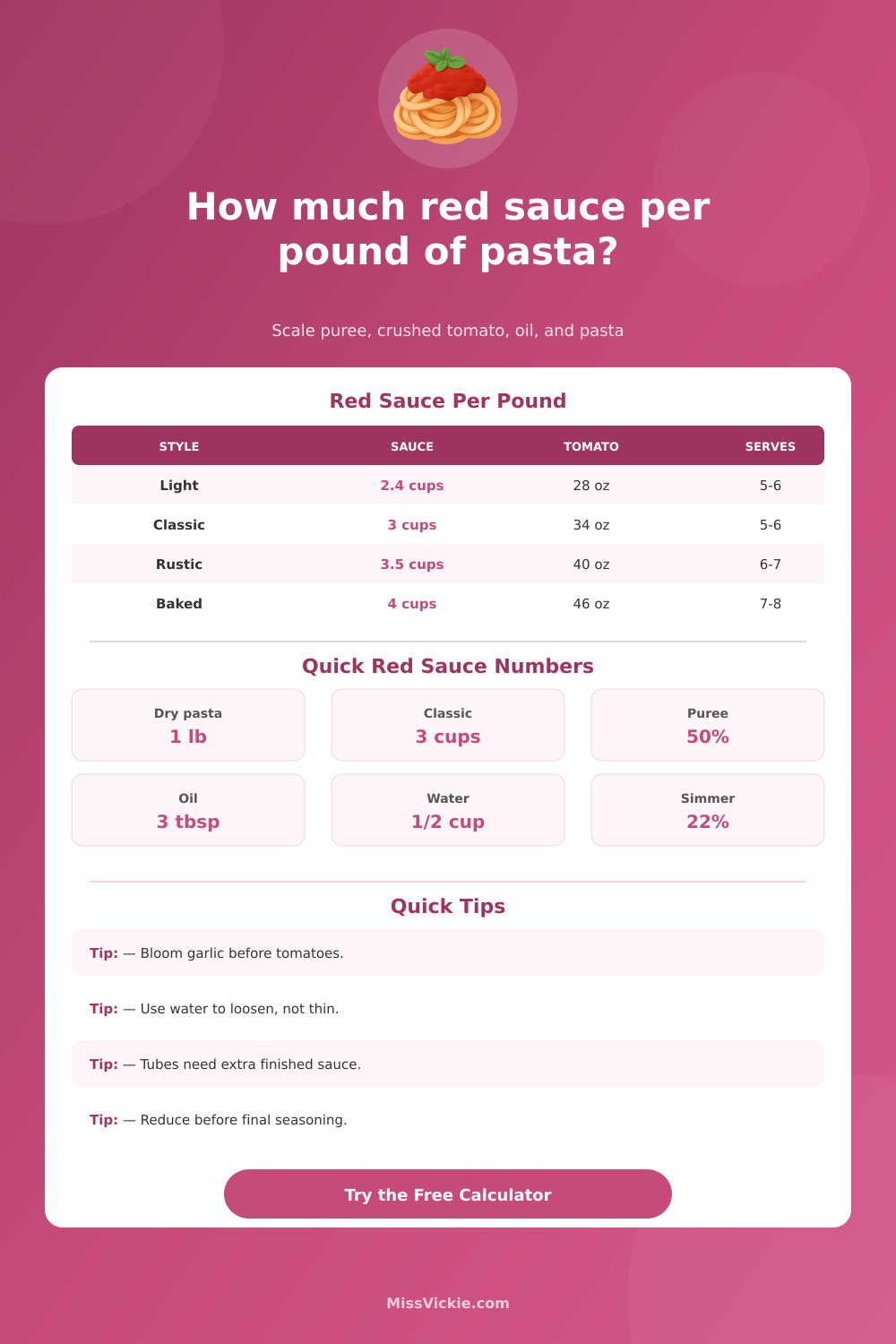
| Light red coating | 2.4 cups | 75% puree for smooth cling | Angel hair, spaghetti, light side plates |
| Classic pantry red sauce | 3 cups | 50% puree and 50% crushed tomato | Spaghetti, penne, weeknight bowls |
| Smooth puree-forward sauce | 3.1 cups | 75-100% puree | Penne, ziti, kids' pasta, freezer batches |
| Rustic crushed tomato sauce | 3.4 cups | 25-75% crushed tomato | Rigatoni, shells, rotini, spoonable plates |
| Garlic-oil red sauce | 3.05 cups | Balanced puree with loose finish | Linguine, bucatini, glossy pan finish |
| Spicy red sauce | 3.25 cups | 50% puree, chile bloomed in oil | Rotini, penne, arrabbiata-style bowls |
| Baked pasta red sauce | 3.8 cups | More crushed tomato for body | Ziti, shells, rigatoni, casserole trays |
| Extra saucy plated pasta | 4 cups | Any ratio with extra finished reserve | Bread-dipping plates and family-style bowls |
A general red sauce is broader than marinara: it can be smoother, more garlicky, spicier, or built for baking while staying meatless and cream-free.
| Tomato blend | Texture result | Starting tomato for 3 cups finished | Best adjustment |
|---|---|---|---|
| 100% puree | Smooth, even coating | 3.65 cups at 18% loss | Add pasta water slowly so it stays glossy |
| 75% puree / 25% crushed | Smooth with small tomato bits | 3.75 cups at 20% loss | Good for kids' pasta and penne |
| 50% puree / 50% crushed | Balanced pantry red sauce | 3.85 cups at 22% loss | Default for most pasta pounds |
| 25% puree / 75% crushed | Rustic and spoonable | 4 cups at 25% loss | Use tubes and reserve extra sauce |
| 100% crushed | Chunky, loose tomato body | 4.15 cups at 28% loss | Simmer longer before tossing pasta |
| Passata-style | Silky and concentrated | 3.55 cups at 16% loss | Use oil and pasta water for cling |
| Base choice | Garlic per lb | Oil per lb | How to use it |
|---|---|---|---|
| Mild base | 2 cloves | 2 tbsp | Soft family red sauce; keep chile out or use a tiny pinch |
| Classic base | 3 cloves | 3 tbsp | Bloom garlic gently, then add tomatoes before garlic browns |
| Garlicky base | 5 cloves | 4 tbsp | Use low heat and a shorter simmer to keep garlic sweet |
| Silky oil base | 3 cloves | 5 tbsp | Best with long pasta and 1/2 to 1 cup pasta water per lb |
| Roasted garlic base | 6 cloves | 3 tbsp | Mash roasted garlic into puree for a mellow sauce |
| Pasta amount | Classic finished sauce | Starting tomatoes | Serving range |
|---|---|---|---|
| 1/2 lb dry pasta | 1.5 cups red sauce | about 2 cups tomato base | 2 to 3 hearty servings |
| 1 lb dry pasta | 3 cups red sauce | about 34 oz tomato base | 5 to 6 moderate servings |
| 2 lb dry pasta | 6 cups red sauce | about 68 oz tomato base | 10 to 12 servings |
| 4 lb dry pasta | 12 cups red sauce | about 136 oz tomato base | 20 to 24 buffet servings |
| 8 lb dry pasta | 24 cups red sauce | about 272 oz tomato base | 40 to 48 buffet servings |
Puree and crushed tomato ratios, garlic oil, spice, and pasta water can move up or down by the pasta shape.
Usually quicker, brighter, and lighter, with fewer texture and garlic-oil adjustments.
Adds vodka and cream, so its ratio is governed by dairy balance rather than pure tomato coating.
Meat, mirepoix, and long simmering change both yield and serving size, so those need separate math.
It’s 5pm and you’re staring into your kitchen. A can of tomatoes and a pound of dry pasta stare back at you. You have more people to feed than you’d like, and that small container won’t be enough. Will the noodles be swimming in a lake of tomatoey goodness? Or will they be floating in a puddle of insufficiency? Most home cooks eyeball it, estimating based on what looks good… but that’s where things go wrong.
Enter the specifics and the calculator does the math. No need to guess what converts to what; just cook.
How to Make Perfect Tomato Sauce for Pasta
The other big variable is the shape of the pasta. Spaghetti and other long pastas has a smooth surface, so the sauce coats easily and you do not need much sauce. Rigatoni, penne, etc.; these tubular shapes, have areas on their surface where sauce can cling. You want to pack in the sauce to fit inside these holes and grooves. This is what the clinging feature adjusts for.
When you choose a rustic tube shape with all of that space for sauce to fit inside, it will estimate you’ll need more final sauce because some of your sauce will dissapears within the pasta structure itself. It’s not just about quantity, its also about texture. Purees are different than sauces made with crushed tomatoes. While the tomato pieces in the crushed version give body and chunkiness, they also give up some moisture when simmered. They require a larger initial batch volume, adjusted to make up for evaporation. To see what effect moving from puree to crush has on your starting volume and ultimate yield, check out the table of references.
Your goal is balance: no dried-out starch; no soup. The sauce’s base is garlic and oil. First comes garlic, then comes olive oil. This sets the stage for all of the flavor without even one drop of tomato going through the pan. When we bloom our garlic in oil, we get its aromas, which wouldn’t happen if we were simmering in water. You can make it a big punch or a subtle note; just use the calculator.
And yes, there are other ingredients to consider (peppers, mushrooms…), which soak up some liquid and function as sponges. The calculator considers the add-in ingredient, accounting for a higher final sauce volume required to maintain the dish’s moisture level. Otherwise, you’ll end up with a bowl of wet-but-still-dry pasta.
Red sauces get a restaurant-style finish thanks to pasta water. When you mix this starchy water with your olive oil base, it emulsifies into fat and adds a gloss to the finished dish. Instead of sliding off the noodles, the sauce clings onto them in a sticky coating. Recipes tell you to set aside a cup, but rarely do they tell you why. The calculator lets you know just how much water to add back depending on how loose or tight you want your sauce. Using less water makes a thicker coat and adding more water makes a looser sauce. Now you’ve turned separate components into a cohesive dish.
As the tomatoes simmer, some water evaporates, meaning that your liquid has decreased over time. Simmer them for just a few minutes (say, 12) and most of the volume remains intact. Leave them on low longer (45 minutes), and the resulting concentration will be more flavorful, though it’ll also reduce considerably, yielding far less than you began with. Want a side-dishs worth? Start with only 3 cups of tomato base, and plan to simmer it for one hour… You’ll end up with almost nothing.
The tool is actualy backwards: it computes the number of ingredients you should of put in at the beginning, based on your desired volume after everything’s been reduced by simmering. That way, even if some water boils off before you’re done, you’ll still achieve the right volume in the end. Home cooks mess up here, measuring out what they want in the end without taking into account what happens during cooking.
It gets trickier when scaling this up for a party. A pound of pasta feeds five to six; eight pounds will need 24 cups of finished sauce. That’s simple math, which scales directly. But our intuition doesn’t: it’s easy to undersauce a big batch of something, since the ratio becomes abstract at bulk quantities. With the tool, you’ll never be caught running short.
If you prefer measuring out tomatoes in cups (or weighing them by ounces), that works too. Switch units as necessary based on what you have in your pantry. Metric? Imperial? Balance: That’s what cooking’s all about.
The calculator serves as a good starting point. Taste it along the way; ultimately, it’s your palate. If the sauce is running on the thick side, add some water, adjust the salt, etc. Trust the numbers to give you confidence, but don’t rely solely on them because taste testing is irreplaceable. You can cook with precision, yet there is room to improvise. A pound of pasta becomes a meal that dissapears before people realize they are hungry.