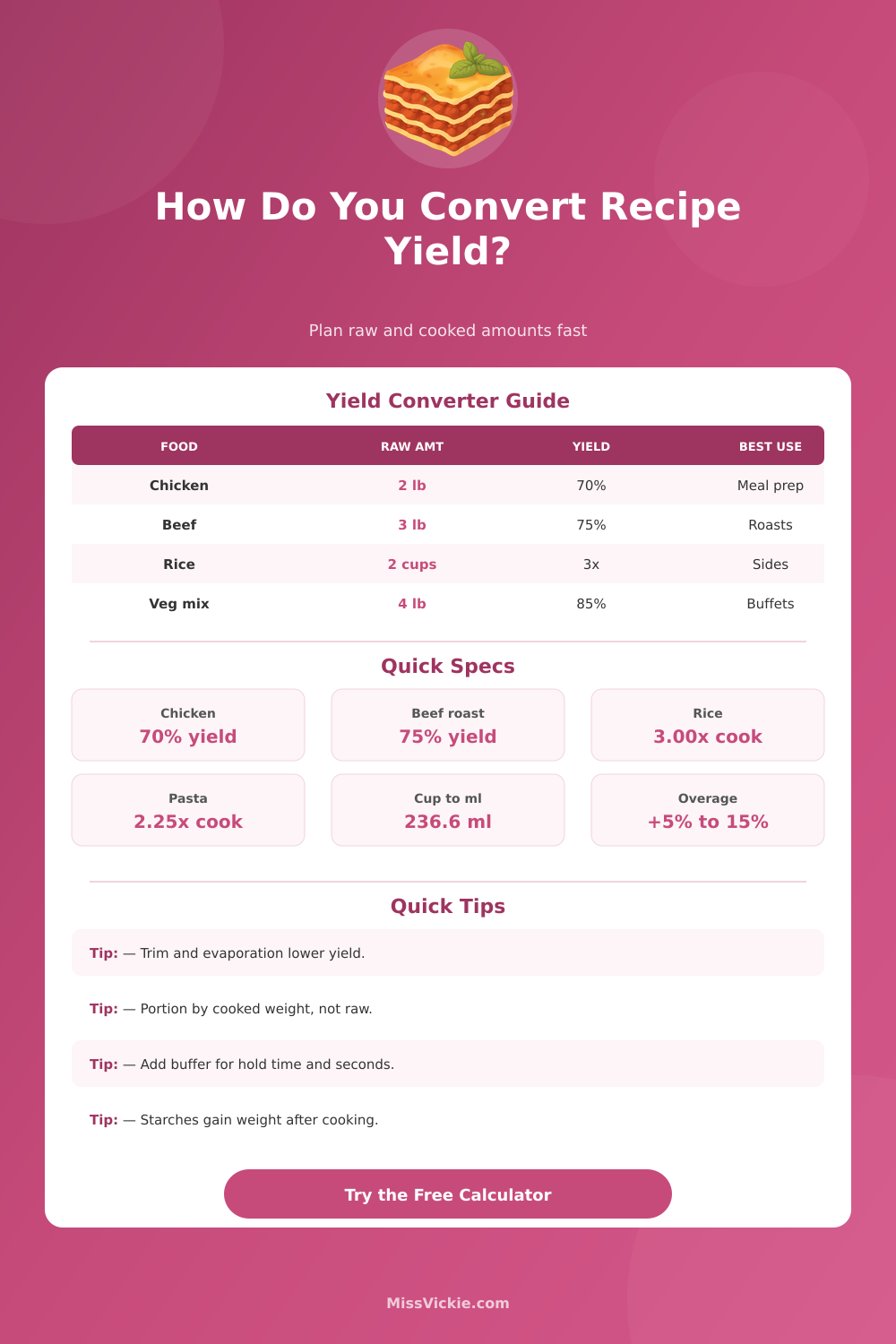
Recipe planning with real yield percentages
Recipe Yield Converter Calculator
Estimate how much cooked food a raw amount will make, how much raw product you need for a target yield, and what that means per serving in metric or imperial units.
Typical cooking yield varies with trim, moisture loss, and hydration. The calculator uses practical kitchen percentages for meats, grains, vegetables, beans, and soup-style recipes.
Chicken Breast
70%
A good rule for trimmed boneless meat after cooking loss.
Beef Roast
75%
Roasts lose fat and moisture, but keep solid slicing yield.
Dry Rice
3.00x
A dry cup of rice typically triples after simmering.
Dry Pasta
2.25x
Most pasta roughly doubles to a little more than double cooked.
| Food Type | Base Yield | Cooked Portion | Kitchen Note |
|---|---|---|---|
| Chicken breast | 70% | 5 to 6 oz | Pan or grill cooking usually loses 25% to 30% moisture. |
| Beef roast | 75% | 6 to 8 oz | Roasts hold shape well but still lose fat and juices. |
| Pulled pork | 60% | 4 to 6 oz | Bone, fat rendering, and shredding reduce final yield. |
| Salmon fillet | 78% | 5 to 6 oz | Moderate moisture loss with little trim waste. |
| Roasted vegetables | 85% | 4 to 5 oz | Water loss is the main shrink factor. |
| Soup or chili | 95% | 8 to 12 oz | Mostly held in the pot, so only minor ladle and simmer loss. |
| Dry rice | 300% | 5 to 6 oz | Water absorption raises cooked yield to about triple. |
| Dry pasta | 225% | 4 to 6 oz | Shape and doneness change final uptake slightly. |
| Scenario | Raw Amount | Cooked Yield | Servings at Standard Portion |
|---|---|---|---|
| Chicken meal prep | 4 lb raw | 2.8 lb cooked | 7 servings at 6 oz |
| Beef roast dinner | 6 lb raw | 4.5 lb cooked | 12 servings at 6 oz |
| Pulled pork slider bar | 10 lb raw | 6 lb cooked | 24 servings at 4 oz |
| Rice side dish | 2 cups dry | 6 cups cooked | 12 servings at 1/2 cup |
| Pasta bake | 1 lb dry | 2.25 lb cooked | 9 servings at 4 oz |
| Vegetable tray | 5 lb raw | 4.25 lb cooked | 17 servings at 4 oz |
| Dish Type | Light Portion | Average Portion | Hearty Portion |
|---|---|---|---|
| Sliced meat | 4 oz | 6 oz | 8 oz |
| Shredded meat | 3 oz | 4.5 oz | 6 oz |
| Fish fillet | 4 oz | 5.5 oz | 7 oz |
| Rice or grains | 4 oz | 5 oz | 6 oz |
| Pasta | 4 oz | 5 oz | 7 oz |
| Soup or chili | 8 oz | 10 oz | 12 oz |
| Unit | Metric Equivalent | Imperial Equivalent | Use Case |
|---|---|---|---|
| 1 oz | 28.35 g | 0.0625 lb | Portioning meats and grains |
| 1 lb | 453.6 g | 16 oz | Buying raw proteins |
| 1 cup | 236.6 ml | 8 fl oz | Soups, beans, and cooked starches |
| 1 quart | 946.4 ml | 4 cups | Large soup and chili batches |
| 1 kg | 1000 g | 2.2 lb | Bulk prep and catering orders |
Yield refer to the amount of food that a person can serve after the food is cooked. The concept of yield is not abstract; it is a measurement of the cooked weights of the food after waste from trimming meat and losing water from the food has occurred. People often believe that the weight of the raw food will be the same as the cooked food.
However, the weight of raw food often change during the cooking process. For instance, the yield of meat is 70 to 75 percent because the protein in the meat contract as the water evaporates from the meat during the cooking process. Chicken breasts, for instance, will lose around 25 percent of their weight from raw meat to cooked meat.
How Food Weight Changes When Cooked
Starch products have a different yield than meat. Rice products will triple in weight because of the water that the cooked rice will absorb. The same is true for pasta products; pasta will double or more in weight when it is cooked.
Vegetables will also experience a change in weight during the cooking process. However, the change will not be as great as meat products because vegetables also contains water that will evaporate during the cooking process. For example, vegetables may lose around 15 percent of their weight when they are roasted.
When purchasing raw food, people must take into account the weight loss of the food during the cooking process to ensure that there is enough food for each person during the meal. Home cooks often ignore the concept of yield. People only realize the importance of this concept when they find that there is not enough food for each person who is to have the meal.
If cooks double the recipe based on raw ingredient, they will find that there is not enough food to feed each guest. Restaurants take into account this issue with food yield because they measure and portion food based on cooked weight. To avoid cooking issues with food shrinkage during the cooking process, cooks must take into account the base yield for each type of food and also take waste into account.
Waste occur during the trimming of meat or in the tasting of food, which causes some of the food to become evaporated during the cooking process. Yield can be used for planning food for specific events. Take, for instance, the event that feature brisket.
Brisket yields around 60 percent of its weight when cooked. Thus, if a person purchases ten pounds of raw brisket, there will be six pounds of cooked brisket. If a person does not take the yield of brisket into account when preparing the event, the meat may not last all of the guests at the event.
Use of the concept of yield can also be made to prepare rice for an event. If a cook uses two cups of dry rice, there will be six cups of cooked rice. Thus, two cups of dry rice can feed twelve people if each person is to receive a half-cup portion of the rice.
There are different ways to prepare food based on yield. One method is starting with the amount of raw food that is available and determining the yield of the cooked product. An example of this would be calculating the amount of pounds of vegetable that will be roasted if five pounds of raw vegetables are roasted.
Another method of calculating the food yield is to start with the target amount of cooked food and determining the amount of raw food that is to be purchased. The third method is to perform portion planning to determine how much raw food will be needed for the meal based on the number of servings and the size of each portion. In this case, cooks must use the same unit of measurement for the raw and cooked food and also account for waste by providing for the guests requests or the loss of the food due to warming.
The yields of food can change according to the type of food and the cooking method. For instance, thicker cuts of meat contain more water than thin pieces of meat. Furthermore, sous-vide cooking of salmon will provide a higher yield than pan-searing salmon.
Dry brining of meat can create more yield because the process affects how the water evaporates from the meat. Additionally, the amount of starch that starch products absorb can change the yield of the food. The shape of the pasta can also change the yield of the product in terms of how much sauce the pasta can hold.
For vegetables, the density of the peel will change the way in which the vegetables shrink; some vegetables will shrink more than others. Furthermore, waste in the cooking process will occur with food like chicken because the amount of trim that the cook will remove from the raw chicken will add up over time. Additionally, the amount of evaporation of the raw food during simmering processes will create yield loss for the cooked food.
A common mistake in the kitchen is to portion food based on the raw weight of the food. This is a mistake because the portion of the food that is edible will shrink during the cooking process. For instance, if a cook tries to prepare food to feed ten people without calculating the yield of the food, the pans may not have enough food to feed each guest.
Buffets require cooks to take into account the extra buffer for the buffet lamps that remove moisture from the food. Always portion food based on the cooked weight of the food. Additionally, calculate the nutrition of the food based on the cooked weight of the food; the protein and calorie counts for food will be based on the final weight of the food rather than the raw weight of the food.
Yield planning for food will help cooks to reduce food waste, manage their restaurant budget, and ensure that there is enough food to feed all of the guests at the restaurant. Cooks should always remember that food will shrink during the cooking process. For instance, if cooks start with four pounds of raw meat, there will not be four pounds of cooked meat at the end of the cooking process.
Instead, the cooked meat will be less than four pounds. To avoid having food containers that are not fully provisioned with enough food for the guests, cooks must plan the food based on the knowledge of the shrinkage of the raw food during the cooking process.