Batch weight, volume, cooked yield, pan area, and desired portions
Recipe Serving Size Calculator
Convert a homemade recipe into practical portions from the batch weight or volume, cooked yield, pan size, serving count, target grams, and the number of portions you want.
Load a common recipe style, then adjust the batch, pan, yield, and serving goal to match the dish you actually cooked.
Serving Breakdown
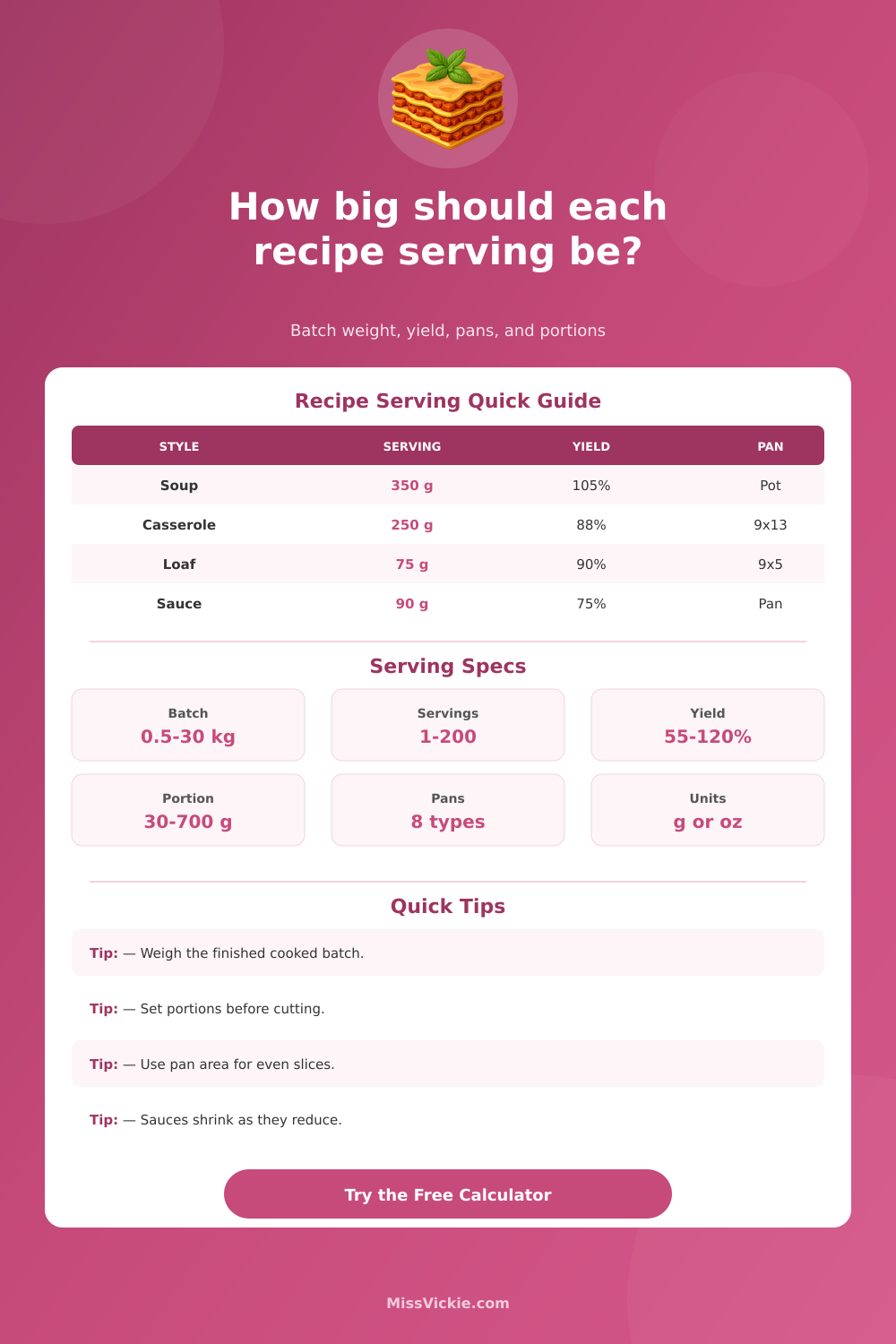
Casseroles, skillet meals, rice bowls, and pasta bakes usually land here.
Brothy recipes often need a larger gram serving for a full bowl.
Loaves, bars, and desserts are portioned smaller because they are denser.
Reduced sauces and curries can serve many portions from a smaller batch.
| Recipe Style | Typical Serving | Cooked Yield Range | Best Calculator Input | Portion Note |
|---|---|---|---|---|
| Casserole or lasagna | 220 to 330 g | 78 to 95% | Pan cuts plus cooked weight | Cut after resting so squares hold shape. |
| Soup, stew, or chili | 300 to 450 g | 95 to 115% | Finished pot weight or volume | Include broth that will be served in each bowl. |
| Sheet pan dinner | 260 to 380 g | 70 to 88% | Raw weight plus cooked yield | Roasting removes water, so cooked portions get denser. |
| Skillet stir-fry | 240 to 340 g | 82 to 98% | Cooked batch weight | Sauce left in the pan belongs in the batch total. |
| Meal prep bowl | 300 to 425 g | 88 to 105% | Desired portions and target grams | Weigh containers for the most even servings. |
| Grain salad | 180 to 300 g | 95 to 110% | Batch weight after mixing | Cold salads may gain weight from dressing and add-ins. |
| Recipe Density | Estimated g Per Cup | 1 Quart Batch | 8-Cup Batch | Best For |
|---|---|---|---|---|
| Brothy soup or thin sauce | 235 g | 940 g | 1880 g | Stocks, broths, light soups |
| Stew, chili, or curry | 250 g | 1000 g | 2000 g | Beans, meat stews, saucy mains |
| Casserole or pasta bake | 225 g | 900 g | 1800 g | Baked pasta, layered dishes |
| Rice bowl or grain salad | 185 g | 740 g | 1480 g | Rice, quinoa, pasta salad |
| Loaf cake or firm bake | 150 g | 600 g | 1200 g | Breads, loaf cakes, muffins |
| Dense bars or brownies | 275 g | 1100 g | 2200 g | Brownies, blondies, compact desserts |
| Pan | Area | Common Cuts | Approx. Slice Area | Useful Recipe Styles |
|---|---|---|---|---|
| 8-inch round | 50 sq in | 8 wedges | 6.3 sq in | Small cakes, quiche, cornbread |
| 9-inch round | 64 sq in | 10 to 12 wedges | 5.3 to 6.4 sq in | Layer cakes, frittata, tarts |
| 9x5-inch loaf | 45 sq in | 10 to 12 slices | 3.8 to 4.5 sq in | Quick bread, meatloaf, terrine |
| 8-inch square | 64 sq in | 9 or 16 squares | 4 to 7.1 sq in | Bars, brownies, snack cakes |
| 9x13-inch dish | 117 sq in | 12 or 15 squares | 7.8 to 9.8 sq in | Casseroles, lasagna, sheet cake |
| Half sheet pan | 204 sq in | 24 to 40 pieces | 5.1 to 8.5 sq in | Sheet pan dinners, party bars |
| Goal | Light Portion | Standard Portion | Hearty Portion | Cooked Batch Needed |
|---|---|---|---|---|
| 4 people | 800 g | 1200 g | 1600 g | Plan 0.8 to 1.6 kg cooked |
| 6 people | 1200 g | 1800 g | 2400 g | Plan 1.2 to 2.4 kg cooked |
| 10 portions | 2000 g | 3000 g | 4000 g | Useful for meal prep containers |
| 16 buffet portions | 3200 g | 4800 g | 6400 g | Add buffer for seconds and uneven scoops |
| 24 party pieces | 1440 g | 2400 g | 3600 g | Works for bars, bites, or side portions |
| 50 tasting portions | 2500 g | 4000 g | 6000 g | Keep portions small and consistent |
Volume works well when liquid is evenly distributed and served with every portion.
Pan cuts should match both cooked weight and slice geometry for fair portions.
Water loss concentrates the batch, so raw weight usually overstates final servings.
Target serving grams make containers consistent even if the recipe style changes.
When you have cooked a large amount of foods you must determine how many individual meal the food will provide. A large pot of chili may be alot of food, but it may be consumed more faster than you expect. Conversely, a small sheet pan dinner may provide more meals than you have planned.
The number of meals that a dish will provide is dependent upon how you define the portion of that meal, and what that portion size mean according to the type of meal that you are feeding (family, lunches, group). To determine the number of portion that the food will provide the calculator must work backward from the finished meal. You must enter the amount of the food that you started with its raw ingredient into the calculator.
How to Find Servings from Cooked Food
The cook must adjust the percentage of the food that was lost during the cooking process; for instance, a vegetable tray may lose twenty percent of its weight during roasting but a soup may not lose much of its weight during the cooking process. The cook can then convert the raw ingredient into the portion sizes according to the type of dish, the pan used to cook it, or the desired gram target for each person who eats the meal. Foods can change in different ways during the cooking process.
For instance, grain salad often gain weight during cooking due to the addition of dressing and vegetables but a curry sauce that is reduced during cooking may lose weight as the water evaporates during the cooking process. To account for this the calculator allows users to select a density setting for the type of dish that they are creating. This setting ensure that the weight that is calculated will reflect the weight of each portion based on how dense the food will be when served; without this setting a cup of brothy soup will not have the same weight as a dense brownie tray.
The size of the pan can impact the portion size. For instance, a nine by thirteen baking dish may be divided into twelve squares of even portions but the weight of each square may differ from the weight of each of the fifteen squares that could be cut from the same pan. While the total weight of the pan will be the same, the weight of each portion can change according to the number of portion of food that are cut from the pan.
This can be adjusted within the portion calculator so that if the pan is divided into a different number of portion the portion size can be calculated to avoid inaccuracies. This adjustment ensures that the portion size is not estimated but calculated; the portion size will not be adjusted for geometry but prevented from being mistaken for a specific number of serving that may be printed on the recipe. The portion calculator can be used to adjust the recipe for a different number of people.
If a recipe is to be adjusted it is not necessary to simply multiply each ingredient by a round number to create the portion for a different number of people; the portions will not be correct. Instead, the user can select the portion size that is targeted for each person, along with a buffer percentage to account for the fact that scoops of food are rarely even and that some individual may desire second helping of food. The portion calculator ensures that the last individual to eat the food will not find the food empty.
Most cook make a few mistake when using the portion calculator. One of the most common is to measure the food at the wrong time. For instance, it is common for cooks to weigh the ingredient prior to cooking the ingredient but then to assume that the weight of the food prior to cooking is the same as the finished food.
The portion size of food change during cooking; moisture leaves the food. Another common mistake is to cut a casserole while it is still warm from the oven; if the cook cuts the casserole before it rests the portions may fall apart. While the portion calculator does not change these habit of cooks the calculator does help cooks to consider at what time the food should be measured and what that weight of food means when the food is served.
The reference tables for common portion size are provided to assist cooks who are unsure what size portion should be made. These tables are in the same units as the portion calculator so that cooks can easily compare the portion size that they calculate for their recipe to examples of portion sizes for different types of food. For instance, a portion size of soup can be considered to be large in one type of meal setting but small in another so these tables can help cooks to understand what portion sizes are common for the type of food that is being prepared.
The human makes the portion size decision rather than the mathematics behind the portion calculator. It is up to cooks to decide how large or small the portion for the meal will be, if the meal will include side dish, and for how many days the food will be prepared. While the portion calculator will not provide a correct portion size for any specific meal the portion calculator will provide cooks with a set of option according to the food that has been cooked.