
If there’s one thing that tends to go wrong in baking, it’s scaling recipes incorrectly or using the wrong measuring cup. Most times this end up being a disaster; you taste burnt flour and regret. Baking isn’t just comfort food, its a science; treating it casually based off intuition will turn into a recipe for disaster.
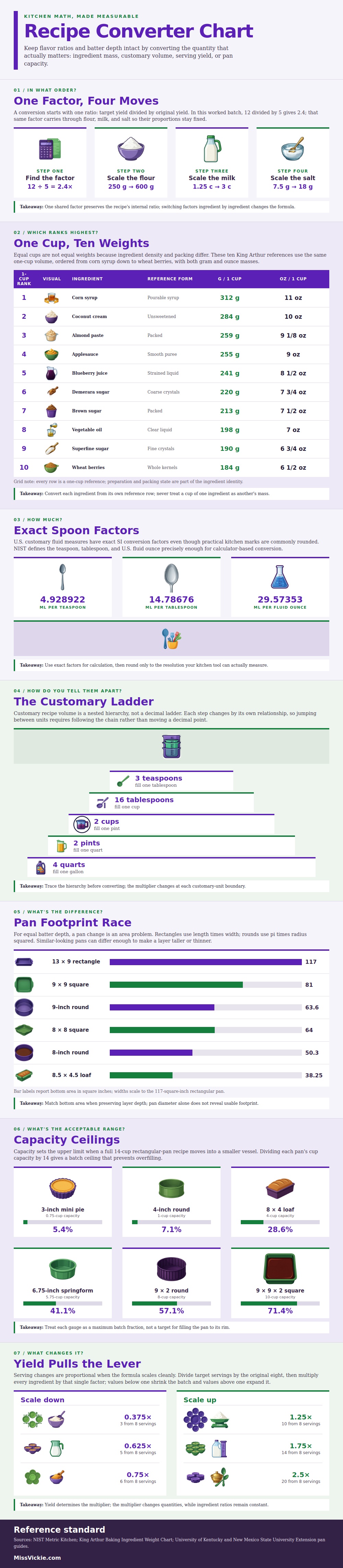
As the infographic above shows, scaling doesn’t involve guessing. It is all about keeping the right ratio of each ingredient in the recipe. Once you understand how weight works compared to volume, you will stop fighting against your ingredients and begin to work with them.
How to Scale Baking Recipes
So, what’s the most important thing to understand? It is the one conversion factor. Because when you’re cooking at home, it can be tempting to adjust the individual ingredient, a few drops of this or a handful of that, following your gut feeling about how things look. That’s the recipe-ruining stuff.
What you should of do is figure out the one conversion factor (how many times bigger is the yield you have compared to the yield you want?) and apply that to everything in the recipe. So if you’ve got a recipe for five servings and you want twelve, you divide twelve by five to get a factor of 2.4, and you multiply all of the ingredients by that one and only number. And that preserves the ratios.
See, that’s where folks go off the rails, they think you adjust each ingredient separately, instead of thinking mathematicaly. Measurements of volume, particularly those based on a hierarchical system different than clean decimals, are always difficult. Converting from teaspoons to cups doesn’t involve simply shifting decimal point. There’s a chain to follow: three teaspoons = one tablespoon; sixteen tablespoons = one cup; two cups = one pint. The multipliers changes with each link. Because these multipliers build on each other, small errors with teaspoon can grow quickly once you start using cups.
To avoid any potential errors, calculate using precise conversion factors then round off to the level of precision allowed by your actual cooking tools. Precision matters more than you think.
What’s also quite interesting is weight. A cup of wheat berries are lighter than a cup of corn syrup, even though they take up the same amount of space. Packed brown sugar is heavier than loose brown sugar. Ingredients vary widely in their densities and how they are filled in containers. The key here: measuring cups suck. Scales do not.
By weighing ingredients, you eliminate the guesswork of packing density and air pockets. You’re measuring what really matters- what an ingredient weighs. Baking stops being a guessing game it becomes a precise science.
Another problem is pan size. If you change the shape of your pan but don’t adjust amount of batter, you’ll bake something that’s far too shallow or deep. If a recipe calls for baking in a big rectangular pan, you can’t use a tiny round cake tin, your baked good will be to thin and dry around the edges, with a mushy middle. Consider the area, not just the diameter, of the pan on which you’re planning to bake. Though two pans may appear to have the same size at first glance (like a nine-inch round pan versus an eight-by-eight square pan), their surface areas isn’t the same. Using the second pan will keep the cooking time and texture how you want them.
Ultimately, baking is a matter of control. If you’re doubling a recipe for a dinner party, or halving it for an after-dinner treat, follow these same rules: Maintain the ratio with one single conversion factor, weigh what you can, honor your pan’s dimensions. Treat those measurements as directions, not mere guidelines, and you’ll immediately see an improvement in your baking.
The leap from a good treat to a great one tends to be measured by only a few more (or fewer) grams of flour, or a slightly adjusted oven time. Learn the math and the magic will follow.