🍳 MissVickie kitchen install math
Range Hood Height Calculator
Estimate the best mounting height above the cooktop by fuel type, hood style, CFM, heat output, user height, cabinet clearance, and capture area.
📌Range hood height presets
Choose a common kitchen install, then adjust the dimensions and airflow. Always compare the result with the hood manufacturer's manual and local code before drilling.
⚙Calculator inputs
Height breakdown
📏Current install snapshot
📋Range hood height tables
These tables are planning references. The calculator combines them with your exact CFM, heat load, user height, cabinet clearance, and capture area.
1. Fuel type height starting points
| Fuel type | Typical low | Typical target | Typical high |
|---|---|---|---|
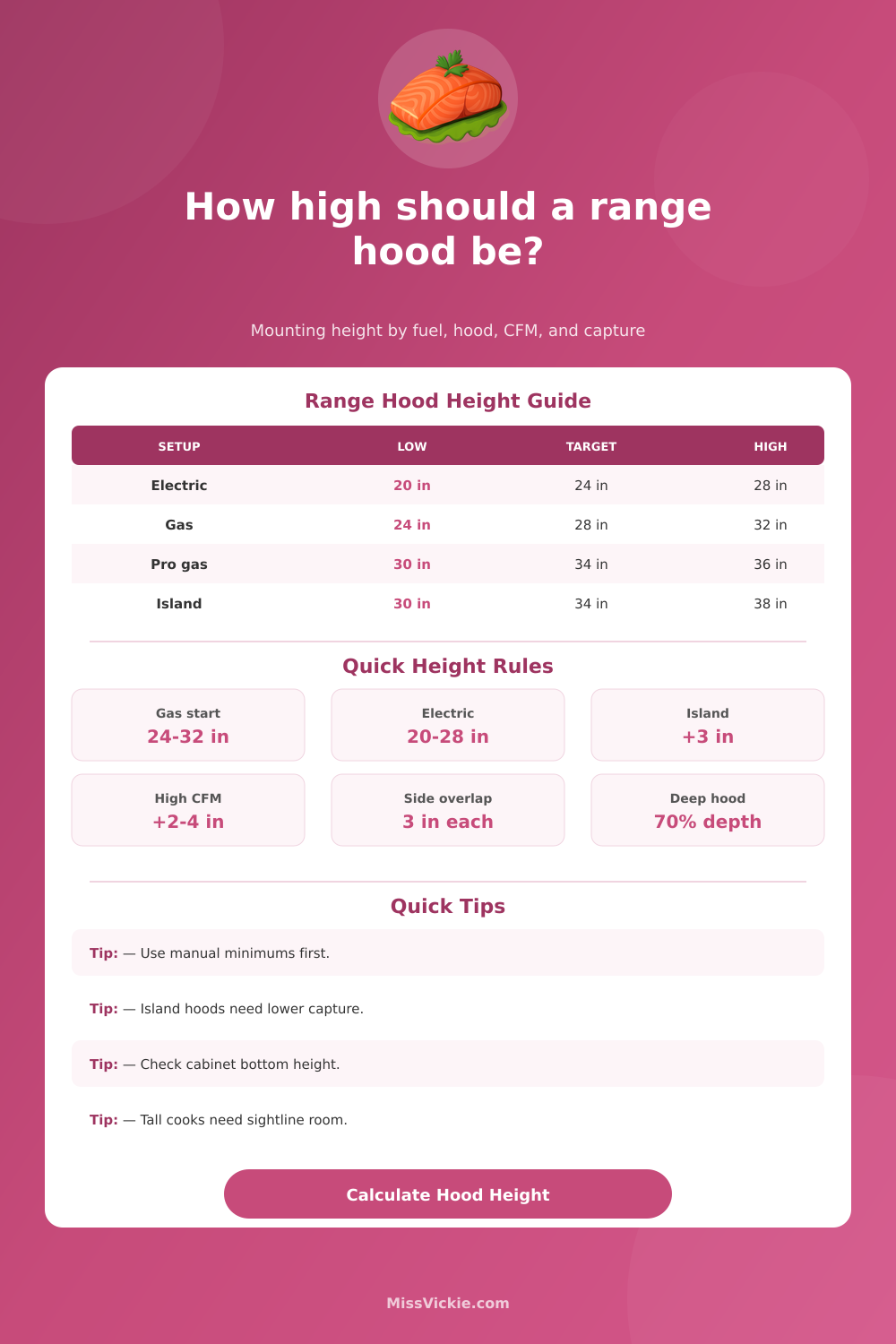
| Electric smooth-top | 20 in | 24 in | 28 in |
| Induction cooktop | 24 in | 28 in | 30 in |
| Standard gas range | 24 in | 28 in | 32 in |
| Dual fuel range | 28 in | 31 in | 34 in |
| Commercial-style gas | 30 in | 34 in | 36 in |
| Wok or high-heat burner | 32 in | 36 in | 40 in |
Gas and wok setups need more heat clearance, but capture still drops as the hood moves up.
2. Hood type height adjustment
| Hood type | Height effect | Capture issue | Best check |
|---|---|---|---|
| Under-cabinet | Lower range | Shallow depth | Cabinet bottom clearance |
| Wall canopy | Neutral | Back wall helps plume | Width overlap |
| Island hood | Add 2 to 4 in | Open sides leak steam | Extra width and depth |
| Insert or liner | Add 1 to 2 in | Depends on wood surround | Liner depth |
| Ceiling or recessed | Much higher | Needs very high capture | Manual CFM and distance limit |
Island and ceiling hoods should not be judged from gas clearance alone.
3. CFM and heat height adjustment
| Signal | Low | Medium | High |
|---|---|---|---|
| Rated airflow | 100 to 399 CFM: keep low | 400 to 799 CFM: normal | 800+ CFM: may mount higher |
| Gas heat | Under 35k BTU | 35k to 60k BTU | 60k+ BTU |
| Electric load | Under 7 kW | 7 to 11 kW | 11+ kW |
| Cooking style | Simmer and steam | Daily saute | Searing, wok, frying |
More CFM does not fix a narrow or shallow hood; it only helps when the plume reaches the filter area.
4. Capture area height table
| Capture condition | Side overlap | Depth cover | Height guidance |
|---|---|---|---|
| Weak capture | 0 to 1 in | Under 60% | Use low end of range |
| Average capture | 1 to 3 in | 60% to 75% | Use target height |
| Strong capture | 3 to 6 in | 75% to 90% | Target can move up slightly |
| Pro capture | 6 in or more | 90% or more | Higher install is more forgiving |
Front burner capture usually fails before width capture, especially with shallow under-cabinet hoods.
🛠Hood install comparison grid
💡Two practical tips
Another important factor in determining the proper installation height for a range hood is the height of the range hood itself. The height of a range hood will determine how well the range hood can effectively captures the smoke and grease that is created while cooking. If the range hood is placed too low, a cook may bump there head against the range hood while cooking.
If, however, the range hood is placed too high, the smoke and grease will bypass the filters of the range hood, potentially resulting in smoke and grease settling upon the cooktops cabinets and curtains. The distance between the cooktop and the range hood is the primary consideration in determining the installation height of the range hood. The fuel type that the cooktop uses is another of the primary factors in determining the proper installation height for the range hood.
How High Should You Install a Range Hood
The type of heat that is emitted from gas cooktops or electric cooktops can influence the height of placement of the range hood; the gas burners will emit more heat than electric cooktops, and the range hood may need to be mounted lower to accommodate the heat that the burners emit. Under-cabinet range hoods may have some limiting factors in their installation relative to the cabinets above the range hood. Range hoods that are mounted to the ceiling or that is recessed into the cabinetry will have different installation considerations then those that are mounted to the counters.
The airflow rating of the range hood and the heat load of the cooktop are related to one another. Range hoods with higher cubic feet per minute (CFM) rating can be mounted at higher heights than those with lower CFM ratings; however, only if the range hood is deep enough to capture the smoke and grease that the cooktop creates. Similarly, cooktops that have higher BTU ratings will create more heat and smoke than those that contains lower BTU ratings.
The size of the cooktop will impact the installation height of the range hood. The range hood must be wide enough to cover the cooktop’s burners, and deep enough to cover the depth of the cooktop. If the cooktop is significantly wider than the range hood, or if the range hood is relatively shallow in comparison with the cooktop, the range hood will not cover the outer burners of the cooktop.
In addition to the size of the cooktop, the range hood must be high enough to ensure that it covers all the front burner of the cooktop; otherwise, the smoke created by those burners will exit the range hood. Other factor to consider besides the specifications of the cooktop include your personal height and the height of the cabinets in the kitchen. Individuals that are taller than others will require more headroom within their kitchen range hood installation.
Additionally, the height of the cabinets will limit some cooks to installing the range hood at a certain height. Finally, you must also consider the requirements of the range hood manufacturer; installation heights of range hoods should not be lower than the minimum clearance requirements as stated in the manufacturer’s range hood manual. Capture performance is a measurement of the efficiency of the range hood in relation to the height at which it is mounted.
Capture performance is influenced by the overlap of the range hood with the cooktop (in relation to the sides of the cooktop) and the depth of the range hood in relation to the cooktop. Range hoods with high capture performance may allow the range hood to be mounted higher than with cooktops and range hoods with low capture performance scores. Ranges have a habit of introducing mistakes in the placement of the range hood at the installation of the range hood.
Many individuals may consider the inch range of the installation height for electric range cooktops only. Others may consider the CFM ratings of range hoods, but not the depth of the range hood. Additionally, some cooks may mount the range hood too high to even the line of their cabinets, which will lead to the front burners of the cooktop trigger the smoke alarms in the kitchen.
One test that can be performed once the range hood is installed is the steam test. To perform the steam test, you can set the range hood fan to the medium setting. Additionally, a cook can boil a pot of water on the front burner of the cooktop.
If the steam is being pulled into the range hood’s filters, the range hood installation height are appropriate. If, however, the steam is drifting away from the range hood, the range hood should be lowered or a deeper range hood liner should be utilized. This test is one that can be used to ensure the installation height for the range hood is appropriate to the range hood and cooktop in the kitchen.