🍳 MissVickie kitchen ventilation math
Range Hood Duct Size Calculator
Estimate round or rectangular kitchen exhaust duct size from hood CFM, collar diameter, duct shape, run length, elbows, fittings, velocity target, noise comfort, and makeup-air needs.
📌Range hood presets
Choose a common kitchen ventilation scenario, then fine-tune the CFM, collar, duct shape, elbows, cap, material, and noise target for your real route.
⚙Calculator inputs
Calculation breakdown
📏Duct sizing reference cards
🧰Duct type comparison grid
Lowest resistance, easiest to size, and usually the quietest option when wall or attic space allows.
Useful in soffits and shallow chases, but keep the area generous because corners add friction.
Works for very short appliance offsets, but it should not replace a long rigid duct route.
Ridges, sags, and crushed spots raise noise and grease buildup; use only when allowed and truly unavoidable.
📊Round duct CFM table
| Round duct | Area | Quiet capacity at 650 FPM | Balanced capacity at 800 FPM | High comfort limit at 900 FPM |
|---|---|---|---|---|
| 5 in | 19.6 in² | 89 CFM | 109 CFM | 123 CFM |
| 6 in | 28.3 in² | 128 CFM | 157 CFM | 177 CFM |
| 7 in | 38.5 in² | 174 CFM | 214 CFM | 241 CFM |
| 8 in | 50.3 in² | 227 CFM | 279 CFM | 314 CFM |
| 9 in | 63.6 in² | 287 CFM | 353 CFM | 398 CFM |
| 10 in | 78.5 in² | 354 CFM | 436 CFM | 491 CFM |
| 12 in | 113.1 in² | 511 CFM | 628 CFM | 707 CFM |
| 14 in | 153.9 in² | 695 CFM | 855 CFM | 962 CFM |
| 16 in | 201.1 in² | 908 CFM | 1117 CFM | 1257 CFM |
▭Rectangular duct table
| Rectangular duct | Area | Approx round equivalent | Good CFM range | Kitchen note |
|---|---|---|---|---|
| 3.25 in x 10 in | 32.5 in² | 6.4 in | 150-220 CFM | Common microwave-hood duct, limited for higher CFM. |
| 4 in x 10 in | 40 in² | 7.1 in | 200-280 CFM | Acceptable for modest hoods with short runs. |
| 6 in x 8 in | 48 in² | 7.8 in | 250-330 CFM | Balanced shape, easier airflow than very flat duct. |
| 6 in x 10 in | 60 in² | 8.7 in | 300-420 CFM | Useful cabinet or soffit size for midrange hoods. |
| 8 in x 10 in | 80 in² | 10.1 in | 400-560 CFM | Good rectangular target for many 600 CFM systems. |
| 8 in x 12 in | 96 in² | 11.1 in | 500-670 CFM | More area keeps long runs calmer. |
| 10 in x 12 in | 120 in² | 12.4 in | 625-830 CFM | Strong choice for island or pro-style hoods. |
| 10 in x 14 in | 140 in² | 13.4 in | 725-970 CFM | High CFM with better noise control. |
| 12 in x 16 in | 192 in² | 15.6 in | 1000-1300 CFM | Large remote blowers and long duct routes. |
↪Equivalent length table
| Fitting or condition | Round duct allowance | Rectangular allowance | Why it matters |
|---|---|---|---|
| Straight duct | Actual measured ft | Actual measured ft | Base route length before fittings. |
| 90 degree elbow | 12 ft each | 14 ft each | Tight turns create turbulence and noise. |
| 45 degree elbow | 6 ft each | 7 ft each | Smaller turn but still adds resistance. |
| Round-rect transition | 5 ft each | 5 ft each | Shape change disturbs airflow. |
| Standard wall cap | 22 ft | 22 ft | Damper and screen can dominate short runs. |
| Roof cap | 30 ft | 30 ft | Longer exit and weather hood add loss. |
| Flexible or crushed route | 1.55x multiplier | 1.55x multiplier | Ridges and compression reduce real CFM. |
🔊Velocity, noise, and makeup-air table
| Air speed | Noise feel | Grease behavior | Design action |
|---|---|---|---|
| Below 500 FPM | Very quiet | May settle in the duct | Usually too slow for greasy exhaust. |
| 600-750 FPM | Quiet | Good residential balance | Best target for open kitchens. |
| 750-900 FPM | Moderate | Good capture velocity | Often acceptable when space is tight. |
| 900-1100 FPM | Noticeable | Strong but louder | Upsize if the kitchen is noise-sensitive. |
| Above 1100 FPM | Loud | High pressure drop | Upsize duct or reduce CFM demand. |
| 400+ CFM fan | House dependent | May depressurize kitchen | Review makeup air with local code and appliance needs. |
💡Practical kitchen duct tips
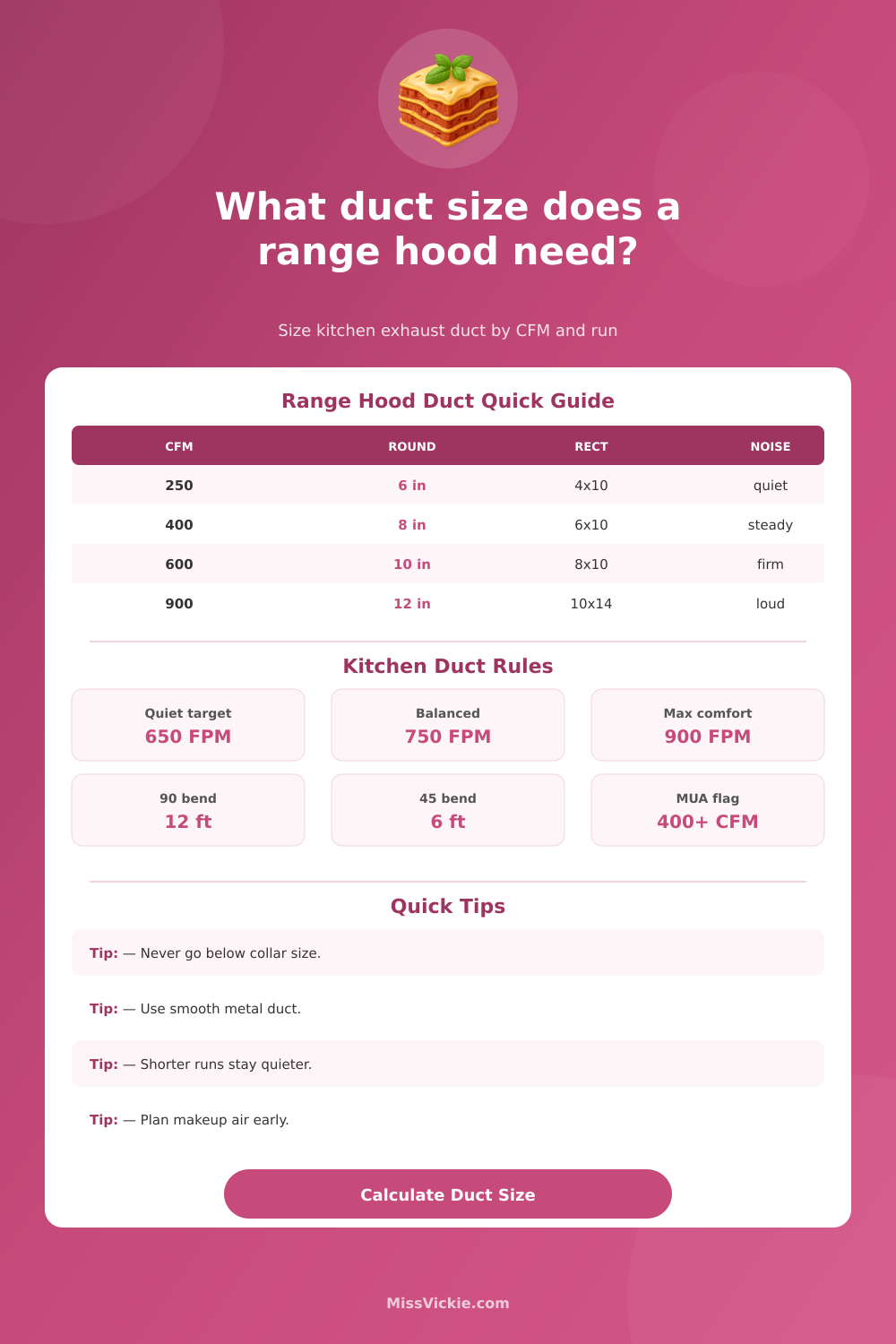
Selecting the correct duct size for a range hood is an important part of installing the range hood into the kitchen. Selecting the correct duct size will ensure that the range hood will function in the kitchen in the way that you require. If the duct too small for the requirement of the range hood, the fan will have to work harder to move the air and the kitchen will become louder then it should be.
If the duct is larger than what is required to effectively move the air from the range hood to the exhaust vent, the kitchen will have to purchase the extra materials to create such a large duct; however, the range hood will not effectively remove the grease and moisture from the kitchen. You must match the duct with the range hoods airflow, the path that the duct will take, and the amount of noises that you wish to be present in the kitchen. Range hoods is measured in cubic feet per minute (cfm) which represents the amount of air that the range hood can move.
How to Choose the Right Duct Size for Your Range Hood
However, the cfm of the range hood only describes the range hood’s output under perfect conditions. If there are elbows in the ducting of the range hood, if the range hood has a roof cap, or if the range hood’s exhaust duct passes through the attic, the cfm that the range hood provides will be less than the cfm that the manufacturer’s ratings represent. A calculator will allow the individual to input the cfm of the range hood, the collar size of the range hood, and the shape of the duct to recieve a recommendation for the ducting system.
Additionally, the calculator will also ask for the length of the straight duct, the number of turns of the duct, and the type of termination cap for the range hood’s ducting. The air velocity of the range hood is the rate at which the air can travel through the ducting system. Air velocity is one of the critical measurement to determine for the installation of the range hood.
If the air velocity is too low, the range hood will deposit grease into its ducting system, presenting a major cleaning problem. If the air velocity is too high, the range hood will create too much noise in the kitchen, and the static pressure will be too high for the ducting system; the range hood will not be able to effectively move as much air into the kitchen as it otherwise would. The calculator will allow the individual to select the air velocity that they would like in their kitchen, which helps to make a decision about the level of noise that they are willing to have in their kitchen.
The equivalent length of the ducting system is a means of calculating the resistance that the ducting system creates. Each 90-degree elbow in the ducting system create resistance for the movement of air within the duct. Each 90-degree elbow is roughly equivalent to twelve feet of ducting that is straight in the path of the range hood.
Each standard wall cap that has a damper also create resistance to the movement of air within the ducting system. Each such wall cap can create twenty feet of equivalent length to the ducting system. By calculating each 90-degree elbow, the length of the ducting system, and each wall cap, the individual can calculate the total length of the ducting system.
The calculator will provide an adjusted length to the individual so that they can ensure that the size of the ducting system will remain within a workable range of static pressure for the range hood. The makeup air for the kitchen is the air that enters into the individual’s home to replace the air that the range hood is removing from the kitchen. If the range hood is moving four hundred cubic feet of air per minute, the range hood could potentially remove enough air from the kitchen to create a draft or to impact other appliances within the home.
The calculator will indicate when the range hood reaches these four hundred cubic feet per minute ratings; at this point, the calculator will ask the individual about the tightness of their home so that they can determine whether they need a passive vent or a powered unit to provide makeup air to the home. The round ducting system is common among range hoods. Round ducting systems are common due to the fact that round ducting systems have the lowest friction rates among ducting systems of each of the different shapes.
Additionally, round duct systems tend to be more quiet than rectangular duct systems. Rectangular ducting system are an alternative for those who would like to hide the duct behind a soffit or cabinet; however, rectangular duct systems have higher points of drag within the system. The calculator will provide options for both round and rectangular ducting systems for the individual to consider.
Flexible ducting system are often purchased by those installing range hoods because they are typically cheaper and easier to install in the various routes in the kitchen. However, flexible ducting system are not as efficient as rigid ducting systems. The ridges within the flexible ducting system create points of resistance for the movement of air.
These ridges also create areas for grease to accumulate within the range hood’s ducting system. The calculator will ask for the type of flexible duct that will be used, and will adjust the length of the ducting system according to the flexible ducting system adjustment factor. These reference tables provide a comparison between round and rectangular ducting systems.
An individual can use each of these tables to determine the equivalent length of each 90-degree elbow in the range hood’s ducting system and the length of the wall cap for that range hood. These tables dont replace measuring the length of the range hood’s ducting system, but they do provide numbers to the individual for planning the installation. By using the calculator in the planning stages of installation, individuals can alter the layout of their cabinets and soffits before the installation of the cabinets.
For instance, using a six-inch collar for a range hood with a rating of four hundred cubic feet of air per minute might seem appropriate. However, adding an elbow to the ducting system might increase the static pressure in the system to the point that it is no longer within a desired range. By using the calculator to determine the static pressure and the air velocity of the range hood before the purchase of the range hood’s cabinets, the individual can avoid the need to alter the range hood and its ducting system afterwards.
The final step in the installation of the range hood is to ensure that the range hood and its ducting system are in compliance with local building codes and the other appliances in the kitchen. The calculator will provide an indication of the size of the ducting system for the range hood to ensure that the static pressure created by the range hood remains within an appropriate range. Additionally, the installer will make the final decision about the range hood and its ducting system installation.
If the range hood and its ducting system are installed correctly, the range hood will effectively remove air from the kitchen and the individual will remain comfortable in their kitchen.