🌬 MissVickie kitchen ventilation
Range Hood CFM Calculator
Estimate exhaust power from cooktop width, BTU or watts, hood capture, cooking style, duct length, elbows, and kitchen volume.
📌Range and hood presets
Choose a common kitchen setup, then adjust the numbers to match your cooktop, duct route, room size, and cooking style.
⚙Calculator inputs
CFM sizing breakdown
📊Hood type comparison grid
Works well for modest electric or gas ranges when the duct path is short and the hood is close to the wall.
A wall-mounted canopy usually captures better than a shallow cabinet hood at the same rated airflow.
Island hoods fight cross-drafts on every side, so the calculator adds airflow and rewards wider coverage.
Downdrafts pull across the plume instead of above it, so high-heat cooking needs a much larger rating.
📘CFM reference tables
Power and width starting points
| Range setup | Starting rule | Typical target | Best use |
|---|---|---|---|
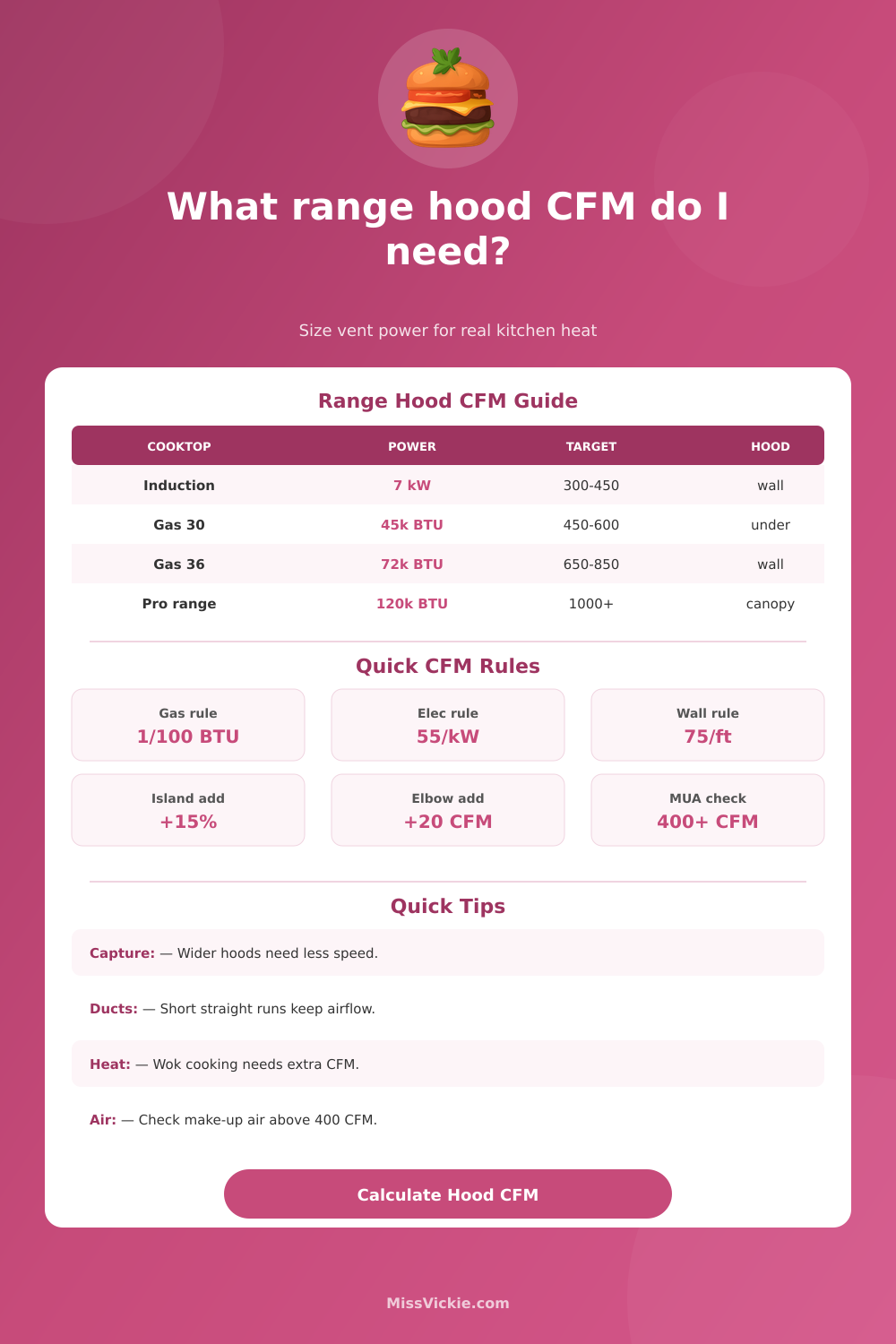
| 30 in induction | 50 to 60 CFM per kW | 250 to 450 CFM | Steam and everyday cooking |
| 30 in electric coil or radiant | 55 to 70 CFM per kW | 300 to 500 CFM | Moderate heat and frying |
| 30 to 36 in gas range | BTU per hour divided by 100 | 450 to 800 CFM | Standard family cooking |
| 42 to 48 in dual-fuel range | BTU rule plus width floor | 700 to 1100 CFM | Large burners and ovens below |
| Wok burner or high-output range | BTU divided by 85 to 90 | 900 to 1500 CFM | Fast searing and stir-fry smoke |
Hood type adjustment
| Hood type | CFM factor | Capture note | Width target |
|---|---|---|---|
| Under-cabinet | 1.05x | Shallow capture area | Equal to cooktop |
| Wall-mount chimney | 1.00x | Good rear wall support | 3 to 6 in wider |
| Custom insert | 0.98x | Depends on canopy depth | 3 to 6 in wider |
| Island hood | 1.18x | Open on all sides | 6 to 12 in wider |
| Pro-style canopy | 0.95x | Deep baffle capture | 6 in wider |
| Downdraft vent | 1.35x | Pulls across plume | Match burner zone |
Duct and elbow penalty guide
| Duct condition | Equivalent load | CFM add | Planning note |
|---|---|---|---|
| 0 to 10 ft straight | Low friction | 0 to 20 CFM | Best airflow case |
| 11 to 25 ft straight | Moderate friction | 20 to 80 CFM | Common wall exit |
| 26 to 45 ft straight | High friction | 80 to 160 CFM | Attic or roof route |
| Each 90-degree elbow | About 5 ft duct | 20 to 30 CFM | Use sweeping elbows |
| 5 to 6 in duct | Small cross-section | 25 to 100 CFM | Noisy at high flow |
| 8 to 10 in duct | Lower restriction | 0 to 20 CFM | Better for 700+ CFM |
Kitchen volume and make-up air checks
| Room volume | Light cooking | Heavy cooking | Check |
|---|---|---|---|
| 600 to 900 ft3 | 120 to 180 CFM | 240 to 360 CFM | Small kitchen |
| 900 to 1400 ft3 | 180 to 280 CFM | 360 to 560 CFM | Typical kitchen |
| 1400 to 2200 ft3 | 280 to 440 CFM | 560 to 880 CFM | Open zone |
| 2200+ ft3 | 440+ CFM | 880+ CFM | Large open plan |
| 400+ CFM hood | Code varies | MUA often reviewed | Ask local inspector |
| 900+ CFM hood | Strong exhaust | MUA strongly likely | Balance the house |
🧮Quick CFM markers
A range hood move air to remove grease, steam, and smoke from a kitchen. If a range hood move the correct amount of air, grease wont land on the kitchen cabinets. Furthermore, if a range hood moves the correct amount of air, steam will not land on the kitchen windows.
If a range hood does not move enough air, the kitchen will have lingering odor. However, if a range hood moves too much air, the range hood will create a negative pressure that can extract air from gaps in doors and windows or even from the chimney in the house. To select a correct range hood for the kitchen, you must understand the unit’s CFM.
How to Choose the Right Range Hood CFM
CFM stand for cubic feet per minute and represents the volume of air that a range hood fan can move through the kitchen range hood in sixty second. The CFM that a range hood requires depend on several factor. These factors include the heat that the cooktop produce, the shape of the range hood, and the length and the shape of the duct that connect the range hood to the exhaust vent.
The CFM for a range hood must be matched with the heat and the moisture output of the cooktop. The heat and moisture that the cooktop produce will dictate the amount of CFM that the range hood will need. The cooktop’s wattage will provide the baseline for determining the required CFM.
Gas stove use BTU ratings to indicate how many BTU each burner can produce per hour. Range hood CFM calculation use watts or kilowatts to represent the power of electric or induction stoves. Range hood sizing calculator will calculate the heat output of the cooktop and divide it by the factor that represents the cooking style.
For example, cooking with a wok or a range oven will produce a tall plume of smoke and steam that require more CFM than gentle simmer. Another factor that impact the required CFM is the range hood’s width and the mounting height of the range hood. The range hood must be wider than the cooktop to allow for the plume of hot air to rise straight up.
Raising the mounting height of the range hood will require the range hood to work harder to catch the plume of hot air. Range hood sizing calculator take into account both the width of the range hood and its mounting height to calculate the capture score of the range hood. The capture score indicate the margin that the range hood has to capture the plume of hot air.
Factors that impact the length and the shape of the duct connected to the range hood will also impact the range hood’s CFM requirements. Each 90-degree turn that the duct makes will create friction that will impact the performance of the range hood. The duct must have sufficient diameter to allow the air to move through at an appropriate velocity.
Range hood sizing calculator take into account the length of the duct and the diameter of the duct opening. The total volume of the kitchen and the way that the kitchen is laid out will also impact the CFM of the range hood. An open plan kitchen with high ceiling will allow the steam from the cooking range to drift away from the kitchen range hood.
Therefore, the range hood in an open plan kitchen will have to have a higher CFM rating to provide ventilation for the kitchen. If the range hood’s CFM rating is higher than 400 CFM, make-up air rule must be considered when installing the range hood. A range hood that has a high CFM will pull air from appliance with combustion chambers, such as water heater or furnaces, if the house is built to be very tight with few gaps in the ventilation.
In such cases, building code will require installation of either a dedicated intake for fresh air into the house or installation of an interlocked range hood fan that will operate in tandem with the range hood’s fan. The make-up air rule will vary depending on the situation in the house; therefore, it is recommended to ask the local inspector for there requirement on make-up air. Many people create the mistake of choosing a range hood that is sized only to the width of the cooktop or only to the BTU of the cooktop burner.
A correct range hood will be sized using a sizing calculator to account for each of the factor mentioned in this paragraph. Another side effect of range hoods that operate at full capacity is noise. If the consumer follows the range hood’s CFM recommendation without changing the size of the duct connected to the range hood, the range hood will create a roar that can interfere with conversation in the kitchen.
Range hood sizing calculator will include an estimation of the velocity of the air through the duct. This will allow the consumer to determine whether the range hood will be quiet while operating at full capacity or if the diameter of the duct should be increased. Range hood filter must also be maintained to allow the range hood to operate at its required capacity.
If the filter are too clogged with grease, the range hood will fail to function correctly. Range hood sizing calculator include a reserve factor to account for the decline in performance of a range hood with dirty filter and duct that are filled with grease buildup. If the CFM of the range hood is matched with the plume of hot air that rise from the cooktop and takes into consideration the path of the duct to the exhaust vent, the range hood will clear the kitchen quick and remain relatively quiet.
You should of used a sizing tool to avoid teh noise. It is actualy important to realize that cooktops is the main source of steam. Dont forget that the duct diameter matter too.
Most people think the range hood is more simple than it is. It’s just a matter of matching the CFM to the needs of the room. Youll find that the right size makes a big differance.