🐇 MissVickie rabbit calculator
Rabbit Cooking Time Calculator
Estimate cooking time for whole rabbit, saddles, legs, mixed pieces, and stew cuts using weight, thickness, bone-in adjustment, method, liquid depth, starting temperature, tenderness target, rest time, and yield shrink.
📍Rabbit cooking presets
Start with a common rabbit dish, then tune the cut, weight, thickness, braising liquid, oven heat, target tenderness, and serving yield for your pan.
⚖Calculator inputs
Rabbit is lean, so method and liquid matter as much as weight. Use a thermometer for safety and use tenderness checks for braises and stews.
Rabbit cooking estimate
Timing breakdown
Use an instant-read thermometer in the thickest meat, away from bone.
🌡Safe temperature and tenderness table
| Rabbit check | Pull or finish | Best method | What to look for |
|---|---|---|---|
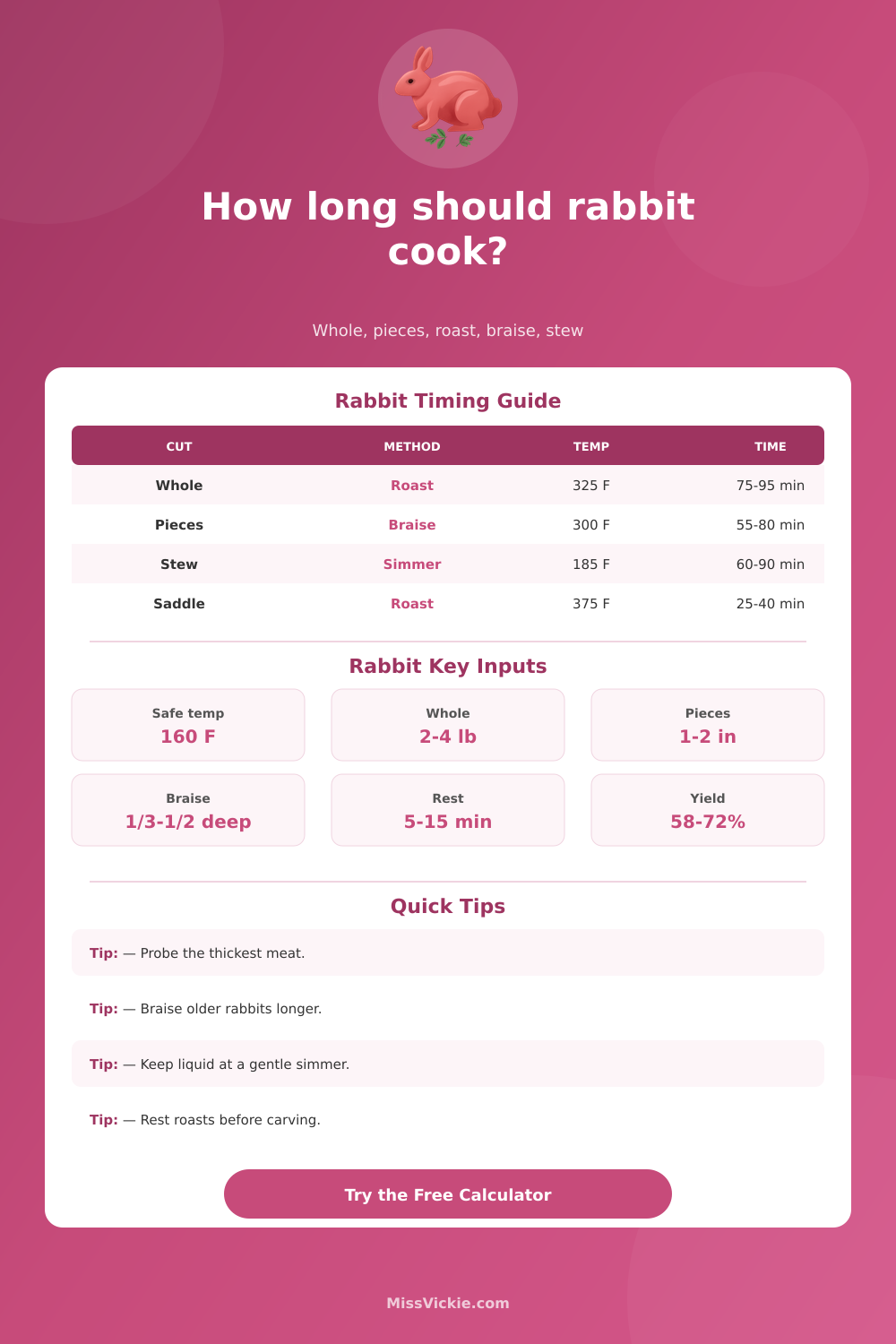
| USDA-style safety minimum | 160 F / 71 C | All rabbit cuts | Thermometer reaches the thickest meat away from bone. |
| Sliceable roast rabbit | 160 to 165 F / 71 to 74 C | Whole roast, saddle, young fryer | Juicy but firm; rest before carving to protect lean meat. |
| Fork-tender braise | 170 to 180 F / 77 to 82 C | Legs, quartered rabbit, mixed pieces | Knife slides in easily; meat loosens but still holds shape. |
| Stew-soft rabbit | 180 to 190 F / 82 to 88 C | Stew, older rabbit, wild rabbit | Meat pulls from bone and sauce rests without a hard boil. |
⏱Rabbit method timing table
| Form | Braise or stew | Roast range | Yield note |
|---|---|---|---|
| Whole 2 to 3 lb rabbit | 70 to 95 min covered | 70 to 90 min at 325 F | About 58% to 65% edible cooked meat. |
| Quartered bone-in pieces | 55 to 80 min covered | 45 to 65 min at 350 F | Best balance of tenderness and yield for family meals. |
| Hind legs or older rabbit | 75 to 115 min covered | Not ideal without added fat | Collagen needs time, liquid, and a gentle simmer. |
| Saddle, loin, or medallions | 20 to 35 min gentle sauce | 20 to 40 min depending on thickness | High yield but dries quickly past the safe target. |
| Stew pieces, 1 to 1.5 in | 60 to 90 min simmer | Not recommended dry | Cook until tender, then rest in sauce 10 minutes. |
🍲Serving yield guide
Usually serves 2 to 3 after bones and shrink.
Usually serves 3 to 4 with sauce or sides.
Usually serves 4 to 6 when braised or stewed.
A hearty plated serving of edible cooked rabbit.
💡Rabbit cooking tips
Keep the heat gentle. Rabbit is lean, so a covered braise or steady simmer usually gives better tenderness than an aggressive boil.
Check both numbers and feel. For safety, reach at least 160 F; for braised legs and older rabbits, keep cooking until the meat yields to a fork.
Rabbit is a white, lean meat. It’s not like chicken, so you’re hesitant to try it out. It requires some attention to levels of doneness, get it wrong and you’ve got yourself a dry, tough meal.
The calculator does the math for you. Just input the weight and cut. You’ll get a realistic timeframe based off your desired tenderness, along with thickness and depth for your cooking vessel. No more guesswork about conversions.
How to Cook Rabbit Perfectly
It’s also important to know how the rabbit is built and why it’s picky. It doesn’t conduct heat well. The same shape that look good on a plate (or in your belly) defies even heat. A beef roast has uniform density but a whole rabbit, or even just one bone-in leg, has bones that insulates the meat, creating different temperatures and rates of change throughout the cut.
The outside of a large hind quarter warms up more quickly than its cold, insulating core; that’s true until both are safe to eat. That’s why we adjust based on bone-in status, and why knowing initial temp matters. If the rabbit is straight-from-the-fridge cold, it’ll start out somewhere around forty degrees, making the oven do extra work as it slowly comes around. Twenty minutes on counter brings meat closer to room temp, lessening thermal shock and saving a minute or two of oven time. Small savings add up, especially when you’re aiming for precision.
That’s where choice of cooking method comes in. Do you want tender or do you fear dry? High heat and a fast roast brown the skin. However, it exposes the lean meat to temperatures over one hundred sixty degrees Fahrenheit, which dries it out fast. Braising uses slow, gentle, moist heat to cook tough cuts or older animals like rabbit; the collagen conducts heat through the liquid. Your selection guides the timing.
To increase the cooking time, you chose to braise with plenty of liquid; liquid simmers slower then dry hot air in the oven. This trade-off offers more texture at the expense of speed. By slow-cooking (covered) you break down connective tissue without squeezing moisture from muscle fibers. Cooking variables such as type of cover and liquid depth is also ignored by many cooks.
If using a tight lid, the food will be steamed rather than browned (although this can help tenderize meat). Perhaps begin with a sear to create some flavor on the outside, followed by a covered cooking period until it is done. The tool takes into account what level of deep vs light searing you anticipate and includes those minutes in the overall active cooking time.
Prep time includes browning time… An easy thing to forget about once timer begins ticking away. Once the clock starts, every minute is precious. Braises and especially roasts requires a resting period, which is never negotiable. When rabbit is cooked, its muscle contracts, forcing juice inward. Slicing open meat at once will expel that liquid onto the cutting board rather than within your mouth. By letting the rabbit rest for anywhere from five to fifteen minutes, the fibers loosens up and reabsorb that liquid. For whole-roast servings, build ten minutes of wait time into total plan (the calculator accounts for it) to ensure your side dishes are ready. This isn’t wasted time, it’s flavor insurance.
Use yield calculations to manage expectations at the table: how much rabbit will cook down? Bones won’t contribute to edible portion of the dish, so they’ll still occupy space. If I start with a three-pound dressed rabbit, I’ll get maybe just a little over half that back in terms of usable, cooked, and boned meat. Depending on what cut you make, yield calculator guesses how many pounds that’ll be. It pads it out to account for some lost sauce, too. This way you know how much rabbit to purchase to ensure there’s enough food to satisfy your guests. No one wants to go home hungry after eating tiny portions.
One hundred sixty degrees is safe internal temperature. However, reaching higher temperatures, up to a hundred eighty degrees for an older animal destined for braise or stew, may result in greater tenderness as connective tissue dissolves completely. This table (found on the page) makes it easy to see which temperature corresponds to what texture: the intersection of safety and palatability. Go by thermometer for the lower limit; go by the tines of your fork for the upper one. Meat won’t yield to your spoon until it’s ready.
Time is on rabbit’s side: with enough time, this lean meat develops deeper flavors than many larger varieties can ever hope to have. You should of learned these factors, and you’ll be past dreading the dish’s leanness, you’ll embrace its adaptability.