Queso Per Person Calculator
Scale warm queso for chips, nachos, tacos, drizzle trays, and party warmers using guest count, serving size, cheese type, dairy ratio, add-ins, hold time, heat level, and reserve buffer.
Choose a real serving setup, then adjust guests, queso role, cheese style, dairy ratio, add-ins, warmer hold, chip use, heat, and backup reserve.
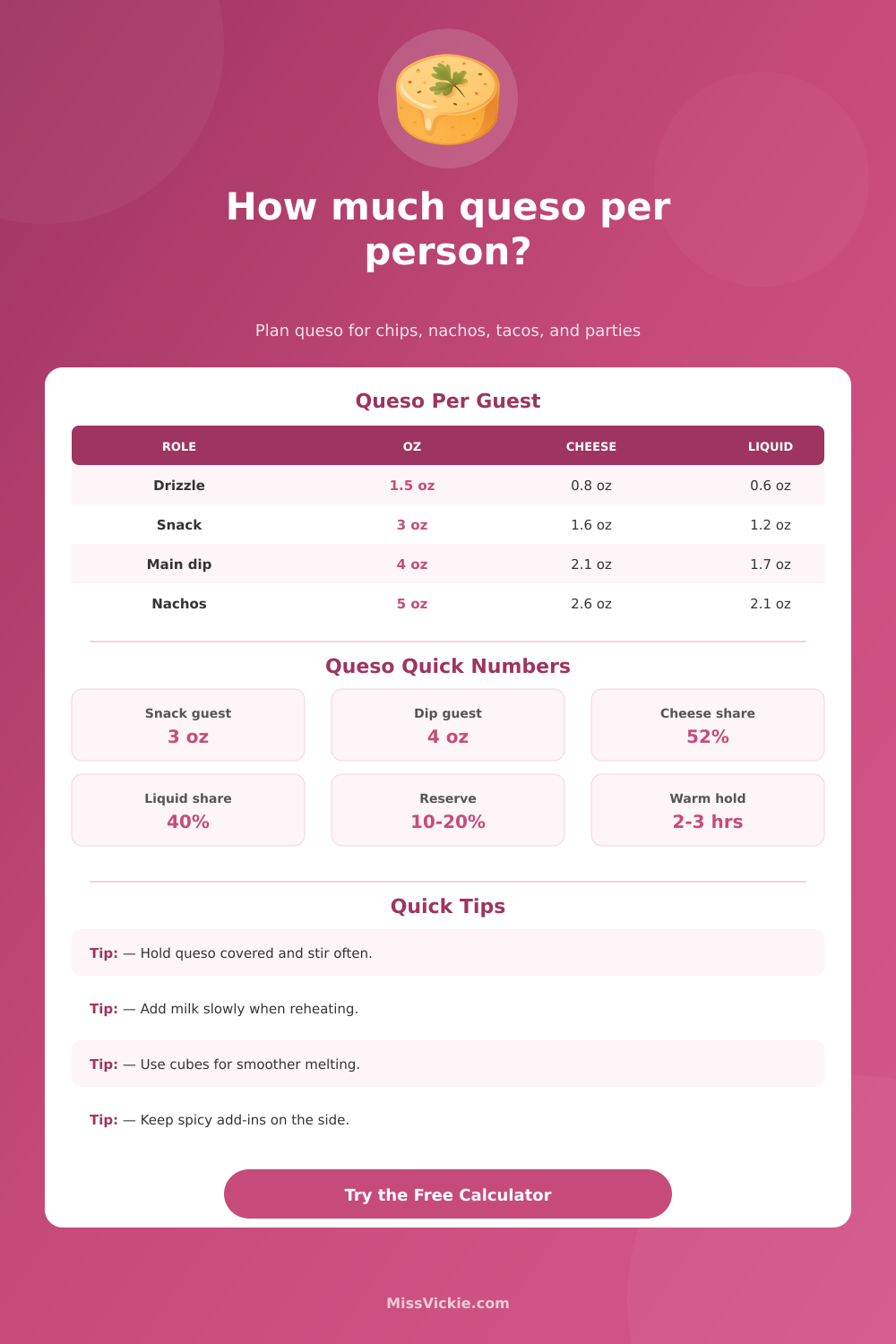
| Queso role | Serving per guest | Best use | Buffer note |
|---|---|---|---|
| Light drizzle | 1 to 2 oz | Tacos, burrito bowls, sliders | Use 5% to 10% extra |
| Side dip | 2 to 3 oz | Snack table with salsa and guacamole | Use 10% extra |
| Chip centerpiece | 3 to 4 oz | Main warm dip for chips | Use 15% extra |
| Nacho bar | 4 to 5 oz | Sheet pans or self-serve ladles | Use 15% to 20% extra |
| Loaded station | 5 to 6 oz | Queso bowls with meat or beans | Use 20% extra |
| Cheese style | Cheese share | Liquid share | Melting note |
|---|---|---|---|
| Processed loaf style | 50% to 54% | 38% to 42% | Smoothest for long warmers |
| American and cheddar | 52% to 56% | 36% to 40% | Reliable melt with stronger flavor |
| Cheddar Jack blend | 55% to 60% | 34% to 38% | Stir gently and avoid high heat |
| Oaxaca and Asadero | 54% to 58% | 35% to 39% | Stretchier, best served fresh |
| Plant-based shreds | 48% to 54% | 42% to 48% | Needs extra liquid and whisking |
| Guests | Side dip | Chip dip | Nacho bar |
|---|---|---|---|
| 6 guests | 1.1 lb | 1.5 lb | 2.0 lb |
| 12 guests | 2.1 lb | 3.0 lb | 3.9 lb |
| 25 guests | 4.4 lb | 6.3 lb | 8.2 lb |
| 50 guests | 8.8 lb | 12.5 lb | 16.4 lb |
| 100 guests | 17.6 lb | 25.0 lb | 32.8 lb |
| Hold plan | Texture risk | Reserve liquid | Best practice |
|---|---|---|---|
| Fresh service | Low | 2% extra | Serve soon after melting |
| 1 to 2 hours | Low to medium | 5% extra | Keep covered between scoops |
| 3 to 4 hours | Medium | 8% extra | Stir every 15 minutes |
| 5 to 6 hours | High | 12% extra | Refresh with hot milk |
| Over 6 hours | Very high | 15% extra | Rotate smaller warm batches |
Best for tacos, bowls, hot dogs, sliders, and controlled catered portions.
Works when queso shares the table with salsa, beans, wings, or other dips.
Good default for casual parties where guests return for several scoops.
Use for sheet pans, build-your-own plates, and heavier game day servings.
That’s the worst part. When that happens, the queso has dipped beneath its own surface, leaving only a bare expanse of cheese, sticking to bottom of bowl. That kills the party.
Making queso isn’t as simple as opening a block of cheese and throwing it in the pot. It’s a mix of heat control, ratio calculations, and variable appetites. Avoiding this catastrophe mean knowing the math before lighting the stove. This is where our calculator comes in. It calculates the correct amount of liquid and cheese based off your guests (and how they want it served). From start to last drop, your dip will flow smoothly.
How to Make Perfect Queso
But here’s where things get tricky: What are you using the queso as? Is it a light drizzle for tacos, or is it star attraction on a nacho bar? That volume gap is huge. For one thing, you’re likely looking at an ounce-and-a-half-per-person scenario if you use queso as a taco topping, but three-to-five-ounce servings is more common when queso acts as its own starring dish with chips as a supporting player.
Get that basic serving size wrong… As in, assuming a hearty dip is actualy meant as a mild complement rather than its own centerpiece, and you’ll be scraping up leftovers off the floor at halftime.
Now that you’ve estimated how much cheese you’re working with, it’s time to consider what kind of cheese you have. Different cheeses melts differently. Forgiving workhorses include American blends and processed loaves that remains melted for hours without turning grainy or breaking apart. These has emulsifiers that stabilize them and a higher moisture content.
Temperamental cheddars such as cheddar jack are delicious but tricky. If left too long on the heat, they will go oily and separate, not good. The tool accounts for these differences in how they melt. By adjusting the ratio of different kinds of dairies, you’ll be able to create proper consistency in the end no matter which block you purchased from the store shelf.
Home cooks tend to falter at this point: liquid. While a creamy, flavorful sauce require sufficient cream or evaporated milk, using too much results in soupy, runny queso that slips down side of every chip. Evaporated milk is golden because it has less water and therefore blends well with fats in cheese.
As the queso sits out (for longer than an hour or so), the moisture content will gradually be soaked up by chips, or evaporate altogether. That’s why having some kind of reserve makes sense. The additional dip isn’t for show, it’s for backup, should things take a turn for the texture-challenged. Having a small amount of hot milk ready in reserve allows you to thicken up the queso without jolting the temperature.
Then there’s the issue of complexity: Add-ins. Flavorful things like roasted peppers, beans, and salsa pack extra moisture that make for an uncertain outcome. Cooked meats will soak up some of that fat. At the other extreme, fresh pico de gallo can dilute your dip by party’s end. Are you making a loaded station featuring beans and/or chorizo? You’ll want even more of that base queso just to cover it all so it doesn’t get watered down. These bulk ingredients is accounted for on the calculator. They will take up some of the volume of your final yield.
The silent variable that ruins your great plan is the heat. The best milk:cheese ratio won’t matter if you leave your dip on high heat…you’ll break it down. You should of used only low and slow heat. Stir often, especially if you are keeping this out at a buffet. When the queso separates or becomes shiny, it’s too hot. Turn it down now. Also, keep warmer covered when not in service. This retains moisture and prevents surface from skinning over.
At the end of the day, queso is all about finding the sweet spot between restraint and excess. How much do I need to make so my friends are full but not left with five pounds of congealed cheese in their fridge for the following week? It’s all about knowing what cheese mix you’re working with and figuring out how long it’ll be in the warm zone, so you can set realistic portion sizes and remove some of the uncertainty from behind the stove.
The end result: A perfect, golden bowl that doesn’t budge all evening. A true moment as a host that people will remember.