🦚 Quail Per Person Calculator
Estimate quail counts for snack boards, plated dinners, and buffet service
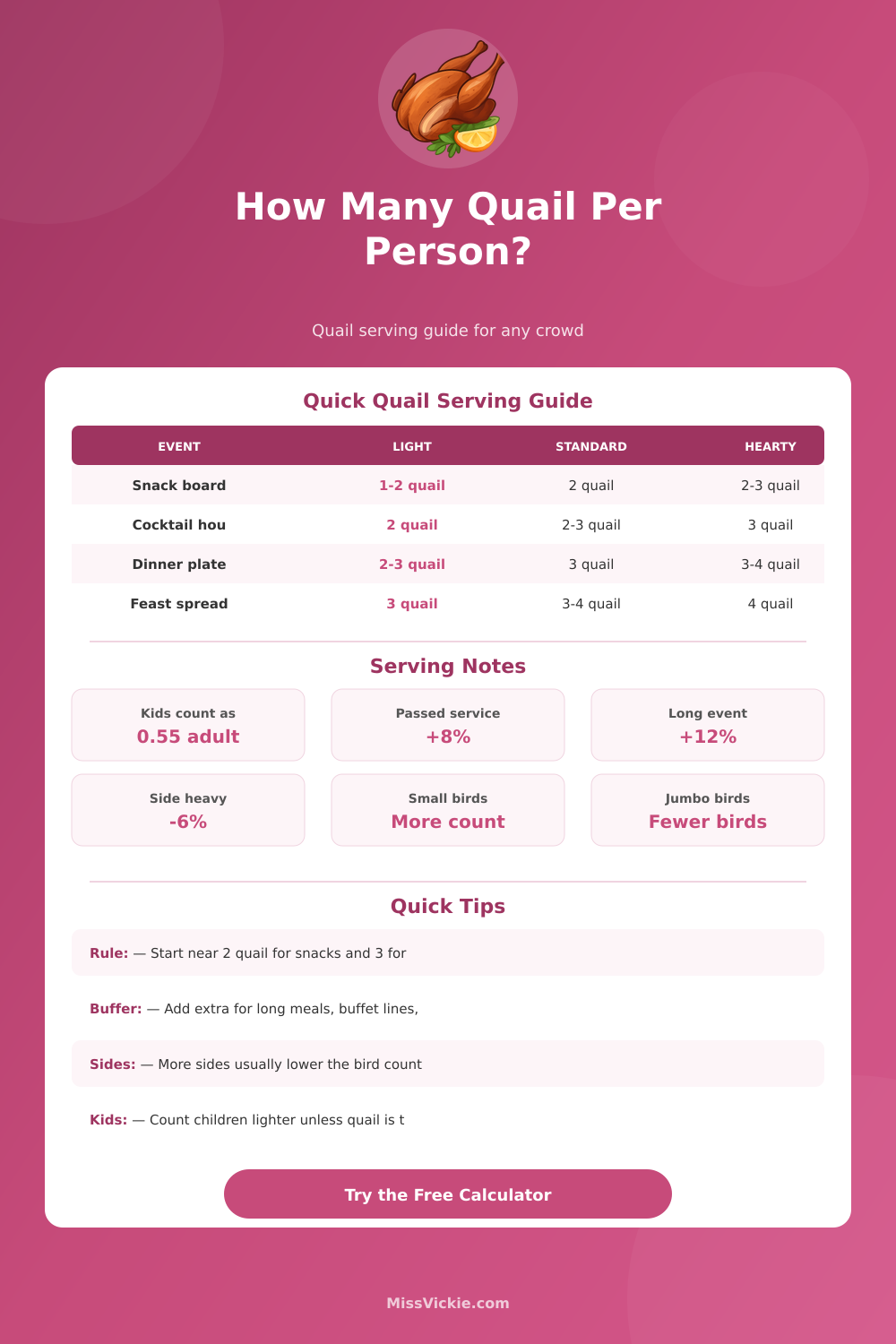
| Meal Style | Light Appetite | Standard Appetite | Hearty Appetite |
|---|---|---|---|
| Snack Board | 1-2 quail | 2 quail | 2-3 quail |
| Cocktail Hour | 2 quail | 2-3 quail | 3 quail |
| Dinner Plate | 2-3 quail | 3 quail | 3-4 quail |
| Feast Spread | 3 quail | 3-4 quail | 4 quail |
| Quail Size | Yield Factor | Edible Oz | Best Use |
|---|---|---|---|
| Petite | 1.08x | 2.8 oz | Tasting plates |
| Standard | 1.00x | 3.4 oz | Most menus |
| Large | 0.92x | 4.0 oz | Heavier plates |
| Jumbo | 0.84x | 4.6 oz | Fewer birds |
| Service Style | Factor | Timing | Planning Note |
|---|---|---|---|
| Plated | 0.98x | Steady | Portions stay controlled |
| Buffet | 1.00x | Moderate | Most common setup |
| Passed | 1.08x | Fast | Guests take more |
| Family Style | 1.05x | Shared | Round up a little |
| Side Count | Factor | Birds / Guest | Fit |
|---|---|---|---|
| 1 Side | 1.08x | +0.2 | Light meal |
| 2 Sides | 1.00x | Base | Balanced plate |
| 3 Sides | 0.94x | -0.1 | Fuller spread |
| 4-5 Sides | 0.88x | -0.2 | Side-heavy menu |
When planning a meal that includes quail, it is essential to determine the correct number of quail that must be prepared and served to each person attending the meal. Determining the amount of quail that you must purchase is an important part of meal planning; if you provide too little quail to the guests, they will be hungry after the meal. Conversely, if you provide too much quail, you will have many leftover that may not reheat well.
The number of quail that you need to purchase depends upon several different factors, including the size of the quail, the type of meal that you are serving, and the number of guests that will be attending your event. The size of the quail that you purchase will have a primary effect upon the number of quails that you must buy to satisfy each guest. Small quails will contain less meat than large or jumbo sized quails after you remove the bones from the birds and excess pieces of meat is trimmed.
How Many Quails Per Person
Thus, you will have to buy more small quails to provide each guest with the amount of protein that they will require. The opposite is true of large or jumbo sized quails; because they contain more protein, you can provide fewer of these quails to each guest to satisfy there protein needs. The type of meal that you are creating will also dictate the amount of quail that must be purchased.
If you are having a snack event with quail as one of the main components of the meal, you can provide one or two quails per guest. Snack events tend to contain fewer pieces of food than dinner events. However, if you are having a dinner event, you can provide two to three quails per guest.
Dinner events typically contain quail as the main protein for the meal. Additionally, if you are having a buffet you may need to provide more quails than if you were having a plated meal. With a buffet, the guests will likely eat more of the quails that are offered.
With a plated meal, the cooks can better control the amount of quails that are provided to each guest. The number of guests that are attending your event and the age of those guests also will have an effect upon the amount of quail that you need to purchase. One suggestion is to separate your guests into two separate groups: adults and children.
Children will typically eat less protein than adults will eat. Thus, you can estimate that a child will eat approximately half the amount of quails that an adult will require to satisfy their protein needs. Additionally, you may need to provide more quails if you know that some of your guests will have hearty appetites, as compared to others with light appetites.
The number of side dishes that is provided at the event will also have an effect upon the amount of quail that you need to purchase for each guest. If you only serve one side dish to each guest, you will need to provide more quail to each guest, since the quail will be the primary component of the meal for each guest. However, if you serve many side dishes to each guest, such as starches and salads, you will need to purchase fewer quail for each guest.
Thus, the amount of quail that you serve is directly related to the amount of side dishes that you serve to each guest. Finally, you should also provide for waste when you purchase your quails. Some guests may not show up to the event, and some may eat more than others.
Thus, it is a good idea to provide an extra amount of quail to account for these situations. Most recipes suggest that you provide a buffer of approximately 10 percent of the amount of quails that you calculate for each guest for waste. To determine the total amount of quail that will be needed for the event, start with a baseline amount of quail per person.
If the quails that will be provided to the guests are small in size or if the guests have hearty appetites, you should add to the number of quails that are calculated for each guest. If the quails are large or jumbo sized or if you are providing many side dishes to each guest, you should subtract from the calculated number of quails for each guest. Finally, 10 percent of the total number of quails that were calculated for all of the guests will be used as a waste buffer.
When planning a meal that includes quail, it is essential to determine the correct number of quail that must be prepared and served to each person attending the meal. Determining the amount of quail that you must purchase is an important part of meal planning; if you provide too little quail to the guests, they will be hungry after the meal. Conversely, if you provide too much quail, you will have alot of leftover that may not reheat well.
The number of quail that you need to purchase depends upon several different factors, including the size of the quail, the type of meal that you are serving, and the number of guests that will be attending your event. The size of the quail that you purchase will have a primary effect upon the number of quails that you must buy to satisfy each guest. Small quails will contain less meat than large or jumbo sized quails after you remove the bones from the birds and excess pieces of meat is trimmed.
Thus, you will have to buy more small quails to provide each guest with the amount of protein that they will require. The opposite is true of large or jumbo sized quails; because they contain more protein, you can provide fewer of these quails to each guest to satisfy their protein needs. The type of meal that you are creating will also dictate the amount of quail that must be purchased.
If you are having a snack event with quail as one of the main components of the meal, you can provide one or two quails per guest. Snack events tend to contain fewer pieces of food than dinner events. However, if you are having a dinner event, you can provide two to three quails per guest.
Dinner events typically contain quail as the main protein for the meal. Additionally, if you are having a buffet you may need to provide more quails than if you were having a plated meal. With a buffet, the guests will likely eat more of the quails that are offered.
With a plated meal, the cooks can better control the amount of quails that is provided to each guest. The number of guests that are attending your event and the age of those guests also will have an effect upon the amount of quail that you need to purchase. One suggestion is to separate your guests into two separate groups: adults and children.
Children will typically eat less protein than adults will eat. Thus, you can estimate that a child will eat approximately half the amount of quails that an adult will require to satisfy their protein needs. Additionally, you may need to provide more quails if you know that some of your guests will have hearty appetites, as compared to others with light appetites.
The number of side dishes that is provided at the event will also have an effect upon the amount of quail that you need to purchase for each guest. If you only serve one side dish to each guest, you will need to provide more quail to each guest, since the quail will be the primary component of the meal for each guest. However, if you serve many side dishes to each guest, such as starches and salads, you will need to purchase fewer quail for each guest.
Thus, the amount of quail that you serve is directly related to the amount of side dishes that you serve to each guest. Finally, you should also provide for waste when you purchase your quails. Some guests may not show up to the event, and some may eat more than others.
Thus, it is a good idea to provide an extra amount of quail to account for these situations. Most recipes suggest that you provide a buffer of approximately 10 percent of the amount of quails that you calculate for each guest for waste. To determine the total amount of quail that will be needed for the event, start with a baseline amount of quail per person.
If the quails that will be provided to the guests are small in size or if the guests have hearty appetites, you should add to the number of quails that are calculated for each guest. If the quails are large or jumbo sized or if you are providing many side dishes to each guest, you should subtract from the calculated number of quails for each guest. Finally, 10 percent of the total number of quails that were calculated for all of the guests will be used as a waste buffer.
When planning a meal that includes quail, it is essential to determine the correct number of quail that must be prepared and served to each person attending the meal. Determining the amount of quail that you must purchase is an important part of meal planning; if you provide too little quail to the guests, they will be hungry after the meal. Conversely, if you provide too much quail, you will have alot of leftover that may not reheat well.
The number of quail that you need to purchase depends upon several different factors, including the size of the quail, the type of meal that you are serving, and the number of guests that will be attending your event. The size of the quail that you purchase will have a primary effect upon the number of quails that you must buy to satisfy each guest. Small quails will contain less meat than large or jumbo sized quails after you remove the bones from the birds and excess pieces of meat is trimmed.
Thus, you will have to buy more small quails to provide each guest with the amount of protein that they will require. The opposite is true of large or jumbo sized quails; because they contain more protein, you can provide fewer of these quails to each guest to satisfy their protein needs. The type of meal that you are creating will also dictate the amount of quail that must be purchased.
If you are having a snack event with quail as one of the main components of the meal, you can provide one or two quails per guest. Snack events tend to contain fewer pieces of food than dinner events. However, if you are having a dinner event, you can provide two to three quails per guest.
Dinner events typically contain quail as the main protein for the meal. Additionally, if you are having a buffet you may need to provide more quails than if you were having a plated meal. With a buffet, the guests will likely eat more of the quails that are offered.
With a plated meal, the cooks can better control the amount of quails that are provided to each guest. The number of guests that are attending your event and the age of those guests also will have an effect upon the amount of quail that you need to purchase. One suggestion is to separate your guests into two separate groups: adults and children.
Children will typically eat less protein than adults will eat. Thus, you can estimate that a child will eat approximately half the amount of quails that an adult will require to satisfy their protein needs. Additionally, you may need to provide more quails if you know that some of your guests will have hearty appetites, as compared to others with light appetites.
The number of side dishes that is provided at the event will also have an effect upon the amount of quail that you need to purchase for each guest. If you only serve one side dish to each guest, you will need to provide more quail to each guest, since the quail will be the primary component of the meal for each guest. However, if you serve many side dishes to each guest, such as starches and salads, you will need to purchase fewer quail for each guest.
Thus, the amount of quail that you serve is directly related to the amount of side dishes that you serve to each guest. Finally, you should also provide for waste when you purchase your quails. Some guests may not show up to the event, and some may eat more than others.
Thus, it is a good idea to provide an extra amount of quail to account for these situations. Most recipes suggest that you provide a buffer of approximately 10 percent of the amount of quails that you calculate for each guest for waste. To determine the total amount of quail that will be needed for the event, start with a baseline amount of quail per person.
If the quails that will be provided to the guests are small in size or if the guests have hearty appetites, you should add to the number of quails that are calculated for each guest. If the quails are large or jumbo sized or if you are providing many side dishes to each guest, you should subtract from the calculated number of quails for each guest. Finally, 10 percent of the total number of quails that were calculated for all of the guests will be used as a waste buffer.
When planning a meal that includes quail, it is essential to determine the correct number of quail that must be prepared and served to each person attending the meal. Determining the amount of quail that you must purchase is an important part of meal planning; if you provide too little quail to the guests, they will be hungry after the meal. Conversely, if you provide too much quail, you will have alot of leftover that may not reheat well.
The number of quail that you need to purchase depends upon several different factors, including the size of the quail, the type of meal that you are serving, and the number of guests that will be attending your event. The size of the quail that you purchase will have a primary effect upon the number of quails that you must buy to satisfy each guest. Small quails will contain less meat than large or jumbo sized quails after you remove the bones from the birds and excess pieces of meat is trimmed.
Thus, you will have to buy more small quails to provide each guest with the amount of protein that they will require. The opposite is true of large or jumbo sized quails; because they contain more protein, you can provide fewer of these quails to each guest to satisfy their protein needs. The type of meal that you are creating will also dictate the amount of quail that must be purchased.
If you are having a snack event with quail as one of the main components of the meal, you can provide one or two quails per guest. Snack events tend to contain fewer pieces of food than dinner events. However, if you are having a dinner event, you can provide two to three quails per guest.
Dinner events typically contain quail as the main protein for the meal. Additionally, if you are having a buffet you may need to provide more quails than if you were having a plated meal. With a buffet, the guests will likely eat more of the quails that are offered.
With a plated meal, the cooks can better control the amount of quails that is provided to each guest. The number of guests that are attending your event and the age of those guests also will have an effect upon the amount of quail that you need to purchase. One suggestion is to separate your guests into two separate groups: adults and children.
Children will typically eat less protein than adults will eat. Thus, you can estimate that a child will eat approximately half the amount of quails that an adult will require to satisfy their protein needs. Additionally, you may need to provide more quails if you know that some of your guests will have hearty appetites, as compared to others with light appetites.
The number of side dishes that is provided at the event will also have an effect upon the amount of quail that you need to purchase for each guest. If you only serve one side dish to each guest, you will need to provide more quail to each guest, since the quail will be the primary component of the meal for each guest. However, if you serve many side dishes to each guest, such as starches and salads, you will need to purchase fewer quail for each guest.
Thus, the amount of quail that you serve is directly related to the amount of side dishes that you serve to each guest. Finally, you should also provide for waste when you purchase your quails. Some guests may not show up to the event, and some may eat more than others.
Thus, it is a good idea to provide an extra amount of quail to account for these situations. Most recipes suggest that you provide a buffer of approximately 10 percent of the amount of quails that you calculate for each guest for waste. To determine the total amount of quail that will be needed for the event, start with a baseline amount of quail per person.
If the quails that will be provided to the guests are small in size or if the guests have hearty appetites, you should add to the number of quails that are calculated for each guest. If the quails are large or jumbo sized or if you are providing many side dishes to each guest, you should subtract from the calculated number of quails for each guest. Finally, 10 percent of the total number of quails that were calculated for all of the guests will be used as a waste buffer.
When planning a meal that includes quail, it is essential to determine the correct number of quail that must be prepared and served to each person attending the meal. Determining the amount of quail that you must purchase is an important part of meal planning; if you provide too little quail to the guests, they will be hungry after the meal. Conversely, if you provide too much quail, you will have alot of leftover that may not reheat well.
The number of quail that you need to purchase depends upon several different factors, including the size of the quail, the type of meal that you are serving, and the number of guests that will be attending your event. The size of the quail that you purchase will have a primary effect upon the number of quails that you must buy to satisfy each guest. Small quails will contain less meat than large or jumbo sized quails after you remove the bones from the birds and excess pieces of meat is trimmed.
Thus, you will have to buy more small quails to provide each guest with the amount of protein that they will require. The opposite is true of large or jumbo sized quails; because they contain more protein, you can provide fewer of these quails to each guest to satisfy their protein needs. The type of meal that you are creating will also dictate the amount of quail that must be purchased.
If you are having a snack event with quail as one of the main components of the meal, you can provide one or two quails per guest. Snack events tend to contain fewer pieces of food than dinner events. However, if you are having a dinner event, you can provide two to three quails per guest.
Dinner events typically contain quail as the main protein for the meal. Additionally, if you are having a buffet you may need to provide more quails than if you were having a plated meal. With a buffet, the guests will likely eat more of the quails that are offered.
With a plated meal, the cooks can better control the amount of quails that is provided to each guest. The number of guests that are attending your event and the age of those guests also will have an effect upon the amount of quail that you need to purchase. One suggestion is to separate your guests into two separate groups: adults and children.
Children will typically eat less protein than adults will eat. Thus, you can estimate that a child will eat approximately half the amount of quails that an adult will require to satisfy their protein needs. Additionally, you may need to provide more quails if you know that some of your guests will have hearty appetites, as compared to others with light appetites.
The number of side dishes that is provided at the event will also have an effect upon the amount of quail that you need to purchase for each guest. If you only serve one side dish to each guest, you will need to provide more quail to each guest, since the quail will be the primary component of the meal for each guest. However, if you serve many side dishes to each guest, such as starches and salads, you will need to purchase fewer quail for each guest.
Thus, the amount of quail that you serve is directly related to the amount of side dishes that you serve to each guest. Finally, you should also provide for waste when you purchase your quails. Some guests may not show up to the event, and some may eat more than others.
Thus, it is a good idea to provide an extra amount of quail to account for these situations. Most recipes suggest that you provide a buffer of approximately 10 percent of the amount of quails that you calculate for each guest for waste. To determine the total amount of quail that will be needed for the event, start with a baseline amount of quail per person.
If the quails that will be provided to the guests are small in size or if the guests have hearty appetites, you should add to the number of quails that are calculated for each guest. If the quails are large or jumbo sized or if you are providing many side dishes to each guest, you should subtract from the calculated number of quails for each guest. Finally, 10 percent of the total number of quails that were calculated for all of the guests will be used as a waste buffer.
When planning a meal that includes quail, it is essential to determine the correct number of quail that must be prepared and served to each person attending the meal. Determining the amount of quail that you must purchase is an important part of meal planning; if you provide too little quail to the guests, they will be hungry after the meal. Conversely, if you provide too much quail, you will have alot of leftover that may not reheat well.
The number of quail that you need to purchase depends upon several different factors, including the size of the quail, the type of meal that you are serving, and the number of guests that will be attending your event. The size of the quail that you purchase will have a primary effect upon the number of quails that you must buy to satisfy each guest. Small quails will contain less meat than large or jumbo sized quails after you remove the bones from the birds and excess pieces of meat is trimmed.
Thus, you will have to buy more small quails to provide each guest with the amount of protein that they will require. The opposite is true of large or jumbo sized quails; because they contain more protein, you can provide fewer of these quails to each guest to satisfy their protein needs. The type of meal that you are creating will also dictate the amount of quail that must be purchased.
If you are having a snack event with quail as one of the main components of the meal, you can provide one or two quails per guest. Snack events tend to contain fewer pieces of food than dinner events. However, if you are having a dinner event, you can provide two to three quails per guest.
Dinner events typically contain quail as the main protein for the meal. Additionally, if you are having a buffet you may need to provide more quails than if you were having a plated meal. With a buffet, the guests will likely eat more of the quails that are offered.
With a plated meal, the cooks can better control the amount of quails that is provided to each guest. The number of guests that are attending your event and the age of those guests also will have an effect upon the amount of quail that you need to purchase. One suggestion is to separate your guests into two separate groups: adults and children.
Children will typically eat less protein than adults will eat. Thus, you can estimate that a child will eat approximately half the amount of quails that an adult will require to satisfy their protein needs. Additionally, you may need to provide more quails if you know that some of your guests will have hearty appetites, as compared to others with light appetites.
The number of side dishes that is provided at the event will also have an effect upon the amount of quail that you need to purchase for each guest. If you only serve one side dish to each guest, you will need to provide more quail to each guest, since the quail will be the primary component of the meal for each guest. However, if you serve many side dishes to each guest, such as starches and salads, you will need to purchase fewer quail for each guest.
Thus, the amount of quail that you serve is directly related to the amount of side dishes that you serve to each guest. Finally, you should also provide for waste when you purchase your quails. Some guests may not show up to the event, and some may eat more than others.
Thus, it is a good idea to provide an extra amount of quail to account for these situations. Most recipes suggest that you provide a buffer of approximately 10 percent of the amount of quails that you calculate for each guest for waste. To determine the total amount of quail that will be needed for the event, start with a baseline amount of quail per person.
If the quails that will be provided to the guests are small in size or if the guests have hearty appetites, you should add to the number of quails that are calculated for each guest. If the quails are large or jumbo sized or if you are providing many side dishes to each guest, you should subtract from the calculated number of quails for each guest. Finally, 10 percent of the total number of quails that were calculated for all of the guests will be used as a waste buffer.
When planning a meal that includes quail, it is essential to determine the correct number of quail that must be prepared and served to each person attending the meal. Determining the amount of quail that you must purchase is an important part of meal planning; if you provide too little quail to the guests, they will be hungry after the meal. Conversely, if you provide too much quail, you will have alot of leftover that may not reheat well.
The number of quail that you need to purchase depends upon several different factors, including the size of the quail, the type of meal that you are serving, and the number of guests that will be attending your event. The size of the quail that you purchase will have a primary effect upon the number of quails that you must buy to satisfy each guest. Small quails will contain less meat than large or jumbo sized quails after you remove the bones from the birds and excess pieces of meat is trimmed.
Thus, you will have to buy more small quails to provide each guest with the amount of protein that they will require. The opposite is true of large or jumbo sized quails; because they contain more protein, you can provide fewer of these quails to each guest to satisfy their protein needs. The type of meal that you are creating will also dictate the amount of quail that must be purchased.
If you are having a snack event with quail as one of the main components of the meal, you can provide one or two quails per guest. Snack events tend to contain fewer pieces of food than dinner events. However, if you are having a dinner event, you can provide two to three quails per guest.
Dinner events typically contain quail as the main protein for the meal. Additionally, if you are having a buffet you may need to provide more quails than if you were having a plated meal. With a buffet, the guests will likely eat more of the quails that are offered.
With a plated meal, the cooks can better control the amount of quails that is provided to each guest. The number of guests that are attending your event and the age of those guests also will have an effect upon the amount of quail that you need to purchase. One suggestion is to separate your guests into two separate groups: adults and children.
Children will typically eat less protein than adults will eat. Thus, you can estimate that a child will eat approximately half the amount of quails that an adult will require to satisfy their protein needs. Additionally, you may need to provide more quails if you know that some of your guests will have hearty appetites, as compared to others with light appetites.
The number of side dishes that is provided at the event will also have an effect upon the amount of quail that you need to purchase for each guest. If you only serve one side dish to each guest, you will need to provide more quail to each guest, since the quail will be the primary component of the meal for each guest. However, if you serve many side dishes to each guest, such as starches and salads, you will need to purchase fewer quail for each guest.
Thus, the amount of quail that you serve is directly related to the amount of side dishes that you serve to each guest. Finally, you should also provide for waste when you purchase your quails. Some guests may not show up to the event, and some may eat more than others.
Thus, it is a good idea to provide an extra amount of quail to account for these situations. Most recipes suggest that you provide a buffer of approximately 10 percent of the amount of quails that you calculate for each guest for waste. To determine the total amount of quail that will be needed for the event, start with a baseline amount of quail per person.
If the quails that will be provided to the guests are small in size or if the guests have hearty appetites, you should add to the number of quails that are calculated for each guest. If the quails are large or jumbo sized or if you are providing many side dishes to each guest, you should subtract from the calculated number of quails for each guest. Finally, 10 percent of the total number of quails that were calculated for all of the guests will be used as a waste buffer.
When planning a meal that includes quail, it is essential to determine the correct number of quail that must be prepared and served to each person attending the meal. Determining the amount of quail that you must purchase is an important part of meal planning; if you provide too little quail to the guests, they will be hungry after the meal. Conversely, if you provide too much quail, you will have alot of leftover that may not reheat well.
The number of quail that you need to purchase depends upon several different factors, including the size of the quail, the type of meal that you are serving, and the number of guests that will be attending your event. The size of the quail that you purchase will have a primary effect upon the number of quails that you must buy to satisfy each guest. Small quails will contain less meat than large or jumbo sized quails after you remove the bones from the birds and excess pieces of meat is trimmed.
Thus, you will have to buy more small quails to provide each guest with the amount of protein that they will require. The opposite is true of large or jumbo sized quails; because they contain more protein, you can provide fewer of these quails to each guest to satisfy their protein needs. The type of meal that you are creating will also dictate the amount of quail that must be purchased.
If you are having a snack event with quail as one of the main components of the meal, you can provide one or two quails per guest. Snack events tend to contain fewer pieces of food than dinner events. However, if you are having a dinner event, you can provide two to three quails per guest.
Dinner events typically contain quail as the main protein for the meal. Additionally, if you are having a buffet you may need to provide more quails than if you were having a plated meal. With a buffet, the guests will likely eat more of the quails that are offered.
With a plated meal, the cooks can better control the amount of quails that is provided to each guest. The number of guests that are attending your event and the age of those guests also will have an effect upon the amount of quail that you need to purchase. One suggestion is to separate your guests into two separate groups: adults and children.
Children will typically eat less protein than adults will eat. Thus, you can estimate that a child will eat approximately half the amount of quails that an adult will require to satisfy their protein needs. Additionally, you may need to provide more quails if you know that some of your guests will have hearty appetites, as compared to others with light appetites.
The number of side dishes that is provided at the event will also have an effect upon the amount of quail that you need to purchase for each guest. If you only serve one side dish to each guest, you will need to provide more quail to each guest, since the quail will be the primary component of the meal for each guest. However, if you serve many side dishes to each guest, such as starches and salads, you will need to purchase fewer quail for each guest.
Thus, the amount of quail that you serve is directly related to the amount of side dishes that you serve to each guest. Finally, you should also provide for waste when you purchase your quails. Some guests may not show up to the event, and some may eat more than others.
Thus, it is a good idea to provide an extra amount of quail to account for these situations. Most recipes suggest that you provide a buffer of approximately 10 percent of the amount of quails that you calculate for each guest for waste. To determine the total amount of quail that will be needed for the event, start with a baseline amount of quail per person.
If the quails that will be provided to the guests are small in size or if the guests have hearty appetites, you should add to the number of quails that are calculated for each guest. If the quails are large or jumbo sized or if you are providing many side dishes to each guest, you should subtract from the calculated number of quails for each guest. Finally, 10 percent of the total number of quails that were calculated for all of the guests will be used as a waste buffer.
When planning a meal that includes quail, it is essential to determine the correct number of quail that must be prepared and served to each person attending the meal. Determining the amount of quail that you must purchase is an important part of meal planning; if you provide too little quail to the guests, they will be hungry after the meal. Conversely, if you provide too much quail, you will have alot of leftover that may not reheat well.
The number of quail that you need to purchase depends upon several different factors, including the size of the quail, the type of meal that you are serving, and the number of guests that will be attending your event. The size of the quail that you purchase will have a primary effect upon the number of quails that you must buy to satisfy each guest. Small quails will contain less meat than large or jumbo sized quails after you remove the bones from the birds and excess pieces of meat is trimmed.
Thus, you will have to buy more small quails to provide each guest with the amount of protein that they will require. The opposite is true of large or jumbo sized quails; because they contain more protein, you can provide fewer of these quails to each guest to satisfy their protein needs. The type of meal that you are creating will also dictate the amount of quail that must be purchased.
If you are having a snack event with quail as one of the main components of the meal, you can provide one or two quails per guest. Snack events tend to contain fewer pieces of food than dinner events. However, if you are having a dinner event, you can provide two to three quails per guest.
Dinner events typically contain quail as the main protein for the meal. Additionally, if you are having a buffet you may need to provide more quails than if you were having a plated meal. With a buffet, the guests will likely eat more of the quails that are offered.
With a plated meal, the cooks can better control the amount of quails that is provided to each guest. The number of guests that are attending your event and the age of those guests also will have an effect upon the amount of quail that you need to purchase. One suggestion is to separate your guests into two separate groups: adults and children.
Children will typically eat less protein than adults will eat. Thus, you can estimate that a child will eat approximately half the amount of quails that an adult will require to satisfy their protein needs. Additionally, you may need to provide more quails if you know that some of your guests will have hearty appetites, as compared to others with light appetites.
The number of side dishes that is provided at the event will also have an effect upon the amount of quail that you need to purchase for each guest. If you only serve one side dish to each guest, you will need to provide more quail to each guest, since the quail will be the primary component of the meal for each guest. However, if you serve many side dishes to each guest, such as starches and salads, you will need to purchase fewer quail for each guest.
Thus, the amount of quail that you serve is directly related to the amount of side dishes that you serve to each guest. Finally, you should also provide for waste when you purchase your quails. Some guests may not show up to the event, and some may eat more than others.
Thus, it is a good idea to provide an extra amount of quail to account for these situations. Most recipes suggest that you provide a buffer of approximately 10 percent of the amount of quails that you calculate for each guest for waste. To determine the total amount of quail that will be needed for the event, start with a baseline amount of quail per person.
If the quails that will be provided to the guests are small in size or if the guests have hearty appetites, you should add to the number of quails that are calculated for each guest. If the quails are large or jumbo sized or if you are providing many side dishes to each guest, you should subtract from the calculated number of quails for each guest. Finally, 10 percent of the total number of quails that were calculated for all of the guests will be used as a waste buffer.
When planning a meal that includes quail, it is essential to determine the correct number of quail that must be prepared and served to each person attending the meal. Determining the amount of quail that you must purchase is an important part of meal planning; if you provide too little quail to the guests, they will be hungry after the meal. Conversely, if you provide too much quail, you will have alot of leftover that may not reheat well.
The number of quail that you need to purchase depends upon several different factors, including the size of the quail, the type of meal that you are serving, and the number of guests that will be attending your event. The size of the quail that you purchase will have a primary effect upon the number of quails that you must buy to satisfy each guest. Small quails will contain less meat than large or jumbo sized quails after you remove the bones from the birds and excess pieces of meat is trimmed.
Thus, you will have to buy more small quails to provide each guest with the amount of protein that they will require. The opposite is true of large or jumbo sized quails; because they contain more protein, you can provide fewer of these quails to each guest to satisfy their protein needs. The type of meal that you are creating will also dictate the amount of quail that must be purchased.
If you are having a snack event with quail as one of the main components of the meal, you can provide one or two quails per guest. Snack events tend to contain fewer pieces of food than dinner events. However, if you are having a dinner event, you can provide two to three quails per guest.
Dinner events typically contain quail as the main protein for the meal. Additionally, if you are having a buffet you may need to provide more quails than if you were having a plated meal. With a buffet, the guests will likely eat more of the quails that are offered.
With a plated meal, the cooks can better control the amount of quails that is provided to each guest. The number of guests that are attending your event and the age of those guests also will have an effect upon the amount of quail that you need to purchase. One suggestion is to separate your guests into two separate groups: adults and children.
Children will typically eat less protein than adults will eat. Thus, you can estimate that a child will eat approximately half the amount of quails that an adult will require to satisfy their protein needs. Additionally, you may need to provide more quails if you know that some of your guests will have hearty appetites, as compared to others with light appetites.
The number of side dishes that is provided at the event will also have an effect upon the amount of quail that you need to purchase for each guest. If you only serve one side dish to each guest, you will need to provide more quail to each guest, since the quail will be the primary component of the meal for each guest. However, if you serve many side dishes to each guest, such as starches and salads, you will need to purchase fewer quail for each guest.
Thus, the amount of quail that you serve is directly related to the amount of side dishes that you serve to each guest. Finally, you should also provide for waste when you purchase your quails. Some guests may not show up to the event, and some may eat more than others.
Thus, it is a good idea to provide an extra amount of quail to account for these situations. Most recipes suggest that you provide a buffer of approximately 10 percent of the amount of quails that you calculate for each guest for waste. To determine the total amount of quail that will be needed for the event, start with a baseline amount of quail per person.
If the quails that will be provided to the guests are small in size or if the guests have hearty appetites, you should add to the number of quails that are calculated for each guest. If the quails are large or jumbo sized or if you are providing many side dishes to each guest, you should subtract from the calculated number of quails for each guest. Finally, 10 percent of the total number of quails that were calculated for all of the guests will be used as a waste buffer.
When planning a meal that includes quail, it is essential to determine the correct number of quail that must be prepared and served to each person attending the meal. Determining the amount of quail that you must purchase is an important part of meal planning; if you provide too little quail to the guests, they will be hungry after the meal. Conversely, if you provide too much quail, you will have alot of leftover that may not reheat well.
The number of quail that you need to purchase depends upon several different factors, including the size of the quail, the type of meal that you are serving, and the number of guests that will be attending your event. The size of the quail that you purchase will have a primary effect upon the number of quails that you must buy to satisfy each guest. Small quails will contain less meat than large or jumbo sized quails after you remove the bones from the birds and excess pieces of meat is trimmed.
Thus, you will have to buy more small quails to provide each guest with the amount of protein that they will require. The opposite is true of large or jumbo sized quails; because they contain more protein, you can provide fewer of these quails to each guest to satisfy their protein needs. The type of meal that you are creating will also dictate the amount of quail that must be purchased.
If you are having a snack event with quail as one of the main components of the meal, you can provide one or two quails per guest. Snack events tend to contain fewer pieces of food than dinner events. However, if you are having a dinner event, you can provide two to three quails per guest.
Dinner events typically contain quail as the main protein for the meal. Additionally, if you are having a buffet you may need to provide more quails than if you were having a plated meal. With a buffet, the guests will likely eat more of the quails that are offered.
With a plated meal, the cooks can better control the amount of quails that is provided to each guest. The number of guests that are attending your event and the age of those guests also will have an effect upon the amount of quail that you need to purchase. One suggestion is to separate your guests into two separate groups: adults and children.
Children will typically eat less protein than adults will eat. Thus, you can estimate that a child will eat approximately half the amount of quails that an adult will require to satisfy their protein needs. Additionally, you may need to provide more quails if you know that some of your guests will have hearty appetites, as compared to others with light appetites.
The number of side dishes that is provided at the event will also have an effect upon the amount of quail that you need to purchase for each guest. If you only serve one side dish to each guest, you will need to provide more quail to each guest, since the quail will be the primary component of the meal for each guest. However, if you serve many side dishes to each guest, such as starches and salads, you will need to purchase fewer quail for each guest.
Thus, the amount of quail that you serve is directly related to the amount of side dishes that you serve to each guest. Finally, you should also provide for waste when you purchase your quails. Some guests may not show up to the event, and some may eat more than others.
Thus, it is a good idea to provide an extra amount of quail to account for these situations. Most recipes suggest that you provide a buffer of approximately 10 percent of the amount of quails that you calculate for each guest for waste. To determine the total amount of quail that will be needed for the event, start with a baseline amount of quail per person.
If the quails that will be provided to the guests are small in size or if the guests have hearty appetites, you should add to the number of quails that are calculated for each guest. If the quails are large or jumbo sized or if you are providing many side dishes to each guest, you should subtract from the calculated number of quails for each guest. Finally, 10 percent of the total number of quails that were calculated for all of the guests will be used as a waste buffer.
When planning a meal that includes quail, it is essential to determine the correct number of quail that must be prepared and served to each person attending the meal. Determining the amount of quail that you must purchase is an important part of meal planning; if you provide too little quail to the guests, they will be hungry after the meal. Conversely, if you provide too much quail, you will have alot of leftover that may not reheat well.
The number of quail that you need to purchase depends upon several different factors, including the size of the quail, the type of meal that you are serving, and the number of guests that will be attending your event. The size of the quail that you purchase will have a primary effect upon the number of quails that you must buy to satisfy each guest. Small quails will contain less meat than large or jumbo sized quails after you remove the bones from the birds and excess pieces of meat is trimmed.
Thus, you will have to buy more small quails to provide each guest with the amount of protein that they will require. The opposite is true of large or jumbo sized quails; because they contain more protein, you can provide fewer of these quails to each guest to satisfy their protein needs. The type of meal that you are creating will also dictate the amount of quail that must be purchased.
If you are having a snack event with quail as one of the main components of the meal, you can provide one or two quails per guest. Snack events tend to contain fewer pieces of food than dinner events. However, if you are having a dinner event, you can provide two to three quails per guest.
Dinner events typically contain quail as the main protein for the meal. Additionally, if you are having a buffet you may need to provide more quails than if you were having a plated meal. With a buffet, the guests will likely eat more of the quails that are offered.
With a plated meal, the cooks can better control the amount of quails that is provided to each guest. The number of guests that are attending your event and the age of those guests also will have an effect upon the amount of quail that you need to purchase. One suggestion is to separate your guests into two separate groups: adults and children.
Children will typically eat less protein than adults will eat. Thus, you can estimate that a child will eat approximately half the amount of quails that an adult will require to satisfy their protein needs. Additionally, you may need to provide more quails if you know that some of your guests will have hearty appetites, as compared to others with light appetites.
The number of side dishes that is provided at the event will also have an effect upon the amount of quail that you need to purchase for each guest. If you only serve one side dish to each guest, you will need to provide more quail to each guest, since the quail will be the primary component of the meal for each guest. However, if you serve many side dishes to each guest, such as starches and salads, you will need to purchase fewer quail for each guest.
Thus, the amount of quail that you serve is directly related to the amount of side dishes that you serve to each guest. Finally, you should also provide for waste when you purchase your quails. Some guests may not show up to the event, and some may eat more than others.
Thus, it is a good idea to provide an extra amount of quail to account for these situations. Most recipes suggest that you provide a buffer of approximately 10 percent of the amount of quails that you calculate for each guest for waste. To determine the total amount of quail that will be needed for the event, start with a baseline amount of quail per person.
If the quails that will be provided to the guests are small in size or if the guests have hearty appetites, you should add to the number of quails that are calculated for each guest. If the quails are large or jumbo sized or if you are providing many side dishes to each guest, you should subtract from the calculated number of quails for each guest. Finally, 10 percent of the total number of quails that were calculated for all of the guests will be used as a waste buffer.
When planning a meal that includes quail, it is essential to determine the correct number of quail that must be prepared and served to each person attending the meal. Determining the amount of quail that you must purchase is an important part of meal planning; if you provide too little quail to the guests, they will be hungry after the meal. Conversely, if you provide too much quail, you will have alot of leftover that may not reheat well.
The number of quail that you need to purchase depends upon several different factors, including the size of the quail, the type of meal that you are serving, and the number of guests that will be attending your event. The size of the quail that you purchase will have a primary effect upon the number of quails that you must buy to satisfy each guest. Small quails will contain less meat than large or jumbo sized quails after you remove the bones from the birds and excess pieces of meat is trimmed.
Thus, you will have to buy more small quails to provide each guest with the amount of protein that they will require. The opposite is true of large or jumbo sized quails; because they contain more protein, you can provide fewer of these quails to each guest to satisfy their protein needs. The type of meal that you are creating will also dictate the amount of quail that must be purchased.
If you are having a snack event with quail as one of the main components of the meal, you can provide one or two quails per guest. Snack events tend to contain fewer pieces of food than dinner events. However, if you are having a dinner event, you can provide two to three quails per guest.
Dinner events typically contain quail as the main protein for the meal. Additionally, if you are having a buffet you may need to provide more quails than if you were having a plated meal. With a buffet, the guests will likely eat more of the quails that are offered.
With a plated meal, the cooks can better control the amount of quails that is provided to each guest. The number of guests that are attending your event and the age of those guests also will have an effect upon the amount of quail that you need to purchase. One suggestion is to separate your guests into two separate groups: adults and children.
Children will typically eat less protein than adults will eat. Thus, you can estimate that a child will eat approximately half the amount of quails that an adult will require to satisfy their protein needs. Additionally, you may need to provide more quails if you know that some of your guests will have hearty appetites, as compared to others with light appetites.
The number of side dishes that is provided at the event will also have an effect upon the amount of quail that you need to purchase for each guest. If you only serve one side dish to each guest, you will need to provide more quail to each guest, since the quail will be the primary component of the meal for each guest. However, if you serve many side dishes to each guest, such as starches and salads, you will need to purchase fewer quail for each guest.
Thus, the amount of quail that you serve is directly related to the amount of side dishes that you serve to each guest. Finally, you should also provide for waste when you purchase your quails. Some guests may not show up to the event, and some may eat more than others.
Thus, it is a good idea to provide an extra amount of quail to account for these situations. Most recipes suggest that you provide a buffer of approximately 10 percent of the amount of quails that you calculate for each guest for waste. To determine the total amount of quail that will be needed for the event, start with a baseline amount of quail per person.
If the quails that will be provided to the guests are small in size or if the guests have hearty appetites, you should add to the number of quails that are calculated for each guest. If the quails are large or jumbo sized or if you are providing many side dishes to each guest, you should subtract from the calculated number of quails for each guest. Finally, 10 percent of the total number of quails that were calculated for all of the guests will be used as a waste buffer.
When planning a meal that includes quail, it is essential to determine the correct number of quail that must be prepared and served to each person attending the meal. Determining the amount of quail that you must purchase is an important part of meal planning; if you provide too little quail to the guests, they will be hungry after the meal. Conversely, if you provide too much quail, you will have alot of leftover that may not reheat well.
The number of quail that you need to purchase depends upon several different factors, including the size of the quail, the type of meal that you are serving, and the number of guests that will be attending your event. The size of the quail that you purchase will have a primary effect upon the number of quails that you must buy to satisfy each guest. Small quails will contain less meat than large or jumbo sized quails after you remove the bones from the birds and excess pieces of meat is trimmed.
Thus, you will have to buy more small quails to provide each guest with the amount of protein that they will require. The opposite is true of large or jumbo sized quails; because they contain more protein, you can provide fewer of these quails to each guest to satisfy their protein needs. The type of meal that you are creating will also dictate the amount of quail that must be purchased.
If you are having a snack event with quail as one of the main components of the meal, you can provide one or two quails per guest. Snack events tend to contain fewer pieces of food than dinner events. However, if you are having a dinner event, you can provide two to three quails per guest.
Dinner events typically contain quail as the main protein for the meal. Additionally, if you are having a buffet you may need to provide more quails than if you were having a plated meal. With a buffet, the guests will likely eat more of the quails that are offered.
With a plated meal, the cooks can better control the amount of quails that is provided to each guest. The number of guests that are attending your event and the age of those guests also will have an effect upon the amount of quail that you need to purchase. One suggestion is to separate your guests into two separate groups: adults and children.
Children will typically eat less protein than adults will eat. Thus, you can estimate that a child will eat approximately half the amount of quails that an adult will require to satisfy their protein needs. Additionally, you may need to provide more quails if you know that some of your guests will have hearty appetites, as compared to others with light appetites.
The number of side dishes that is provided at the event will also have an effect upon the amount of quail that you need to purchase for each guest. If you only serve one side dish to each guest, you will need to provide more quail to each guest, since the quail will be the primary component of the meal for each guest. However, if you serve many side dishes to each guest, such as starches and salads, you will need to purchase fewer quail for each guest.
Thus, the amount of quail that you serve is directly related to the amount of side dishes that you serve to each guest. Finally, you should also provide for waste when you purchase your quails. Some guests may not show up to the event, and some may eat more than others.
Thus, it is a good idea to provide an extra amount of quail to account for these situations. Most recipes suggest that you provide a buffer of approximately 10 percent of the amount of quails that you calculate for each guest for waste. To determine the total amount of quail that will be needed for the event, start with a baseline amount of quail per person.
If the quails that will be provided to the guests are small in size or if the guests have hearty appetites, you should add to the number of quails that are calculated for each guest. If the quails are large or jumbo sized or if you are providing many side dishes to each guest, you should subtract from the calculated number of quails for each guest. Finally, 10 percent of the total number of quails that were calculated for all of the guests will be used as a waste buffer.
When planning a meal that includes quail, it is essential to determine the correct number of quail that must be prepared and served to each person attending the meal. Determining the amount of quail that you must purchase is an important part of meal planning; if you provide too little quail to the guests, they will be hungry after the meal. Conversely, if you provide too much quail, you will have alot of leftover that may not reheat well.
The number of quail that you need to purchase depends upon several different factors, including the size of the quail, the type of meal that you are serving, and the number of guests that will be attending your event. The size of the quail that you purchase will have a primary effect upon the number of quails that you must buy to satisfy each guest. Small quails will contain less meat than large or jumbo sized quails after you remove the bones from the birds and excess pieces of meat is trimmed.
Thus, you will have to buy more small quails to provide each guest with the amount of protein that they will require. The opposite is true of large or jumbo sized quails; because they contain more protein, you can provide fewer of these quails to each guest to satisfy their protein needs. The type of meal that you are creating will also dictate the amount of quail that must be purchased.
If you are having a snack event with quail as one of the main components of the meal, you can provide one or two quails per guest. Snack events tend to contain fewer pieces of food than dinner events. However, if you are having a dinner event, you can provide two to three quails per guest.
Dinner events typically contain quail as the main protein for the meal. Additionally, if you are having a buffet you may need to provide more quails than if you were having a plated meal. With a buffet, the guests will likely eat more of the quails that are offered.
With a plated meal, the cooks can better control the amount of quails that is provided to each guest. The number of guests that are attending your event and the age of those guests also will have an effect upon the amount of quail that you need to purchase. One suggestion is to separate your guests into two separate groups: adults and children.
Children will typically eat less protein than adults will eat. Thus, you can estimate that a child will eat approximately half the amount of quails that an adult will require to satisfy their protein needs. Additionally, you may need to provide more quails if you know that some of your guests will have hearty appetites, as compared to others with light appetites.
The number of side dishes that is provided at the event will also have an effect upon the amount of quail that you need to purchase for each guest. If you only serve one side dish to each guest, you will need to provide more quail to each guest, since the quail will be the primary component of the meal for each guest. However, if you serve many side dishes to each guest, such as starches and salads, you will need to purchase fewer quail for each guest.
Thus, the amount of quail that you serve is directly related to the amount of side dishes that you serve to each guest. Finally, you should also provide for waste when you purchase your quails. Some guests may not show up to the event, and some may eat more than others.
Thus, it is a good idea to provide an extra amount of quail to account for these situations. Most recipes suggest that you provide a buffer of approximately 10 percent of the amount of quails that you calculate for each guest for waste. To determine the total amount of quail that will be needed for the event, start with a baseline amount of quail per person.
If the quails that will be provided to the guests are small in size or if the guests have hearty appetites, you should add to the number of quails that are calculated for each guest. If the quails are large or jumbo sized or if you are providing many side dishes to each guest, you should subtract from the calculated number of quails for each guest. Finally, 10 percent of the total number of quails that were calculated for all of the guests will be used as a waste buffer.
When planning a meal that includes quail, it is essential to determine the correct number of quail that must be prepared and served to each person attending the meal. Determining the amount of quail that you must purchase is an important part of meal planning; if you provide too little quail to the guests, they will be hungry after the meal. Conversely, if you provide too much quail, you will have alot of leftover that may not reheat well.
The number of quail that you need to purchase depends upon several different factors, including the size of the quail, the type of meal that you are serving, and the number of guests that will be attending your event. The size of the quail that you purchase will have a primary effect upon the number of quails that you must buy to satisfy each guest. Small quails will contain less meat than large or jumbo sized quails after you remove the bones from the birds and excess pieces of meat is trimmed.
Thus, you will have to buy more small quails to provide each guest with the amount of protein that they will require. The opposite is true of large or jumbo sized quails; because they contain more protein, you can provide fewer of these quails to each guest to satisfy their protein needs. The type of meal that you are creating will also dictate the amount of quail that must be purchased.
If you are having a snack event with quail as one of the main components of the meal, you can provide one or two quails per guest. Snack events tend to contain fewer pieces of food than dinner events. However, if you are having a dinner event, you can provide two to three quails per guest.
Dinner events typically contain quail as the main protein for the meal. Additionally, if you are having a buffet you may need to provide more quails than if you were having a plated meal. With a buffet, the guests will likely eat more of the quails that are offered.
With a plated meal, the cooks can better control the amount of quails that is provided to each guest. The number of guests that are attending your event and the age of those guests also will have an effect upon the amount of quail that you need to purchase. One suggestion is to separate your guests into two separate groups: adults and children.
Children will typically eat less protein than adults will eat. Thus, you can estimate that a child will eat approximately half the amount of quails that an adult will require to satisfy their protein needs. Additionally, you may need to provide more quails if you know that some of your guests will have hearty appetites, as compared to others with light appetites.
The number of side dishes that is provided at the event will also have an effect upon the amount of quail that you need to purchase for each guest. If you only serve one side dish to each guest, you will need to provide more quail to each guest, since the quail will be the primary component of the meal for each guest. However, if you serve many side dishes to each guest, such as starches and salads, you will need to purchase fewer quail for each guest.
Thus, the amount of quail that you serve is directly related to the amount of side dishes that you serve to each guest. Finally, you should also provide for waste when you purchase your quails. Some guests may not show up to the event, and some may eat more than others.
Thus, it is a good idea to provide an extra amount of quail to account for these situations. Most recipes suggest that you provide a buffer of approximately 10 percent of the amount of quails that you calculate for each guest for waste. To determine the total amount of quail that will be needed for the event, start with a baseline amount of quail per person.
If the quails that will be provided to the guests are small in size or if the guests have hearty appetites, you should add to the number of quails that are calculated for each guest. If the quails are large or jumbo sized or if you are providing many side dishes to each guest, you should subtract from the calculated number of quails for each guest. Finally, 10 percent of the total number of quails that were calculated for all of the guests will be used as a waste buffer.
When planning a meal that includes quail, it is essential to determine the correct number of quail that must be prepared and served to each person attending the meal. Determining the amount of quail that you must purchase is an important part of meal planning; if you provide too little quail to the guests, they will be hungry after the meal. Conversely, if you provide too much quail, you will have alot of leftover that may not reheat well.
The number of quail that you need to purchase depends upon several different factors, including the size of the quail, the type of meal that you are serving, and the number of guests that will be attending your event. The size of the quail that you purchase will have a primary effect upon the number of quails that you must buy to satisfy each guest. Small quails will contain less meat than large or jumbo sized quails after you remove the bones from the birds and excess pieces of meat is trimmed.
Thus, you will have to buy more small quails to provide each guest with the amount of protein that they will require. The opposite is true of large or jumbo sized quails; because they contain more protein, you can provide fewer of these quails to each guest to satisfy their protein needs. The type of meal that you are creating will also dictate the amount of quail that must be purchased.
If you are having a snack event with quail as one of the main components of the meal, you can provide one or two quails per guest. Snack events tend to contain fewer pieces of food than dinner events. However, if you are having a dinner event, you can provide two to three quails per guest.
Dinner events typically contain quail as the main protein for the meal. Additionally, if you are having a buffet you may need to provide more quails than if you were having a plated meal. With a buffet, the guests will likely eat more of the quails that are offered.
With a plated meal, the cooks can better control the amount of quails that is provided to each guest. The number of guests that are attending your event and the age of those guests also will have an effect upon the amount of quail that you need to purchase. One suggestion is to separate your guests into two separate groups: adults and children.
Children will typically eat less protein than adults will eat. Thus, you can estimate that a child will eat approximately half the amount of quails that an adult will require to satisfy their protein needs. Additionally, you may need to provide more quails if you know that some of your guests will have hearty appetites, as compared to others with light appetites.
The number of side dishes that is provided at the event will also have an effect upon the amount of quail that you need to purchase for each guest. If you only serve one side dish to each guest, you will need to provide more quail to each guest, since the quail will be the primary component of the meal for each guest. However, if you serve many side dishes to each guest, such as starches and salads, you will need to purchase fewer quail for each guest.
Thus, the amount of quail that you serve is directly related to the amount of side dishes that you serve to each guest. Finally, you should also provide for waste when you purchase your quails. Some guests may not show up to the event, and some may eat more than others.
Thus, it is a good idea to provide an extra amount of quail to account for these situations. Most recipes suggest that you provide a buffer of approximately 10 percent of the amount of quails that you calculate for each guest for waste. To determine the total amount of quail that will be needed for the event, start with a baseline amount of quail per person.
If the quails that will be provided to the guests are small in size or if the guests have hearty appetites, you should add to the number of quails that are calculated for each guest. If the quails are large or jumbo sized or if you are providing many side dishes to each guest, you should subtract from the calculated number of quails for each guest. Finally, 10 percent of the total number of quails that were calculated for all of the guests will be used as a waste buffer.
When planning a meal that includes quail, it is essential to determine the correct number of quail that must be prepared and served to each person attending the meal. Determining the amount of quail that you must purchase is an important part of meal planning; if you provide too little quail to the guests, they will be hungry after the meal. Conversely, if you provide too much quail, you will have alot of leftover that may not reheat well.
The number of quail that you need to purchase depends upon several different factors, including the size of the quail, the type of meal that you are serving, and the number of guests that will be attending your event. The size of the quail that you purchase will have a primary effect upon the number of quails that you must buy to satisfy each guest. Small quails will contain less meat than large or jumbo sized quails after you remove the bones from the birds and excess pieces of meat is trimmed.
Thus, you will have to buy more small quails to provide each guest with the amount of protein that they will require. The opposite is true of large or jumbo sized quails; because they contain more protein, you can provide fewer of these quails to each guest to satisfy their protein needs. The type of meal that you are creating will also dictate the amount of quail that must be purchased.
If you are having a snack event with quail as one of the main components of the meal, you can provide one or two quails per guest. Snack events tend to contain fewer pieces of food than dinner events. However, if you are having a dinner event, you can provide two to three quails per guest.
Dinner events typically contain quail as the main protein for the meal. Additionally, if you are having a buffet you may need to provide more quails than if you were having a plated meal. With a buffet, the guests will likely eat more of the quails that are offered.
With a plated meal, the cooks can better control the amount of quails that is provided to each guest. The number of guests that are attending your event and the age of those guests also will have an effect upon the amount of quail that you need to purchase. One suggestion is to separate your guests into two separate groups: adults and children.
Children will typically eat less protein than adults will eat. Thus, you can estimate that a child will eat approximately half the amount of quails that an adult will require to satisfy their protein needs. Additionally, you may need to provide more quails if you know that some of your guests will have hearty appetites, as compared to others with light appetites.
The number of side dishes that is provided at the event will also have an effect upon the amount of quail that you need to purchase for each guest. If you only serve one side dish to each guest, you will need to provide more quail to each guest, since the quail will be the primary component of the meal for each guest. However, if you serve many side dishes to each guest, such as starches and salads, you will need to purchase fewer quail for each guest.
Thus, the amount of quail that you serve is directly related to the amount of side dishes that you serve to each guest. Finally, you should also provide for waste when you purchase your quails. Some guests may not show up to the event, and some may eat more than others.
Thus, it is a good idea to provide an extra amount of quail to account for these situations. Most recipes suggest that you provide a buffer of approximately 10 percent of the amount of quails that you calculate for each guest for waste. To determine the total amount of quail that will be needed for the event, start with a baseline amount of quail per person.
If the quails that will be provided to the guests are small in size or if the guests have hearty appetites, you should add to the number of quails that are calculated for each guest. If the quails are large or jumbo sized or if you are providing many side dishes to each guest, you should subtract from the calculated number of quails for each guest. Finally, 10 percent of the total number of quails that were calculated for all of the guests will be used as a waste buffer.
When planning a meal that includes quail, it is essential to determine the correct number of quail that must be prepared and served to each person attending the meal. Determining the amount of quail that you must purchase is an important part of meal planning; if you provide too little quail to the guests, they will be hungry after the meal. Conversely, if you provide too much quail, you will have alot of leftover that may not reheat well.
The number of quail that you need to purchase depends upon several different factors, including the size of the quail, the type of meal that you are serving, and the number of guests that will be attending your event. The size of the quail that you purchase will have a primary effect upon the number of quails that you must buy to satisfy each guest. Small quails will contain less meat than large or jumbo sized quails after you remove the bones from the birds and excess pieces of meat is trimmed.
Thus, you will have to buy more small quails to provide each guest with the amount of protein that they will require. The opposite is true of large or jumbo sized quails; because they contain more protein, you can provide fewer of these quails to each guest to satisfy their protein needs. The type of meal that you are creating will also dictate the amount of quail that must be purchased.
If you are having a snack event with quail as one of the main components of the meal, you can provide one or two quails per guest. Snack events tend to contain fewer pieces of food than dinner events. However, if you are having a dinner event, you can provide two to three quails per guest.
Dinner events typically contain quail as the main protein for the meal. Additionally, if you are having a buffet you may need to provide more quails than if you were having a plated meal. With a buffet, the guests will likely eat more of the quails that are offered.
With a plated meal, the cooks can better control the amount of quails that is provided to each guest. The number of guests that are attending your event and the age of those guests also will have an effect upon the amount of quail that you need to purchase. One suggestion is to separate your guests into two separate groups: adults and children.
Children will typically eat less protein than adults will eat. Thus, you can estimate that a child will eat approximately half the amount of quails that an adult will require to satisfy their protein needs. Additionally, you may need to provide more quails if you know that some of your guests will have hearty appetites, as compared to others with light appetites.
The number of side dishes that is provided at the event will also have an effect upon the amount of quail that you need to purchase for each guest. If you only serve one side dish to each guest, you will need to provide more quail to each guest, since the quail will be the primary component of the meal for each guest. However, if you serve many side dishes to each guest, such as starches and salads, you will need to purchase fewer quail for each guest.
Thus, the amount of quail that you serve is directly related to the amount of side dishes that you serve to each guest. Finally, you should also provide for waste when you purchase your quails. Some guests may not show up to the event, and some may eat more than others.
Thus, it is a good idea to provide an extra amount of quail to account for these situations. Most recipes suggest that you provide a buffer of approximately 10 percent of the amount of quails that you calculate for each guest for waste. To determine the total amount of quail that will be needed for the event, start with a baseline amount of quail per person.
If the quails that will be provided to the guests are small in size or if the guests have hearty appetites, you should add to the number of quails that are calculated for each guest. If the quails are large or jumbo sized or if you are providing many side dishes to each guest, you should subtract from the calculated number of quails for each guest. Finally, 10 percent of the total number of quails that were calculated for all of the guests will be used as a waste buffer.
When planning a meal that includes quail, it is essential to determine the correct number of quail that must be prepared and served to each person attending the meal. Determining the amount of quail that you must purchase is an important part of meal planning; if you provide too little quail to the guests, they will be hungry after the meal. Conversely, if you provide too much quail, you will have alot of leftover that may not reheat well.
The number of quail that you need to purchase depends upon several different factors, including the size of the quail, the type of meal that you are serving, and the number of guests that will be attending your event. The size of the quail that you purchase will have a primary effect upon the number of quails that you must buy to satisfy each guest. Small quails will contain less meat than large or jumbo sized quails after you remove the bones from the birds and excess pieces of meat is trimmed.
Thus, you will have to buy more small quails to provide each guest with the amount of protein that they will require. The opposite is true of large or jumbo sized quails; because they contain more protein, you can provide fewer of these quails to each guest to satisfy their protein needs. The type of meal that you are creating will also dictate the amount of quail that must be purchased.
If you are having a snack event with quail as one of the main components of the meal, you can provide one or two quails per guest. Snack events tend to contain fewer pieces of food than dinner events. However, if you are having a dinner event, you can provide two to three quails per guest.
Dinner events typically contain quail as the main protein for the meal. Additionally, if you are having a buffet you may need to provide more quails than if you were having a plated meal. With a buffet, the guests will likely eat more of the quails that are offered.
With a plated meal, the cooks can better control the amount of quails that is provided to each guest. The number of guests that are attending your event and the age of those guests also will have an effect upon the amount of quail that you need to purchase. One suggestion is to separate your guests into two separate groups: adults and children.
Children will typically eat less protein than adults will eat. Thus, you can estimate that a child will eat approximately half the amount of quails that an adult will require to satisfy their protein needs. Additionally, you may need to provide more quails if you know that some of your guests will have hearty appetites, as compared to others with light appetites.
The number of side dishes that is provided at the event will also have an effect upon the amount of quail that you need to purchase for each guest. If you only serve one side dish to each guest, you will need to provide more quail to each guest, since the quail will be the primary component of the meal for each guest. However, if you serve many side dishes to each guest, such as starches and salads, you will need to purchase fewer quail for each guest.
Thus, the amount of quail that you serve is directly related to the amount of side dishes that you serve to each guest. Finally, you should also provide for waste when you purchase your quails. Some guests may not show up to the event, and some may eat more than others.
Thus, it is a good idea to provide an extra amount of quail to account for these situations. Most recipes suggest that you provide a buffer of approximately 10 percent of the amount of quails that you calculate for each guest for waste. To determine the total amount of quail that will be needed for the event, start with a baseline amount of quail per person.
If the quails that will be provided to the guests are small in size or if the guests have hearty appetites, you should add to the number of quails that are calculated for each guest. If the quails are large or jumbo sized or if you are providing many side dishes to each guest, you should subtract from the calculated number of quails for each guest. Finally, 10 percent of the total number of quails that were calculated for all of the guests will be used as a waste buffer.
When planning a meal that includes quail, it is essential to determine the correct number of quail that must be prepared and served to each person attending the meal. Determining the amount of quail that you must purchase is an important part of meal planning; if you provide too little quail to the guests, they will be hungry after the meal. Conversely, if you provide too much quail, you will have alot of leftover that may not reheat well.
The number of quail that you need to purchase depends upon several different factors, including the size of the quail, the type of meal that you are serving, and the number of guests that will be attending your event. The size of the quail that you purchase will have a primary effect upon the number of quails that you must buy to satisfy each guest. Small quails will contain less meat than large or jumbo sized quails after you remove the bones from the birds and excess pieces of meat is trimmed.
Thus, you will have to buy more small quails to provide each guest with the amount of protein that they will require. The opposite is true of large or jumbo sized quails; because they contain more protein, you can provide fewer of these quails to each guest to satisfy their protein needs. The type of meal that you are creating will also dictate the amount of quail that must be purchased.
If you are having a snack event with quail as one of the main components of the meal, you can provide one or two quails per guest. Snack events tend to contain fewer pieces of food than dinner events. However, if you are having a dinner event, you can provide two to three quails per guest.
Dinner events typically contain quail as the main protein for the meal. Additionally, if you are having a buffet you may need to provide more quails than if you were having a plated meal. With a buffet, the guests will likely eat more of the quails that are offered.
With a plated meal, the cooks can better control the amount of quails that is provided to each guest. The number of guests that are attending your event and the age of those guests also will have an effect upon the amount of quail that you need to purchase. One suggestion is to separate your guests into two separate groups: adults and children.
Children will typically eat less protein than adults will eat. Thus, you can estimate that a child will eat approximately half the amount of quails that an adult will require to satisfy their protein needs. Additionally, you may need to provide more quails if you know that some of your guests will have hearty appetites, as compared to others with light appetites.
The number of side dishes that is provided at the event will also have an effect upon the amount of quail that you need to purchase for each guest. If you only serve one side dish to each guest, you will need to provide more quail to each guest, since the quail will be the primary component of the meal for each guest. However, if you serve many side dishes to each guest, such as starches and salads, you will need to purchase fewer quail for each guest.
Thus, the amount of quail that you serve is directly related to the amount of side dishes that you serve to each guest. Finally, you should also provide for waste when you purchase your quails. Some guests may not show up to the event, and some may eat more than others.
Thus, it is a good idea to provide an extra amount of quail to account for these situations. Most recipes suggest that you provide a buffer of approximately 10 percent of the amount of quails that you calculate for each guest for waste. To determine the total amount of quail that will be needed for the event, start with a baseline amount of quail per person.
If the quails that will be provided to the guests are small in size or if the guests have hearty appetites, you should add to the number of quails that are calculated for each guest. If the quails are large or jumbo sized or if you are providing many side dishes to each guest, you should subtract from the calculated number of quails for each guest. Finally, 10 percent of the total number of quails that were calculated for all of the guests will be used as a waste buffer.
When planning a meal that includes quail, it is essential to determine the correct number of quail that must be prepared and served to each person attending the meal. Determining the amount of quail that you must purchase is an important part of meal planning; if you provide too little quail to the guests, they will be hungry after the meal. Conversely, if you provide too much quail, you will have alot of leftover that may not reheat well.
The number of quail that you need to purchase depends upon several different factors, including the size of the quail, the type of meal that you are serving, and the number of guests that will be attending your event. The size of the quail that you purchase will have a primary effect upon the number of quails that you must buy to satisfy each guest. Small quails will contain less meat than large or jumbo sized quails after you remove the bones from the birds and excess pieces of meat is trimmed.
Thus, you will have to buy more small quails to provide each guest with the amount of protein that they will require. The opposite is true of large or jumbo sized quails; because they contain more protein, you can provide fewer of these quails to each guest to satisfy their protein needs. The type of meal that you are creating will also dictate the amount of quail that must be purchased.
If you are having a snack event with quail as one of the main components of the meal, you can provide one or two quails per guest. Snack events tend to contain fewer pieces of food than dinner events. However, if you are having a dinner event, you can provide two to three quails per guest.
Dinner events typically contain quail as the main protein for the meal. Additionally, if you are having a buffet you may need to provide more quails than if you were having a plated meal. With a buffet, the guests will likely eat more of the quails that are offered.
With a plated meal, the cooks can better control the amount of quails that is provided to each guest. The number of guests that are attending your event and the age of those guests also will have an effect upon the amount of quail that you need to purchase. One suggestion is to separate your guests into two separate groups: adults and children.
Children will typically eat less protein than adults will eat. Thus, you can estimate that a child will eat approximately half the amount of quails that an adult will require to satisfy their protein needs. Additionally, you may need to provide more quails if you know that some of your guests will have hearty appetites, as compared to others with light appetites.
The number of side dishes that is provided at the event will also have an effect upon the amount of quail that you need to purchase for each guest. If you only serve one side dish to each guest, you will need to provide more quail to each guest, since the quail will be the primary component of the meal for each guest. However, if you serve many side dishes to each guest, such as starches and salads, you will need to purchase fewer quail for each guest.
Thus, the amount of quail that you serve is directly related to the amount of side dishes that you serve to each guest. Finally, you should also provide for waste when you purchase your quails. Some guests may not show up to the event, and some may eat more than others.
Thus, it is a good idea to provide an extra amount of quail to account for these situations. Most recipes suggest that you provide a buffer of approximately 10 percent of the amount of quails that you calculate for each guest for waste. To determine the total amount of quail that will be needed for the event, start with a baseline amount of quail per person.
If the quails that will be provided to the guests are small in size or if the guests have hearty appetites, you should add to the number of quails that are calculated for each guest. If the quails are large or jumbo sized or if you are providing many side dishes to each guest, you should subtract from the calculated number of quails for each guest. Finally, 10 percent of the total number of quails that were calculated for all of the guests will be used as a waste buffer.
When planning a meal that includes quail, it is essential to determine the correct number of quail that must be prepared and served to each person attending the meal. Determining the amount of quail that you must purchase is an important part of meal planning; if you provide too little quail to the guests, they will be hungry after the meal. Conversely, if you provide too much quail, you will have alot of leftover that may not reheat well.
The number of quail that you need to purchase depends upon several different factors, including the size of the quail, the type of meal that you are serving, and the number of guests that will be attending your event. The size of the quail that you purchase will have a primary effect upon the number of quails that you must buy to satisfy each guest. Small quails will contain less meat than large or jumbo sized quails after you remove the bones from the birds and excess pieces of meat is trimmed.
Thus, you will have to buy more small quails to provide each guest with the amount of protein that they will require. The opposite is true of large or jumbo sized quails; because they contain more protein, you can provide fewer of these quails to each guest to satisfy their protein needs. The type of meal that you are creating will also dictate the amount of quail that must be purchased.
If you are having a snack event with quail as one of the main components of the meal, you can provide one or two quails per guest. Snack events tend to contain fewer pieces of food than dinner events. However, if you are having a dinner event, you can provide two to three quails per guest.
Dinner events typically contain quail as the main protein for the meal. Additionally, if you are having a buffet you may need to provide more quails than if you were having a plated meal. With a buffet, the guests will likely eat more of the quails that are offered.
With a plated meal, the cooks can better control the amount of quails that is provided to each guest. The number of guests that are attending your event and the age of those guests also will have an effect upon the amount of quail that you need to purchase. One suggestion is to separate your guests into two separate groups: adults and children.
Children will typically eat less protein than adults will eat. Thus, you can estimate that a child will eat approximately half the amount of quails that an adult will require to satisfy their protein needs. Additionally, you may need to provide more quails if you know that some of your guests will have hearty appetites, as compared to others with light appetites.
The number of side dishes that is provided at the event will also have an effect upon the amount of quail that you need to purchase for each guest. If you only serve one side dish to each guest, you will need to provide more quail to each guest, since the quail will be the primary component of the meal for each guest. However, if you serve many side dishes to each guest, such as starches and salads, you will need to purchase fewer quail for each guest.
Thus, the amount of quail that you serve is directly related to the amount of side dishes that you serve to each guest. Finally, you should also provide for waste when you purchase your quails. Some guests may not show up to the event, and some may eat more than others.
Thus, it is a good idea to provide an extra amount of quail to account for these situations. Most recipes suggest that you provide a buffer of approximately 10 percent of the amount of quails that you calculate for each guest for waste. To determine the total amount of quail that will be needed for the event, start with a baseline amount of quail per person.
If the quails that will be provided to the guests are small in size or if the guests have hearty appetites, you should add to the number of quails that are calculated for each guest. If the quails are large or jumbo sized or if you are providing many side dishes to each guest, you should subtract from the calculated number of quails for each guest. Finally, 10 percent of the total number of quails that were calculated for all of the guests will be used as a waste buffer.
When planning a meal that includes quail, it is essential to determine the correct number of quail that must be prepared and served to each person attending the meal. Determining the amount of quail that you must purchase is an important part of meal planning; if you provide too little quail to the guests, they will be hungry after the meal. Conversely, if you provide too much quail, you will have alot of leftover that may not reheat well.
The number of quail that you need to purchase depends upon several different factors, including the size of the quail, the type of meal that you are serving, and the number of guests that will be attending your event. The size of the quail that you purchase will have a primary effect upon the number of quails that you must buy to satisfy each guest. Small quails will contain less meat than large or jumbo sized quails after you remove the bones from the birds and excess pieces of meat is trimmed.
Thus, you will have to buy more small quails to provide each guest with the amount of protein that they will require. The opposite is true of large or jumbo sized quails; because they contain more protein, you can provide fewer of these quails to each guest to satisfy their protein needs. The type of meal that you are creating will also dictate the amount of quail that must be purchased.
If you are having a snack event with quail as one of the main components of the meal, you can provide one or two quails per guest. Snack events tend to contain fewer pieces of food than dinner events. However, if you are having a dinner event, you can provide two to three quails per guest.
Dinner events typically contain quail as the main protein for the meal. Additionally, if you are having a buffet you may need to provide more quails than if you were having a plated meal. With a buffet, the guests will likely eat more of the quails that are offered.
With a plated meal, the cooks can better control the amount of quails that is provided to each guest. The number of guests that are attending your event and the age of those guests also will have an effect upon the amount of quail that you need to purchase. One suggestion is to separate your guests into two separate groups: adults and children.
Children will typically eat less protein than adults will eat. Thus, you can estimate that a child will eat approximately half the amount of quails that an adult will require to satisfy their protein needs. Additionally, you may need to provide more quails if you know that some of your guests will have hearty appetites, as compared to others with light appetites.
The number of side dishes that is provided at the event will also have an effect upon the amount of quail that you need to purchase for each guest. If you only serve one side dish to each guest, you will need to provide more quail to each guest, since the quail will be the primary component of the meal for each guest. However, if you serve many side dishes to each guest, such as starches and salads, you will need to purchase fewer quail for each guest.
Thus, the amount of quail that you serve is directly related to the amount of side dishes that you serve to each guest. Finally, you should also provide for waste when you purchase your quails. Some guests may not show up to the event, and some may eat more than others.
Thus, it is a good idea to provide an extra amount of quail to account for these situations. Most recipes suggest that you provide a buffer of approximately 10 percent of the amount of quails that you calculate for each guest for waste. To determine the total amount of quail that will be needed for the event, start with a baseline amount of quail per person.
If the quails that will be provided to the guests are small in size or if the guests have hearty appetites, you should add to the number of quails that are calculated for each guest. If the quails are large or jumbo sized or if you are providing many side dishes to each guest, you should subtract from the calculated number of quails for each guest. Finally, 10 percent of the total number of quails that were calculated for all of the guests will be used as a waste buffer.
When planning a meal that includes quail, it is essential to determine the correct number of quail that must be prepared and served to each person attending the meal. Determining the amount of quail that you must purchase is an important part of meal planning; if you provide too little quail to the guests, they will be hungry after the meal. Conversely, if you provide too much quail, you will have alot of leftover that may not reheat well.
The number of quail that you need to purchase depends upon several different factors, including the size of the quail, the type of meal that you are serving, and the number of guests that will be attending your event. The size of the quail that you purchase will have a primary effect upon the number of quails that you must buy to satisfy each guest. Small quails will contain less meat than large or jumbo sized quails after you remove the bones from the birds and excess pieces of meat is trimmed.
Thus, you will have to buy more small quails to provide each guest with the amount of protein that they will require. The opposite is true of large or jumbo sized quails; because they contain more protein, you can provide fewer of these quails to each guest to satisfy their protein needs. The type of meal that you are creating will also dictate the amount of quail that must be purchased.
If you are having a snack event with quail as one of the main components of the meal, you can provide one or two quails per guest. Snack events tend to contain fewer pieces of food than dinner events. However, if you are having a dinner event, you can provide two to three quails per guest.
Dinner events typically contain quail as the main protein for the meal. Additionally, if you are having a buffet you may need to provide more quails than if you were having a plated meal. With a buffet, the guests will likely eat more of the quails that are offered.
With a plated meal, the cooks can better control the amount of quails that is provided to each guest. The number of guests that are attending your event and the age of those guests also will have an effect upon the amount of quail that you need to purchase. One suggestion is to separate your guests into two separate groups: adults and children.
Children will typically eat less protein than adults will eat. Thus, you can estimate that a child will eat approximately half the amount of quails that an adult will require to satisfy their protein needs. Additionally, you may need to provide more quails if you know that some of your guests will have hearty appetites, as compared to others with light appetites.
The number of side dishes that is provided at the event will also have an effect upon the amount of quail that you need to purchase for each guest. If you only serve one side dish to each guest, you will need to provide more quail to each guest, since the quail will be the primary component of the meal for each guest. However, if you serve many side dishes to each guest, such as starches and salads, you will need to purchase fewer quail for each guest.
Thus, the amount of quail that you serve is directly related to the amount of side dishes that you serve to each guest. Finally, you should also provide for waste when you purchase your quails. Some guests may not show up to the event, and some may eat more than others.
Thus, it is a good idea to provide an extra amount of quail to account for these situations. Most recipes suggest that you provide a buffer of approximately 10 percent of the amount of quails that you calculate for each guest for waste. To determine the total amount of quail that will be needed for the event, start with a baseline amount of quail per person.
If the quails that will be provided to the guests are small in size or if the guests have hearty appetites, you should add to the number of quails that are calculated for each guest. If the quails are large or jumbo sized or if you are providing many side dishes to each guest, you should subtract from the calculated number of quails for each guest. Finally, 10 percent of the total number of quails that were calculated for all of the guests will be used as a waste buffer.
When planning a meal that includes quail, it is essential to determine the correct number of quail that must be prepared and served to each person attending the meal. Determining the amount of quail that you must purchase is an important part of meal planning; if you provide too little quail to the guests, they will be hungry after the meal. Conversely, if you provide too much quail, you will have alot of leftover that may not reheat well.
The number of quail that you need to purchase depends upon several different factors, including the size of the quail, the type of meal that you are serving, and the number of guests that will be attending your event. The size of the quail that you purchase will have a primary effect upon the number of quails that you must buy to satisfy each guest. Small quails will contain less meat than large or jumbo sized quails after you remove the bones from the birds and excess pieces of meat is trimmed.
Thus, you will have to buy more small quails to provide each guest with the amount of protein that they will require. The opposite is true of large or jumbo sized quails; because they contain more protein, you can provide fewer of these quails to each guest to satisfy their protein needs. The type of meal that you are creating will also dictate the amount of quail that must be purchased.
If you are having a snack event with quail as one of the main components of the meal, you can provide one or two quails per guest. Snack events tend to contain fewer pieces of food than dinner events. However, if you are having a dinner event, you can provide two to three quails per guest.
Dinner events typically contain quail as the main protein for the meal. Additionally, if you are having a buffet you may need to provide more quails than if you were having a plated meal. With a buffet, the guests will likely eat more of the quails that are offered.
With a plated meal, the cooks can better control the amount of quails that is provided to each guest. The number of guests that are attending your event and the age of those guests also will have an effect upon the amount of quail that you need to purchase. One suggestion is to separate your guests into two separate groups: adults and children.
Children will typically eat less protein than adults will eat. Thus, you can estimate that a child will eat approximately half the amount of quails that an adult will require to satisfy their protein needs. Additionally, you may need to provide more quails if you know that some of your guests will have hearty appetites, as compared to others with light appetites.
The number of side dishes that is provided at the event will also have an effect upon the amount of quail that you need to purchase for each guest. If you only serve one side dish to each guest, you will need to provide more quail to each guest, since the quail will be the primary component of the meal for each guest. However, if you serve many side dishes to each guest, such as starches and salads, you will need to purchase fewer quail for each guest.
Thus, the amount of quail that you serve is directly related to the amount of side dishes that you serve to each guest. Finally, you should also provide for waste when you purchase your quails. Some guests may not show up to the event, and some may eat more than others.
Thus, it is a good idea to provide an extra amount of quail to account for these situations. Most recipes suggest that you provide a buffer of approximately 10 percent of the amount of quails that you calculate for each guest for waste. To determine the total amount of quail that will be needed for the event, start with a baseline amount of quail per person.
If the quails that will be provided to the guests are small in size or if the guests have hearty appetites, you should add to the number of quails that are calculated for each guest. If the quails are large or jumbo sized or if you are providing many side dishes to each guest, you should subtract from the calculated number of quails for each guest. Finally, 10 percent of the total number of quails that were calculated for all of the guests will be used as a waste buffer.
When planning a meal that includes quail, it is essential to determine the correct number of quail that must be prepared and served to each person attending the meal. Determining the amount of quail that you must purchase is an important part of meal planning; if you provide too little quail to the guests, they will be hungry after the meal. Conversely, if you provide too much quail, you will have alot of leftover that may not reheat well.
The number of quail that you need to purchase depends upon several different factors, including the size of the quail, the type of meal that you are serving, and the number of guests that will be attending your event. The size of the quail that you purchase will have a primary effect upon the number of quails that you must buy to satisfy each guest. Small quails will contain less meat than large or jumbo sized quails after you remove the bones from the birds and excess pieces of meat is trimmed.
Thus, you will have to buy more small quails to provide each guest with the amount of protein that they will require. The opposite is true of large or jumbo sized quails; because they contain more protein, you can provide fewer of these quails to each guest to satisfy their protein needs. The type of meal that you are creating will also dictate the amount of quail that must be purchased.
If you are having a snack event with quail as one of the main components of the meal, you can provide one or two quails per guest. Snack events tend to contain fewer pieces of food than dinner events. However, if you are having a dinner event, you can provide two to three quails per guest.
Dinner events typically contain quail as the main protein for the meal. Additionally, if you are having a buffet you may need to provide more quails than if you were having a plated meal. With a buffet, the guests will likely eat more of the quails that are offered.
With a plated meal, the cooks can better control the amount of quails that is provided to each guest. The number of guests that are attending your event and the age of those guests also will have an effect upon the amount of quail that you need to purchase. One suggestion is to separate your guests into two separate groups: adults and children.
Children will typically eat less protein than adults will eat. Thus, you can estimate that a child will eat approximately half the amount of quails that an adult will require to satisfy their protein needs. Additionally, you may need to provide more quails if you know that some of your guests will have hearty appetites, as compared to others with light appetites.
The number of side dishes that is provided at the event will also have an effect upon the amount of quail that you need to purchase for each guest. If you only serve one side dish to each guest, you will need to provide more quail to each guest, since the quail will be the primary component of the meal for each guest. However, if you serve many side dishes to each guest, such as starches and salads, you will need to purchase fewer quail for each guest.
Thus, the amount of quail that you serve is directly related to the amount of side dishes that you serve to each guest. Finally, you should also provide for waste when you purchase your quails. Some guests may not show up to the event, and some may eat more than others.
Thus, it is a good idea to provide an extra amount of quail to account for these situations. Most recipes suggest that you provide a buffer of approximately 10 percent of the amount of quails that you calculate for each guest for waste. To determine the total amount of quail that will be needed for the event, start with a baseline amount of quail per person.
If the quails that will be provided to the guests are small in size or if the guests have hearty appetites, you should add to the number of quails that are calculated for each guest. If the quails are large or jumbo sized or if you are providing many side dishes to each guest, you should subtract from the calculated number of quails for each guest. Finally, 10 percent of the total number of quails that were calculated for all of the guests will be used as a waste buffer.
When planning a meal that includes quail, it is essential to determine the correct number of quail that must be prepared and served to each person attending the meal. Determining the amount of quail that you must purchase is an important part of meal planning; if you provide too little quail to the guests, they will be hungry after the meal. Conversely, if you provide too much quail, you will have alot of leftover that may not reheat well.
The number of quail that you need to purchase depends upon several different factors, including the size of the quail, the type of meal that you are serving, and the number of guests that will be attending your event. The size of the quail that you purchase will have a primary effect upon the number of quails that you must buy to satisfy each guest. Small quails will contain less meat than large or jumbo sized quails after you remove the bones from the birds and excess pieces of meat is trimmed.
Thus, you will have to buy more small quails to provide each guest with the amount of protein that they will require. The opposite is true of large or jumbo sized quails; because they contain more protein, you can provide fewer of these quails to each guest to satisfy their protein needs. The type of meal that you are creating will also dictate the amount of quail that must be purchased.
If you are having a snack event with quail as one of the main components of the meal, you can provide one or two quails per guest. Snack events tend to contain fewer pieces of food than dinner events. However, if you are having a dinner event, you can provide two to three quails per guest.
Dinner events typically contain quail as the main protein for the meal. Additionally, if you are having a buffet you may need to provide more quails than if you were having a plated meal. With a buffet, the guests will likely eat more of the quails that are offered.
With a plated meal, the cooks can better control the amount of quails that is provided to each guest. The number of guests that are attending your event and the age of those guests also will have an effect upon the amount of quail that you need to purchase. One suggestion is to separate your guests into two separate groups: adults and children.
Children will typically eat less protein than adults will eat. Thus, you can estimate that a child will eat approximately half the amount of quails that an adult will require to satisfy their protein needs. Additionally, you may need to provide more quails if you know that some of your guests will have hearty appetites, as compared to others with light appetites.
The number of side dishes that is provided at the event will also have an effect upon the amount of quail that you need to purchase for each guest. If you only serve one side dish to each guest, you will need to provide more quail to each guest, since the quail will be the primary component of the meal for each guest. However, if you serve many side dishes to each guest, such as starches and salads, you will need to purchase fewer quail for each guest.
Thus, the amount of quail that you serve is directly related to the amount of side dishes that you serve to each guest. Finally, you should also provide for waste when you purchase your quails. Some guests may not show up to the event, and some may eat more than others.
Thus, it is a good idea to provide an extra amount of quail to account for these situations. Most recipes suggest that you provide a buffer of approximately 10 percent of the amount of quails that you calculate for each guest for waste. To determine the total amount of quail that will be needed for the event, start with a baseline amount of quail per person.
If the quails that will be provided to the guests are small in size or if the guests have hearty appetites, you should add to the number of quails that are calculated for each guest. If the quails are large or jumbo sized or if you are providing many side dishes to each guest, you should subtract from the calculated number of quails for each guest. Finally, 10 percent of the total number of quails that were calculated for all of the guests will be used as a waste buffer.
When planning a meal that includes quail, it is essential to determine the correct number of quail that must be prepared and served to each person attending the meal. Determining the amount of quail that you must purchase is an important part of meal planning; if you provide too little quail to the guests, they will be hungry after the meal. Conversely, if you provide too much quail, you will have alot of leftover that may not reheat well.
The number of quail that you need to purchase depends upon several different factors, including the size of the quail, the type of meal that you are serving, and the number of guests that will be attending your event. The size of the quail that you purchase will have a primary effect upon the number of quails that you must buy to satisfy each guest. Small quails will contain less meat than large or jumbo sized quails after you remove the bones from the birds and excess pieces of meat is trimmed.
Thus, you will have to buy more small quails to provide each guest with the amount of protein that they will require. The opposite is true of large or jumbo sized quails; because they contain more protein, you can provide fewer of these quails to each guest to satisfy their protein needs. The type of meal that you are creating will also dictate the amount of quail that must be purchased.
If you are having a snack event with quail as one of the main components of the meal, you can provide one or two quails per guest. Snack events tend to contain fewer pieces of food than dinner events. However, if you are having a dinner event, you can provide two to three quails per guest.
Dinner events typically contain quail as the main protein for the meal. Additionally, if you are having a buffet you may need to provide more quails than if you were having a plated meal. With a buffet, the guests will likely eat more of the quails that are offered.
With a plated meal, the cooks can better control the amount of quails that is provided to each guest. The number of guests that are attending your event and the age of those guests also will have an effect upon the amount of quail that you need to purchase. One suggestion is to separate your guests into two separate groups: adults and children.
Children will typically eat less protein than adults will eat. Thus, you can estimate that a child will eat approximately half the amount of quails that an adult will require to satisfy their protein needs. Additionally, you may need to provide more quails if you know that some of your guests will have hearty appetites, as compared to others with light appetites.
The number of side dishes that is provided at the event will also have an effect upon the amount of quail that you need to purchase for each guest. If you only serve one side dish to each guest, you will need to provide more quail to each guest, since the quail will be the primary component of the meal for each guest. However, if you serve many side dishes to each guest, such as starches and salads, you will need to purchase fewer quail for each guest.
Thus, the amount of quail that you serve is directly related to the amount of side dishes that you serve to each guest. Finally, you should also provide for waste when you purchase your quails. Some guests may not show up to the event, and some may eat more than others.
Thus, it is a good idea to provide an extra amount of quail to account for these situations. Most recipes suggest that you provide a buffer of approximately 10 percent of the amount of quails that you calculate for each guest for waste. To determine the total amount of quail that will be needed for the event, start with a baseline amount of quail per person.
If the quails that will be provided to the guests are small in size or if the guests have hearty appetites, you should add to the number of quails that are calculated for each guest. If the quails are large or jumbo sized or if you are providing many side dishes to each guest, you should subtract from the calculated number of quails for each guest. Finally, 10 percent of the total number of quails that were calculated for all of the guests will be used as a waste buffer.
When planning a meal that includes quail, it is essential to determine the correct number of quail that must be prepared and served to each person attending the meal. Determining the amount of quail that you must purchase is an important part of meal planning; if you provide too little quail to the guests, they will be hungry after the meal. Conversely, if you provide too much quail, you will have alot of leftover that may not reheat well.
The number of quail that you need to purchase depends upon several different factors, including the size of the quail, the type of meal that you are serving, and the number of guests that will be attending your event. The size of the quail that you purchase will have a primary effect upon the number of quails that you must buy to satisfy each guest. Small quails will contain less meat than large or jumbo sized quails after you remove the bones from the birds and excess pieces of meat is trimmed.
Thus, you will have to buy more small quails to provide each guest with the amount of protein that they will require. The opposite is true of large or jumbo sized quails; because they contain more protein, you can provide fewer of these quails to each guest to satisfy their protein needs. The type of meal that you are creating will also dictate the amount of quail that must be purchased.
If you are having a snack event with quail as one of the main components of the meal, you can provide one or two quails per guest. Snack events tend to contain fewer pieces of food than dinner events. However, if you are having a dinner event, you can provide two to three quails per guest.
Dinner events typically contain quail as the main protein for the meal. Additionally, if you are having a buffet you may need to provide more quails than if you were having a plated meal. With a buffet, the guests will likely eat more of the quails that are offered.
With a plated meal, the cooks can better control the amount of quails that is provided to each guest. The number of guests that are attending your event and the age of those guests also will have an effect upon the amount of quail that you need to purchase. One suggestion is to separate your guests into two separate groups: adults and children.
Children will typically eat less protein than adults will eat. Thus, you can estimate that a child will eat approximately half the amount of quails that an adult will require to satisfy their protein needs. Additionally, you may need to provide more quails if you know that some of your guests will have hearty appetites, as compared to others with light appetites.
The number of side dishes that is provided at the event will also have an effect upon the amount of quail that you need to purchase for each guest. If you only serve one side dish to each guest, you will need to provide more quail to each guest, since the quail will be the primary component of the meal for each guest. However, if you serve many side dishes to each guest, such as starches and salads, you will need to purchase fewer quail for each guest.
Thus, the amount of quail that you serve is directly related to the amount of side dishes that you serve to each guest. Finally, you should also provide for waste when you purchase your quails. Some guests may not show up to the event, and some may eat more than others.
Thus, it is a good idea to provide an extra amount of quail to account for these situations. Most recipes suggest that you provide a buffer of approximately 10 percent of the amount of quails that you calculate for each guest for waste. To determine the total amount of quail that will be needed for the event, start with a baseline amount of quail per person.
If the quails that will be provided to the guests are small in size or if the guests have hearty appetites, you should add to the number of quails that are calculated for each guest. If the quails are large or jumbo sized or if you are providing many side dishes to each guest, you should subtract from the calculated number of quails for each guest. Finally, 10 percent of the total number of quails that were calculated for all of the guests will be used as a waste buffer.
When planning a meal that includes quail, it is essential to determine the correct number of quail that must be prepared and served to each person attending the meal. Determining the amount of quail that you must purchase is an important part of meal planning; if you provide too little quail to the guests, they will be hungry after the meal. Conversely, if you provide too much quail, you will have alot of leftover that may not reheat well.
The number of quail that you need to purchase depends upon several different factors, including the size of the quail, the type of meal that you are serving, and the number of guests that will be attending your event. The size of the quail that you purchase will have a primary effect upon the number of quails that you must buy to satisfy each guest. Small quails will contain less meat than large or jumbo sized quails after you remove the bones from the birds and excess pieces of meat is trimmed.
Thus, you will have to buy more small quails to provide each guest with the amount of protein that they will require. The opposite is true of large or jumbo sized quails; because they contain more protein, you can provide fewer of these quails to each guest to satisfy their protein needs. The type of meal that you are creating will also dictate the amount of quail that must be purchased.
If you are having a snack event with quail as one of the main components of the meal, you can provide one or two quails per guest. Snack events tend to contain fewer pieces of food than dinner events. However, if you are having a dinner event, you can provide two to three quails per guest.
Dinner events typically contain quail as the main protein for the meal. Additionally, if you are having a buffet you may need to provide more quails than if you were having a plated meal. With a buffet, the guests will likely eat more of the quails that are offered.
With a plated meal, the cooks can better control the amount of quails that is provided to each guest. The number of guests that are attending your event and the age of those guests also will have an effect upon the amount of quail that you need to purchase. One suggestion is to separate your guests into two separate groups: adults and children.
Children will typically eat less protein than adults will eat. Thus, you can estimate that a child will eat approximately half the amount of quails that an adult will require to satisfy their protein needs. Additionally, you may need to provide more quails if you know that some of your guests will have hearty appetites, as compared to others with light appetites.
The number of side dishes that is provided at the event will also have an effect upon the amount of quail that you need to purchase for each guest. If you only serve one side dish to each guest, you will need to provide more quail to each guest, since the quail will be the primary component of the meal for each guest. However, if you serve many side dishes to each guest, such as starches and salads, you will need to purchase fewer quail for each guest.
Thus, the amount of quail that you serve is directly related to the amount of side dishes that you serve to each guest. Finally, you should also provide for waste when you purchase your quails. Some guests may not show up to the event, and some may eat more than others.
Thus, it is a good idea to provide an extra amount of quail to account for these situations. Most recipes suggest that you provide a buffer of approximately 10 percent of the amount of quails that you calculate for each guest for waste. To determine the total amount of quail that will be needed for the event, start with a baseline amount of quail per person.
If the quails that will be provided to the guests are small in size or if the guests have hearty appetites, you should add to the number of quails that are calculated for each guest. If the quails are large or jumbo sized or if you are providing many side dishes to each guest, you should subtract from the calculated number of quails for each guest. Finally, 10 percent of the total number of quails that were calculated for all of the guests will be used as a waste buffer.
When planning a meal that includes quail, it is essential to determine the correct number of quail that must be prepared and served to each person attending the meal. Determining the amount of quail that you must purchase is an important part of meal planning; if you provide too little quail to the guests, they will be hungry after the meal. Conversely, if you provide too much quail, you will have alot of leftover that may not reheat well.
The number of quail that you need to purchase depends upon several different factors, including the size of the quail, the type of meal that you are serving, and the number of guests that will be attending your event. The size of the quail that you purchase will have a primary effect upon the number of quails that you must buy to satisfy each guest. Small quails will contain less meat than large or jumbo sized quails after you remove the bones from the birds and excess pieces of meat is trimmed.
Thus, you will have to buy more small quails to provide each guest with the amount of protein that they will require. The opposite is true of large or jumbo sized quails; because they contain more protein, you can provide fewer of these quails to each guest to satisfy their protein needs. The type of meal that you are creating will also dictate the amount of quail that must be purchased.
If you are having a snack event with quail as one of the main components of the meal, you can provide one or two quails per guest. Snack events tend to contain fewer pieces of food than dinner events. However, if you are having a dinner event, you can provide two to three quails per guest.
Dinner events typically contain quail as the main protein for the meal. Additionally, if you are having a buffet you may need to provide more quails than if you were having a plated meal. With a buffet, the guests will likely eat more of the quails that are offered.
With a plated meal, the cooks can better control the amount of quails that is provided to each guest. The number of guests that are attending your event and the age of those guests also will have an effect upon the amount of quail that you need to purchase. One suggestion is to separate your guests into two separate groups: adults and children.
Children will typically eat less protein than adults will eat. Thus, you can estimate that a child will eat approximately half the amount of quails that an adult will require to satisfy their protein needs. Additionally, you may need to provide more quails if you know that some of your guests will have hearty appetites, as compared to others with light appetites.
The number of side dishes that is provided at the event will also have an effect upon the amount of quail that you need to purchase for each guest. If you only serve one side dish to each guest, you will need to provide more quail to each guest, since the quail will be the primary component of the meal for each guest. However, if you serve many side dishes to each guest, such as starches and salads, you will need to purchase fewer quail for each guest.
Thus, the amount of quail that you serve is directly related to the amount of side dishes that you serve to each guest. Finally, you should also provide for waste when you purchase your quails. Some guests may not show up to the event, and some may eat more than others.
Thus, it is a good idea to provide an extra amount of quail to account for these situations. Most recipes suggest that you provide a buffer of approximately 10 percent of the amount of quails that you calculate for each guest for waste. To determine the total amount of quail that will be needed for the event, start with a baseline amount of quail per person.
If the quails that will be provided to the guests are small in size or if the guests have hearty appetites, you should add to the number of quails that are calculated for each guest. If the quails are large or jumbo sized or if you are providing many side dishes to each guest, you should subtract from the calculated number of quails for each guest. Finally, 10 percent of the total number of quails that were calculated for all of the guests will be used as a waste buffer.
When planning a meal that includes quail, it is essential to determine the correct number of quail that must be prepared and served to each person attending the meal. Determining the amount of quail that you must purchase is an important part of meal planning; if you provide too little quail to the guests, they will be hungry after the meal. Conversely, if you provide too much quail, you will have alot of leftover that may not reheat well.
The number of quail that you need to purchase depends upon several different factors, including the size of the quail, the type of meal that you are serving, and the number of guests that will be attending your event. The size of the quail that you purchase will have a primary effect upon the number of quails that you must buy to satisfy each guest. Small quails will contain less meat than large or jumbo sized quails after you remove the bones from the birds and excess pieces of meat is trimmed.
Thus, you will have to buy more small quails to provide each guest with the amount of protein that they will require. The opposite is true of large or jumbo sized quails; because they contain more protein, you can provide fewer of these quails to each guest to satisfy their protein needs. The type of meal that you are creating will also dictate the amount of quail that must be purchased.
If you are having a snack event with quail as one of the main components of the meal, you can provide one or two quails per guest. Snack events tend to contain fewer pieces of food than dinner events. However, if you are having a dinner event, you can provide two to three quails per guest.
Dinner events typically contain quail as the main protein for the meal. Additionally, if you are having a buffet you may need to provide more quails than if you were having a plated meal. With a buffet, the guests will likely eat more of the quails that are offered.
With a plated meal, the cooks can better control the amount of quails that is provided to each guest. The number of guests that are attending your event and the age of those guests also will have an effect upon the amount of quail that you need to purchase. One suggestion is to separate your guests into two separate groups: adults and children.
Children will typically eat less protein than adults will eat. Thus, you can estimate that a child will eat approximately half the amount of quails that an adult will require to satisfy their protein needs. Additionally, you may need to provide more quails if you know that some of your guests will have hearty appetites, as compared to others with light appetites.
The number of side dishes that is provided at the event will also have an effect upon the amount of quail that you need to purchase for each guest. If you only serve one side dish to each guest, you will need to provide more quail to each guest, since the quail will be the primary component of the meal for each guest. However, if you serve many side dishes to each guest, such as starches and salads, you will need to purchase fewer quail for each guest.
Thus, the amount of quail that you serve is directly related to the amount of side dishes that you serve to each guest. Finally, you should also provide for waste when you purchase your quails. Some guests may not show up to the event, and some may eat more than others.
Thus, it is a good idea to provide an extra amount of quail to account for these situations. Most recipes suggest that you provide a buffer of approximately 10 percent of the amount of quails that you calculate for each guest for waste. To determine the total amount of quail that will be needed for the event, start with a baseline amount of quail per person.
If the quails that will be provided to the guests are small in size or if the guests have hearty appetites, you should add to the number of quails that are calculated for each guest. If the quails are large or jumbo sized or if you are providing many side dishes to each guest, you should subtract from the calculated number of quails for each guest. Finally, 10 percent of the total number of quails that were calculated for all of the guests will be used as a waste buffer.
When planning a meal that includes quail, it is essential to determine the correct number of quail that must be prepared and served to each person attending the meal. Determining the amount of quail that you must purchase is an important part of meal planning; if you provide too little quail to the guests, they will be hungry after the meal. Conversely, if you provide too much quail, you will have alot of leftover that may not reheat well.
The number of quail that you need to purchase depends upon several different factors, including the size of the quail, the type of meal that you are serving, and the number of guests that will be attending your event. The size of the quail that you purchase will have a primary effect upon the number of quails that you must buy to satisfy each guest. Small quails will contain less meat than large or jumbo sized quails after you remove the bones from the birds and excess pieces of meat is trimmed.
Thus, you will have to buy more small quails to provide each guest with the amount of protein that they will require. The opposite is true of large or jumbo sized quails; because they contain more protein, you can provide fewer of these quails to each guest to satisfy their protein needs. The type of meal that you are creating will also dictate the amount of quail that must be purchased.
If you are having a snack event with quail as one of the main components of the meal, you can provide one or two quails per guest. Snack events tend to contain fewer pieces of food than dinner events. However, if you are having a dinner event, you can provide two to three quails per guest.
Dinner events typically contain quail as the main protein for the meal. Additionally, if you are having a buffet you may need to provide more quails than if you were having a plated meal. With a buffet, the guests will likely eat more of the quails that are offered.
With a plated meal, the cooks can better control the amount of quails that is provided to each guest. The number of guests that are attending your event and the age of those guests also will have an effect upon the amount of quail that you need to purchase. One suggestion is to separate your guests into two separate groups: adults and children.
Children will typically eat less protein than adults will eat. Thus, you can estimate that a child will eat approximately half the amount of quails that an adult will require to satisfy their protein needs. Additionally, you may need to provide more quails if you know that some of your guests will have hearty appetites, as compared to others with light appetites.
The number of side dishes that is provided at the event will also have an effect upon the amount of quail that you need to purchase for each guest. If you only serve one side dish to each guest, you will need to provide more quail to each guest, since the quail will be the primary component of the meal for each guest. However, if you serve many side dishes to each guest, such as starches and salads, you will need to purchase fewer quail for each guest.
Thus, the amount of quail that you serve is directly related to the amount of side dishes that you serve to each guest. Finally, you should also provide for waste when you purchase your quails. Some guests may not show up to the event, and some may eat more than others.
Thus, it is a good idea to provide an extra amount of quail to account for these situations. Most recipes suggest that you provide a buffer of approximately 10 percent of the amount of quails that you calculate for each guest for waste. To determine the total amount of quail that will be needed for the event, start with a baseline amount of quail per person.
If the quails that will be provided to the guests are small in size or if the guests have hearty appetites, you should add to the number of quails that are calculated for each guest. If the quails are large or jumbo sized or if you are providing many side dishes to each guest, you should subtract from the calculated number of quails for each guest. Finally, 10 percent of the total number of quails that were calculated for all of the guests will be used as a waste buffer.
When planning a meal that includes quail, it is essential to determine the correct number of quail that must be prepared and served to each person attending the meal. Determining the amount of quail that you must purchase is an important part of meal planning; if you provide too little quail to the guests, they will be hungry after the meal. Conversely, if you provide too much quail, you will have alot of leftover that may not reheat well.
The number of quail that you need to purchase depends upon several different factors, including the size of the quail, the type of meal that you are serving, and the number of guests that will be attending your event. The size of the quail that you purchase will have a primary effect upon the number of quails that you must buy to satisfy each guest. Small quails will contain less meat than large or jumbo sized quails after you remove the bones from the birds and excess pieces of meat is trimmed.
Thus, you will have to buy more small quails to provide each guest with the amount of protein that they will require. The opposite is true of large or jumbo sized quails; because they contain more protein, you can provide fewer of these quails to each guest to satisfy their protein needs. The type of meal that you are creating will also dictate the amount of quail that must be purchased.
If you are having a snack event with quail as one of the main components of the meal, you can provide one or two quails per guest. Snack events tend to contain fewer pieces of food than dinner events. However, if you are having a dinner event, you can provide two to three quails per guest.
Dinner events typically contain quail as the main protein for the meal. Additionally, if you are having a buffet you may need to provide more quails than if you were having a plated meal. With a buffet, the guests will likely eat more of the quails that are offered.
With a plated meal, the cooks can better control the amount of quails that is provided to each guest. The number of guests that are attending your event and the age of those guests also will have an effect upon the amount of quail that you need to purchase. One suggestion is to separate your guests into two separate groups: adults and children.
Children will typically eat less protein than adults will eat. Thus, you can estimate that a child will eat approximately half the amount of quails that an adult will require to satisfy their protein needs. Additionally, you may need to provide more quails if you know that some of your guests will have hearty appetites, as compared to others with light appetites.
The number of side dishes that is provided at the event will also have an effect upon the amount of quail that you need to purchase for each guest. If you only serve one side dish to each guest, you will need to provide more quail to each guest, since the quail will be the primary component of the meal for each guest. However, if you serve many side dishes to each guest, such as starches and salads, you will need to purchase fewer quail for each guest.
Thus, the amount of quail that you serve is directly related to the amount of side dishes that you serve to each guest. Finally, you should also provide for waste when you purchase your quails. Some guests may not show up to the event, and some may eat more than others.
Thus, it is a good idea to provide an extra amount of quail to account for these situations. Most recipes suggest that you provide a buffer of approximately 10 percent of the amount of quails that you calculate for each guest for waste. To determine the total amount of quail that will be needed for the event, start with a baseline amount of quail per person.
If the quails that will be provided to the guests are small in size or if the guests have hearty appetites, you should add to the number of quails that are calculated for each guest. If the quails are large or jumbo sized or if you are providing many side dishes to each guest, you should subtract from the calculated number of quails for each guest. Finally, 10 percent of the total number of quails that were calculated for all of the guests will be used as a waste buffer.
When planning a meal that includes quail, it is essential to determine the correct number of quail that must be prepared and served to each person attending the meal. Determining the amount of quail that you must purchase is an important part of meal planning; if you provide too little quail to the guests, they will be hungry after the meal. Conversely, if you provide too much quail, you will have alot of leftover that may not reheat well.
The number of quail that you need to purchase depends upon several different factors, including the size of the quail, the type of meal that you are serving, and the number of guests that will be attending your event. The size of the quail that you purchase will have a primary effect upon the number of quails that you must buy to satisfy each guest. Small quails will contain less meat than large or jumbo sized quails after you remove the bones from the birds and excess pieces of meat is trimmed.
Thus, you will have to buy more small quails to provide each guest with the amount of protein that they will require. The opposite is true of large or jumbo sized quails; because they contain more protein, you can provide fewer of these quails to each guest to satisfy their protein needs. The type of meal that you are creating will also dictate the amount of quail that must be purchased.
If you are having a snack event with quail as one of the main components of the meal, you can provide one or two quails per guest. Snack events tend to contain fewer pieces of food than dinner events. However, if you are having a dinner event, you can provide two to three quails per guest.
Dinner events typically contain quail as the main protein for the meal. Additionally, if you are having a buffet you may need to provide more quails than if you were having a plated meal. With a buffet, the guests will likely eat more of the quails that are offered.
With a plated meal, the cooks can better control the amount of quails that is provided to each guest. The number of guests that are attending your event and the age of those guests also will have an effect upon the amount of quail that you need to purchase. One suggestion is to separate your guests into two separate groups: adults and children.
Children will typically eat less protein than adults will eat. Thus, you can estimate that a child will eat approximately half the amount of quails that an adult will require to satisfy their protein needs. Additionally, you may need to provide more quails if you know that some of your guests will have hearty appetites, as compared to others with light appetites.
The number of side dishes that is provided at the event will also have an effect upon the amount of quail that you need to purchase for each guest. If you only serve one side dish to each guest, you will need to provide more quail to each guest, since the quail will be the primary component of the meal for each guest. However, if you serve many side dishes to each guest, such as starches and salads, you will need to purchase fewer quail for each guest.
Thus, the amount of quail that you serve is directly related to the amount of side dishes that you serve to each guest. Finally, you should also provide for waste when you purchase your quails. Some guests may not show up to the event, and some may eat more than others.
Thus, it is a good idea to provide an extra amount of quail to account for these situations. Most recipes suggest that you provide a buffer of approximately 10 percent of the amount of quails that you calculate for each guest for waste. To determine the total amount of quail that will be needed for the event, start with a baseline amount of quail per person.
If the quails that will be provided to the guests are small in size or if the guests have hearty appetites, you should add to the number of quails that are calculated for each guest. If the quails are large or jumbo sized or if you are providing many side dishes to each guest, you should subtract from the calculated number of quails for each guest. Finally, 10 percent of the total number of quails that were calculated for all of the guests will be used as a waste buffer.
When planning a meal that includes quail, it is essential to determine the correct number of quail that must be prepared and served to each person attending the meal. Determining the amount of quail that you must purchase is an important part of meal planning; if you provide too little quail to the guests, they will be hungry after the meal. Conversely, if you provide too much quail, you will have alot of leftover that may not reheat well.
The number of quail that you need to purchase depends upon several different factors, including the size of the quail, the type of meal that you are serving, and the number of guests that will be attending your event. The size of the quail that you purchase will have a primary effect upon the number of quails that you must buy to satisfy each guest. Small quails will contain less meat than large or jumbo sized quails after you remove the bones from the birds and excess pieces of meat is trimmed.
Thus, you will have to buy more small quails to provide each guest with the amount of protein that they will require. The opposite is true of large or jumbo sized quails; because they contain more protein, you can provide fewer of these quails to each guest to satisfy their protein needs. The type of meal that you are creating will also dictate the amount of quail that must be purchased.
If you are having a snack event with quail as one of the main components of the meal, you can provide one or two quails per guest. Snack events tend to contain fewer pieces of food than dinner events. However, if you are having a dinner event, you can provide two to three quails per guest.
Dinner events typically contain quail as the main protein for the meal. Additionally, if you are having a buffet you may need to provide more quails than if you were having a plated meal. With a buffet, the guests will likely eat more of the quails that are offered.
With a plated meal, the cooks can better control the amount of quails that is provided to each guest. The number of guests that are attending your event and the age of those guests also will have an effect upon the amount of quail that you need to purchase. One suggestion is to separate your guests into two separate groups: adults and children.
Children will typically eat less protein than adults will eat. Thus, you can estimate that a child will eat approximately half the amount of quails that an adult will require to satisfy their protein needs. Additionally, you may need to provide more quails if you know that some of your guests will have hearty appetites, as compared to others with light appetites.
The number of side dishes that is provided at the event will also have an effect upon the amount of quail that you need to purchase for each guest. If you only serve one side dish to each guest, you will need to provide more quail to each guest, since the quail will be the primary component of the meal for each guest. However, if you serve many side dishes to each guest, such as starches and salads, you will need to purchase fewer quail for each guest.
Thus, the amount of quail that you serve is directly related to the amount of side dishes that you serve to each guest. Finally, you should also provide for waste when you purchase your quails. Some guests may not show up to the event, and some may eat more than others.
Thus, it is a good idea to provide an extra amount of quail to account for these situations. Most recipes suggest that you provide a buffer of approximately 10 percent of the amount of quails that you calculate for each guest for waste. To determine the total amount of quail that will be needed for the event, start with a baseline amount of quail per person.
If the quails that will be provided to the guests are small in size or if the guests have hearty appetites, you should add to the number of quails that are calculated for each guest. If the quails are large or jumbo sized or if you are providing many side dishes to each guest, you should subtract from the calculated number of quails for each guest. Finally, 10 percent of the total number of quails that were calculated for all of the guests will be used as a waste buffer.
When planning a meal that includes quail, it is essential to determine the correct number of quail that must be prepared and served to each person attending the meal. Determining the amount of quail that you must purchase is an important part of meal planning; if you provide too little quail to the guests, they will be hungry after the meal. Conversely, if you provide too much quail, you will have alot of leftover that may not reheat well.
The number of quail that you need to purchase depends upon several different factors, including the size of the quail, the type of meal that you are serving, and the number of guests that will be attending your event. The size of the quail that you purchase will have a primary effect upon the number of quails that you must buy to satisfy each guest. Small quails will contain less meat than large or jumbo sized quails after you remove the bones from the birds and excess pieces of meat is trimmed.
Thus, you will have to buy more small quails to provide each guest with the amount of protein that they will require. The opposite is true of large or jumbo sized quails; because they contain more protein, you can provide fewer of these quails to each guest to satisfy their protein needs. The type of meal that you are creating will also dictate the amount of quail that must be purchased.
If you are having a snack event with quail as one of the main components of the meal, you can provide one or two quails per guest. Snack events tend to contain fewer pieces of food than dinner events. However, if you are having a dinner event, you can provide two to three quails per guest.
Dinner events typically contain quail as the main protein for the meal. Additionally, if you are having a buffet you may need to provide more quails than if you were having a plated meal. With a buffet, the guests will likely eat more of the quails that are offered.
With a plated meal, the cooks can better control the amount of quails that is provided to each guest. The number of guests that are attending your event and the age of those guests also will have an effect upon the amount of quail that you need to purchase. One suggestion is to separate your guests into two separate groups: adults and children.
Children will typically eat less protein than adults will eat. Thus, you can estimate that a child will eat approximately half the amount of quails that an adult will require to satisfy their protein needs. Additionally, you may need to provide more quails if you know that some of your guests will have hearty appetites, as compared to others with light appetites.
The number of side dishes that is provided at the event will also have an effect upon the amount of quail that you need to purchase for each guest. If you only serve one side dish to each guest, you will need to provide more quail to each guest, since the quail will be the primary component of the meal for each guest. However, if you serve many side dishes to each guest, such as starches and salads, you will need to purchase fewer quail for each guest.
Thus, the amount of quail that you serve is directly related to the amount of side dishes that you serve to each guest. Finally, you should also provide for waste when you purchase your quails. Some guests may not show up to the event, and some may eat more than others.
Thus, it is a good idea to provide an extra amount of quail to account for these situations. Most recipes suggest that you provide a buffer of approximately 10 percent of the amount of quails that you calculate for each guest for waste. To determine the total amount of quail that will be needed for the event, start with a baseline amount of quail per person.
If the quails that will be provided to the guests are small in size or if the guests have hearty appetites, you should add to the number of quails that are calculated for each guest. If the quails are large or jumbo sized or if you are providing many side dishes to each guest, you should subtract from the calculated number of quails for each guest. Finally, 10 percent of the total number of quails that were calculated for all of the guests will be used as a waste buffer.
When planning a meal that includes quail, it is essential to determine the correct number of quail that must be prepared and served to each person attending the meal. Determining the amount of quail that you must purchase is an important part of meal planning; if you provide too little quail to the guests, they will be hungry after the meal. Conversely, if you provide too much quail, you will have alot of leftover that may not reheat well.
The number of quail that you need to purchase depends upon several different factors, including the size of the quail, the type of meal that you are serving, and the number of guests that will be attending your event. The size of the quail that you purchase will have a primary effect upon the number of quails that you must buy to satisfy each guest. Small quails will contain less meat than large or jumbo sized quails after you remove the bones from the birds and excess pieces of meat is trimmed.
Thus, you will have to buy more small quails to provide each guest with the amount of protein that they will require. The opposite is true of large or jumbo sized quails; because they contain more protein, you can provide fewer of these quails to each guest to satisfy their protein needs. The type of meal that you are creating will also dictate the amount of quail that must be purchased.
If you are having a snack event with quail as one of the main components of the meal, you can provide one or two quails per guest. Snack events tend to contain fewer pieces of food than dinner events. However, if you are having a dinner event, you can provide two to three quails per guest.
Dinner events typically contain quail as the main protein for the meal. Additionally, if you are having a buffet you may need to provide more quails than if you were having a plated meal. With a buffet, the guests will likely eat more of the quails that are offered.
With a plated meal, the cooks can better control the amount of quails that is provided to each guest. The number of guests that are attending your event and the age of those guests also will have an effect upon the amount of quail that you need to purchase. One suggestion is to separate your guests into two separate groups: adults and children.
Children will typically eat less protein than adults will eat. Thus, you can estimate that a child will eat approximately half the amount of quails that an adult will require to satisfy their protein needs. Additionally, you may need to provide more quails if you know that some of your guests will have hearty appetites, as compared to others with light appetites.
The number of side dishes that is provided at the event will also have an effect upon the amount of quail that you need to purchase for each guest. If you only serve one side dish to each guest, you will need to provide more quail to each guest, since the quail will be the primary component of the meal for each guest. However, if you serve many side dishes to each guest, such as starches and salads, you will need to purchase fewer quail for each guest.
Thus, the amount of quail that you serve is directly related to the amount of side dishes that you serve to each guest. Finally, you should also provide for waste when you purchase your quails. Some guests may not show up to the event, and some may eat more than others.
Thus, it is a good idea to provide an extra amount of quail to account for these situations. Most recipes suggest that you provide a buffer of approximately 10 percent of the amount of quails that you calculate for each guest for waste. To determine the total amount of quail that will be needed for the event, start with a baseline amount of quail per person.
If the quails that will be provided to the guests are small in size or if the guests have hearty appetites, you should add to the number of quails that are calculated for each guest. If the quails are large or jumbo sized or if you are providing many side dishes to each guest, you should subtract from the calculated number of quails for each guest. Finally, 10 percent of the total number of quails that were calculated for all of the guests will be used as a waste buffer.
When planning a meal that includes quail, it is essential to determine the correct number of quail that must be prepared and served to each person attending the meal. Determining the amount of quail that you must purchase is an important part of meal planning; if you provide too little quail to the guests, they will be hungry after the meal. Conversely, if you provide too much quail, you will have alot of leftover that may not reheat well.
The number of quail that you need to purchase depends upon several different factors, including the size of the quail, the type of meal that you are serving, and the number of guests that will be attending your event. The size of the quail that you purchase will have a primary effect upon the number of quails that you must buy to satisfy each guest. Small quails will contain less meat than large or jumbo sized quails after you remove the bones from the birds and excess pieces of meat is trimmed.
Thus, you will have to buy more small quails to provide each guest with the amount of protein that they will require. The opposite is true of large or jumbo sized quails; because they contain more protein, you can provide fewer of these quails to each guest to satisfy their protein needs. The type of meal that you are creating will also dictate the amount of quail that must be purchased.
If you are having a snack event with quail as one of the main components of the meal, you can provide one or two quails per guest. Snack events tend to contain fewer pieces of food than dinner events. However, if you are having a dinner event, you can provide two to three quails per guest.
Dinner events typically contain quail as the main protein for the meal. Additionally, if you are having a buffet you may need to provide more quails than if you were having a plated meal. With a buffet, the guests will likely eat more of the quails that are offered.
With a plated meal, the cooks can better control the amount of quails that is provided to each guest. The number of guests that are attending your event and the age of those guests also will have an effect upon the amount of quail that you need to purchase. One suggestion is to separate your guests into two separate groups: adults and children.
Children will typically eat less protein than adults will eat. Thus, you can estimate that a child will eat approximately half the amount of quails that an adult will require to satisfy their protein needs. Additionally, you may need to provide more quails if you know that some of your guests will have hearty appetites, as compared to others with light appetites.
The number of side dishes that is provided at the event will also have an effect upon the amount of quail that you need to purchase for each guest. If you only serve one side dish to each guest, you will need to provide more quail to each guest, since the quail will be the primary component of the meal for each guest. However, if you serve many side dishes to each guest, such as starches and salads, you will need to purchase fewer quail for each guest.
Thus, the amount of quail that you serve is directly related to the amount of side dishes that you serve to each guest. Finally, you should also provide for waste when you purchase your quails. Some guests may not show up to the event, and some may eat more than others.
Thus, it is a good idea to provide an extra amount of quail to account for these situations. Most recipes suggest that you provide a buffer of approximately 10 percent of the amount of quails that you calculate for each guest for waste. To determine the total amount of quail that will be needed for the event, start with a baseline amount of quail per person.
If the quails that will be provided to the guests are small in size or if the guests have hearty appetites, you should add to the number of quails that are calculated for each guest. If the quails are large or jumbo sized or if you are providing many side dishes to each guest, you should subtract from the calculated number of quails for each guest. Finally, 10 percent of the total number of quails that were calculated for all of the guests will be used as a waste buffer.
When planning a meal that includes quail, it is essential to determine the correct number of quail that must be prepared and served to each person attending the meal. Determining the amount of quail that you must purchase is an important part of meal planning; if you provide too little quail to the guests, they will be hungry after the meal. Conversely, if you provide too much quail, you will have alot of leftover that may not reheat well.
The number of quail that you need to purchase depends upon several different factors, including the size of the quail, the type of meal that you are serving, and the number of guests that will be attending your event. The size of the quail that you purchase will have a primary effect upon the number of quails that you must buy to satisfy each guest. Small quails will contain less meat than large or jumbo sized quails after you remove the bones from the birds and excess pieces of meat is trimmed.
Thus, you will have to buy more small quails to provide each guest with the amount of protein that they will require. The opposite is true of large or jumbo sized quails; because they contain more protein, you can provide fewer of these quails to each guest to satisfy their protein needs. The type of meal that you are creating will also dictate the amount of quail that must be purchased.
If you are having a snack event with quail as one of the main components of the meal, you can provide one or two quails per guest. Snack events tend to contain fewer pieces of food than dinner events. However, if you are having a dinner event, you can provide two to three quails per guest.
Dinner events typically contain quail as the main protein for the meal. Additionally, if you are having a buffet you may need to provide more quails than if you were having a plated meal. With a buffet, the guests will likely eat more of the quails that are offered.
With a plated meal, the cooks can better control the amount of quails that is provided to each guest. The number of guests that are attending your event and the age of those guests also will have an effect upon the amount of quail that you need to purchase. One suggestion is to separate your guests into two separate groups: adults and children.
Children will typically eat less protein than adults will eat. Thus, you can estimate that a child will eat approximately half the amount of quails that an adult will require to satisfy their protein needs. Additionally, you may need to provide more quails if you know that some of your guests will have hearty appetites, as compared to others with light appetites.
The number of side dishes that is provided at the event will also have an effect upon the amount of quail that you need to purchase for each guest. If you only serve one side dish to each guest, you will need to provide more quail to each guest, since the quail will be the primary component of the meal for each guest. However, if you serve many side dishes to each guest, such as starches and salads, you will need to purchase fewer quail for each guest.
Thus, the amount of quail that you serve is directly related to the amount of side dishes that you serve to each guest. Finally, you should also provide for waste when you purchase your quails. Some guests may not show up to the event, and some may eat more than others.
Thus, it is a good idea to provide an extra amount of quail to account for these situations. Most recipes suggest that you provide a buffer of approximately 10 percent of the amount of quails that you calculate for each guest for waste. To determine the total amount of quail that will be needed for the event, start with a baseline amount of quail per person.
If the quails that will be provided to the guests are small in size or if the guests have hearty appetites, you should add to the number of quails that are calculated for each guest. If the quails are large or jumbo sized or if you are providing many side dishes to each guest, you should subtract from the calculated number of quails for each guest. Finally, 10 percent of the total number of quails that were calculated for all of the guests will be used as a waste buffer.
When planning a meal that includes quail, it is essential to determine the correct number of quail that must be prepared and served to each person attending the meal. Determining the amount of quail that you must purchase is an important part of meal planning; if you provide too little quail to the guests, they will be hungry after the meal. Conversely, if you provide too much quail, you will have alot of leftover that may not reheat well.
The number of quail that you need to purchase depends upon several different factors, including the size of the quail, the type of meal that you are serving, and the number of guests that will be attending your event. The size of the quail that you purchase will have a primary effect upon the number of quails that you must buy to satisfy each guest. Small quails will contain less meat than large or jumbo sized quails after you remove the bones from the birds and excess pieces of meat is trimmed.
Thus, you will have to buy more small quails to provide each guest with the amount of protein that they will require. The opposite is true of large or jumbo sized quails; because they contain more protein, you can provide fewer of these quails to each guest to satisfy their protein needs. The type of meal that you are creating will also dictate the amount of quail that must be purchased.
If you are having a snack event with quail as one of the main components of the meal, you can provide one or two quails per guest. Snack events tend to contain fewer pieces of food than dinner events. However, if you are having a dinner event, you can provide two to three quails per guest.
Dinner events typically contain quail as the main protein for the meal. Additionally, if you are having a buffet you may need to provide more quails than if you were having a plated meal. With a buffet, the guests will likely eat more of the quails that are offered.
With a plated meal, the cooks can better control the amount of quails that is provided to each guest. The number of guests that are attending your event and the age of those guests also will have an effect upon the amount of quail that you need to purchase. One suggestion is to separate your guests into two separate groups: adults and children.
Children will typically eat less protein than adults will eat. Thus, you can estimate that a child will eat approximately half the amount of quails that an adult will require to satisfy their protein needs. Additionally, you may need to provide more quails if you know that some of your guests will have hearty appetites, as compared to others with light appetites.
The number of side dishes that is provided at the event will also have an effect upon the amount of quail that you need to purchase for each guest. If you only serve one side dish to each guest, you will need to provide more quail to each guest, since the quail will be the primary component of the meal for each guest. However, if you serve many side dishes to each guest, such as starches and salads, you will need to purchase fewer quail for each guest.
Thus, the amount of quail that you serve is directly related to the amount of side dishes that you serve to each guest. Finally, you should also provide for waste when you purchase your quails. Some guests may not show up to the event, and some may eat more than others.
Thus, it is a good idea to provide an extra amount of quail to account for these situations. Most recipes suggest that you provide a buffer of approximately 10 percent of the amount of quails that you calculate for each guest for waste. To determine the total amount of quail that will be needed for the event, start with a baseline amount of quail per person.
If the quails that will be provided to the guests are small in size or if the guests have hearty appetites, you should add to the number of quails that are calculated for each guest. If the quails are large or jumbo sized or if you are providing many side dishes to each guest, you should subtract from the calculated number of quails for each guest. Finally, 10 percent of the total number of quails that were calculated for all of the guests will be used as a waste buffer.
When planning a meal that includes quail, it is essential to determine the correct number of quail that must be prepared and served to each person attending the meal. Determining the amount of quail that you must purchase is an important part of meal planning; if you provide too little quail to the guests, they will be hungry after the meal. Conversely, if you provide too much quail, you will have alot of leftover that may not reheat well.
The number of quail that you need to purchase depends upon several different factors, including the size of the quail, the type of meal that you are serving, and the number of guests that will be attending your event. The size of the quail that you purchase will have a primary effect upon the number of quails that you must buy to satisfy each guest. Small quails will contain less meat than large or jumbo sized quails after you remove the bones from the birds and excess pieces of meat is trimmed.
Thus, you will have to buy more small quails to provide each guest with the amount of protein that they will require. The opposite is true of large or jumbo sized quails; because they contain more protein, you can provide fewer of these quails to each guest to satisfy their protein needs. The type of meal that you are creating will also dictate the amount of quail that must be purchased.
If you are having a snack event with quail as one of the main components of the meal, you can provide one or two quails per guest. Snack events tend to contain fewer pieces of food than dinner events. However, if you are having a dinner event, you can provide two to three quails per guest.
Dinner events typically contain quail as the main protein for the meal. Additionally, if you are having a buffet you may need to provide more quails than if you were having a plated meal. With a buffet, the guests will likely eat more of the quails that are offered.
With a plated meal, the cooks can better control the amount of quails that is provided to each guest. The number of guests that are attending your event and the age of those guests also will have an effect upon the amount of quail that you need to purchase. One suggestion is to separate your guests into two separate groups: adults and children.
Children will typically eat less protein than adults will eat. Thus, you can estimate that a child will eat approximately half the amount of quails that an adult will require to satisfy their protein needs. Additionally, you may need to provide more quails if you know that some of your guests will have hearty appetites, as compared to others with light appetites.
The number of side dishes that is provided at the event will also have an effect upon the amount of quail that you need to purchase for each guest. If you only serve one side dish to each guest, you will need to provide more quail to each guest, since the quail will be the primary component of the meal for each guest. However, if you serve many side dishes to each guest, such as starches and salads, you will need to purchase fewer quail for each guest.
Thus, the amount of quail that you serve is directly related to the amount of side dishes that you serve to each guest. Finally, you should also provide for waste when you purchase your quails. Some guests may not show up to the event, and some may eat more than others.
Thus, it is a good idea to provide an extra amount of quail to account for these situations. Most recipes suggest that you provide a buffer of approximately 10 percent of the amount of quails that you calculate for each guest for waste. To determine the total amount of quail that will be needed for the event, start with a baseline amount of quail per person.
If the quails that will be provided to the guests are small in size or if the guests have hearty appetites, you should add to the number of quails that are calculated for each guest. If the quails are large or jumbo sized or if you are providing many side dishes to each guest, you should subtract from the calculated number of quails for each guest. Finally, 10 percent of the total number of quails that were calculated for all of the guests will be used as a waste buffer.
When planning a meal that includes quail, it is essential to determine the correct number of quail that must be prepared and served to each person attending the meal. Determining the amount of quail that you must purchase is an important part of meal planning; if you provide too little quail to the guests, they will be hungry after the meal. Conversely, if you provide too much quail, you will have alot of leftover that may not reheat well.
The number of quail that you need to purchase depends upon several different factors, including the size of the quail, the type of meal that you are serving, and the number of guests that will be attending your event. The size of the quail that you purchase will have a primary effect upon the number of quails that you must buy to satisfy each guest. Small quails will contain less meat than large or jumbo sized quails after you remove the bones from the birds and excess pieces of meat is trimmed.
Thus, you will have to buy more small quails to provide each guest with the amount of protein that they will require. The opposite is true of large or jumbo sized quails; because they contain more protein, you can provide fewer of these quails to each guest to satisfy their protein needs. The type of meal that you are creating will also dictate the amount of quail that must be purchased.
If you are having a snack event with quail as one of the main components of the meal, you can provide one or two quails per guest. Snack events tend to contain fewer pieces of food than dinner events. However, if you are having a dinner event, you can provide two to three quails per guest.
Dinner events typically contain quail as the main protein for the meal. Additionally, if you are having a buffet you may need to provide more quails than if you were having a plated meal. With a buffet, the guests will likely eat more of the quails that are offered.
With a plated meal, the cooks can better control the amount of quails that is provided to each guest. The number of guests that are attending your event and the age of those guests also will have an effect upon the amount of quail that you need to purchase. One suggestion is to separate your guests into two separate groups: adults and children.
Children will typically eat less protein than adults will eat. Thus, you can estimate that a child will eat approximately half the amount of quails that an adult will require to satisfy their protein needs. Additionally, you may need to provide more quails if you know that some of your guests will have hearty appetites, as compared to others with light appetites.
The number of side dishes that is provided at the event will also have an effect upon the amount of quail that you need to purchase for each guest. If you only serve one side dish to each guest, you will need to provide more quail to each guest, since the quail will be the primary component of the meal for each guest. However, if you serve many side dishes to each guest, such as starches and salads, you will need to purchase fewer quail for each guest.
Thus, the amount of quail that you serve is directly related to the amount of side dishes that you serve to each guest. Finally, you should also provide for waste when you purchase your quails. Some guests may not show up to the event, and some may eat more than others.
Thus, it is a good idea to provide an extra amount of quail to account for these situations. Most recipes suggest that you provide a buffer of approximately 10 percent of the amount of quails that you calculate for each guest for waste. To determine the total amount of quail that will be needed for the event, start with a baseline amount of quail per person.
If the quails that will be provided to the guests are small in size or if the guests have hearty appetites, you should add to the number of quails that are calculated for each guest. If the quails are large or jumbo sized or if you are providing many side dishes to each guest, you should subtract from the calculated number of quails for each guest. Finally, 10 percent of the total number of quails that were calculated for all of the guests will be used as a waste buffer.
When planning a meal that includes quail, it is essential to determine the correct number of quail that must be prepared and served to each person attending the meal. Determining the amount of quail that you must purchase is an important part of meal planning; if you provide too little quail to the guests, they will be hungry after the meal. Conversely, if you provide too much quail, you will have alot of leftover that may not reheat well.
The number of quail that you need to purchase depends upon several different factors, including the size of the quail, the type of meal that you are serving, and the number of guests that will be attending your event. The size of the quail that you purchase will have a primary effect upon the number of quails that you must buy to satisfy each guest. Small quails will contain less meat than large or jumbo sized quails after you remove the bones from the birds and excess pieces of meat is trimmed.
Thus, you will have to buy more small quails to provide each guest with the amount of protein that they will require. The opposite is true of large or jumbo sized quails; because they contain more protein, you can provide fewer of these quails to each guest to satisfy their protein needs. The type of meal that you are creating will also dictate the amount of quail that must be purchased.
If you are having a snack event with quail as one of the main components of the meal, you can provide one or two quails per guest. Snack events tend to contain fewer pieces of food than dinner events. However, if you are having a dinner event, you can provide two to three quails per guest.
Dinner events typically contain quail as the main protein for the meal. Additionally, if you are having a buffet you may need to provide more quails than if you were having a plated meal. With a buffet, the guests will likely eat more of the quails that are offered.
With a plated meal, the cooks can better control the amount of quails that is provided to each guest. The number of guests that are attending your event and the age of those guests also will have an effect upon the amount of quail that you need to purchase. One suggestion is to separate your guests into two separate groups: adults and children.
Children will typically eat less protein than adults will eat. Thus, you can estimate that a child will eat approximately half the amount of quails that an adult will require to satisfy their protein needs. Additionally, you may need to provide more quails if you know that some of your guests will have hearty appetites, as compared to others with light appetites.
The number of side dishes that is provided at the event will also have an effect upon the amount of quail that you need to purchase for each guest. If you only serve one side dish to each guest, you will need to provide more quail to each guest, since the quail will be the primary component of the meal for each guest. However, if you serve many side dishes to each guest, such as starches and salads, you will need to purchase fewer quail for each guest.
Thus, the amount of quail that you serve is directly related to the amount of side dishes that you serve to each guest. Finally, you should also provide for waste when you purchase your quails. Some guests may not show up to the event, and some may eat more than others.
Thus, it is a good idea to provide an extra amount of quail to account for these situations. Most recipes suggest that you provide a buffer of approximately 10 percent of the amount of quails that you calculate for each guest for waste. To determine the total amount of quail that will be needed for the event, start with a baseline amount of quail per person.
If the quails that will be provided to the guests are small in size or if the guests have hearty appetites, you should add to the number of quails that are calculated for each guest. If the quails are large or jumbo sized or if you are providing many side dishes to each guest, you should subtract from the calculated number of quails for each guest. Finally, 10 percent of the total number of quails that were calculated for all of the guests will be used as a waste buffer.
When planning a meal that includes quail, it is essential to determine the correct number of quail that must be prepared and served to each person attending the meal. Determining the amount of quail that you must purchase is an important part of meal planning; if you provide too little quail to the guests, they will be hungry after the meal. Conversely, if you provide too much quail, you will have alot of leftover that may not reheat well.
The number of quail that you need to purchase depends upon several different factors, including the size of the quail, the type of meal that you are serving, and the number of guests that will be attending your event. The size of the quail that you purchase will have a primary effect upon the number of quails that you must buy to satisfy each guest. Small quails will contain less meat than large or jumbo sized quails after you remove the bones from the birds and excess pieces of meat is trimmed.
Thus, you will have to buy more small quails to provide each guest with the amount of protein that they will require. The opposite is true of large or jumbo sized quails; because they contain more protein, you can provide fewer of these quails to each guest to satisfy their protein needs. The type of meal that you are creating will also dictate the amount of quail that must be purchased.
If you are having a snack event with quail as one of the main components of the meal, you can provide one or two quails per guest. Snack events tend to contain fewer pieces of food than dinner events. However, if you are having a dinner event, you can provide two to three quails per guest.
Dinner events typically contain quail as the main protein for the meal. Additionally, if you are having a buffet you may need to provide more quails than if you were having a plated meal. With a buffet, the guests will likely eat more of the quails that are offered.
With a plated meal, the cooks can better control the amount of quails that is provided to each guest. The number of guests that are attending your event and the age of those guests also will have an effect upon the amount of quail that you need to purchase. One suggestion is to separate your guests into two separate groups: adults and children.
Children will typically eat less protein than adults will eat. Thus, you can estimate that a child will eat approximately half the amount of quails that an adult will require to satisfy their protein needs. Additionally, you may need to provide more quails if you know that some of your