Pumpkin weight, puree yield, stock volume, cream, coconut milk, reduction, and blender loss
Stock for Pumpkin Soup Calculator
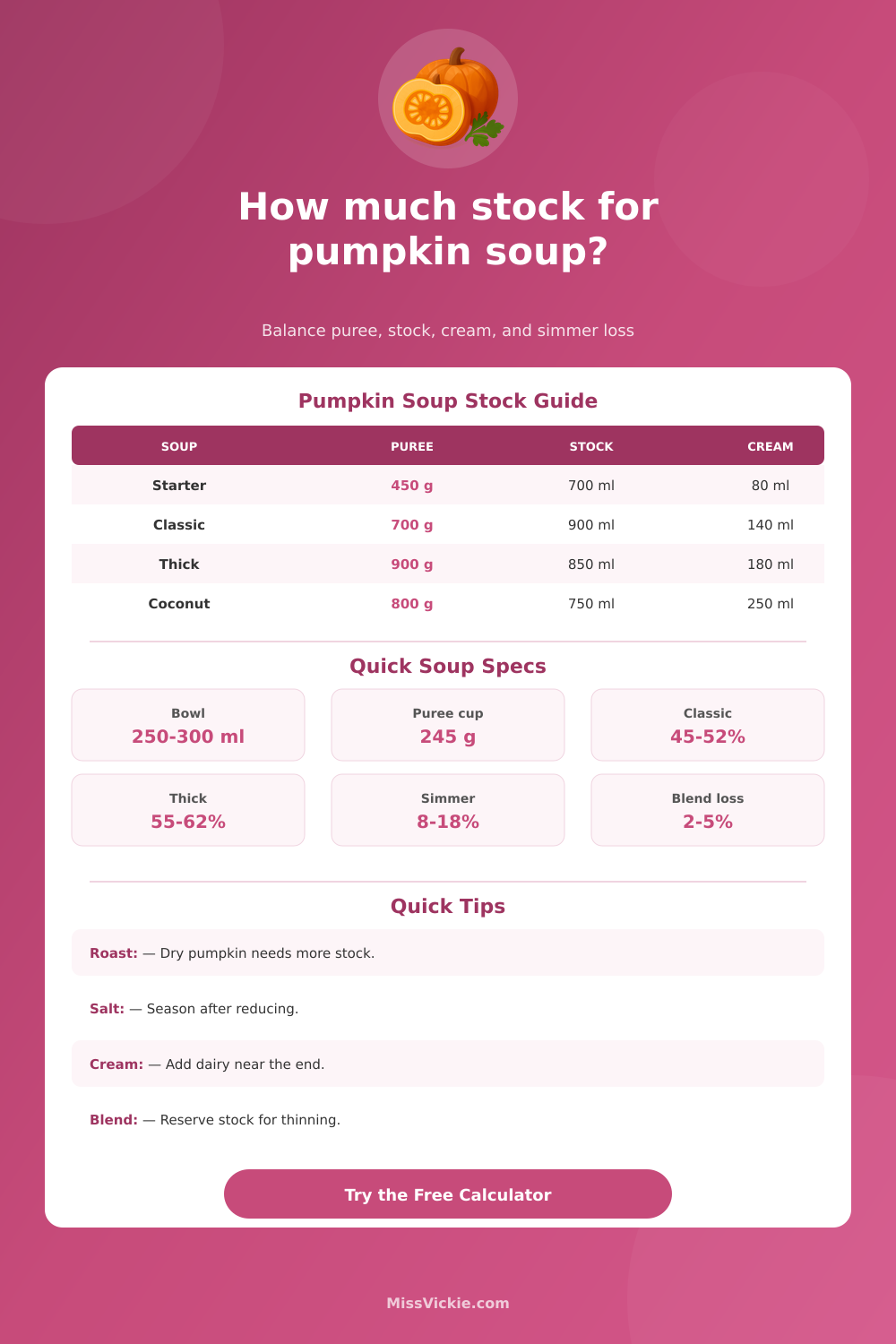
Estimate how much stock to add to pumpkin soup from pumpkin weight or puree volume, desired thickness, stock style, cream or coconut addition, simmer reduction, serving size, blender loss, and roast moisture.
Pick a starting soup plan, then adjust pumpkin form, roast moisture, stock type, dairy or coconut, thickness, simmer loss, serving size, and blender holdback.
Calculation Breakdown
| Pumpkin form | Usable puree estimate | Typical moisture behavior | Stock planning note |
|---|---|---|---|
| Canned pumpkin puree | Nearly 100% usable | Stable, thick, and low-drain | Start with less stock, then thin after blending. |
| Homemade puree | 90% to 100% after draining | Varies by strain and puree smoothness | Reserve more stock if the puree is fibrous. |
| Raw peeled pie pumpkin | 65% to 75% after roasting | Loses 20% to 30% moisture uncovered | Roasted pumpkin usually needs extra stock. |
| Roasted pumpkin flesh | 90% to 95% usable | Dense, sweet, and slightly dry | Add stock gradually to protect body. |
| Butternut squash | 70% to 80% after roasting | Silky but drier than canned puree | Chicken or vegetable stock both work well. |
| Kabocha squash | 60% to 70% after roasting | Very dense, starchy, and dry | Choose a lighter thickness or more stock. |
| Stock type | Flavor body | Approx sodium per cup | Best pumpkin soup use |
|---|---|---|---|
| Vegetable stock | Clean and light | 500 to 750 mg | Classic pumpkin soup, dairy finish, herb-forward bowls. |
| Roasted vegetable stock | Deep and sweet | 500 to 800 mg | Roasted pumpkin soup where caramelized edges matter. |
| Chicken stock | Round and savory | 450 to 800 mg | Silky restaurant-style soup with cream. |
| Low-sodium stock | Mild and flexible | 120 to 250 mg | Large batches, reduced soups, and salty toppings. |
| Mushroom stock | Earthy and dark | 400 to 700 mg | Pumpkin soup with sage, thyme, or roasted garlic. |
| Miso-dashi style stock | Salty umami | 700 to 1100 mg | Coconut pumpkin soup, ginger, and chile finishes. |
Pourable soup for small cups, appetizers, and soup shooters.
Balanced pumpkin flavor with enough stock for a smooth spoonful.
Thicker body that still flows after cream or coconut milk.
Very dense soup for garnishes, swirls, and small portions.
| Serving plan | Finished volume | Good stock range | Cream or coconut range |
|---|---|---|---|
| Four standard bowls | 1.0 liter / 4.2 cups | 450 to 750 ml | 80 to 140 ml |
| Six standard bowls | 1.5 liters / 6.3 cups | 700 to 1100 ml | 120 to 220 ml |
| Eight starter cups | 1.44 liters / 6.1 cups | 800 to 1200 ml | 80 to 180 ml |
| Twelve holiday bowls | 3.0 liters / 12.7 cups | 1.4 to 2.2 liters | 250 to 450 ml |
| Meal prep batch | 2.5 liters / 10.6 cups | 1.2 to 1.9 liters | 150 to 350 ml |
Values are kitchen planning estimates. Pumpkin variety, blender power, straining, and cooking time can shift the final texture, so keep a little warm stock nearby for finishing.
Determining the amount of stocks that is needed for the pumpkin soup is a necessary part of the process. The amount of stock that are added to the pumpkin will determine the thickness of the resulting pumpkin soup; if too little stock is added, the resulting pumpkin soup will be too thick, and if you add too much stock, the pumpkin soup will be too thin. The amount of stock that is needed to create a pumpkin soup of the desired thickness will depend upon the state of the pumpkin, the method of cooking the pumpkin, and the desired thickness of the pumpkin soup.
You can use a calculator to determine the amount of stock that should be added to the pot, as the calculator can mathematically calculate the amount of stock that will create the volume of pumpkin soup of the desired thickness. One of the factor that will influence the amount of stock that is needed for a pumpkin soup of the desired thickness is the state of the pumpkin that is to be utilized in the soup. Different forms of pumpkin contain different amount of moisture.
How Much Stock to Use for Pumpkin Soup
For instance, canned pumpkin puree contains a high amount of moisture, and therefore, requires less stock to thicken the pumpkin to the desired thickness. Raw pumpkin and squash will lose some of there moisture when roasted; the less moisture that the pumpkin loses while roasting, the less stock will be required to thin the pumpkin to the desired thickness. Thus, the calculator will ask for the form of the pumpkin that is to be utilized, as well as the amount of moisture that will be lost during roasting, to determine the volume that the pumpkin will have after it is roasted.
The thickness of the pumpkin soup is another factor that will influence the amount of stock that is required to thin the pumpkin to the desired thickness. Thin pumpkin soup will contain more stock relative to the amount of pumpkin that is use, while thick pumpkin soup will contain more pumpkin relative to the amount of stock that is used in the recipe. The calculator will calculate the amount of stock that will be utilized in the recipe by utilizing a target puree percentage; the target puree percentage will indicate whether or not the amount of pumpkin that is to be used is sufficient for create pumpkin soup of the desired thickness.
Thus, prior to adding stock to the pot, the chef must make the decision as to the thickness that is to be targeted by the pumpkin soup. Finally, the use of cream or coconut milk as one of the ingredient for the pumpkin soup will also impact the thickness of the pumpkin soup; the more cream or coconut milk that you utilize, the thinner the pumpkin soup will be. Cream and coconut milk will add body to your pumpkin soup.
Because cream and coconut milk will add body to your pumpkin soup, you will need to add less stock to achieve your target volume. Cream will add weight to your pumpkin soup due to it fat content. Additionally, coconut milk will add sweetness to your pumpkin soup.
The calculator first subtracts the volume of the cream and coconut milk you will use from the total volume of your pumpkin soup you want to make. Then, the calculator will calculate the amount of stock you need to add based on that remaining volume. This ensures that the ratios of the ingredients you use will be accurate.
Because of evaporation and blending loss, the volumes of both stock and finished pumpkin soup will be less than you calculate. Stock will lose some of its liquid during simmerming. As a result, the stock will become more concentrated with simmering.
Additionally, some of the liquid will adhere to the blade of your blender and remain in the pot during blending. Using a reserve percentage for these ingredients accounts for the loss of both stock and pumpkin soup due to evaporation and blending. Using a reserve percentage allows you to hold back some of your stock until after blending.
Holding back some of your stock prevents you from adding too much of it to your pumpkin soup before testing it’s thickness. The type of stock you use will impact the flavor of your pumpkin soup and its sodium content. Roasted vegetable stock will add color and sweetness to your pumpkin soup.
Additionally, using low sodium stock allows you better control of the salt level in your pumpkin soup. Using mushroom or miso stock will add umami to your pumpkin soup. Umami provides a sensation of richness to soups that do not contain cream.
The calculator also displays the sodium content of your pumpkin soup per serving so that you can know how salty your pumpkin soup will be before you finish cooking it. Using the calculator is useful because it forces you to think about the constraint of your recipe before you start cooking. For example, you must decide how many serving of pumpkin soup you would like to make, the size of each serving, and the desired thickness of the soup.
Once you have these three variables selected, the calculator will provide you a measurement of how much stock to add to your pot of pumpkin soup. Then, you can use a ladle to make small adjustments to the thickness of your pumpkin soup during the cooking process.