Puff pastry lamination math
Butter in Puff Pastry Calculator
Calculate detrempe water, lock-in butter, butter fat correction, folds, layer count, final sheet yield, trimming loss, and batch scaling from one flour weight.
🥐Choose a lamination preset
Each preset loads a real puff pastry plan, then you can adjust flour, hydration, butter percentage, folds, sheet size, and trim loss.
⚖Units and batch scale
🧈Dough, butter, and sheet inputs
📊Reference cards
📘Butter and fold reference
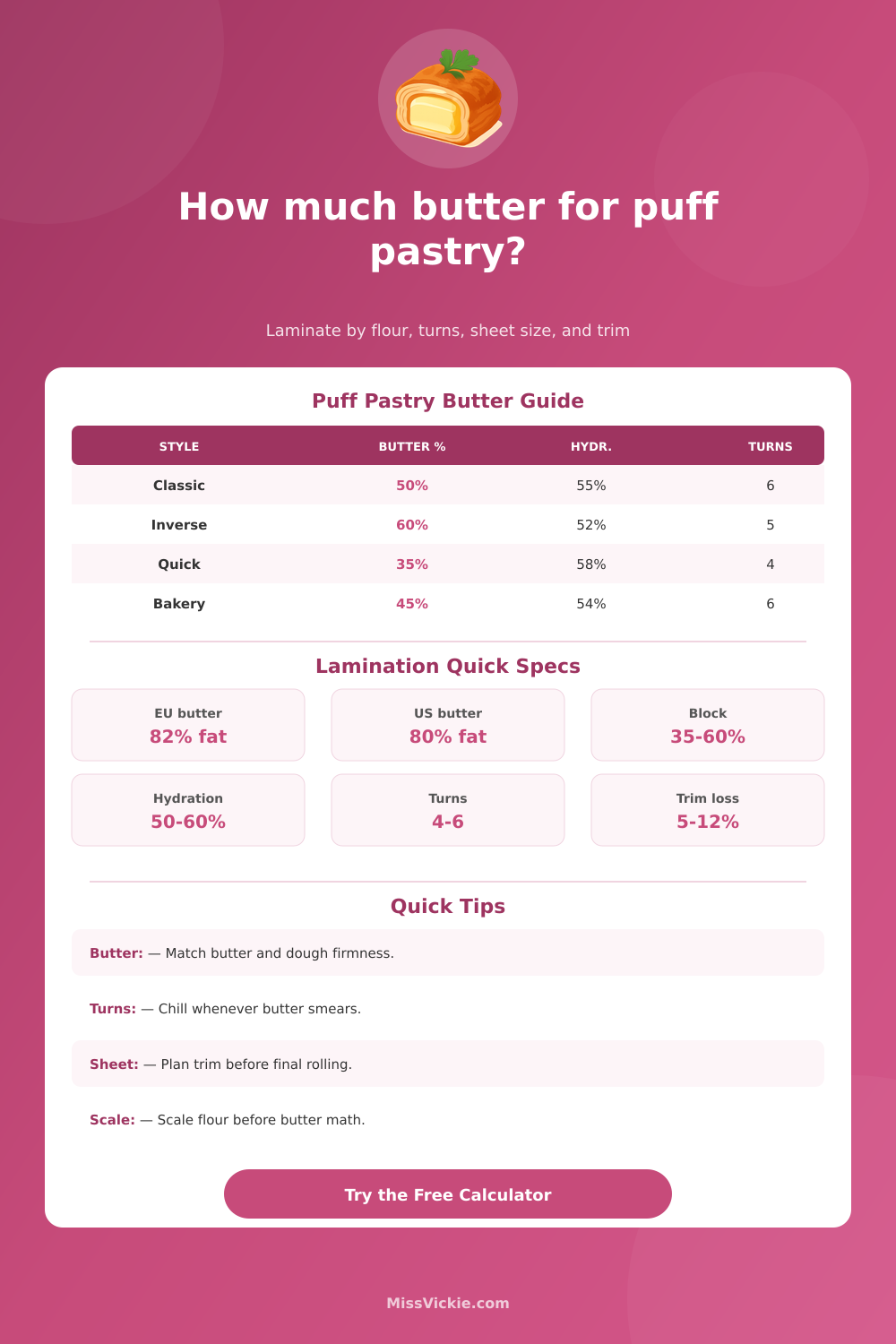
| Lamination style | Butter block | Hydration range | Typical fold plan | Best use |
|---|---|---|---|---|
| Classic full puff | 45% to 55% of flour | 52% to 58% | 5 to 6 single turns | General pastry sheets, lids, cases, and decorative cuts. |
| Inverse puff | 55% to 65% of flour | 48% to 54% | 1 book plus 3 to 4 single turns | Very flaky pastry where butter wraps the detrempe. |
| Quick puff | 30% to 40% of flour | 56% to 62% | 4 rough single turns | Fast savory bakes where perfect layer separation is less critical. |
| Lean savory puff | 35% to 45% of flour | 54% to 60% | 4 to 5 single turns | Cheese straws, tart bases, and rich fillings. |
| Bakery sheeter puff | 45% to 55% of flour | 52% to 56% | 2 book turns plus 2 single turns | Consistent sheet production with firm butter and chill intervals. |
🧈Butter fat comparison
| Butter type | Approx fat | Water in butter | Lamination effect | Calculator adjustment |
|---|---|---|---|---|
| European-style butter | 82% | About 16% to 17% | Plastic, flavorful, reliable for hand lamination. | Baseline target for butter block math. |
| US supermarket butter | 80% | About 18% to 19% | Softer and wetter, so chilling matters more. | Adds a small block-weight correction to match butterfat. |
| Pastry dry butter | 84% | About 14% to 15% | Firm, elastic, and good for sheeters. | Reduces block weight slightly for equal butterfat. |
| Cultured butter | 82% | About 16% to 17% | Good flavor; acidity can make butter feel firmer. | Uses European-style baseline unless custom fat is chosen. |
📏Sheet yield examples
| Sheet size | Thickness | Dough at 1.0 g/ml | With 8% trim | Typical use |
|---|---|---|---|---|
| 30 cm x 40 cm | 3 mm | 360 g | 391 g | Small tart lids or pastry strips. |
| 40 cm x 60 cm | 3 mm | 720 g | 783 g | Half-sheet pan pastry and mille-feuille slabs. |
| 18 in x 26 in | 3.2 mm | 966 g | 1050 g | Full bakery sheet for turnovers or straws. |
| 50 cm x 70 cm | 2.5 mm | 875 g | 951 g | Thin puff for layered pastry and crisp bases. |
Sheet weight is an estimate because puff pastry density changes with flour, butter, and rolling pressure.
💡Lamination notes
The amount of butter that is included in the puff pastry will determine whether the layer of puff pastry will lift or whether they will collapse into a dense structure altogether. The balance between the dough and the butter block will impact the height of the rise of the puff pastry and the texture of the layers. If you use to little butter, the structure will remain tight.
However, if you use too much butter, it may slide within the dough. These issue can result from using the wrong amount of butter within your puff pastry layers, which can make the puff pastry either fail to puff or have the butter leak onto teh sheet pan. The amount of butter that the recipe will require for the puff pastry will depend on a few different factors, such as the type of flour that will be used and the fat content of the butter.
How to Measure Butter and Water for Puff Pastry
The type of flour that is used will impact how much water that the dough will absorb. Additionally, the amount of water that is absorbed will impact the size of the butter block. The fat percentage of the butter will also impact how the butter behave within the dough.
European butter contains 82% fat by weight, for instance, whereas supermarket butter is 80% fat. In these case, the weight of the butter block must be adjusted. The calculator will help to make these calculations once you input the weight of the flour that will be used, the type of lamination that you will use, and the fat percentage of the butter that will be used.
Using the calculator will eliminate the guesswork involved in changing the type of butter that is used in the recipe or in scaling the recipe to make a larger batch of puff pastry. Hydration is another factor that will be just as important as the amount of butter that is used. The level of hydration of the dough will impact how the dough feel and rolls.
For instance, dough that contains 52% hydration will feel different than dough that contains 58% hydration. It may be more even when rolling dough that contains 52% hydration, but it may be easier to roll on warm day with 58% hydration. Additionally, the hydration will impact how the edges of the dough will roll and the texture of the layers after baking the puff pastry.
If the edges feel too dry, the calculator can help to even out the hydration. In this case, the calculator will also provide an adjusted calculation for the amount of butter that should be used with the dough with the adjusted hydration. The number of folds that you perform in the puff pastry will also impact the structure of the layers that are created.
For example, using six single turns will result in many layers of puff pastry, but using a book fold will create more layers at a faster rate. Using more layers, however, means that the dough will need more time to rest in between folds. If the dough is not rested enough, the butter may warm or even smear within the dough altogether.
The calculator includes an estimated number of layers for each fold that you can use to decide whether you would like a larger number of layers or to save time in the recipe. Trim loss is another factor of puff pastry that you need to consider when preparing the pastry. The dough will lose some of its weight when you square the edges of the puff pastry.
If you do not account for this loss of trim, you may end up with a sheet of puff pastry that is smaller than you had planned. To account for this, the calculator will ask for the trim percentage of the puff pastry. By including this percentage in the recipe, the calculator will account for trim loss before the puff pastry is rolled.
This will ensure that you dont run out of dough during the recipe. Another factor to consider is the temperature of the butter and the dough. The two temperatures should be similar to one another throughout the preparation of the puff pastry.
If the butter is too firm, it will crack. However, if it is too soft, it will push into the dough. A good test of the temperature of the butter is to see if it bend without breaking.
The butter and the dough should have the same resistance to pressure. This factor will determine whether or not you must place the dough and butter into the refrigerator to allow them to rest for a period of time to even out the temperatures of these two components of puff pastry. Finally, scaling the batch of puff pastry will change the weight of each ingredient.
However, the ratio of the ingredients must remain the same. The calculator for puff pastry will adjust for this by providing a scale factor for the weight of the flour, water, butter block, and trim loss. Maintaining these ratios will allow the texture and lift of the pastry to remain the same, regardless of the batch size of the recipe.
While the calculator will assist you with the mathematics of making puff pastry, you will also have to observe the dough. The dough will feel different to the touch and behave differently in specific stage of the recipe. By understanding the effect of each of these variables on the puff pastry layers, the calculator will allow you to prepare batches of puff pastry that will have the same texture and lift.