Pudding Set Time Calculator
Estimate pudding chill time from thickener style, batch volume, cup depth, refrigerator temperature, cover choice, dairy fat, deadline, and spoonable or sliceable target.
🍮Pudding Presets
Choose a pudding setup, then adjust batch size, depth, refrigerator temperature, cover, dairy richness, serving deadline, and texture goal.
⚖Set Details
Pudding set plan
Adjust the form to see the set window, deadline status, and serving texture.
Formula Factors
Batch Factors
Chill Schedule
🧊Set Snapshot
📋Pudding Set Time Reference
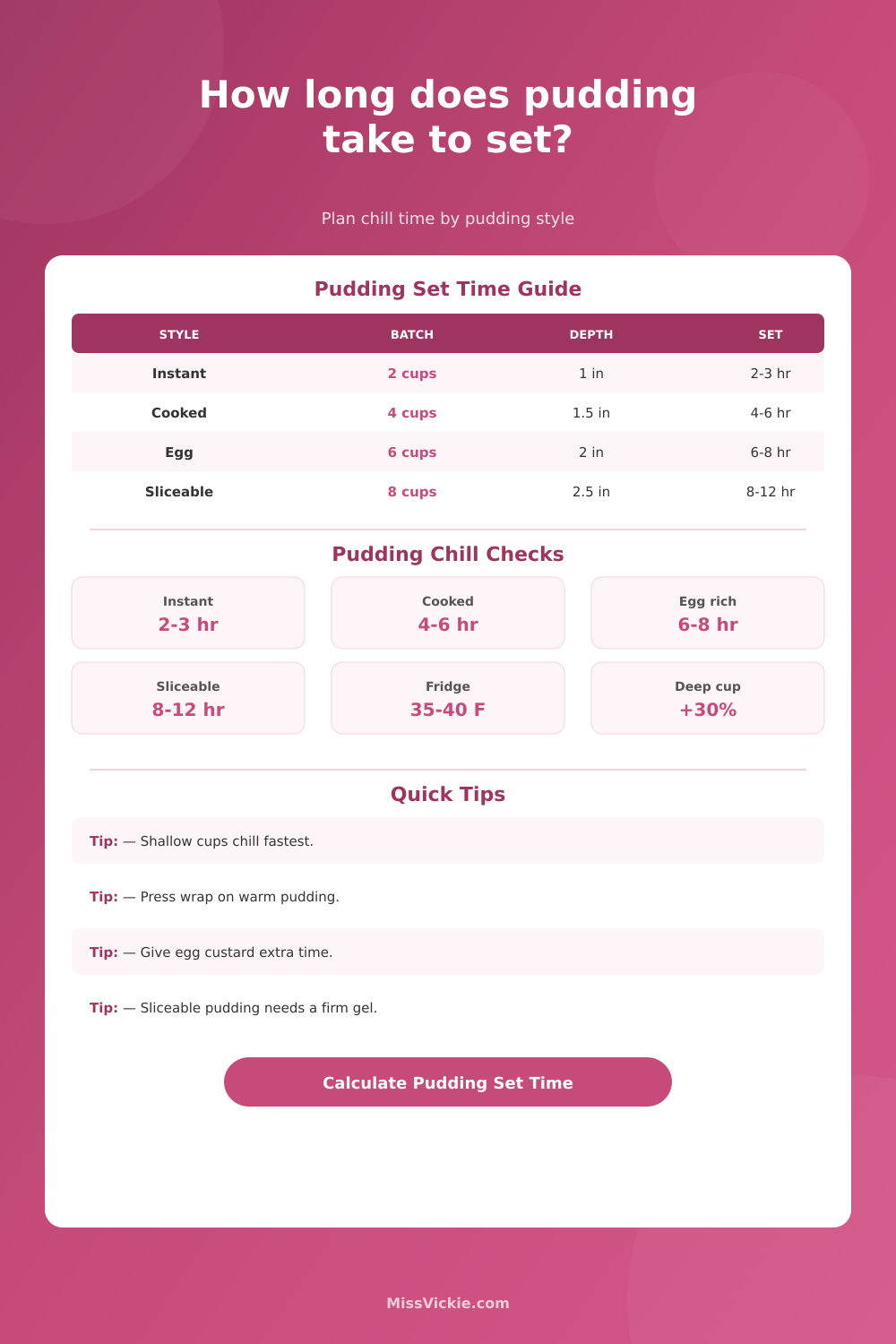
| Pudding Style | Typical Batch | Container | Set Range | Texture Note |
|---|---|---|---|---|
| Instant boxed pudding | 2 to 4 cups | Small cups, 1 inch deep | 2 to 3 hours | Best for classic spoonable cups. |
| Cooked cornstarch pudding | 3 to 6 cups | Cups or shallow bowl | 4 to 6 hours | Starch needs cold time after cooking. |
| Egg custard pudding | 4 to 8 cups | Ramekins or dish | 6 to 8 hours | Rich custard firms slowly in the center. |
| Pudding pie filling | 5 to 8 cups | Pie shell or slab | 8 to 12 hours | Sliceable texture needs a long chill. |
| Chia pudding | 2 to 6 cups | Jars, 1 to 2 inches deep | 4 to 8 hours | Hydration drives the final gel. |
🥛Ingredient And Thickener Table
| Thickener | Fastest Good Use | Firmest Use | Watch Point | Common Hold Time |
|---|---|---|---|---|
| Instant starch blend | Snack cups | Layered dessert | Needs cold milk and full whisking. | 2 to 4 hours |
| Cornstarch | Stovetop pudding | Pie filling with extra starch | Must bubble briefly to activate. | 4 to 8 hours |
| Egg yolk plus starch | Custard cups | Pastry cream | Rich dairy slows cooling. | 5 to 9 hours |
| Gelatin support | Parfait layer | Sliceable pie | Needs full hydration and cold time. | 6 to 12 hours |
| Chia seeds | Breakfast jars | Thick spoonable cups | Stir once after the first chill. | 4 to 10 hours |
| Agar or vegan gel | Firm coconut cups | Molded pudding | Sets firm, but texture can turn brittle. | 2 to 6 hours |
🌡Depth And Fridge Table
| Container Depth | Fridge Temp | Cover Choice | Time Adjustment | Best Move |
|---|---|---|---|---|
| Under 1 inch | 35 to 38 F | Surface wrap | About 15% faster | Use for quick cups. |
| 1 to 1.75 inches | 37 to 40 F | Surface wrap or lid | Baseline pace | Standard pudding cup setup. |
| 2 to 2.75 inches | 39 to 42 F | Loose cover first | Add about 25% | Cool steam before sealing. |
| 3 inches or more | Over 42 F | Wrapped pan | Add 40% or more | Use shallow dishes if time is short. |
⏱Serving Deadline Table
| Time Available | Best Pudding Choice | Texture Target | Container Plan | Risk Level |
|---|---|---|---|---|
| 2 to 3 hours | Instant pudding | Soft spoonable | Small shallow cups | Low if cold milk is used. |
| 4 to 6 hours | Cooked starch pudding | Classic spoonable | Cups or shallow bowl | Moderate for deep bowls. |
| 6 to 8 hours | Egg custard or pastry cream | Pipeable or firm spoonable | Ramekins or tray | Low with fast cooling. |
| 8 to 12 hours | Pudding pie or molded set | Sliceable | Pie shell or slab pan | Best for clean slices. |
📊Method Comparison Grid
Cold milk and shallow cups give the quickest spoonable pudding result.
Full starch activation on the stove sets well after a steady refrigerator chill.
Yolks and dairy need a longer cool-down before the center feels stable.
Deep gel strength and clean slices improve most with an overnight rest.
💡Pudding Set Tips
This calculator estimates pudding set timing for kitchen planning. Actual timing changes with recipe ratio, starch activation, egg content, dish material, air flow, and refrigerator cycling.
It’s two hours until the pudding is supposed to be ready and it’s still liquid. We’ve all been there, and usualy it has nothing to do with recipe being at fault. It has everything to do with physics: Thick, rich-in-dairy puddings is slow to heat, and they’re also resistant to rapid cooling.
Enter this online calculator, which does the math for you after you plug in the depth of your container and size of your batch. You won’t have to fumble with conversions or find the right coefficient, giving you confidence that guests can arrive without a soupy mess.
How to Set Pudding Perfectly
Most home cooks think that putting something in the fridge means it’ll cool down immediately. It doesn’t. If you take a hot custard out of refrigerator, it will spend the next hour adjusting to cold environment before it’ll even start to set.
Depth is the biggest variable. Even with all the right ingredients (the right ratio of cornstarch), your mixture can still go into too deep a bowl which will develop a skin on the sides but stay warm in the middle. You end up with a lumpy mess that just doesn’t feel right in the mouth.
To make up for it, spoon above computes the thermal mass equalization time, i.e., how long it takes for entire cup to reach the same temperature. The shallower the better, especially if time’s limited. Cold air reaches center without fighting through an insulating core of warm milk.
That’s where folks get confused. It’s not the recipe but the dishware. How do they differ? It depends on thickening ingredient. Pre-gelatinized starch (like what’s in instant pudding) thickens when mixed with cold water and left to sit, rather than needing heat. This makes it fast, usually setting in two to three hours without a cooking step required.
With stovetop puddings, you’re actualy cooking out any raw taste from the cornstarch, and then cooling it down so it firms up properly, but that’s still going to take time. Custards made with eggs are slowest of all: Yolk proteins thickens slowly for a luscious texture, requiring some serious waiting. A rushed egg custard will be either spongy in the middle or simply curdle.
The table at the bottom of the page explain this all clearly. And points you toward the appropriate technique, depending on how much time you have.
How do you cover things? That’s another key variable. You don’t want to press down with plastic wrap right against your puddin or else it’ll get this kind of skin where air gets trapped between the plastic and surface. That’ll mess up the texture. On the other hand, if you just seal it tight like a tupperware container, all that steam has nowhere to go so it turns into water droplets and runs back down onto your pudding. That weakens the set, too.
Small details have big impacts. Don’t seal your dish while it’s still steaming. Give it 20 min first then pop the lid on nice and snug. This little detail makes difference between a pro looking dessert and an amateur one. The calculator accounts for how you cover things. If you’re wrapping it in plastic directly on top, it will adjust to match your choice of loose lid or direct surface wrap.
But there’s a subtler factor: fat content. Richer dairy makes things richer, full-fat milk and heavy cream certainly add to that… But fat also serves as insulation. Energy transfer is less efficient through layer of fat, so while a pudding made from heavy cream will be richer, it’ll cool down slower than one made from skim milk. That means if you’re whipping up a rich chocolate custard using heavy cream, don’t expect it to set in the same window as lighter-weight vanilla mix.
The tool accounts for this dairy richness: the resulting timeline shows actual heat behavior of the ingredients in your bowl. It isn’t just a matter of time but of managing expectations given contents of the bowl.
The next category is sliceable puddings. Think of these as basically molded gels that depend based off having enough structure to keep them in one piece on the plate. That takes a bit more time, typically an overnight chill. This gives the gel network time to get stronger across the whole volume. If you try to rush it your edges will fall apart and everything will be a mess when sliced.
In that case, either opt for a spoonable texture instead or bake your pudding inside a pie crust to give it some structure to hang on to. When there’s too little time between setting and the deadline, the calculator alerts you about schedule risk so you can avoid presenting a wobbly creation.
Once you grasp these variables, however, what was once guesswork becomes strategy. You no longer have to wonder if the pudding’s done or not, you’ll know exactly when it is. This isn’t magic, it’s physics: Heat leaves a bowl. Prepare yourself for the depth, be mindful of your thickener, and let cold do the rest.
No one should of ever known how near-to-panic you were. All they’ll notice is a perfectly set dessert that showed up precisely on time.