Body weight, activity, goal, meals, protein source mix, age, and calories
Protein Intake Calculator
Estimate a general daily protein target, meal split, calorie share, and food-source mix from everyday nutrition planning inputs.
Choose a common eating pattern, then adjust the details. Results are general nutrition estimates for planning, not medical diagnosis or treatment advice.
Protein Intake Breakdown
Works well with mixed meals, dairy, eggs, beans, grains, fish, poultry, soy, and nuts across the day.
Useful when training is regular and meals need enough protein without crowding carbohydrates or produce.
Often pairs best with evenly spaced servings and high-quality protein foods at three to six eating times.
Plant-heavy days may use a small planning buffer and variety from legumes, soy, grains, seeds, and nuts.
| Goal Type | Common Range | Best For | Planning Note |
|---|---|---|---|
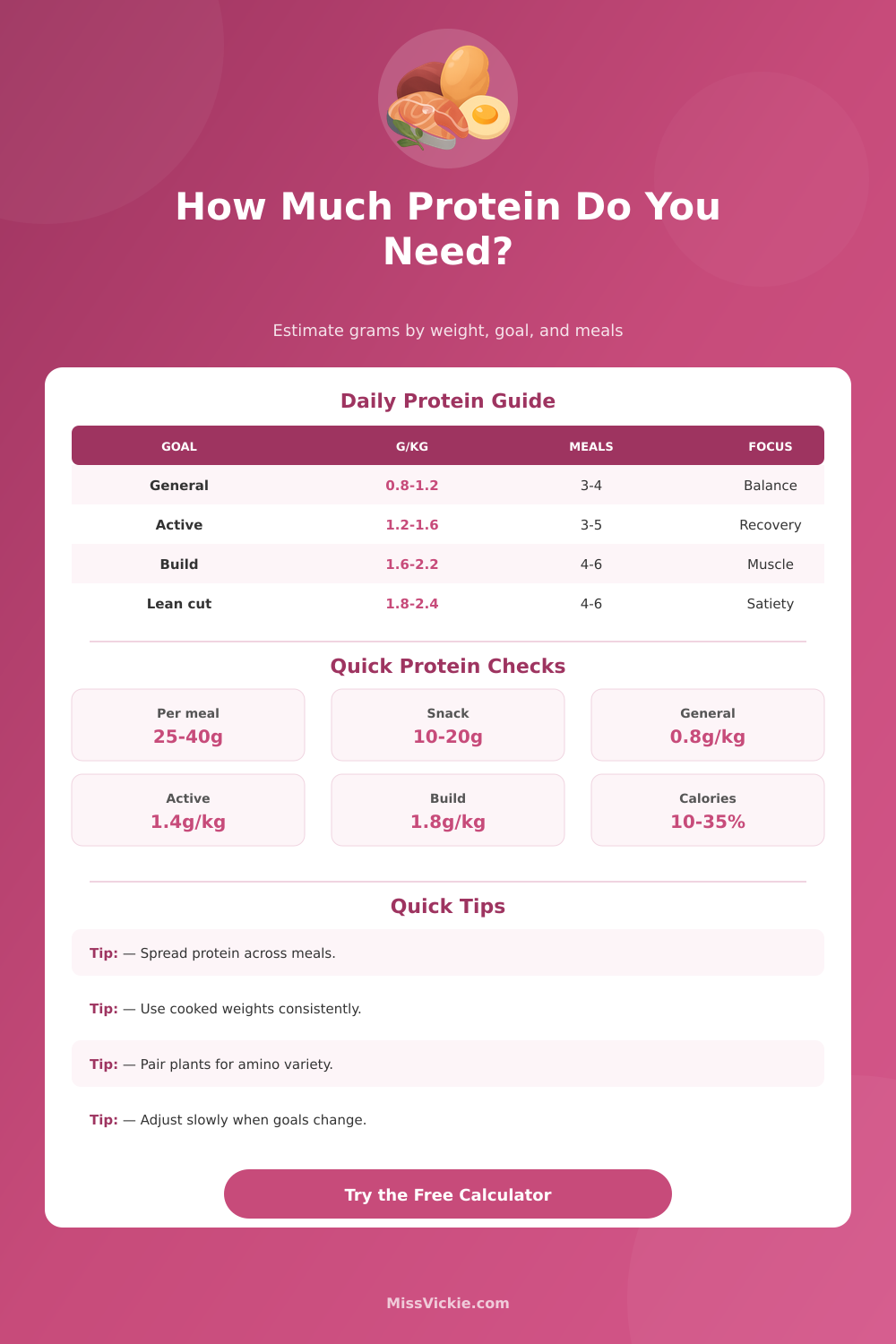
| General healthy eating | 0.8-1.2 g/kg | Basic meal planning | Start near the middle if appetite is steady. |
| Active lifestyle | 1.2-1.6 g/kg | Regular walking, fitness, busy days | Spread protein over three or more meals. |
| Muscle building or preserving | 1.6-2.2 g/kg | Resistance training focus | Use the higher end when training volume is high. |
| Lean weight-loss phase | 1.8-2.4 g/kg | Fullness while calories are lower | Check that protein still fits the calorie target. |
| Endurance training | 1.2-1.8 g/kg | Running, cycling, long sessions | Balance protein with enough carbohydrate. |
| Protein Source | Typical Protein | Portion Example | Mixing Note |
|---|---|---|---|
| Chicken breast, cooked | 31 g per 100 g | 100-150 g cooked | Lean, compact, easy to portion. |
| Greek yogurt | 10 g per 100 g | 170-225 g bowl | Good breakfast or snack base. |
| Eggs | 6 g each | 2-3 large eggs | Often paired with dairy, beans, or grains. |
| Tofu, firm | 12-17 g per 100 g | 150-220 g serving | Soy is a strong plant-forward staple. |
| Lentils, cooked | 9 g per 100 g | 1 to 1.5 cups | Also contributes fiber and carbohydrate. |
| Protein powder | 20-30 g scoop | 1 scoop serving | Use as a supplement to meals, not the whole pattern. |
| Life Stage | Calculator Adjustment | Meal Emphasis | General Note |
|---|---|---|---|
| Teen 14-18 | Uses moderate buffer | Regular meals and snacks | Growing bodies need overall calories too. |
| Adult 19-50 | No extra stage buffer | Match goal and activity | Use the range that fits your eating pattern. |
| Older adult 51+ | Small upward nudge | Protein at breakfast helps distribution | Appetite and chewing comfort can matter. |
| Senior 65+ | Higher distribution focus | Three or more protein servings | Discuss personal needs with a clinician when needed. |
| Pregnancy or breastfeeding context | Uses planning buffer | Steady intake over the day | Follow personalized professional guidance. |
| Meal Count | Daily Target Example | Per Meal Average | Useful Pattern |
|---|---|---|---|
| 3 meals | 90 g/day | 30 g each | Simple breakfast, lunch, dinner split. |
| 4 meals | 120 g/day | 30 g each | Three meals plus one protein snack. |
| 5 meals | 150 g/day | 30 g each | Helpful for large targets or smaller appetites. |
| 6 meals | 180 g/day | 30 g each | Often used for high training volume days. |
Protein needs are not a single constant number for everyones. Protein needs changes according to the movement and eating schedules of the individual. The planning tool will ask for your weight, goals, activity level, meal count, protein sources, age, and calorie target to calculate your protein needs.
The planning tool will calculate this for you, eliminating the need to remember a variety of rule of thumb for protein needs. Body weight are used as the starting point for calculating protein needs. Protein needs are based on body mass.
Find Your Protein Needs
The tool will convert your weight to kilogram and multiplied by a coefficient to find your protein needs in grams. Individuals who lift weights three times a week will require more protein then individuals who walk regularly each week. The difference in protein needs may be small for any one meal, but total protein needs will accumulate over time for those with strong protein needs.
An individual’s activity level will influence there protein needs. The physical training an individual performs will impact there need for protein to recover from those training session. An individual who performs a few sessions of light physical activity per week will have different protein needs than an individual who performs five or six training sessions per week.
The protein calculator will incorporate these training days into the calculation of an individual’s protein needs. If an individual’s activity level changes, they can update their activity level within the planning tool. An individual’s meal count will impact there needs for protein.
Individuals who eat four meals that contain protein will require eating less protein with each meal than individuals who consume only three meals that contain protein. Individuals who eat fewer meals may include older adults in that count, as those individuals may have smaller appetite than younger individuals. The protein sources that an individual consumes will impact the total amount of food that the individual need to consume to meet their protein target.
Individuals who consume protein from animal source will require consuming less total volume of food to meet their protein target than individuals who consume protein from plant-based source. The protein calculator will account for this by providing a buffer for individuals who choose plant-based protein sources. An individual’s age will impact there protein needs.
Individuals whose bodies are still growing, such as teenagers, will require more protein than individuals whose bodies has stabilized between the ages of 20 and 30. Individuals who are approaching the age of 65 may require more protein than younger individuals to aid in the preservation of their lean muscle mass. An individual who is pregnant or breast feeding may also have increased protein needs.
These needs can be entered into the planning tool, but they should of been discussed with a medical clinician. An individual’s total calorie needs will impact there protein needs. The protein calculator will determine the percentage of an individual’s total calories that is to come from protein.
Most individuals consume between 10% and 35% of their total calories from protein. The reference tables provides protein ranges for individuals with different goals. These tables are not exact, but they do provide individuals with an understanding of protein needs for various goals.
For instance, the table that compares diets that focus on incorporating proteins to diets that focus on general healthy eating will show the differences in protein needs between these two groups. In addition, the table can show the protein needs for individuals who consume more protein than others with the same activity and life stage level. It is beneficial for an individual to distribute their protein intake throughout the day.
For instance, consuming protein at breakfast and one lunch will reduce the amount of protein that must be consumed at dinner. The protein calculator accounts for this and allows an individual to distribute the protein needs throughout the day. The protein calculator cannot account for individual appetites or digestion schedules.
An individual may feel good about consuming protein at a specific time of day, but they may not feel like eating that much protein at all. An individual’s appetite may change from day to day, and protein needs can be adjusted accordingly the following day. The protein calculator does not account for specific food tracking or restaurant menus.
The food portion may not match those estimated by the tool, and the portion sizes may need to be rounded. However, it is more important to be consistent in protein intake than precise in measuring the protein that is consumed. For instance, if an individual calculates that they need to consume 120 gram of protein per day, consuming anywhere from 105 to 135 grams of protein will be considered within the goal that is established by the tool.
The protein calculator can be rerun quickly if an individual’s schedule changes. The protein needs can be calculated in about one minute, and the changes to an individual’s activity or goals can be entered into the tool to provide updated information for that individual. This rapid calculation of protein needs can help individuals to align there diet to there lives.
Although the protein calculator can help with the planning of protein intake, it is still just one component of an individual’s diet. Carbohydrates are still needed to fuel an individual’s activities, and adequate amount of vitamins and minerals are still required for an individual’s body to function. The protein calculator provides an individual with an understanding of how much protein is needed to meet there daily diet goals.