🥩 MissVickie prime rib calculator
Prime Rib Roast Cooking Temperature Calculator
Balance bone-in carryover, reverse-sear timing, holding windows, and slice-thickness servings so your roast lands at the table with the right pink center.
Each preset loads a real roast scenario with bone style, weight, path, resting, holding, and slice thickness already tuned for the calculator.
Use the roast weight and thickness as your base, then layer in bone structure, cooking path, carryover, hold temperature, and slice thickness for serving math.
The calculator converts metric inputs internally, then shows pull temperature, finish temperature, hold window, and slice yield in one pass.
Full Breakdown
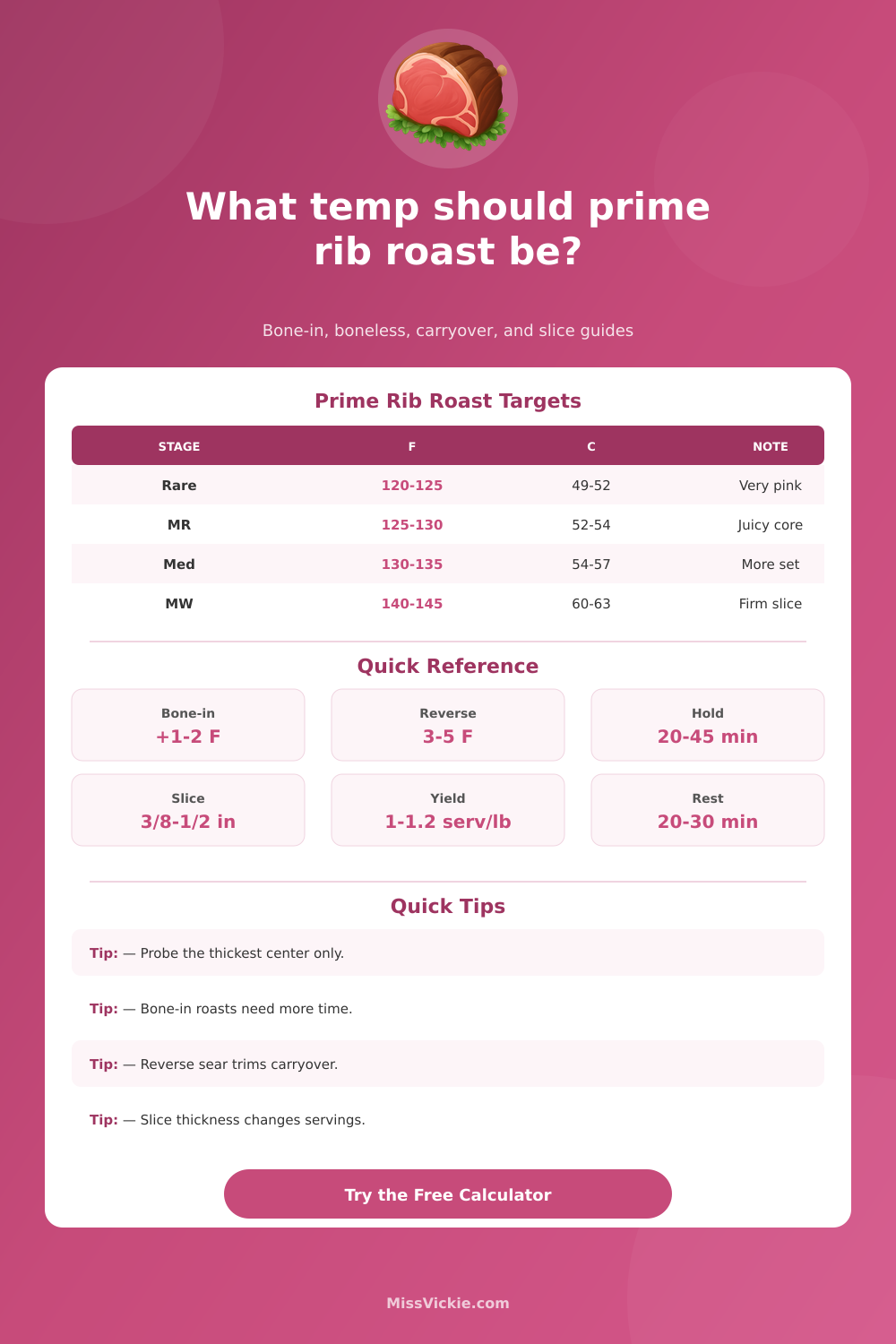
Use this table as your pull target map. The exact rise depends on roast size, bone structure, and whether you choose reverse sear.
| Stage | Pull | Finish | Rest |
|---|---|---|---|
| Rare | 118-120 F | 122-125 F | 18-20 min |
| Med rare | 123-125 F | 128-130 F | 20-25 min |
| Medium | 128-130 F | 133-135 F | 25-30 min |
| Med well | 138-140 F | 143-145 F | 28-35 min |
Bone-in roasts carry more heat and carve a little differently, while boneless roasts tend to finish more evenly and lose less during trimming.
| Build | Carry | Yield | Carve note |
|---|---|---|---|
| Bone-in | +1-2 F | 90-92% | Slow rise |
| Boneless | +0-1 F | 94-96% | Easy carve |
| Tied rib | +1 F | 93-95% | Even shape |
| Cap on | +2 F | 89-91% | Rich crust |
This slice-thickness model keeps the serving estimate practical. Thin slices stretch the roast, while thick steakhouse slices cut servings down quickly.
| Slice | Servings/lb | Guest style | Best use |
|---|---|---|---|
| 1/4 in | 1.25 | Light | Buffet |
| 3/8 in | 1.10 | Normal | Dinner |
| 1/2 in | 1.00 | Hearty | Holiday |
| 3/4 in | 0.85 | Big cut | Plated |
Use this quick planner to see how the roast size changes the total table yield, especially when you are carving for a large holiday group.
| Roast size | Servings | Slices | Good for |
|---|---|---|---|
| 6 lb | 7-8 | 10-12 | Small dinner |
| 8 lb | 10-11 | 14-16 | Family meal |
| 10 lb | 12-13 | 16-18 | Holiday main |
| 12 lb | 14-15 | 20-22 | Big crowd |
Compare the major roast paths so you can choose the carryover style that fits your timeline and finish target.
Best for even edge-to-edge color and a gentler pull temp.
Longer low-temp roast
Simple oven rhythm with a normal carryover rise.
Reliable family method
Smoky roast body with a short final crust finish.
Works for larger roasts
Quick surface color, stronger carryover, and tighter timing.
Best for smaller roasts
Cooking a prime rib roast require an understanding of how heat transfer within the roast. Understanding how heat transfers is important because the roast will continue to cook after you take it out of an oven. This process is known as carryover cooking.
Carryover cooking occur because the exteriors of the roast will be hotter than the center of the roast. As the roast rest on a counter, the heat will continue to transfer from the exterior to the center of the roast, which increase the internal temperature of the roast. If you remove the roast from the oven while it has reached the target temperature, it will continue to cook and can becomes overcooked.
Why prime rib keeps cooking after you take it out of the oven
To avoid overcooking the roast, use a temperature calculator to determine the specific temperature that the cook should pull the roast from the oven. Using this specific temperature will ensure that the roast reach the desired internal temperature. The amount of carryover cooking that occurs is dependent upon the structure of the roast.
The structure of the roast change based off whether or not it is bone in or boneless. A bone-in prime rib roast will hold heat more longer than a boneless roast. This is due to the fact that the roast has more thermal mass with the inclusion of the bone.
Additionally, the method in which you cook the roast will affect the result of the temperature. One method include roasting the roast at a low temperature and then searing the roast at a high temperature. This method will create an even roast color and allow for more predictable in the carryover cooking of the roast.
The starting temperature of the roast will affect both the cooking time and how long the roast need to remain in the oven. If the roast start at a lower temperature (as when you remove it from the refrigerator), it will require more time to reach the target temperature then a roast that has rested on the counter to reach a higher starting temperature for the roast. You must account for this starting temperature to ensure that you can accurately determine the cooking time for the roast.
After removing the roast from the oven, you must account for the “holding window” of the roast. The “holding window” is the length of time between removing the roast from the oven and carving the roast. If you carve the roast too soon, the juice will leave the roast and the roast will be dry.
If you allow the roast to sit too long after removing it from the oven, the roast will become too cold to serve. When carving the roast, you will have to determine the thickness of each slice of roast. The thickness of the slices will determine how many person you can feed with the roast.
A thick slice of roast will have a specific texture, but a thin slice will allow you to serve more people with the same amount of roast. To ensure that the roast will provide enough meat for all of your guest, you must balance the total weight of the roast against the thickness of the slices. Cooking a prime rib roast involve the understanding of a series of thermal shifts.
These shifts include the movement of the roast from the refrigerator to the oven, from the oven to the resting roast, and then from the resting roast to the carving roast. By tracking these thermal shifts and using the calculated internal temperatures of the roast, you will ensure the roast reach the correct internal temperature.