Prime Rib Smoking Time Calculator
Estimate smoked prime rib timing from rib count, roast weight, smoker temperature, starting temperature, target doneness, smoke intensity, sear finish, rest length, and carryover heat.
📌Prime rib presets
Choose a common smoked prime rib setup, then fine tune the roast, pit, sear, smoke level, and resting plan. This calculator treats the smoke phase as a slow heat-rise window with a separate sear and carryover finish.
⚙Smoking inputs
Smoke plan ready
Adjust the inputs above to build a smoked prime rib schedule.
Timing breakdown
Temperature and carryover
📊Prime rib smoke timing cards
🌡Smoking and temperature tables
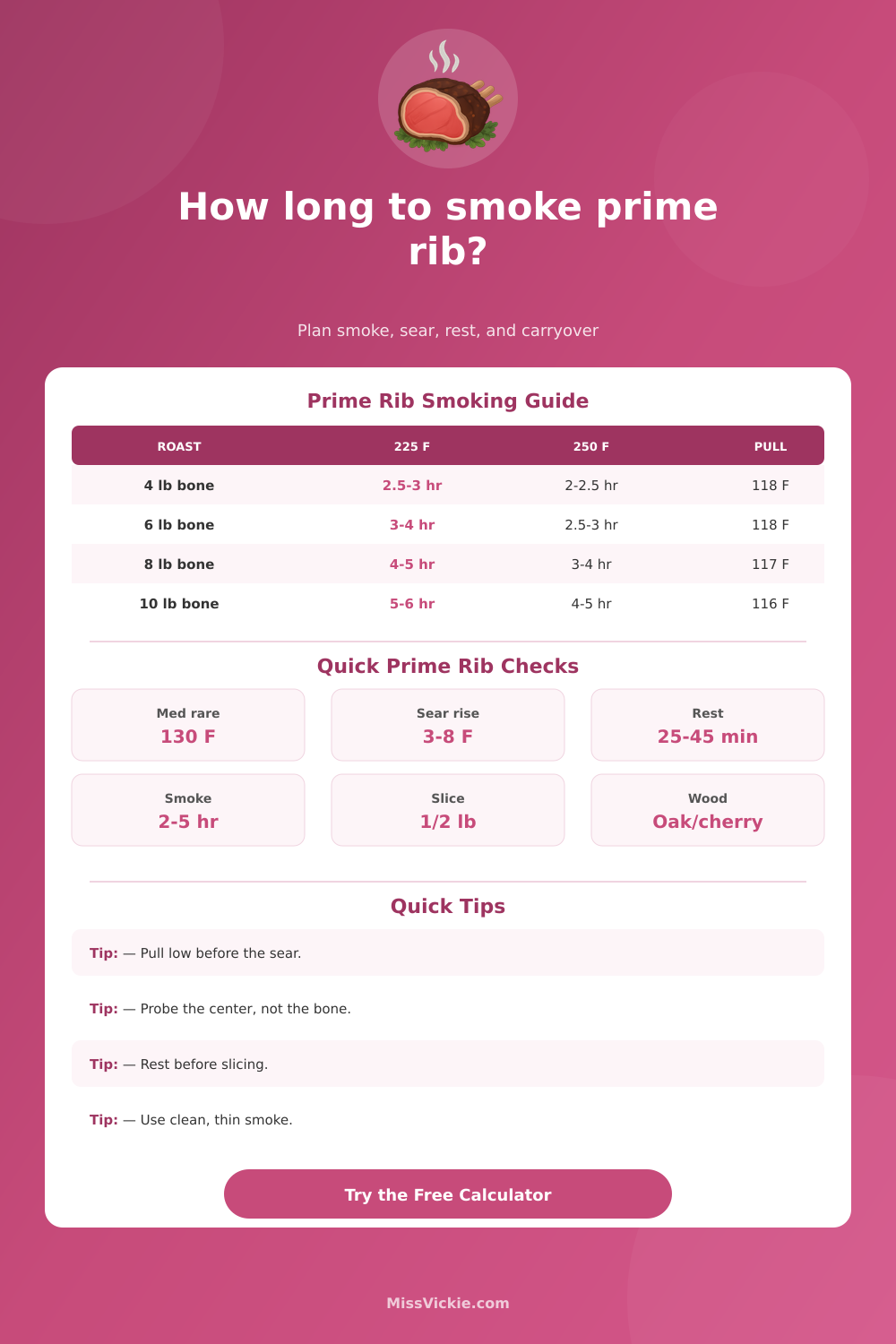
| Roast size | 225 F smoker | 250 F smoker | 275 F smoker | Best use |
|---|---|---|---|---|
| 2-bone, 4 to 5 lb | 2 hr 45 min to 3 hr 30 min | 2 hr 15 min to 3 hr | 1 hr 55 min to 2 hr 35 min | Small dinner, lighter smoke |
| 3-bone, 6 to 7 lb | 3 hr 30 min to 4 hr 30 min | 2 hr 55 min to 3 hr 50 min | 2 hr 30 min to 3 hr 20 min | Holiday center roast |
| 4-bone, 8 to 9 lb | 4 hr 25 min to 5 hr 35 min | 3 hr 40 min to 4 hr 45 min | 3 hr 10 min to 4 hr 5 min | Large group, steady pit |
| 5 to 6 ribs, 10 to 14 lb | 5 hr 30 min to 7 hr | 4 hr 35 min to 5 hr 55 min | 3 hr 55 min to 5 hr 10 min | Full roast, early start |
| Final doneness | Plate temp | Typical smoke pull | With hard sear | Center color |
|---|---|---|---|---|
| Rare | 125 F | 112 to 116 F | 109 to 113 F | Deep red, warm center |
| Medium rare | 130 F | 117 to 121 F | 114 to 118 F | Red-pink, juicy center |
| Medium | 140 F | 127 to 131 F | 124 to 128 F | Pink center, firmer edge |
| Medium well | 150 F | 137 to 141 F | 134 to 138 F | Slight pink, firm slices |
| Sear finish | Typical time | Internal rise | Crust result | Planning note |
|---|---|---|---|---|
| Hot grill or smoker sear | 8 to 12 min | 4 to 7 F | Smoky browned cap | Rotate often to avoid scorching fat. |
| 500 F oven blast | 10 to 15 min | 5 to 8 F | Even holiday crust | Preheat while the roast rests briefly. |
| Broiler finish | 5 to 8 min | 3 to 6 F | Fast top browning | Watch closely and protect rib bones. |
| Torch touch-up | 3 to 6 min | 1 to 3 F | Precise browned patches | Useful when the center is already close. |
| Smoke intensity | Wood choice | Absorption window | Best roast | Flavor caution |
|---|---|---|---|---|
| Light kiss | Cherry, pecan | First 75 to 105 min | Dry-aged or smaller roasts | Keeps beef flavor in front. |
| Balanced | Oak plus cherry | First 120 to 160 min | Most rib roasts | Use clean smoke, not smoldering chunks. |
| Holiday smoke | Oak, apple, cherry | First 150 to 190 min | Large bone-in roasts | Stop heavy wood before the sear. |
| Heavy smoke | Oak, hickory blend | First 180 to 230 min | Big roasts with thick fat cap | Can taste sharp if airflow is dirty. |
🔍Method comparison grid
Best when you want smoke aroma, rosy edge-to-edge doneness, and a planned finishing sear.
More predictable indoors, but it misses the early smoke absorption stage and pit recovery delays.
Close to smoking logic, but wood intensity and airflow change the first half of the cook.
Useful for time pressure, but the gray band grows and smoke flavor has less time to build.
💡Smoked prime rib tips
Kitchen and smoker estimates vary with thermometer placement, lid openings, roast shape, humidity, altitude, and rest coverage. Use this calculator as a planning guide and verify doneness with a calibrated thermometer.
Around four thirty on Christmas Eve, when the roast’s still in the fridge and the smoker’s cold, panic sets in. It is more than just a matter of pairing the side dishes with the main meal; if you leave things too late, the entire holiday can be ruined. Meat cooks according to its own unpredictable timetable, while people has to live out their complicated lives. Prime rib is particularly unforgiving: one moment it’s perfect, but then you cut inside and there’s a band of gray next to the crust; another time it’s cooked, but it looks as if it isn’t yet. That’s where the calculator comes in. It does the math by considering weight, temperature, and carryover cooking. When the numbers fail you, it will save the roast; but only if you understand what all those variables are.
So first off, let’s talk about bone structure and weight. Two three pound roasts will not cook like a single six pound roast. Heat doesn’t just pass through air; it passes through mass. The bones themselves also serves as an insulator, keeping the spine side of meat more protected from immediate radiant heat. It slows down the internal temp increase a bit, but it protects the edges. Shape makes a difference here, which is why sometimes rib count can be a better indicator than straight pounds. Maybe your roast is super wide and short, making it heavy. Or maybe it’s tall and thin, so light. That’s where geometry comes into play in the tool because thickness of the roast is what impacts the time required for the heat to penetrate all the way to the center.
How to Cook Perfect Prime Rib for Christmas
So if you’re feeding an army with some giant ten pounder, just know that even though the smoke phase should only last a little longer than usual, that part does take a little longer when it’s got so far to go before reaching middle. Most folks blow it on the temperature control in the smoker. Run your pit at two hundred fifty degrees Fahrenheit and you’ll have a large window to develop pink band of doneness without over-drying the outside. And if you’re hotter or cooler than I’m recommending, our calculator will redo the predicted time to match. Just keep in mind: It’s not the number on the dial as much as the airflow that does the trick. More flavor comes from a continuous plume of clean smoke than nailing down some wildly fluctuating temperature reading every time you crack the lid.
Here folks go wrong; they become obsessed with needle on the gauge and allow the fire to smolder into acridity. Go low, go slow; blue and thin is what you want, and let the low heat soften those muscle fibers ever-so-gently. The meat will keep cooking long after it comes off the heat source, so don’t think of doneness as a fixed number; it’s a moving target. Carryover cooking is very real and worth keeping in mind, particularly if your roast is large and holds onto heat. Say your thermometer says the roast is one hundred thirty degrees: pull it, then slice and let it rest, and odds are you’ll wind up with medium meat.
Your guess about timing depends on your inputs (rest time, sear finish), but remember: a hard sear in a five-hundred degree oven or on a hot grill add several more degrees to the interior. Best to pull your roast early enough that this last surge nudges you right into target temp. Go easy, let it rest, and trust the remaining heat to do the work without overcooking middle. But there’s no such thing as optional downtime for resting. While meat sits, its juices, which have been moving towards the hot surface, start redistributing themselves throughout the drier interior. If you skip this, all you’ll see on your cutting board is pink liquid pooling up, rather than remaining within the slice. Letting it rest under a loose tent for half an hour ensures both food safety and even-outning of internal temp. This buffer is built into the overall schedule by the calculator, so now you know not only when to remove it from the grill but when to start carving.
Wood selection enhances, but does not determine, your timing plan. Gentle background notes of oak and cherry complement beef without overshadowing it. Avoid letting the fire get too cool; light air movement will prevent heavy smoking from becoming bitter. Ensure a clean burn. You’re enhancing flavor, not accumulating ash.
Finally, when you hit zero on the timer and you’re in the safe zone according to the probe, fight the temptation to peek again. Overthinking those last few minutes typicaly means overcooking them. Trust your prep, trust the carryover and trust yourself to let it rest before making that first cut. Patience separates a good holiday meal from a memorable one. It transforms what could of been a source of stress into a slow, confident finish that rewards everyone around the table.