
The physics of cooking change as you gain altitude, and this is true of home canning as well. If you’re five thousand feet up from sea level, it’s normal to worry if your canner suddenly fails to vent steam or if your pressure gauge bounces around right outside the target range. What if those green beans aren’t safe to eat come wintertime? Most canners operate under assumption that you’re somewhere near sea level.
Altitude alters way heat travels within a closed jar. If you live in the mountains and doubt the wisdom of following some standard recipe for vegetables or meats, know that you’re being scientificly aware, not paranoid.
How Altitude Affects Canning Safety
Remember: Water boils at two hundred twelve degrees Fahrenheit at sea level only. Because air gets thinner with altitude, there’s less weight pressing down on its surface, meaning it can turns to steam at a cooler temp. By eight thousand feet, the temp can decrease almost twenty degree. That makes for a potentially deadly space between what your timer says and how much heat your food will actualy absorbs. Low-acid foods cooked below boiling don’t get enough heat to kill off these bad guys whose spores are everywhere. These bacteria couldn’t of gave a flying fig about your recipe book or time table.
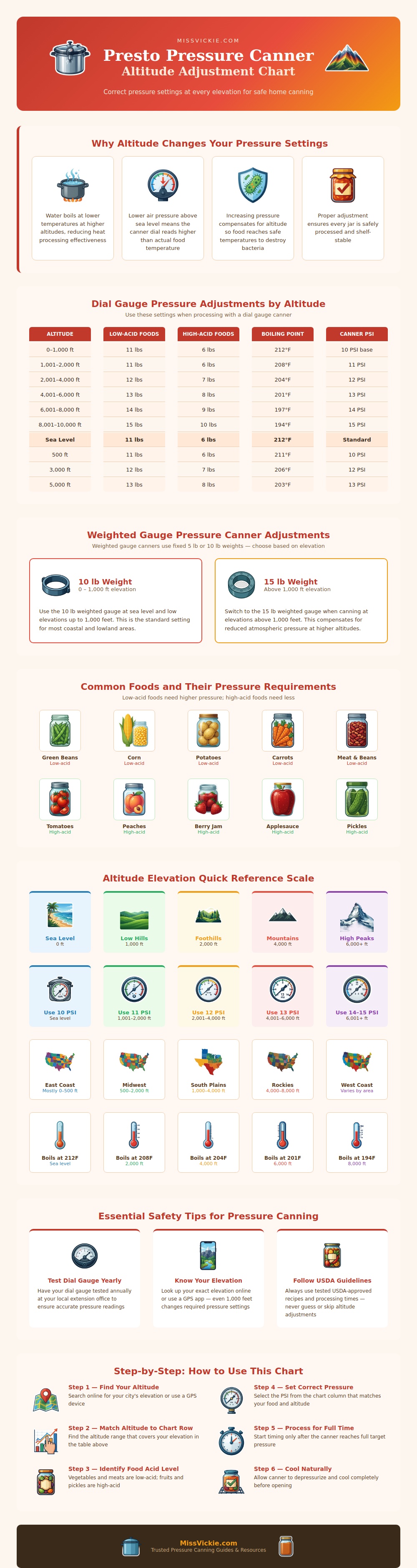
No matter how high up you live, you will need to make sure the water in your canner is hot enough. To compensate for thinner air, this will require more pressure as indicated on chart. For example, normally ten pounds of pressure would work for dial gauge canners processing low-acid foods such as potatoes or corn at sea level. But if you live a mere thousand feet uphill, a reading of ten pounds might simply not boil hot enough to reach safe temperatures. Raise that reading slightly to push the temperature back up into a safe range. The greater the pressure: the higher the boiling point.
Weighted gauge and dial gauge canners appear identical which confuses people. But they are totally different when it comes to adjustments. With a dial gauge, you see exact amount. As your elevation increases, you have to manually turn up the pressure accordingly.
A weighted gauge has fixed weights in the lid, which is supposed to rock and jingle and release steam. And yes, you can’t tweak those weights a half-pound at a time. When you reach an elevation limit, you swap out the entire weight. The ten-pound weight is used for low elevations. Above a thousand feet, you use the fifteen-pound version. It’s a binary system. This makes it hard to make mistakes because there is no room to guess if your needle is off a bit.
The other half of this equation involve figuring out if what you’re cooking is high-acid or low-acid. Low-acid foods such as vegetables, meats, and soups has a pH that allows dangerous bacteria to survive. Therefore, they must be processed at higher pressures to become safe. High-acid foods like fruits, jams, and pickles naturaly kill off these same bacteria with lesser amounts of heat, and thus can be set for lower pressure no matter where you live. What’s really at issue here isn’t density or toughness… It’s chemistry. Carrots and green beans requires more care than a jar of berry jam or peaches, for example, not because they’re tougher but because they aren’t.
Get familiar with your terrain before starting a batch: Use an online map tool or a GPS app to determine your actual elevation. Terrain ranges widely from county to county so don’t just rely on your zip code; use an online map tool or a GPS app to get your exact number before you go canning. Use that height with the right pressure range for your kind of canner.
Check your dial gauges at your local extension office to be sure they haven’t drifted. They do drift! When pressure reaches your desired setting, set your timer. Then wait until the pressure stabilizes there. When your canner cools down, let it cool all the way down until it clicks into place on its own.
Follow the process, trust the numbers. You won’t SEE what’s happening inside those jars, but the heat will do its thing, and that’s how we keep our families healthy and pantries well-stocked when harvest is long gone.