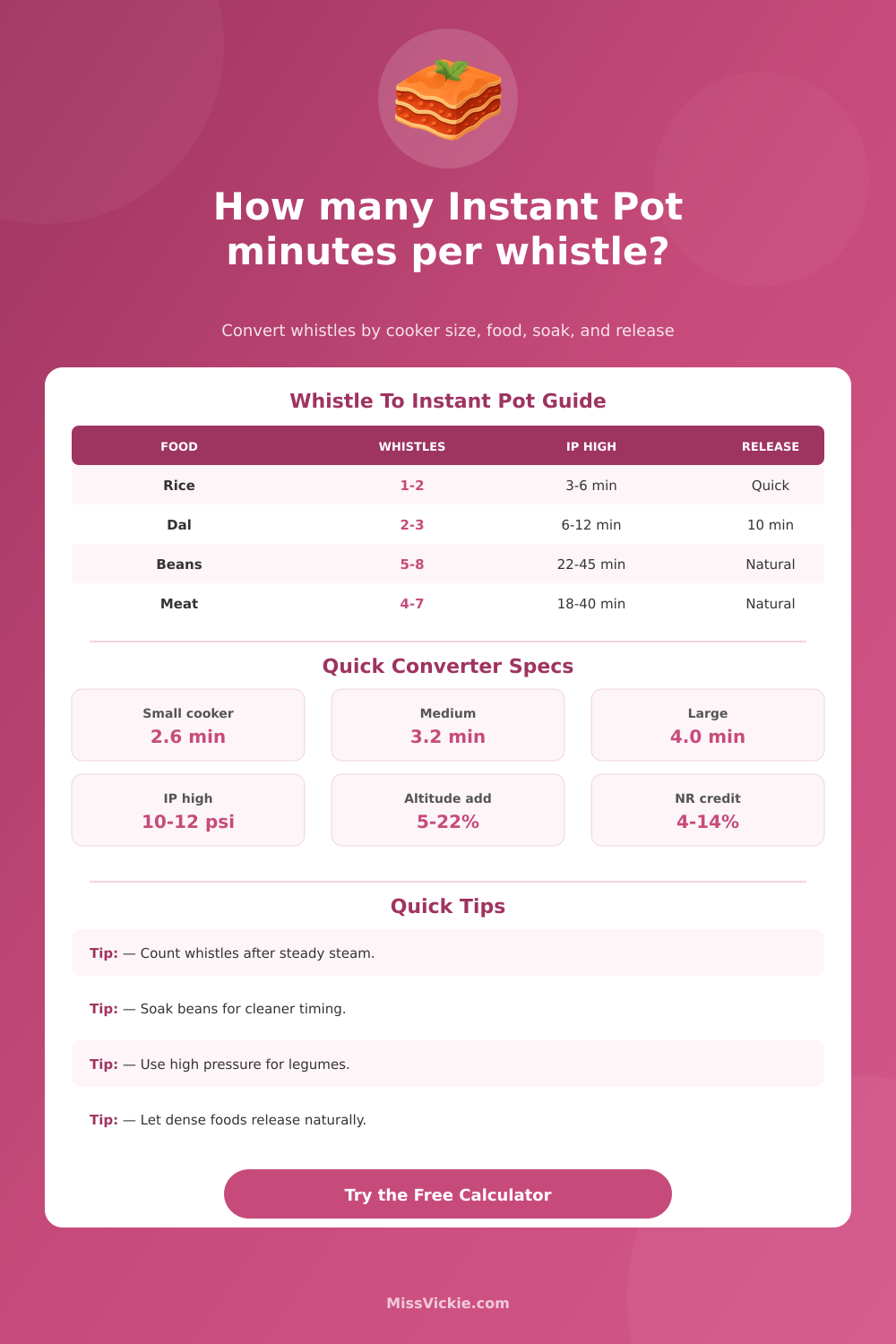
Whistle count, cooker size, pressure, soak, release, and altitude math
Pressure Cooker Whistles to Instant Pot Converter
Convert a stovetop pressure cooker recipe that says 1, 2, 3, or more whistles into an Instant Pot pressure time with release guidance and practical adjustment factors.
Load a common stovetop pressure cooker recipe, then adjust whistles, cooker size, ingredient, soak status, release style, pressure level, fill, texture, and altitude.
Conversion Breakdown
| Cooker Size | 1 Whistle | 3 Whistles | 5 Whistles | Best Use |
|---|---|---|---|---|
| Small 1.5 to 2 L | About 2.6 min | About 7.8 min | About 13 min | Rice, small dal, baby potatoes |
| Medium 3 to 5 L | About 3.2 min | About 9.6 min | About 16 min | Most family recipes and everyday curries |
| Large 6 to 8 L | About 4.0 min | About 12 min | About 20 min | Large bean batches, meat, meal prep |
| Jumbo 9 L or larger | About 4.6 min | About 13.8 min | About 23 min | Dense batches with slower heat response |
Whistles are not a universal timer. This converter treats each whistle as a pressure signal shaped by cooker size, heat retention, ingredient density, and release carryover.
| Ingredient | Typical Stovetop Whistles | Instant Pot High Range | Release Style | Soak Impact |
|---|---|---|---|---|
| White rice or pulao | 1 to 2 whistles | 3 to 6 minutes | Quick or 5 minute natural | Rinsing trims foam, soaking shortens slightly |
| Brown rice | 3 to 4 whistles | 18 to 24 minutes | 10 minute natural | Soaking reduces the long grain cook |
| Moong or masoor dal | 1 to 3 whistles | 4 to 10 minutes | 5 to 10 minute natural | Brief soaking makes it softer faster |
| Toor, chana dal, or urad | 3 to 5 whistles | 10 to 18 minutes | 10 minute or full natural | Overnight soak can reduce time by a third |
| Chickpeas or kala chana | 6 to 8 whistles | 28 to 45 minutes | Full natural release | Soaking is the biggest timing lever |
| Chicken curry pieces | 3 to 5 whistles | 8 to 18 minutes | 5 to 10 minute natural | No soak, but frozen starts need more time |
| Goat, lamb, or mutton | 5 to 8 whistles | 25 to 45 minutes | Full natural release | Cut size and connective tissue matter |
| Mixed vegetables | 1 whistle | 0 to 3 minutes | Quick release | Soaking does not apply |
| Adjustment | Pressure Time Effect | Release Estimate | When To Use |
|---|---|---|---|
| Quick release | No pressure-time reduction | 1 to 3 minutes | Vegetables, rice that should stay separate, delicate foods |
| 5 minute natural release | Small carryover reduction | 5 minutes plus venting | Rice, poultry pieces, medium-soft dal |
| 10 minute natural release | Moderate carryover reduction | 10 minutes plus venting | Most dals, beans, potatoes, saucy curries |
| Full natural release | Largest carryover reduction | 12 to 28 minutes | Beans, chickpeas, rajma, tough meat, foamy foods |
| High altitude | Add about 5 percent per 2,000 ft after 2,000 ft | Release can run longer | Mountain kitchens and very dry climates |
Whistles mark pressure cycling, so timing changes with burner heat, cooker size, gasket condition, and how hard the regulator vents.
Electric high pressure is usually lower than a classic stovetop cooker, so dense foods often need a small time increase.
Low pressure is gentler and much slower. It is useful for delicate foods, but poor for beans and tough meats.
Natural release keeps food cooking while pressure falls, reducing active pressure time for beans, dal, potatoes, and meat.
| Original Recipe Says | Start With This IP Setting | Check Texture | Common Adjustment |
|---|---|---|---|
| 1 whistle for vegetables | 0 to 2 minutes high, quick release | Vegetables should be tender but not collapsed | Use low pressure for very soft vegetables |
| 2 whistles for rice or soft dal | 5 to 8 minutes high, short natural release | Rice grains should hydrate through the center | Reduce by 1 minute for soaked rice |
| 3 whistles for toor dal | 10 to 14 minutes high, 10 minute natural release | Dal should mash easily against the pot side | Add 2 minutes for thicker dal |
| 5 whistles for meat curry | 18 to 30 minutes high, natural release | Meat should pull apart without rubbery edges | Add time for bone-in or large chunks |
| 7 whistles for soaked beans | 28 to 40 minutes high, full natural release | Beans should crush creamy, not chalky | Add 5 minutes for old beans |
Stovetop and electric cookers creates there pressure in slight different methods. Recipes that were created for stovetop cookers use the whistling sound as a means of determine when the cooker has reached the desired amount of pressure. Electric cookers use a set time in minutes as an indicator of when the pressure have been achieved.
In addition, stovetop cookers often reach higher rates of pressure than electric cookers. Therefore, cooking times is often shorter for stovetop cookers than electric cookers. To compensate for the lower rate of pressure that electric cookers reach, youll have to add additional minutes of cooking time to the recipe to achieve the same texture as the stovetop cooker.
Why Pressure Cooker Times Are Different
Another factor that may impact the cooking times for both stovetop and electric cooker is the size of the cooker. Small cookers will heat and release the steam from the food more quick than large cookers. Therefore, small cookers will reach the desired amount of pressure more quickly than large cookers.
Furthermore, large cookers will hold their heat for longer period of time. Thus, large cookers will take longer to reach the desired amount of pressure. The soak status of the ingredients that are to be cooked also play a role in the cooking time.
For instance, beans that are soaked overnight will cook different than beans that are dry and not soaked. Dry beans require more pressure cooking time than beans that have been soaked. Because of this difference, it is important to indicate whether the ingredient are dry, rinsed, quick-soaked, or overnight-soaked as this will impact the cooking time for those ingredients.
The release method for the cooked ingredients will also impact cooking time. For example, if you release the cooked ingredients quick, the cooking process will be stopped immediately. This is helpful for ingredients like vegetables or rice that are meant to be cooked to a certain texture and not beyond.
If the ingredients are released natural, they will continue to cook after the cooking cycle is complete. Foods that are dense to the touch benefit from being released naturaly so that they continue to be cooked after the heat element is turned off. One additional factor that may impact the cooking time and the process of build pressure in the cooker is the altitude at which the cooker is used.
At high altitude, water will boil at a lower temperature. Therefore, the rate at which the pressure builds will be more slower. Additionally, the altitude will lessen the cooking pressure at high altitudes.
In this case, the altitude should of been entered into a pressure cooker calculator so that the percentage increase to the cooking time may be determine so that the ingredient are cooked to the same doneness as they would be at sea level. The batch size for the cookers can impact the cooking times. For example, if the cooker is full of food, it will take longer to reach the desired amount of pressure.
Additionally, food will take longer to release the pressure if the cooker is full of food. Smaller batches of food will cook and cool more quick than large batches. Thus, cooking time may have to be adjust according to the size of the batch of food.
Another factor that will impact cooking time is the texture preference for the cooked ingredients. For example, some individuals may want their food cooked to the texture of mashed potato, while other individuals may like their food prepared to the texture of an al dente vegetable. A selection of firmness for the texture may range from firm to standard to soft.
Each of these textures will impact the amount of cooking time that are required to achieve the desired texture. Overall, a pressure cooker conversion tool is a helpful start for altering the cooking time of food from a stovetop cooker to an electric cooker. Although cooking time isnt an exact science with the different kitchen and burners and stoves in different homes, a conversion tool will help to find a starting point.
From that starting point, the food can be tasted to determine if the cooking time should be alter for the following meal.