
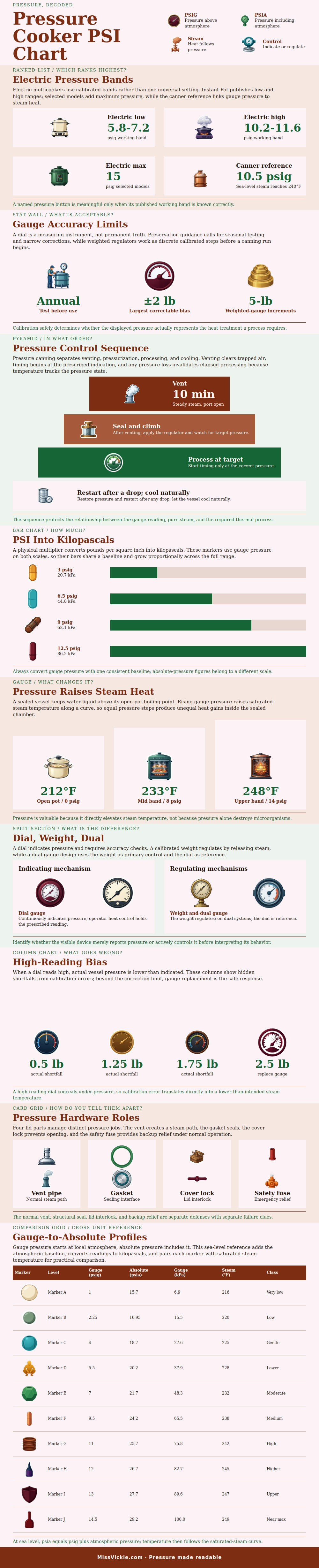
The hissing sound of your pressure cooker might have you afraid it’s going to explode, but there’s nothing complicated about its physics: It all boils down to understanding temperature in relation to pressure, which allows you to master the machine instead of fearing it. As you can see from chart above, pressure increase steam temperature, which explains why your food comes out cooked perfectly or undercooked.
Moddern electric multicookers have obscured the gauges beneath a set of high/low buttons. Press one and let the machine do its thing. However, learning what is happening inside can change how you use it.
How Pressure Cookers Work
Electric low is typically six to seven pounds of pressure higher than ambient (high goes up from there). Those aren’t random numbers, they corresponds to particular temperatures. Water reaches 212 degrees F at sea level, which is a good temperature for boiling rice but not hot enough to kill germs in a jar of jam. But when water is held inside closed space, the boiling point creeps upward. That increase is why this gadget exist. Pressure isn’t something you’re cooking under; it’s facilitating heat that would otherwise be unavailable.
Experienced home cooks can still get tripped up over the difference between absolute pressure and gauge pressure, which is key to reading the charts. Absolute pressure include the atmospheric baseline itself, whereas gauge pressure refer only to that number above the surrounding ambient air outside. To visualize that: The chart adds in the atmospheric constant to represent the actual total force being applied to your food. That’s important because processing times and safety guidelines is adjusted around those precise thermal states. Get those numbers mixed up, and you’ll have the timing wrong; and, ultimately, the results won’t be so good. A fine nuance, but it makes all the difference.
The difference between a weighted regulator and a dial gauge is key hardware in the infographic. And it’s also what gets really important when you start doing things like canning, which is where the precision doesn’t leave any wiggle room. The dial tells you what current pressure is; then you turn up or down the heat to keep it there. A weighted regulator vents out some steam as soon as the pressure hits a certain setting to control it physically. The dial reports on the situation. The weight regulates it.
Why does this matter? This is because a dial can be off. If your dial shows high when real pressure is actualy low, your jars aren’t being heated sufficiently. The chart says that even a half-pound shortfall in pressure could hide under-pressuring, and give you a dangerous false confidence about how safe your food was. That’s the thing they do wronger. They believe the number; they don’t check their instrument.
For safety, canners should of test their gauges annually (not suggested). Because gauges can go out of calibration without alerting you, and because they are only as good as their last check, they are not something you can trust if you haven’t tested them. As this visual breakdown shows, if your gauge is off by more than the safe range… Typically five pounds, you need to replace it instead of changing your recipe. Nothing will make up for a faulty gauge that gives you an incorrect temperature reading.
And it requires that we respect the order of operations: Vent, then pressurize; Set timer when the pressure has stabilized to the desired amount. Re-start timer if the pressure ever fall while in use. Why? Because these actions keep the gauge reading in step with actual heat level in the jar. Fail at any point and you break the chain.
All those elements, the vent pipe, the gasket, the lock, the safety fuse, all have unique functions related to controlling this energy. The vent makes the pathway. The gasket forms the seal. The safety fuse serves as our last line of defense. Each is a line of defense, and must be maintained accordingly.
So in conclusion: Pressure cooking is a collaboration between the laws of physics and your attention span. It’s about patience, not shortcuts. Once you realize that heat is what you’re after and pressure is simply the means to apply it, you’ll trust the hissing process instead of fear it. The numbers on the chart aren’t random data points, they’re the difference between a perfectly cooked meal and a ruined batch. Respect the curve and it will reward you more then it should.