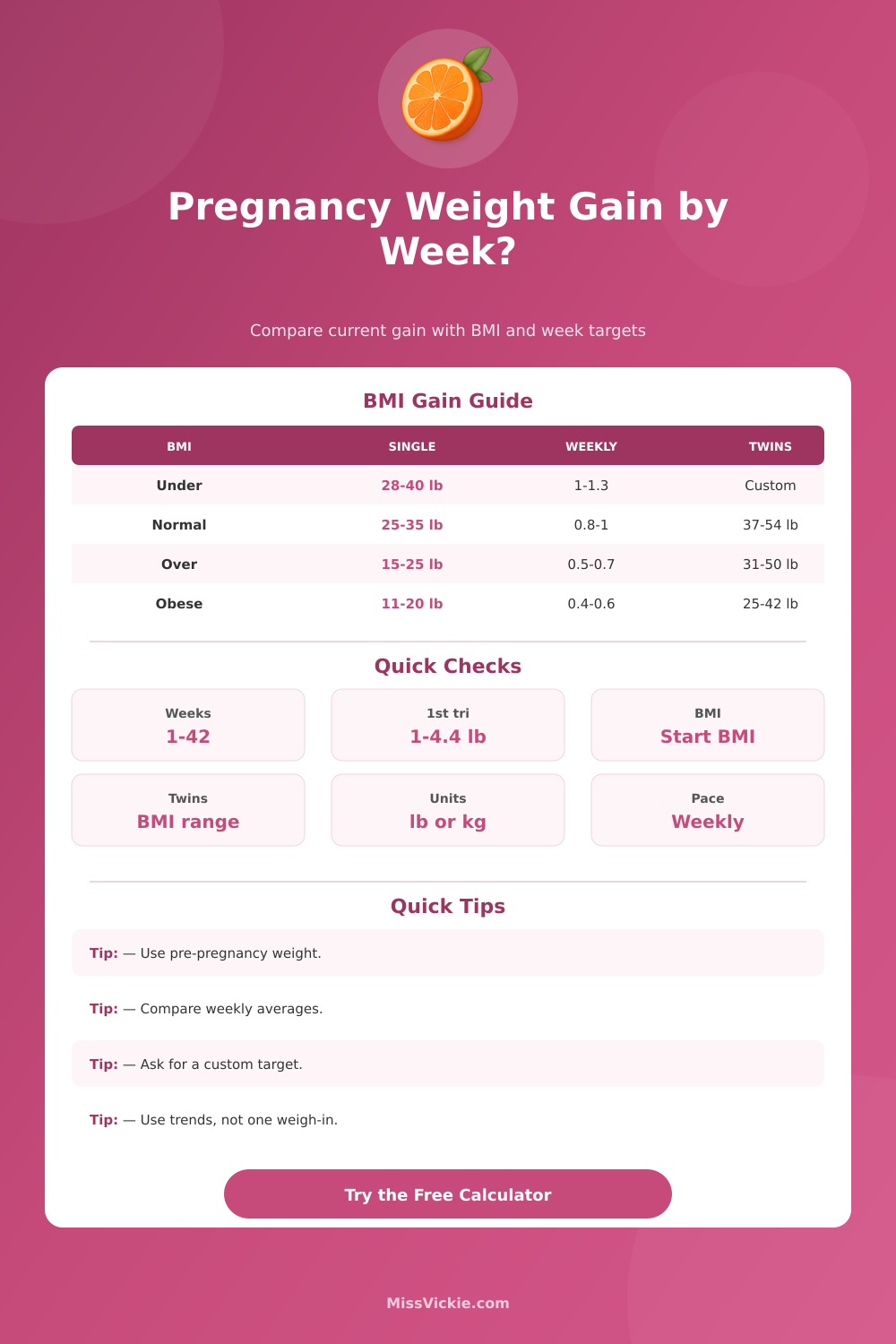
Starting BMI, pregnancy week, current gain, trimester, expected weekly pace, and target range
Pregnancy Weight Gain by Week Calculator
Estimate where current pregnancy weight gain sits against BMI-based total ranges, expected gain by week, weekly rate, trimester progress, and singleton or twin planning targets.
Choose a starting profile, then adjust the week, weight, and pregnancy type to match your own care team's target.
Weekly Pregnancy Weight Gain Breakdown
First trimester gain is usually modest, so this calculator spreads a small starting amount before week 14.
Singleton planning commonly centers near 0.8-1.0 lb per week in the second and third trimesters.
Overweight and obesity categories use lower total-gain and weekly-rate ranges for singleton pregnancies.
Twin targets are higher and more individualized, especially for underweight starting BMI.
| Starting BMI Category | Starting BMI | Total Gain Range | Second And Third Trimester Weekly Rate |
|---|---|---|---|
| Underweight | Below 18.5 | 28-40 lb (12.5-18 kg) | About 1.0-1.3 lb/week (0.44-0.58 kg/week) |
| Normal weight | 18.5-24.9 | 25-35 lb (11.5-16 kg) | About 0.8-1.0 lb/week (0.35-0.50 kg/week) |
| Overweight | 25.0-29.9 | 15-25 lb (7-11.5 kg) | About 0.5-0.7 lb/week (0.23-0.33 kg/week) |
| Obesity | 30.0 or higher | 11-20 lb (5-9 kg) | About 0.4-0.6 lb/week (0.17-0.27 kg/week) |
| Starting BMI Category | Total Twin Gain Range | Calculator Weekly Model | Planning Note |
|---|---|---|---|
| Underweight | Often individualized | Uses 50-62 lb only as a planning placeholder | Ask for a clinician-directed range because standard twin evidence is limited for this group. |
| Normal weight | 37-54 lb (17-25 kg) | About 1.3-1.9 lb/week after week 13 | The calculator spreads a 6 lb early gain, then trends toward the chosen total target. |
| Overweight | 31-50 lb (14-23 kg) | About 1.1-1.7 lb/week after week 13 | Use fetal growth, appetite, and clinician advice to interpret the weekly comparison. |
| Obesity | 25-42 lb (11-19 kg) | About 0.9-1.3 lb/week after week 13 | This is a general tracker and not a prescription for twin pregnancy weight gain. |
| Pregnancy Week | Trimester | Expected Progress Model | How The Calculator Uses It |
|---|---|---|---|
| Week 8 | First trimester | Small early gain or no gain can be common | Compares against a gradual share of the selected first-trimester model. |
| Week 13 | End of first trimester | About 1.1-4.4 lb in many general references | Sets the starting point for the second and third trimester weekly pace. |
| Week 20 | Second trimester | Weekly gain becomes easier to compare | Expected gain equals early gain plus the BMI-based weekly range. |
| Week 28 | Third trimester begins | More of the total target has already accumulated | Shows remaining gain and the pace needed through week 40. |
| Week 36 | Late third trimester | Weekly changes may include fluid and normal scale noise | Uses the comparison band so one weigh-in does not dominate the result. |
| Status | Calculator Trigger | What It Means | General Next Step |
|---|---|---|---|
| Below pace | Current gain is below expected gain by more than the selected band | The trend may be lower than the BMI-week model | Review appetite, nausea, vomiting, fetal growth checks, and individualized targets with a clinician. |
| On track | Current gain sits within the selected comparison band | The weekly trend is close to the selected model | Keep comparing weekly averages and update the inputs as pregnancy progresses. |
| Above pace | Current gain is above expected gain by more than the selected band | The trend may be higher than the BMI-week model | Discuss swelling, blood pressure, nutrition pattern, and target range at prenatal visits. |
| Custom pace | Custom weekly target is selected | The calculator follows your entered rate rather than the default midpoint | Use this for clinician-directed gain plans, twins, or special medical circumstances. |
Pregnancy weight gain are not always a straight line; pregnancy weight gain can vary from week to week for different individual. For some individuals, the weight may increase by a few pound in a given week, while for others the weight may increase by a significant amount during that same period of time. There are a variety of reason for these differences in weight gain for individuals; the time of year in which individuals weigh themselves, the amount of food that they ate the previous day, and the amount of fluid that they hold in their bodies can all play a role in the weight that an individual registers on the scale.
Because of the fact that pregnancy weight gain for an individual can be variable, many individuals turn to pregnancy weight gain calculator to determine if their weight gain is within the range that is considered normal and acceptable for that individual. The pregnancy weight gain calculator requires that an individual enter their height, their pre-pregnancy weight, their current weight, and their current pregnancy week into the calculator. Based upon these entries, the calculator can calculate the Body Mass Index (BMI) for the individual prior to the pregnancy.
How to Use a Pregnancy Weight Gain Calculator
Based upon the calculated pre-pregnancy BMI, the calculator can place the individual into a specific BMI category. Additionally, the pregnancy weight gain calculator can determine how the individual’s actual weight gain compare to the recommended weight gain for that individual’s BMI category. Another question that the pregnancy weight gain calculator asks is whether the individual is carrying one baby or twin.
Because twins results in different recommendations for weight gain then do single babies, the calculator must determine if this is true of the pregnancy that is being assessed. Based upon all of these variable, the pregnancy weight gain calculator can determine in what portion of the recommended weight gain range the individual is currently situated within the pregnancy, and it can indicate the amount of weight that the individual must gain each week for the remainder of the pregnancy to reach the recommended total weight gain. The pregnancy weight gain calculator also includes a question regarding the experience of the pregnancy in the first trimester.
For some individuals, they experienced nausea during the first trimester of their pregnancy, which resulted in very little weight gain (or even weight loss) during that trimester. For other individuals, they experienced hunger during the first trimester, which led to rapid weight gain during that period of time. The pregnancy weight gain calculator allows for an individual to answer this question, which then enables the calculator to change the expected weight gain line after the first trimester.
This calculation is helpful in allowing the individual to determine whether their weight gain is in alignment with the expected weight gain line. An individual’s BMI category is another factor that is used to calculate the recommended weight gain during pregnancy. Individuals who have a normal BMI prior to pregnancy are recommended to gain more weight during pregnancy than individuals who have a BMI that is in the overweight or obesity range.
Additionally, the expected weekly weight gain rate change according to the BMI category of the individual. The pregnancy weight gain calculator can determine the expected weekly weight gain rate for an individual based upon their BMI, enabling the individual to ensure that their weight gain is within the recommended parameter. Such a value can be adjusted within the pregnancy weight gain calculator to any different range that the individual wishes to compare to the actual weight gain that they are experiencing during pregnancy.
For pregnancies where the individual is carrying twins, the recommendations for weight gain differs from those who are carrying only one baby. The pregnancy weight gain calculator changes the recommendations for individuals who are carrying twins; twins require more pregnancy weight gain than single babies. The reason that twins require more weight gain during pregnancy includes the fact that there is more placental tissue, more amniotic fluid, and more fetal growth within the womb of the mother who is carrying twins.
However, these recommendation are only suggested to the pregnant individual, and a doctor may change them based upon the individual’s health and the results of an ultrasound examination of the fetus in utero. Finally, the pregnancy week can change the results of the pregnancy weight gain calculator. Now that you understand the different factor that can impact the accuracy of the pregnancy weight gain calculator, you can begin to use it as a tool to monitor your pregnancy weight gain.
The pregnancy weight gain calculator is not meant to use your current weight as a means of determining whether or not you need to take action with your pregnancy. In the early second trimester, you will have small weight gain that will make small difference in weight look large differences in percentage changes. By the third trimester, the same difference in weight will appear to be smaller percentage change due to the increased total weight of the pregnant mother and fetus.
The pregnancy weight gain calculator will help you to understand how much weight you should gain during pregnancy altogether, as well as how much weight you should gain each week to reach that target by the 40th week of pregnancy. By calculating the remaining weight that you should gain by the end of pregnancy, the calculator will help you to understand if your current rate of weight gain requires your attention. Your weight may fluctuate for a variety of reason during pregnancy.
The pregnancy weight gain calculator is designed to use trend in your weight rather than your current weight to determine your pregnancy-related figure. Additionally, you can use the calculator to determine your target weight gain range by trying different target weight for pregnancy. There are various medical condition and symptoms of pregnancy that may affect the rate at which you gain weight during pregnancy.
As such, the pregnancy weight gain calculator cannot account for these variable in your pregnancy, and will provide only general information about your pregnancy weight gain needs. The information from the pregnancy weight gain calculator is not a replacement for the care provided by your pregnancy clinician. The reference table that are provided with the pregnancy weight gain calculator include information regarding the expected weight gain for both singleton and twin pregnancies based upon the mother’s BMI.
These table also include the rate at which pregnant mothers should gain weight after the first trimester of pregnancy. These table can be read alongside your pregnancy weight gain calculator results to understand the reason for the recommended rate for each mother. Many women and pregnant mother believe that the target weight gain should always be the middle number within the recommended range.
The weight gain range for pregnancy does include some margin for error, though. The comparison band within the pregnancy weight gain calculator allow women to more accurately determine that target weight gain with some margin for error. The goal is for each pregnant mother to gain between the minimum and maximum amount of weight during pregnancy, and to avoid gaining either too much or too little weight.
Thus, the pregnancy weight gain calculator is designed to provide insight into this goal each week of pregnancy. By regularly using the pregnancy weight gain calculator, you can use the tool to understand your pregnancy weight gain trend. By using the same information each week, you can determine the change in the difference and remaining pace figures for pregnancy.
By understanding these changing figure, you can determine whether or not your pregnancy weight gain trend is stable or changing. This type of information can be shared with your pregnancy’s healthcare provider. Pregnancy weight gain is just one piece of information regarding the pregnancy.
Other important information regarding pregnancy includes fundus height measurement, growth of the fetus, blood pressure measurement, energy level, and appetite. The pregnancy weight gain calculator allows each pregnant mother to more accurately track this one piece of information regarding pregnancy, allowing for the woman to provide her healthcare provider with all the information regarding pregnancy that she can obtain.