☕ Pour Over Coffee Calculator
Calculate exact coffee weight, water volume, brew ratio, bloom water, and brew time
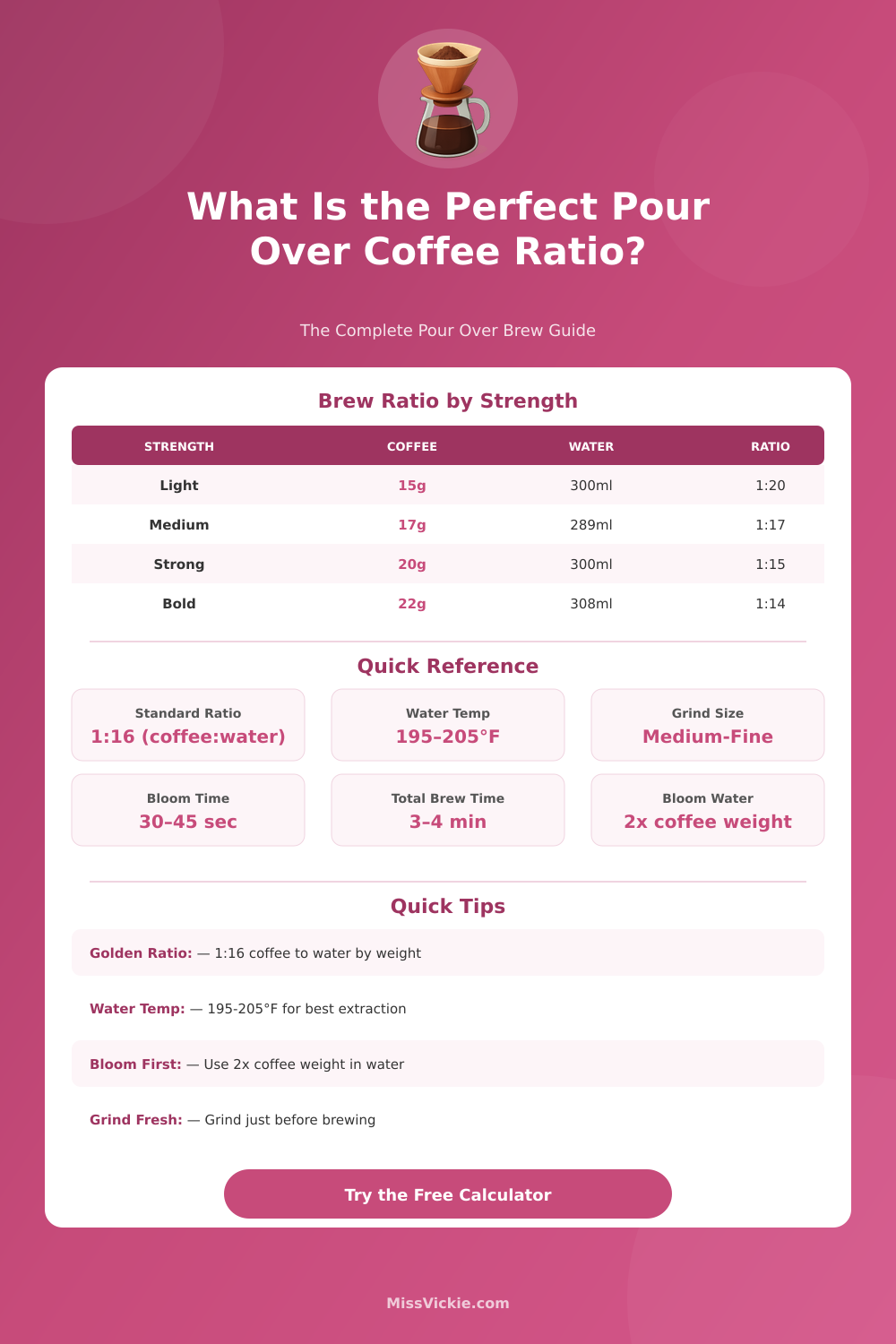
| Strength | Ratio | Coffee (g) | Water (ml) | Notes |
|---|---|---|---|---|
| Very Light | 1:20 | 15g | 300ml | Tea-like, very delicate |
| Light | 1:18 | 15g | 270ml | Good for light roasts |
| Medium-Light | 1:17 | 15g | 255ml | Bright, clean cup |
| Balanced | 1:16 | 17g | 272ml | SCA golden standard |
| Strong | 1:15 | 20g | 300ml | Bold, full body |
| Bold | 1:14 | 22g | 308ml | Very concentrated |
| Grind Size | Texture | Best For | Brew Time |
|---|---|---|---|
| Fine | Table salt | Espresso-style pour over | 1–2 min |
| Medium-Fine | Sand | V60, Kalita Wave | 2.5–3.5 min |
| Medium | Coarse sand | Chemex, drip | 3–4 min |
| Medium-Coarse | Rough sand | Chemex, cold brew | 4–5 min |
| Coarse | Sea salt | French press, cold brew | 4+ min |
| Temp (°F) | Temp (°C) | Best For | Effect |
|---|---|---|---|
| 195°F | 91°C | Dark roasts | Less bitter, smoother |
| 198°F | 92°C | Medium-dark | Balanced extraction |
| 200°F | 93°C | Medium roasts | Sweet spot for most |
| 202°F | 94°C | Medium-light | Highlights brightness |
| 205°F | 96°C | Light roasts | Full extraction, floral |
| Stage | Time | Water Amount | Notes |
|---|---|---|---|
| Bloom Pour | 0:00 – 0:45 | 2x coffee weight | Saturate all grounds evenly |
| First Pour | 0:45 – 1:15 | ~40% of total water | Slow, steady circular pour |
| Second Pour | 1:15 – 2:00 | ~30% of total water | Keep water level steady |
| Final Pour | 2:00 – 2:30 | Remaining water | Avoid disturbing grounds |
| Drawdown | 2:30 – 3:30 | — | Total target: 3–4 minutes |
Pour over coffee is a general name for any handmade brew method where you pour water over coffee grounds in a filter The water goes through the grounds before falling in the server, entirely without machine help. It seems simple; after all, you only pour water on grounds, right? There is more to it than that.
The ideal ratio coffee-to-water is 1:16, so one gram coffee for sixteen grams water. For a 20-gram dose coffee it works to 320 grams water. Without a scale you can use around two tablespoons coffee for a six-ounce cup as a rough guide.
How to Make Pour Over Coffee
Starting with good coffee matters. Buying grocery store coffee, especially pre-ground, is a waste of time. A good burr grinder is worth the investment.
Hand-operated models do not cost a lot and work well. Blade grinders do not work. The ground size can make or break the result, because it changes the flow of water through the filter in the cup.
Gooseneck kettles help control the pour, and a kettle with temperature control is great, because it keeps the wanted heat until the moment of use. A scale is really practical. The Jennings CJ4000 is a good model for around 25 dollars, very precise and durable.
Many specialty coffee shops use them.
To prepare, lay the carafe on digital scales and lay a filter, whether paper or metal. Pour the coffee, then zero the scale. Pour 50 to 60 grams water on the grounds and let them bloom during 45 seconds.
Blooming helps gases exit and improve the whole aroma. Later pour the rest of the water. For a 20-gram dose with 300 grams water, four equal pours of 60 grams, together with the bloom, reach the wanted weight.
A pause of 10 to 20 seconds between pours works well. The hole process should not last more than five minutes, otherwise bad tastes appear.
Different pour modes alter the coffee character. Central pour little moves the grounds, which is good for beans that easily become astringent. In a pour over, you have two extracts: by motion or by diffusion.
Flat bottom drippers give reliable extraction and great results. Many techniques and recipes exist, and most give good results. It depends on grind size, temperature and other details to adapt to your taste.
Too long brewing makes the coffee bitter, while low-quality beans, dirty gear or a bad ratio causes thin texture and flat feeling in the mouthfeel.