Poultry Seasoning Per Pound Calculator
Calculate dried poultry seasoning, salt, herb ratios, under-skin rub, stuffing seasoning, and batch reserve for chicken, turkey, duck, wings, thighs, and mixed poultry.
Pick a real kitchen scenario, then adjust bird type, skin, cooking method, herb intensity, sage, thyme, rosemary, stuffing, and reserve.
Your Poultry Seasoning Plan
Balanced herb and salt amounts for the selected bird.
Seasoning Breakdown
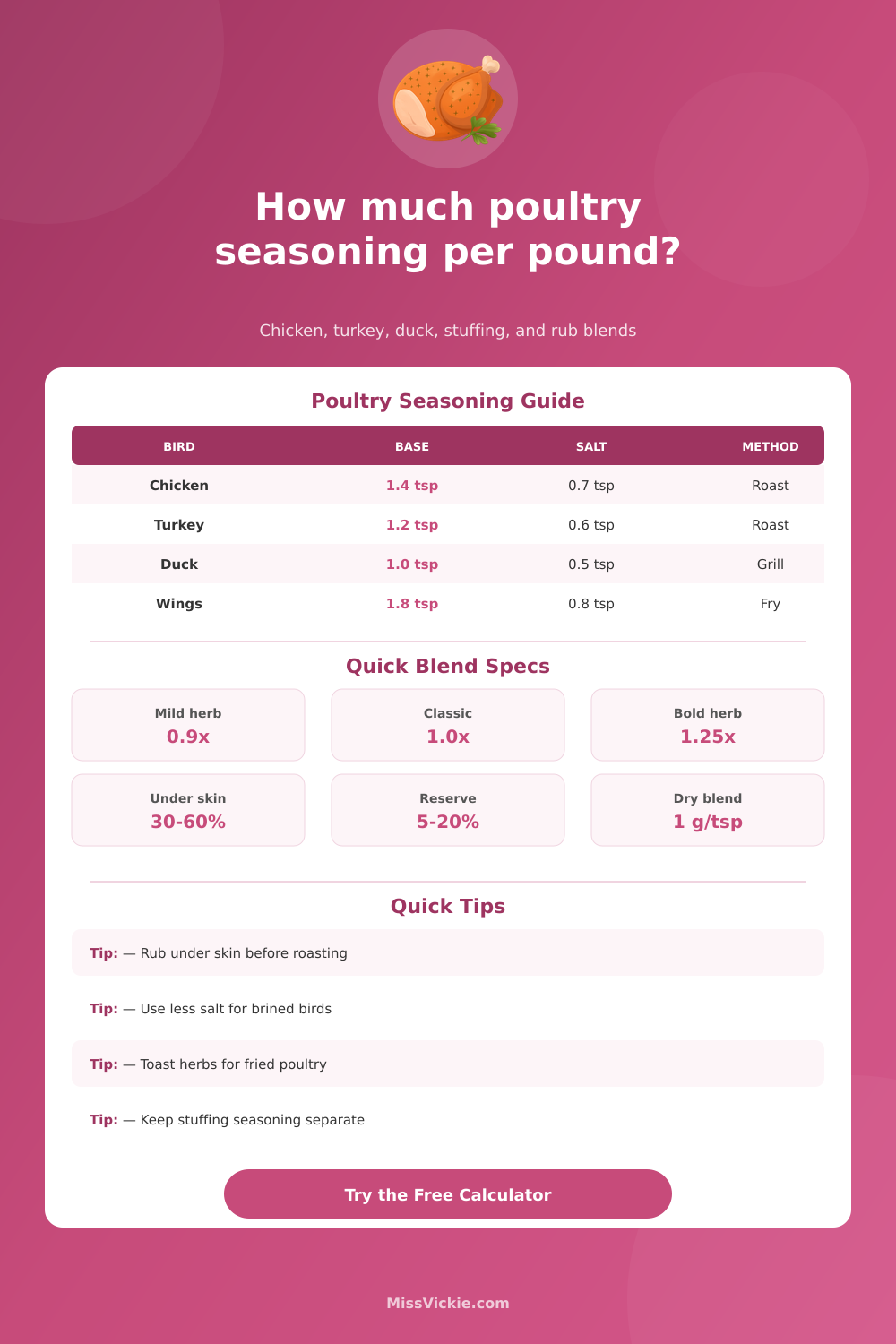
| Poultry Type | Herb Base Per Pound | Salt-Free Use | Best Application |
|---|---|---|---|
| Whole chicken | 1.4 tsp dried herbs | Good for roast chicken | Surface and under skin |
| Chicken breast | 1.2 tsp dried herbs | Keep sage moderate | Light coating or marinade |
| Thighs and legs | 1.6 tsp dried herbs | Handles bold thyme | Skin and underside |
| Wings | 1.8 tsp dried herbs | Use with dry coating | Season before frying |
| Turkey breast | 1.1 tsp dried herbs | Great with butter | Under skin rub |
| Whole turkey | 1.2 tsp dried herbs | Scale gently | Cavity, skin, and breast |
| Duck or goose | 1.0 tsp dried herbs | Use more thyme | Score skin and rub lightly |
| Mixed poultry tray | 1.5 tsp dried herbs | Balanced for pieces | Divide by piece size |
| Blend Choice | Herb Handling | Salt Per Pound | When To Reduce |
|---|---|---|---|
| Salt-free herb blend | Full calculated herb amount | Add 0.65 tsp kosher salt | Reduce for brined poultry |
| Kosher salt separate | Keep herbs and salt apart | 0.65 tsp Diamond Crystal style | Use less with salted butter |
| Salted poultry blend | Use blend as all-in-one | Assume 35 percent salt | Reduce on small pieces |
| Low-salt blend | Add herbs normally | 0.35 tsp salt equivalent | Keep for brines and stocks |
| Already dry-brined | Season with herbs only | 0 tsp added salt | Avoid salty pan drippings |
| Cooking Method | Herb Adjustment | Under-Skin Target | Practical Note |
|---|---|---|---|
| Roast or bake | Classic amount | 40 to 60 percent | Mix with butter or oil |
| Pan-fry or deep-fry | Add 15 percent | 0 to 25 percent | Use fine herbs in coating |
| Grill | Add 10 percent | 25 to 40 percent | Oil the skin lightly |
| Smoke | Add 20 percent | 25 to 40 percent | Smoke mutes delicate herbs |
| Air fry | Add 5 percent | 0 to 25 percent | Use less loose rosemary |
| Slow cook or braise | Reduce 10 percent | 0 percent | Add herbs to liquid too |
| Use Case | Extra Seasoning | Best Ratio | Batch Note |
|---|---|---|---|
| No stuffing | 0 tsp extra | Bird only | Reserve 5 to 10 percent |
| Light stuffing side | 0.25 tsp per cup | More thyme than sage | Keep separate from raw poultry |
| Cavity stuffing | 0.35 tsp per cup | Balanced sage and thyme | Season stuffing before filling |
| Large dressing pan | 0.45 tsp per cup | More sage works well | Make a reserve jar first |
Best for brined turkey, salted butter, gravy control, and cooks who season salt separately.
Useful for quick chicken pieces, but reduce the total amount when the skin is removed.
Places sage, thyme, rosemary, and salt closer to the meat instead of only on the surface.
Add 10 to 20 percent extra when filling a spice jar or holding seasoning for touch-ups.
For many home cooks, the act of seasoning falls on a scale: “just enough” (or “too little”) versus “too much.” But it’s realy about perception and surface area, do you realy know how much sage will be just right for that fresh chicken? Too little and you’ll get bland meat; too much and you’ll overpower the dish with herbs.
This calculator take care of all those math equations after you plug in what kind of bird you’re cooking and its weight. You won’t have to adjust mental ratios during the cooking process. It is just a plan with no more guesswork.
How to Season Poultry Perfectly
Some poultry isn’t equal to others when it comes to creating the flavor base. Leaner cuts like turkey breast has less meat relative to the amount of skin. A whole chicken have less meat and more skin to work with, which allows it to hold onto more seasoning before overpowering the dish. To adjust for that, the tool factors in how many pounds of herbs should goes into a pound of whatever you’re cooking: roasting a whole bird? Frying up some wings?
More herbs (and a heavy hand) is required for wings since there’s less meat per square inch of exposed skin. Season a wing like a tenderloin, and it taste like cardboard; season a breast like a wing, and it tastes like medicine. These categories help keep these rules separated, you don’t have to guess which applies to your cut.
And then there’s skin. Once more, skin changes everything. Not only does it protect the meat from drying out, it also create a surface upon which you can stick your herbs. When you choose skin-on in settings, the tool defaults to applying a regular amount of rub across the skin. Remove the skin, however, and you’re losing the surface area, which means relying further on inside flavor because now you’re not able to build it up on the exterior.
That’s where the under-skin application setting comes into play for roasting. By sliding the seasoning down between dermis and meat, the flavors soak straight through without just sitting atop it. It is a small technique, but one that makes a huge difference in how seasoned each bite ultimately taste.
The thing that realy burns people is the salt. That’s what the tool will help with. You’ll be able to tell it whether you’re working with a standard mix containing sodium or a salt-free blend, which are two completely different things. The reason this matters is obvious: if you’ve got a salty blend, any added kosher salt on top is going to be a bad idea. Ditto if you dry-brined or used a brine on your bird; all that sodium goes in via osmosis, so adding more post-meal is not an option.
The tool breaks the math into separate variables; herbs on one side, salt on the other, and gives you some control over each, which should of prevented any accidental doubling up. But herbs also has personalities. Rosemary is strong and piney, sage is earthy and bold, and thyme is subtle and floral. The calculator even give you the option to adjust how much of each herb goes into your final product (if you prefer not to go for a standard blend).
While rosemary pairs perfectly fine with a slow-roasted duck leg, you probably don’t want any in your chicken wings. That woody taste won’t pair with the crispiest skin you’re hoping for. By adjusting those components, you can season based off the way something will cook instead of simply reaching for a bottle of the shelf and hoping it’ll do.
The other cool part about this calculator is that it handles the math for you once you plug in your bird type and weight. The calculator handles the math once you plug in your bird type and weight, so you don’t have to constantly adjust ratios in your head while dinner is cooking. Other variables that can be overlooked include stuffing. No matter how many times you stuff herbs into the cavity of your bird, they won’t magically appear in your dressing unless you mix them in. And if you’re preparing a big batch of stuffing, you want a seasoning game plan for it too; the tool offers an additional calculation for dressing volume so you don’t wind up with a perfectly seasoned bird but some bland side-dish.
It keeps things in balance. Knowing when and how much of each ingredient to add is part of what makes great poultry. It’s about a little planning and a lot of respect for the ingredients. You don’t have to be a chef to get it right; you just have to know where everything goes and how much to add.
The calculator shows you the way; all you have to do is trust the process and follow it.