Potatoes Per Pound Calculator
Estimate potatoes per pound, total pounds, cooked yield, cup output, serving count, and peel loss using potato type, size grade, count, target cups, and serving style.
🥔Potato Presets
Pick a common kitchen plan, then adjust count, weight, size, peel loss, cooked or raw use, cup target, and serving style.
⚖Potato Count Inputs
Potato count estimate
Your potato count and yield estimate appears here.
Count Breakdown
Yield Breakdown
Cup Target Plan
📌Fast Potato Count Cards
🔍Potato Type Comparison Grid
Best baseline for baked, mashed, fries, and fluffy cooked yield.
Dense, creamy potatoes that hold shape after boiling.
Often smaller, good for salads, soups, and skin-on sides.
High piece count with small trim loss and fast boiling.
📊Potatoes Per Pound by Size
| Size grade | Average each | Potatoes per pound | Raw cups per pound | Best kitchen use |
|---|---|---|---|---|
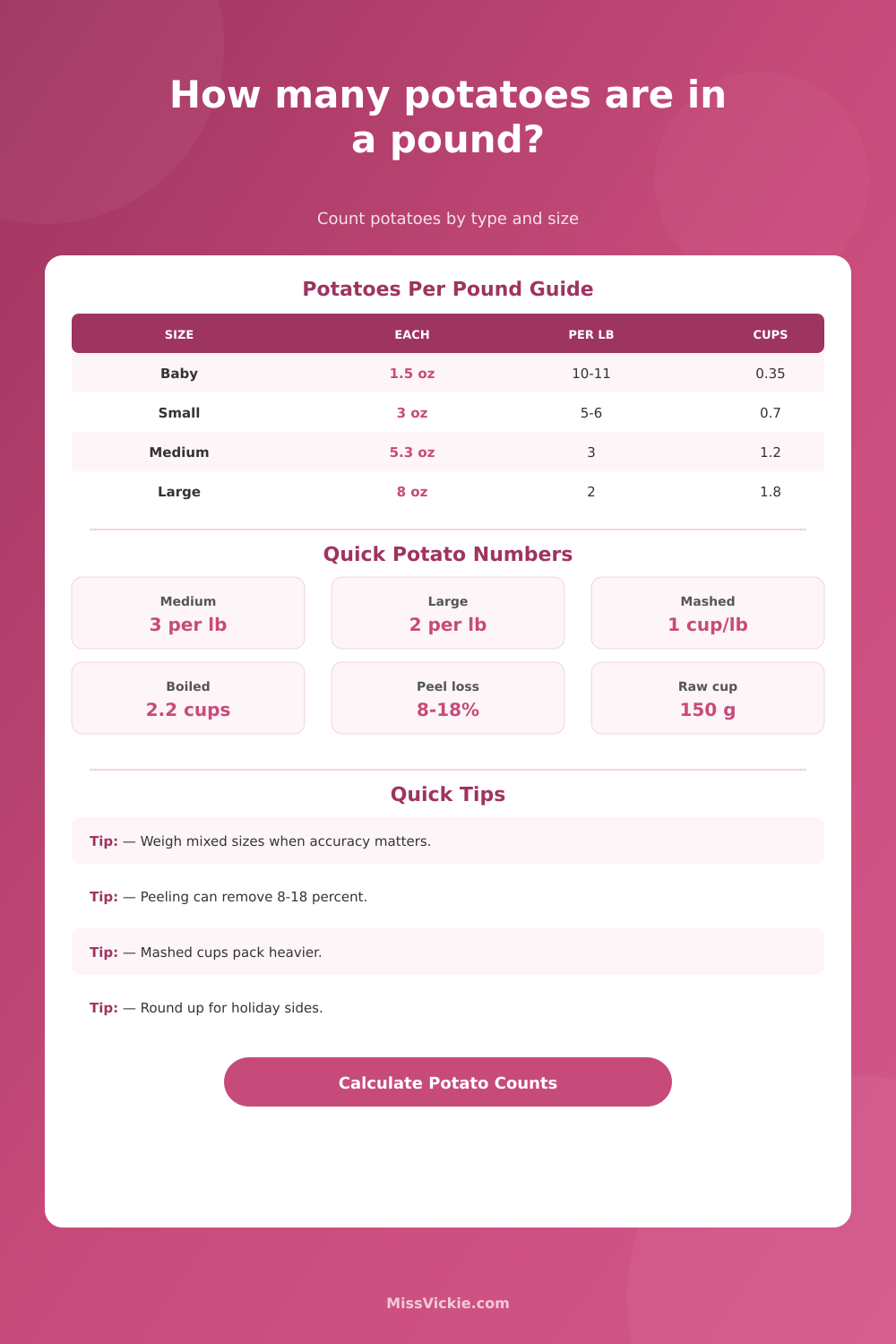
| Baby or creamer | 1 to 2 oz / 28 to 57 g | 8 to 16 | About 2.8 cups diced | Boils, skewers, sheet pans |
| Small potato | 3 oz / 85 g | 5 to 6 | About 2.7 cups diced | Soups, salads, mixed sides |
| Medium potato | 5.3 oz / 150 g | About 3 | About 2.5 cups diced | Mash, gratin, home fries |
| Large potato | 8 oz / 227 g | About 2 | About 2.4 cups diced | Baked potatoes, fries, wedges |
| Jumbo baker | 11 oz / 312 g | 1 to 2 | About 2.3 cups diced | Loaded potatoes and steakhouse sides |
| Mixed pantry bag | 4.5 oz / 128 g | 3 to 4 | About 2.5 cups diced | Everyday meals and casseroles |
🥘Yield and Cup Conversion Table
| Use state | Weight yield after cooking | Cups from 1 lb raw | Grams per cup | Planning note |
|---|---|---|---|---|
| Raw diced or shredded | 100% before peel loss | 2.4 to 2.8 cups | 140 to 170 g | Best for raw recipe volume and freezer prep |
| Boiled or steamed | 95 to 100% | 2.0 to 2.3 cups | 190 to 215 g | Good for potato salad, soups, and sides |
| Mashed potatoes | 90 to 95% | 1.0 to 1.4 cups | 300 to 360 g | Packs heavier because pieces are compressed |
| Roasted potatoes | 75 to 85% | 1.6 to 1.9 cups | 210 to 250 g | Moisture loss concentrates the final pan |
| Whole baked | 80 to 88% | Count based | One potato | Plan by pieces as much as pounds |
| Fries or wedges | 65 to 78% | 1.4 to 1.7 cups | 180 to 230 g | Cut size and browning change final yield |
🍲Common Cup Targets Table
| Recipe target | Raw pounds to buy | Medium potatoes | Large potatoes | Best size choice |
|---|---|---|---|---|
| 2 cups diced | About 1 lb | 3 medium | 2 large | Small or medium |
| 4 cups boiled | About 2 lb | 6 medium | 4 large | Yukon or red |
| 6 cups mashed | About 5 lb | 15 medium | 10 large | Russet or Yukon |
| 8 cups potato salad | About 4 lb | 12 medium | 8 large | Red or Yukon |
| 12 cups roasted | About 7 lb | 21 medium | 14 large | Mixed medium |
🍽Serving Planning Table
| Serving style | Cooked cups per person | Raw pounds for 4 | Raw pounds for 12 | Good use |
|---|---|---|---|---|
| Side dish | 0.65 to 0.8 cup | 2 to 3 lb | 6 to 8 lb | Dinner sides and family meals |
| Hearty main plate | 1.1 to 1.4 cups | 4 to 5 lb | 11 to 15 lb | Loaded bowls or potato-centered meals |
| Buffet or potluck | 0.5 to 0.65 cup | 2 lb | 5 to 7 lb | Many dishes on the table |
| Holiday side | 0.8 to 1 cup | 3 to 4 lb | 8 to 11 lb | Mash, gratin, and big sides |
| Potato salad scoop | 0.6 to 0.75 cup | 2 to 3 lb | 6 to 8 lb | Picnic bowls and BBQ plates |
| Baked potato each | 1 potato | 4 large | 12 large | Piece-count service |
💡Potato Count Tips
Potato size, moisture, storage age, and peeling style vary by kitchen. Use the estimate for shopping and prep planning, then season and portion by taste.
Maybe you’re making a meal plan, and don’t know how far 2 pounds of russet potatoes will go: Will they be enough? Or too much? How full the bowl get. Or make your guests feel?
Here’s why potatoes fool us into thinking we can never have enough: Diced cooked red potatoes, dressed up with vinaigrette, shrink from a big mound in the prep bowl to a smallish portion (but still filling). Mashed potatoes look modest, until you realize that same pound has become a dense, heavy serving that sits heavily on stomach. Mashed potatoes look modest; however, once served, they becomes a dense, heavy serving that sits heavily on the stomach.
How to Know How Many Potatoes You Need
But what’s that? Yes, the size grade of your starting potato is the biggest variable that people ignore. It seems like a potato is a potato. Nope; one ounce of a baby red is nothing like five ounces of a medium russet. One pound may be ten little creamers, or three big bakers. Why does that matter beyond your shopping list? Because that number factors in surface area, which will dramatically affect both cooking speed and peeling time. Buy bigger when you’re roasting whole spuds, for instance, to save oven space, but then risk underdoneness. Small guys gets done faster, without turning to mush on the outside.
Instead of struggling with a shapeless pile of potatoes, you can use the tool to see the tradeoff. You can see how much weight translates to how many actual pieces and therefore exactly how much you’re dealing with. But the yield is totally dependent on the way you cook them. Yes, there’s actually a lot of moisture loss going on.
Boil potatoes before making them into salad? Some of the water gets absorbed, but then those potatoes gets swollen up. You’ll have more cups per pound than if they had stayed raw. Fry them into wedges or roast ’em till crisp? That’s moisture that’s being driven off the surface. The volume decreases. This is why the reference table shows that one pound of raw potato can range from nearly three cups when boiled super-soft to just shy of one and a half cups when roasted so crisp it’s hard to chew.
What happened to all the potatoes? Nothing; it didn’t dissapear. Those air spaces between pieces of diced raw potato collapse as they’re cooked. The water weight simply goes away during the roasting process. Knowing about this change in density will help you avoid under-buying for dry recipes, like home fries. It will also help you avoid over-buying for wet recipes, such as soup.
Another element of your prep process is peel loss. Unless the recipe specifically states to do so, it assumes you’ll be peeling, though doing so will lose eight to eighteen percent of your potato’s final weight (depending on the thickness of a peeler’s strip). So if precision layering is required for your gratin, all that discarded skin equals purchasing extra weight, based off the raw weight called out in the recipe card. Peeling isn’t necessary when cooking with skins-on; not only does it save some time, but it increases amount of fiber as well. But it drastically alters the overall texture profile. You can alter the percentage here with the calculator. This is great if you’re working with smooth new spuds that don’t really need anything more than a flick of the finger, or a gnarly old bag of something that could use an aggressive scrubbing.
Finally, there’s the matter of serving size. For cooked potatoes, a half-cup per person will do as a side dish. For something served as a buffet or holiday meal (where guests are likely to graze), you’ll want to shoot for higher numbers. You need to account for a buffer because the difference between feeding four friends at dinner versus a dozen at a party is not just about math. With mashers, the answer is always “round up.” They’re cheap and comforting; it’s highly unlikely anyone’s going to leave leftovers uneaten. When they’re buttery and hot, folks will eat ’em up. Using these norms, the final output give the serving count, though your ultimate measure is; and should of (the appetite in the room).
Potatoes are humble, and they deserve our respect in the kitchen. Because potatoes are living roots, their density and water content vary, so they don’t neatly fit into familiar volume measures. To take control of your prep, estimate the number of potatoes instead of the weight alone. Then you’ll know exactly how big a job lies ahead: How many skins will I need to remove? When should I start boiling? How large a pan will it fill?
Never try to measure out a potato by the exact gram. Just make sure that when you lift the lid on the pot, there’s plenty left to share around the table… Not too little (that’d be bad), but also not a mountain of leftover mashed spuds that’ll haunt you later. Estimate first, use your eyes while you’re prepping and serve confidently.