Potato Boiling Time Calculator
Estimate potato boiling time from potato type, cut size, starting temperature, salt level, altitude, quantity, desired texture, and pot crowding.
🥔 Potato Boiling Presets
Choose a real kitchen setup, then adjust the cut size, batch weight, water start, salt, altitude, and texture target.
⚖ Boiling Inputs
Boiling estimate
Adjust the potato setup to estimate time.
Timing Breakdown
Pot and Serving Notes
Boiling Guidance
📌 Fast Potato Timing Cards
Best for soup, hash, and quick potato salad.
Standard mash and side-dish cut.
Baby, red, and new potatoes.
Large russets or white potatoes.
Minutes are active simmer estimates at sea level. The calculator adjusts them for potato type, water recovery, salt, altitude, quantity, and crowding.
📊 Potato Type Timing Table
| Potato Type | Texture Profile | 1 Inch Chunk Time | Whole Small Time | Best Boiled Use |
|---|---|---|---|---|
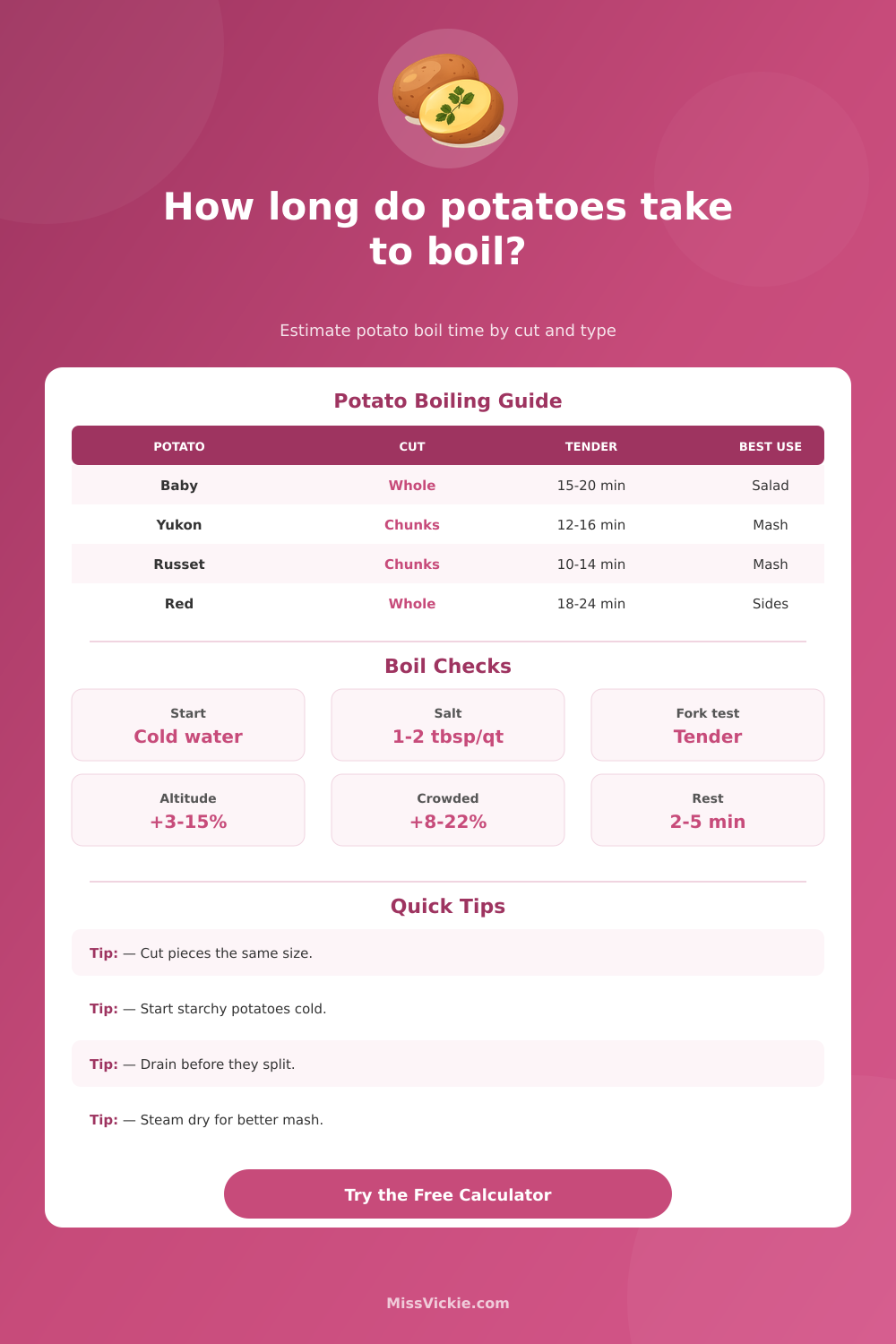
| Russet or Idaho | Starchy, fluffy, breaks down easily | 10-14 min | 18-24 min | Mashed potatoes, ricing, gnocchi base |
| Yukon Gold | Medium starch, creamy | 12-16 min | 18-25 min | Buttery mash, smashed potatoes, sides |
| Red potatoes | Waxy, firm, holds shape | 13-18 min | 18-24 min | Potato salad, stews, skin-on sides |
| White potatoes | All-purpose, mild | 12-17 min | 20-28 min | General boiling, soups, mash |
| Baby or new potatoes | Moist, thin skin, compact | Not usually cut | 15-20 min | Salads, buttered whole potatoes |
| Fingerlings | Waxy, narrow, dense | 10-14 min halved | 16-22 min | Side dishes, warm salads |
| Sweet potatoes | Soft, moist, lower starch | 12-18 min | 25-35 min | Mash, pies, bowls, purees |
| Purple potatoes | Dense, moderately waxy | 14-19 min | 20-28 min | Salads, colorful sides |
🔪 Cut Size and Texture Table
| Cut Size | Approx. Thickness | Parboil | Fork-Tender | Mashed Texture |
|---|---|---|---|---|
| Small dice | 1/2 in / 1.3 cm | 5-7 min | 8-11 min | 10-13 min |
| Standard chunks | 1 in / 2.5 cm | 7-10 min | 11-15 min | 13-18 min |
| Large chunks | 1 1/2 in / 3.8 cm | 10-14 min | 15-20 min | 18-24 min |
| Halved small | 1 1/4-2 in / 3-5 cm | 9-13 min | 14-19 min | 17-23 min |
| Whole small | 1 1/2-2 in / 3.8-5 cm | 12-15 min | 15-22 min | 20-26 min |
| Whole medium | 2 1/4-3 in / 5.7-7.6 cm | 18-23 min | 24-32 min | 30-38 min |
| Whole large | 3-4 in / 7.6-10 cm | 24-30 min | 32-42 min | 38-50 min |
⛰ Altitude, Salt, and Pot Loading Table
| Factor | Typical Setting | Timing Effect | What Changes | Best Adjustment |
|---|---|---|---|---|
| Sea level altitude | 0-2,000 ft / 0-610 m | Baseline | Water boils near 212°F / 100°C | Use normal simmer estimates. |
| Moderate altitude | 2,000-5,000 ft / 610-1,525 m | Add 3-8% | Lower boiling point slows starch softening | Keep the pot covered until boiling. |
| High altitude | 5,000-10,000 ft / 1,525-3,050 m | Add 8-15% | Boil is gentler even at full heat | Cut smaller or allow extra time. |
| Standard salt | About 1 tbsp per qt / L range | Nearly neutral | Better seasoning through the potato | Salt water before potatoes go in. |
| Crowded pot | Pieces stacked or packed | Add 8-22% | More heat recovery and less circulation | Use more water or split the batch. |
| Low water | Under 1 qt per lb / 2 L per kg | Add 4-12% | Pot cools sharply after adding potatoes | Cover by at least 1 inch / 2.5 cm. |
🍝 Yield and Serving Table
| Raw Potatoes | Cooked Drained Yield | Side Servings | Mash Servings | Water Suggestion |
|---|---|---|---|---|
| 1 lb / 0.45 kg | 0.95-1.05 lb / 0.43-0.48 kg | 3 small sides | 2 generous servings | 1.5-2 qt / 1.4-1.9 L |
| 2 lb / 0.9 kg | 1.9-2.1 lb / 0.86-0.95 kg | 5-6 sides | 4 mash servings | 2.5-3.5 qt / 2.4-3.3 L |
| 5 lb / 2.3 kg | 4.8-5.2 lb / 2.2-2.4 kg | 12-16 sides | 10 mash servings | 6-8 qt / 5.7-7.6 L |
| 10 lb / 4.5 kg | 9.5-10.5 lb / 4.3-4.8 kg | 25-32 sides | 20 mash servings | 12-16 qt / 11-15 L |
Potatoes can gain or lose a small amount of water during boiling. Peeling and overcooking create more surface loss; whole skin-on potatoes usually hold yield better.
🧪 Boiling Method Comparison
Best for russets, mash, and larger chunks because the center warms before the outside breaks down.
Useful for small waxy pieces, but the outside can soften before the center catches up.
Hold shape and absorb less water, but need a longer center check with a skewer or thin knife.
Cook predictably when pieces match in size; uneven chunks are the main cause of mixed texture.
💡 Potato Boiling Tips
Now that you know about how heat travels through foods, you don’t get your heart broken. You believe in physics of cooking, not just a clock.
And there’s an online tool (above) to do math for you, depending on what kind of potatoes you’re using and how they’ve been cut. No more guesswork: Is it going to take me ten minutes or twenty? Do I remember which chart say that about Russets? No. I just need to understand why things matter.
Simple Tips for Perfect Potatoes
All potatoes is treated by home cooks as though they were all the same kind of sponge. They’re not. For instance, Russet potatoes (starchy ones) contain a cell structure that quickly becomes mushy. That’s why when you boil them, they get all fluffy and perfect for mashed potatoes, but if you leave them in too long theyll fall apart.
Fatter types, such as fingerlings or other red waxy potatoes, don’t let go so readily. If you want your spuds to stay nice and chunky. Great for potato salad. Those are what you want. You choose a waxy variety and shoot for al dente. Choose a starchy type and wait until it is tender for mash.
It is a small difference. It has a big impact on how your meal turn out.
As for starting temperature: Most of us don’t know it’s important, but it is. If you add cold potatoes to boiling water, you cause a thermal shock that sets the exterior instantly while the interior lag behind. That results in uneven chunks that become a gummy mess on their edges. If you get them started in cool water, they warm up all over and cook evenly from core to skin.
The calculator factors in heat-up time to your overall estimate. And it guards against instinct to toss uncooked tubers into a roiling boil, thinking you can rushes things. No; we want gentle persuasion, not aggressive assault.
Salt, you wait til it’s too late, don’t you? When you add salt to the water, it serves two purposes: season the potato while it cooks, inside-out. It is better than adding salt after cooking when mashing with butter. Secondly, salting the water slightly raises the boiling point. That can save a minute (or two) on large volumes.
People under-salt because they’re afraid the water will taste too salty. Trust the ratio. Use the calculator to see how much salt you need for your amount of water. You won’t have to rescue bland potatoes with extra butter anymore.
Now, if you’re up in altitude, that’s another story. As elevation increase, the boiling point of water drops (remember: less air pressure = lower temp). So while your pot might appear to be vigorously boiling, it’s actually just barely simmering and softening the starches ever-so-slowly. To compensate, the tool takes into account altitude, adding a percentage buffer.
That way, you don’t make mistake of assuming “the clock says” the potatoes are ready, and therefore time’s up. Nope, they’ll tell you when they’re ready; and they will only do so when they give up. Which means. You guessed it, always use a knife or fork to test before draining. Regardless off the algorithm’s prediction.
Perfect texture depends on no crowding. If you put too many potatoes in your little pot, the water gets cold. It will take FOREVER for it to get warm again, which stunts the cooking of some and not others. To make up for pot crowding, this calculator accounts for it in your time line. Please break up big batches and add more water if needed. Two smaller pots are preferable then one overcrowded disaster.
Once you’ve drained them, you give the potatoes a couple of minutes to steam dry… No need for any extra water on the surface, which will just dilute whatever dressing or butter you’re adding. The result is a firmer salad and creamier mash.
Boil, yes. But mastery? That’s in knowing how long heat needs to work. No forcing.