MissVickie Roast Planner
Pot Roast Cooking Temperature Calculator
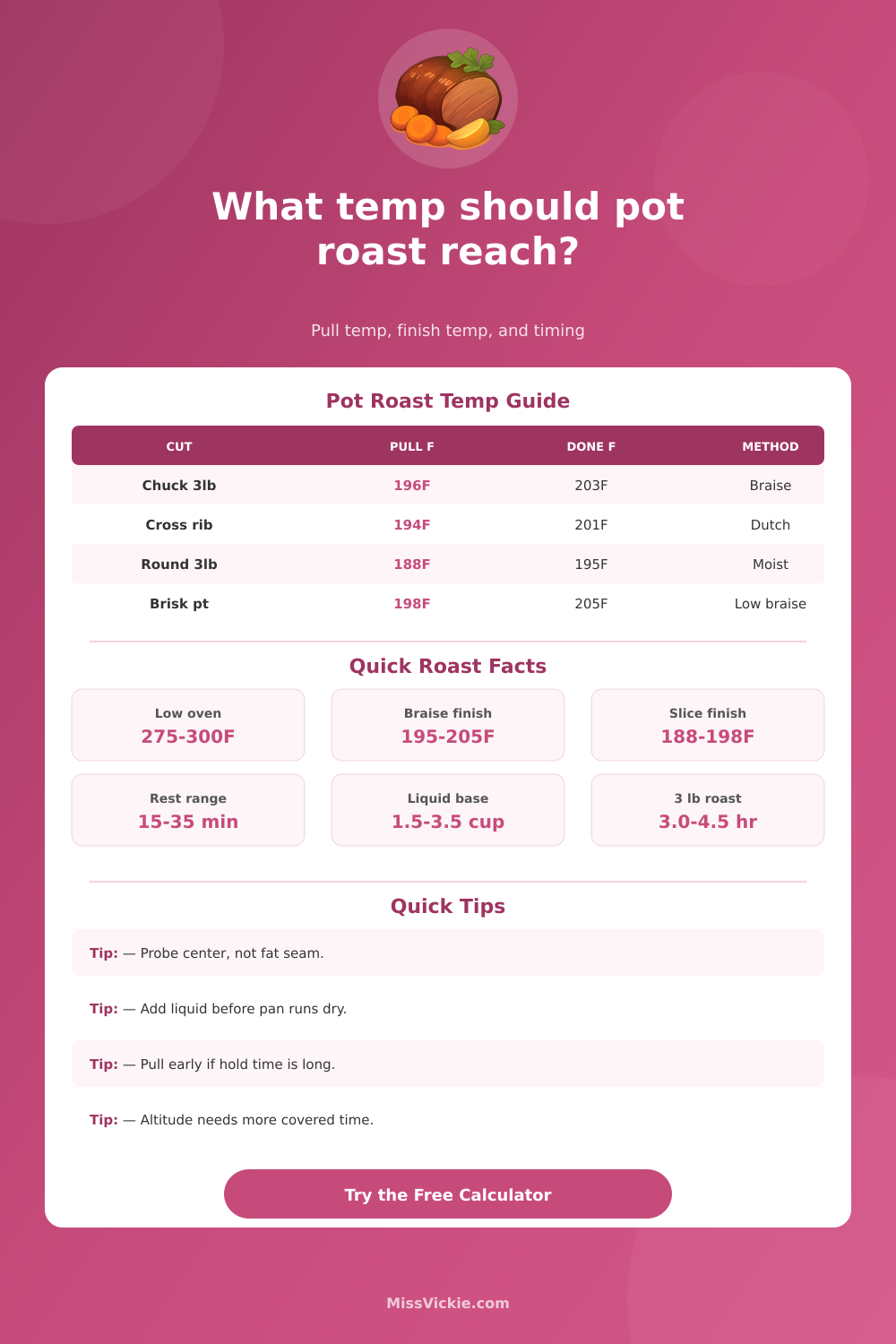
Set pull point, finish point, covered roast time, and liquid plan for classic pot roast. Use presets for chuck, cross rib, brisket point, and round cuts, then tune by weight, method, and altitude.
Fast Presets By Cut, Size, and Method
Each preset loads a real-world baseline. You can still edit every field after loading.
Roast Inputs
Use at least weight, cut, and method. The rest improve timing and temperature precision.
Calculated Roast Targets
Pull Temp
-
Before rest
Finish Temp
-
Texture zone
Roast Time
-
Covered cook
Hold Window
-
After done
Method Comparison Grid
Use this quick grid to choose a roast path before you calculate.
Dutch Braise
Covered Oven
Low and Slow
Hybrid Finish
USDA-Style Pot Roast Reference Tables
Reference bands for safety and tenderness planning. Use them as guideposts, then verify with your probe.
| Stage | Min F | Target F | Hold | Note |
|---|---|---|---|---|
| Safe base | 145F | 145-150F | 3 min | USDA min |
| Warm slice | 160F | 160-170F | 5 min | Not tender |
| Braise set | 180F | 180-190F | 10 min | Starts soft |
| Classic | 190F | 195-203F | 15 min | Fork easy |
| Shred zone | 200F | 203-208F | 20 min | Pull apart |
| Cut | Slice F | Classic F | Shred F | Best path |
|---|---|---|---|---|
| Chuck | 188-194F | 196-203F | 203-208F | Dutch |
| Cross rib | 186-192F | 194-201F | 202-206F | Low slow |
| Blade | 187-193F | 195-202F | 203-207F | Dutch |
| Brisk pt | 190-196F | 198-204F | 204-209F | Low slow |
| Btm rnd | 184-190F | 192-198F | 198-202F | Cover ovn |
| Top rnd | 183-189F | 191-197F | 197-201F | Hybrid |
| Rump | 184-190F | 192-199F | 198-203F | Hybrid |
| Clod | 189-194F | 197-203F | 203-208F | Low slow |
| Method | Oven F | Lid type | Rate lb/h | Liquid |
|---|---|---|---|---|
| Dutch | 285-315F | Tight lid | 0.7-1.0 | 2-3 cup |
| Cover ovn | 300-330F | Foil/top | 0.8-1.2 | 1.5-2.5 |
| Low slow | 255-285F | Tight lid | 0.5-0.8 | 2.5-3.5 |
| Hybrid | 295-320F | Loose lid | 0.7-1.1 | 2-3 cup |
| Wt lb | Base hr | Low slow | Cover ovn | Rest min |
|---|---|---|---|---|
| 2.0-2.9 | 2.4-3.2 | +30 min | -10 min | 15-20 |
| 3.0-3.9 | 3.2-4.2 | +35 min | -10 min | 20-25 |
| 4.0-4.9 | 4.0-5.0 | +40 min | -15 min | 25-30 |
| 5.0-5.9 | 4.8-5.9 | +45 min | -15 min | 30-35 |
| 6.0-7.0 | 5.8-6.8 | +50 min | -20 min | 35-40 |
Two Practical Tip Boxes
Texture Control Tips
- Slice test at 190F for lean cuts.
- Shred test starts near 203F center.
- If tight, add 10F and recheck.
- Rest longer for cleaner slices.
- Deep sear can speed center rise.
Moisture Control Tips
- Keep liquid at one third height.
- Loose lid needs more liquid checks.
- High altitude needs extra broth.
- Foil seal cuts evaporation loss.
- Add hot stock, not cold water.
A pot roast can become tough if you dont correctly transform the connective tissue into gelatin. Connective tissue are one of the parts of the roast cut that must melt into gelatin. The chemical reaction that transforms the connective tissue into gelatin dont occur on a set schedule because the chemical reaction depends upon the temperature and the length of time that the roast is cooked in an oven.
The transformation of the connective tissue into gelatin is a process that must be understood and one that must be followed to ensure the success of cooking a pot roast. The cut of the roast that you choose will play a major role in your cooking process for the roast. A chuck roast is one of the best roasts to cook because it contains high amount of fat and collagen.
How to Keep Your Pot Roast Tender
The fat will aid in the rendering of the collagen into gelatin, which will contribute to the tenderness of the roast. Other roasts that are leaner contain less fat and collagen, meaning that they wont contain as much collagen to turn into gelatin. Because of this, lean cuts can become dry very quick.
To prevent this from happening, cooks should use a lower target temperature when preparing these leaner cut of roast. The equipment used will play a major role in the moisture of the roast. A Dutch oven is an ideal cookware to use for a pot roast preparation because it comes with thick walls and a tight lid.
By cooking the roast in a Dutch oven with a tight lid, the steam created inside the pot will create a pressurized environment. The pressure of the steam will allow for the humidity inside the pot roast to remain high. High humidity ensure that the roast will not dry out during the cooking process.
Using a foil cover or a loose lid will allow the roast to evaporate more quickly. This evaporation of the liquid from the pan will cause the liquid to dissapear and the roast to cook in the oven instead of in the braising liquid. The result of this can be a roast that contains a tough exterior.
The altitude at which you are cooking will impact your preparation of the roast. At high altitudes, water boils at a lower temperature then at lower altitudes. Because the braising liquid cannot reach high temperatures at high altitudes, the gelatinization of the collagen will take place at a slower rate.
To compensate for this, cooks should adjust the cook time and the levels of liquid in which the roast is cooking at high altitude so that the roast will properly turn into gelatin. A pull temperature should be used to extract the roast from the oven. When the roast reaches the target temperature, you should remove it from the oven slightly before reaching the target temperature.
After removing the roast from the oven, the continued cooking of the roast is referred to as carryover cooking. During carryover cooking, the roast continues to cook after being removed from the heat source. If the roast is removed from the oven at the target temperature, the carryover cooking will result in an overcooked roast.
If the roast is removed from the oven at the pull temperature, however, the carryover cooking will result in a roast that has reached the tenderness zone. After the roast has been removed from the oven, it should be allowed to rest for twenty to thirty minutes. All muscle fibers in the roast will tighten when it is cooked, which will force the liquid from the roast to move towards the center of the roast.
If you slice the roast right away, the liquid will exit the roast, which will result in a dry roast. Through allowing the roast to rest, the muscle fibers will reabsorb the liquid from the roast, which will ensure that the roast remains juicy. A meat probe should be inserted into the roast to measure the internal temperature of the roast.
Insert the probe into the center of the roast, but avoid the fat and bones of the roast. If you only measure the internal temperature of the roast with the meat probe, the reading wont be accurate. If the roast feels tight with the meat probe, continue cooking the roast for ten or fifteen minutes.
Because the breakdown of collagen into gelatin is not a linear process, it is possible that some roasts will require more time to complete the process of turning collagen into gelatin.