Calories, meals, plate method, food groups, hand portions, macros, and serving size
Portion Control Calculator
Build a practical meal portion plan from your daily calorie target, meal count, snack budget, plate method, selected foods, hand-size guide, macro profile, and serving-size preference.
Pick a real-life eating setup, then adjust calories, meal count, foods, hand portions, and serving size for the meal you are planning.
Portion Breakdown
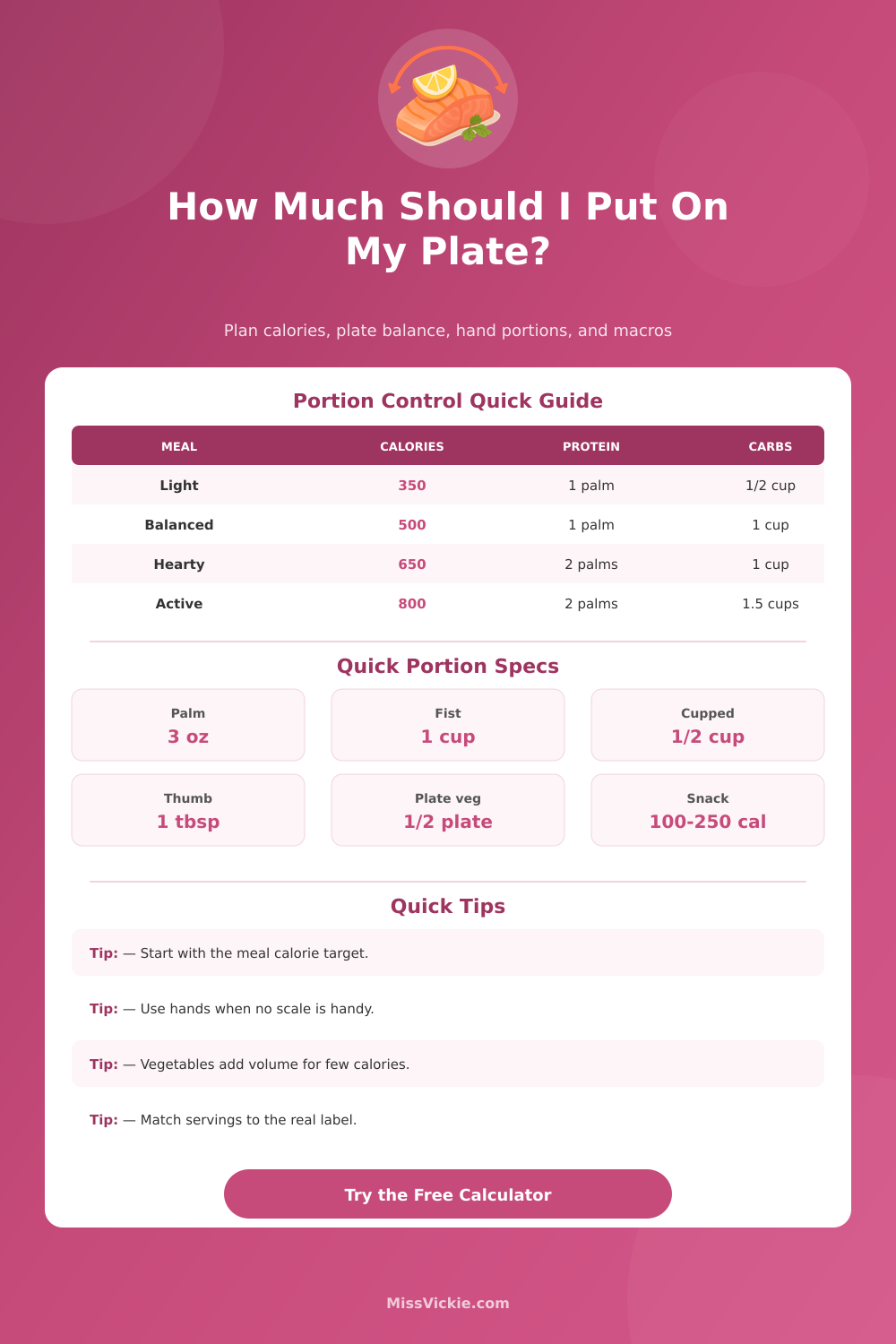
Cooked lean protein uses one palm as about 3 ounces.
A cupped hand is about half a cup of cooked grain or starch.
One fist is roughly one cup of bulky vegetables or fruit.
One thumb is about one tablespoon of oil, dressing, or spread.
| Daily target | 2 meals | 3 meals | 4 meals | Snack note |
|---|---|---|---|---|
| 1,400 calories | 650 each | 420 each | 300 each | Allows about 100 calories for one snack. |
| 1,800 calories | 825 each | 550 each | 400 each | Allows about 150 calories for one snack. |
| 2,000 calories | 925 each | 615 each | 450 each | Allows about 150 calories for one snack. |
| 2,400 calories | 1,100 each | 730 each | 540 each | Allows about 200 calories for one snack. |
| 2,800 calories | 1,275 each | 850 each | 625 each | Allows about 250 calories for one snack. |
| Plate method | Vegetables or fruit | Protein | Starch or grain | Fat or sauce |
|---|---|---|---|---|
| Balanced plate | About 1/2 plate | About 1/4 plate | About 1/4 plate | Small thumb-size accent. |
| Protein-forward plate | About 2/5 plate | About 1/3 plate | About 1/5 plate | Moderate measured fat. |
| Plant-forward plate | About 1/2 plate | Beans, tofu, or yogurt | Whole grain or starch | Nuts, seeds, or dressing. |
| Lower-carb plate | About 1/2 plate | About 1/3 plate | Small starch portion | Measured fat for flavor. |
| Active fueling plate | About 1/3 plate | About 1/4 plate | About 1/3 plate | Moderate fat, not hidden. |
| Light meal plate | About 1/2 plate | Lean palm portion | Half cupped-hand starch | Small sauce portion. |
| Food group | Common serving | Hand guide | Typical calories | Portion note |
|---|---|---|---|---|
| Cooked lean meat or fish | 3 to 5 oz | 1 to 1.5 palms | 140 to 300 | Use cooked edible weight, not raw package weight. |
| Beans, lentils, or tofu | 1/2 to 1 cup | 1 cupped hand to 1 fist | 110 to 240 | Counts as protein and carbohydrate for many meals. |
| Cooked rice, pasta, oats, quinoa | 1/2 to 1 cup | 1 to 2 cupped hands | 80 to 225 | Cooked volume changes with water and softness. |
| Non-starchy vegetables | 1 to 3 cups | 1 to 3 fists | 25 to 120 | Volume is high while calories are usually low. |
| Oils, dressing, nuts, cheese | 1 tbsp or 1 oz | 1 thumb or small handful | 80 to 180 | Small extras can move calories quickly. |
| Macro profile | Protein | Carbohydrate | Fat | Best planning use |
|---|---|---|---|---|
| Balanced macros | 25% | 45% | 30% | Everyday mixed meals with grains, produce, and protein. |
| Higher protein | 35% | 35% | 30% | Meals where protein is the anchor and starch is moderate. |
| Higher carb | 20% | 55% | 25% | Active days, endurance meals, or carb-centered plates. |
| Lower carb | 35% | 25% | 40% | Lower-starch meals with measured fats. |
| Plant-based balance | 22% | 50% | 28% | Beans, tofu, whole grains, vegetables, seeds, and nuts. |
| Moderate-fat plate | 25% | 35% | 40% | Meals with avocado, nuts, dressing, cheese, or sauces. |
Portion control is a method of controlling the amount of food that a person consumes. Portion control requires both the mathematical calculation of the amount of food that a person need to consume each day, as well as the application of that calculated amount each day. Many people struggle with portion control because visually measuring the amount of food that a person consumes does not always reflect the amount of calories that that food contains.
For instance, a portion of chicken that is the size of a person’s palm may contain between 3 and 5 ounce of chicken. Similarly, a portion of rice that is the size of a persons cupped hand may contain between 0.5 and 0.75 cup of rice. The calculator that is provided can assist a person in manage these mathematical requirements.
How to Control Food Portions
Not all meals serve the same purpose within a day. Because each meal does not have the same purpose, each meal does not need to contain the same amount of calories. For instance, the calories within a light breakfast may be less than the calories that are contained within a dinner that is consumed following strenuous exercise.
A dinner that is consumed after exercise may contain 36% of the calories that are consumed daily, while the breakfast may contain only 22% of the calories that is consumed daily. The calculator allows for the calories of each meal to be adjusted according to the purpose of each meal. If the calculator does not account for the roles and percentages of each meal, it is likely that the calories that are allocated to the dinner will be too high for that meal, which could result in the individual consuming too many calorie each day.
Hand portions are often used to control the amount of food that is consumed by an individual. The benefit of using hand portions is that they travel with the individual and dont require a kitchen scale or food labels to measure food portions. Portions of food can be measured by the size of a persons palm, fist, cupped hand, or even thumb.
The advantage of using hand portions is that if an individual has smaller hands, they will naturaly consume smaller portion of food. Conversely, if an individual has larger hands, they will naturaly consume larger portions with each meal. The hand-portion calculator can adjust for the size of an individuals hand to ensure that the portion of food measured by their hand will contain the calories that are targeted by the individual.
The plate method and hand portion methods is two different methods of portion control. Hand portions help an individual to control the weight and volume of the foods that are consumed. The plate method, however, helps an individual to control the proportion of the food that is consumed.
For instance, an individual can use the plate method to determine that half of the plate should be vegetables, a quarter of the plate should be protein foods, and a quarter of the plate should be starch. The portion calculator can help an individual to determine how many gram of each food group are required to meet the individuals targeted calories. The specific food groups that are selected for each meal will impact the total number of calories that are consumed by an individual each day.
For instance, if chicken breast is chosen for a meal as opposed to firm tofu, the caloric content of the meal will be different. Similarly, if rice is chosen as the starch food for a meal as opposed to oats, the caloric content of the meal will also be different. These differences in caloric content within food groups may be small within a single meal, but can be significant if the same meal is consumed each day for a full week.
The portion calculator allows for these food densities to be accounted for within the meal plan that is generated for an individual. Many individuals do not consider the portion of snacks that are consumed by an individual each day. However, the portioning of snacks is another necessary component for maintaining the portion control budget of an individuals diet.
For instance, if an individual consumes 200 calories of coffee and snacks between meetings, those 200 calories will reduce the number of calories that are allocated for the individuals main meals for the day. The snack portion calculator allows for the calories of snacks to be accounted for in the portion plan. Individuals who do not consider snacks often experience lower calories in there main meals.
These individuals may attempt to compensate by consuming more calorie from the main meals the following day. There are two common mistakes made by individuals who are attempting to control the portions of the food that they consume. One of the mistakes is assuming that each meal should contain the same portion sizes of food.
However, the portions of food that are consumed at dinner may differ from those consumed at breakfast. The other mistake that individuals often make is treating the portions of food that are measured with the hands as rules for food portions. However, if an individual measures the portion sizes of food with a scale or measuring cup, the portions of food that are estimated with the hand will be more accurate than if they attempt to use that portioning system as a rule.
Vegetables are a helpful tool in portion control. Vegetables naturaly contain few calories yet add to the volume of food that is consumed. The plate method can be used to ensure that an individual consumes a fist of vegetables with each meal.
By consuming vegetables, an individual can feel full yet consume fewer calories than if the meal contains only other food groups. The portion calculator will generate three specific ways for an individual to check their work. One way is to review the number of calories that will be consumed according to the settings of the portion calculator.
The second way to check the work is to review the hand portion comparison to determine how many portions of each part of the hand is required to consume the targeted calories. The third way to review the work is to review the target grams of each type of food. By reviewing these three components of the portion calculator, an individual can be sure that the portion control system will be reliable for the individuals diet.