🥩 How Much Porterhouse Steak Per Person
Estimate bone-in porterhouse steaks by guest count, lighter eaters, service style, doneness, and holding time so you can buy the right number of steaks without coming up short.
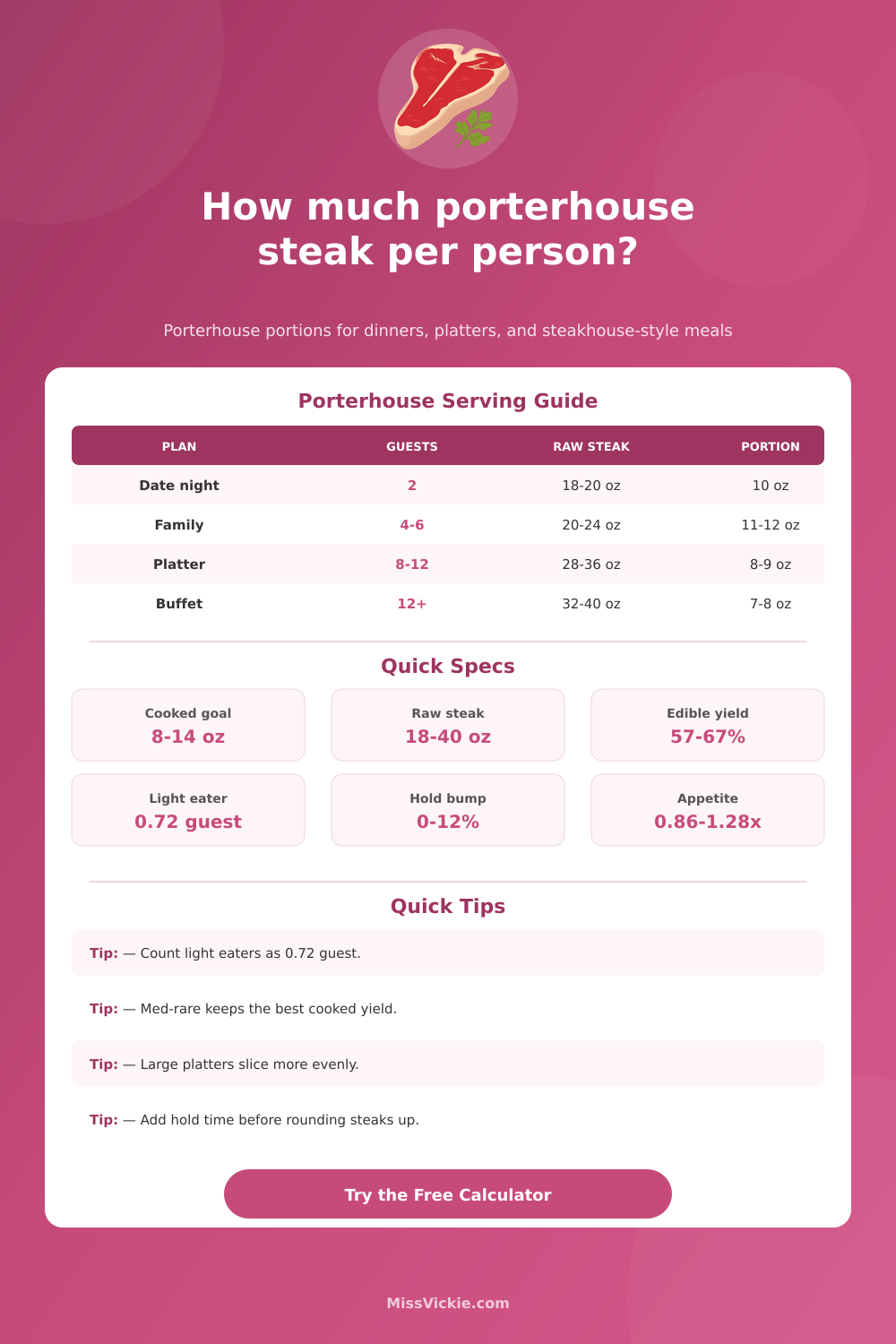
| Service style | Cooked target | Best steak use | Planning note |
|---|---|---|---|
| Date Night Plate | 10 oz per adult | 18 to 20 oz cuts | Rich dinner with one steak split across the table. |
| Steakhouse Dinner | 12 oz per adult | 24 to 28 oz cuts | Best fit when porterhouse is the main event and sides are moderate. |
| Shared Sliced Platter | 8.5 oz per adult | 28 to 36 oz cuts | Large cuts slice more evenly, so the total buy weight can drop a little. |
| Holiday Buffet | 7.5 oz per adult | 32 to 40 oz cuts | Guests usually sample several mains, so per-person steak can be smaller. |
| Steak profile | Raw weight | Typical edible yield | Cooked meat at med-rare |
|---|---|---|---|
| 18 oz Thin-Cut | 18 oz | 66% | 11.9 oz |
| 20 oz Classic | 20 oz | 67% | 13.4 oz |
| 24 oz Steakhouse | 24 oz | 68% | 16.3 oz |
| 28 oz Prime Thick | 28 oz | 69% | 19.3 oz |
| 30 oz Dry-Aged | 30 oz | 66% | 19.9 oz |
| 36 oz Sharing Cut | 36 oz | 70% | 25.1 oz |
| 40 oz Banquet Cut | 40 oz | 71% | 28.2 oz |
| Guest count | Raw total | 24 oz steaks | 36 oz steaks |
|---|---|---|---|
| 2 guests | 24 to 36 oz | 1 to 2 | 1 |
| 4 guests | 48 to 72 oz | 2 to 3 | 2 |
| 8 guests | 96 to 128 oz | 4 to 6 | 3 to 4 |
| 12 guests | 144 to 192 oz | 6 to 8 | 4 to 6 |
| 20 guests | 240 to 320 oz | 10 to 14 | 7 to 9 |
| Doneness | Cooked yield | Rest target | Buying effect |
|---|---|---|---|
| Rare | 89% | 5 min | Lowest buy weight |
| Medium Rare | 86% | 6 to 8 min | Best quality-to-yield balance |
| Medium | 82% | 8 to 10 min | Add a little extra for safety |
| Medium Well | 78% | 10 min | Noticeably higher raw requirement |
| Well Done | 74% | 10 to 12 min | Highest buy total of the set |
Date Night Split
Best when one porterhouse is carved and shared by two guests with salad, potatoes, or another side on the table.
Steakhouse Plates
Use this plan when porterhouse is the clear headliner and each full adult guest expects a steakhouse-size plated portion.
Shared Platter
Great for family-style service because large porterhouses slice cleanly, making it easier to spread strip and tenderloin across the table.
Buffet Board
Use oversized cuts and a hold-time bump whenever steaks will rest, carry to the line, and then be sliced for a crowd.
A porterhouse steak contain both a New York strip and tenderloin, which is separated by a T-shaped bone. Because of the presence of this bone, an individual cannot eat the entire weight of the steak. The bone and fats within the porterhouse steak isnt edible, but they accounts for 18 to 23 percent of the total weight of the steak.
Therefore, individuals must calculate the weight of the porterhouse steak based off the edible portion of the cut of meat. When planning a meal for a group of individuals, you must consider the appetite of those individuals. For example, many adults will eat more than children or individuals with low eating appetites.
How Much Porterhouse Steak to Buy
The cook can calculate an individual with a low eating appetite as three-quarters of the weight of an individual with a hearty eating appetite. By calculating the eating appetite of the individuals that will be eating the porterhouse steak, individuals can avoid buying too much meat for the meal. Additionally, the service style for the porterhouse steak will change the amount of meat that must be purchase for the individuals.
If you are to serve the porterhouse steak whole to each individual, more meat will be required than if the cook slice the steaks into large piece and used as a buffet for the individuals who will eat the steak. The level of doneness that is desired for the porterhouse steak will also impact the weight of the meat that will be served to each individual. If the cook prepare the porterhouse steak medium-rare, the cooked weight of the steak will be 86 percent of the raw weight of the steak.
However, if the cook cook the porterhouse steak to a well-done level, the cooked weight will be 74 percent of the raw weight of the steak. Therefore, if well-done porterhouse steak is to be served to the individuals, more raw meat will be purchased than if the level of doneness were set to medium-rare. In addition to the level of doneness that is selected for the porterhouse steak, the resting period of the meat will also impact the amount of raw meat that must be purchased.
If the porterhouse steak rest for a long time before it is eaten, the meat will lose moisture. If too much moisture is lost, the raw weight of the porterhouse steak should of be increase to ensure that the individual will receive the desired amount of meat. Finally, the side that are served with the porterhouse steak will also impact the amount of meat that must be purchased.
If there are many side dishes, such as salads and vegetables, that are to be served to the individuals, the individuals will eat less porterhouse steak. Therefore, if there are few side dishes that will be served with the porterhouse steak, the individuals will eat more of the steak. For example, if an individual is hosting a cookout that features eight individuals and few side will be served, the total weight of the porterhouse steak that must be purchased will be between six and eight pounds.
If there is a buffet for twelve individuals that features many sides and that uses large porterhouse steaks that are sliced into thin pieces, approximately seven and a half ounce of cooked porterhouse steak will be served to each individual. The size of the porterhouse steak that is to be purchased should also be considered when planning the meal. Porterhouse steaks come in various size; larger cuts contain more tenderloin than smaller cuts of the same type of steak.
The size of the porterhouse steak will determine whether a group of individuals will use it as one large steak that is shared. Additionally, the thickness of the porterhouse steak should be considered. If the cook cook the porterhouse steak on a very hot grill, a thick cut of steak will be easy to cook and slice into clean pieces after resting.
Lastly, if the porterhouse steak is dry aged, it will contain less moisture than a fresh porterhouse steak. The math that is performed to calculate the amount of raw porterhouse steak that must be purchased will have to be adjusted for dry-aged porterhouse steaks. Finally, when calculating the amount of porterhouse steak that will be cooked and sold, an allowance for unexpected factors must be made.
An extra five to twelve percent of the total calculated amount can serve as a buffer for unexpected factors in the meal. If the math is calculated correct, the amount of porterhouse steak that will be raw will provide enough cooked meat for all of the individuals who are to eat the meat. Thus, there will be enough meat for all of the guests and there wont be too much porterhouse steak that is wasted when preparing the meal.