Pork Tenderloin Smoking Time Calculator
Estimate pork tenderloin smoke time by weight, thickest diameter, smoker temperature, meat starting temperature, brine style, smoke intensity, target doneness, sear finish, and rest.
📌Pork tenderloin presets
Pick a common tenderloin cook, then adjust the diameter and finish plan. Lean tenderloin moves quickly, so the calculator favors thickness, carryover, and sear timing over long per-pound barbecue rules.
⚙Smoking time inputs
Tenderloin smoke plan
Your timing estimate will appear here.
Input breakdown
Timing factors
📊Lean tenderloin quick specs
🔥Diameter timing table
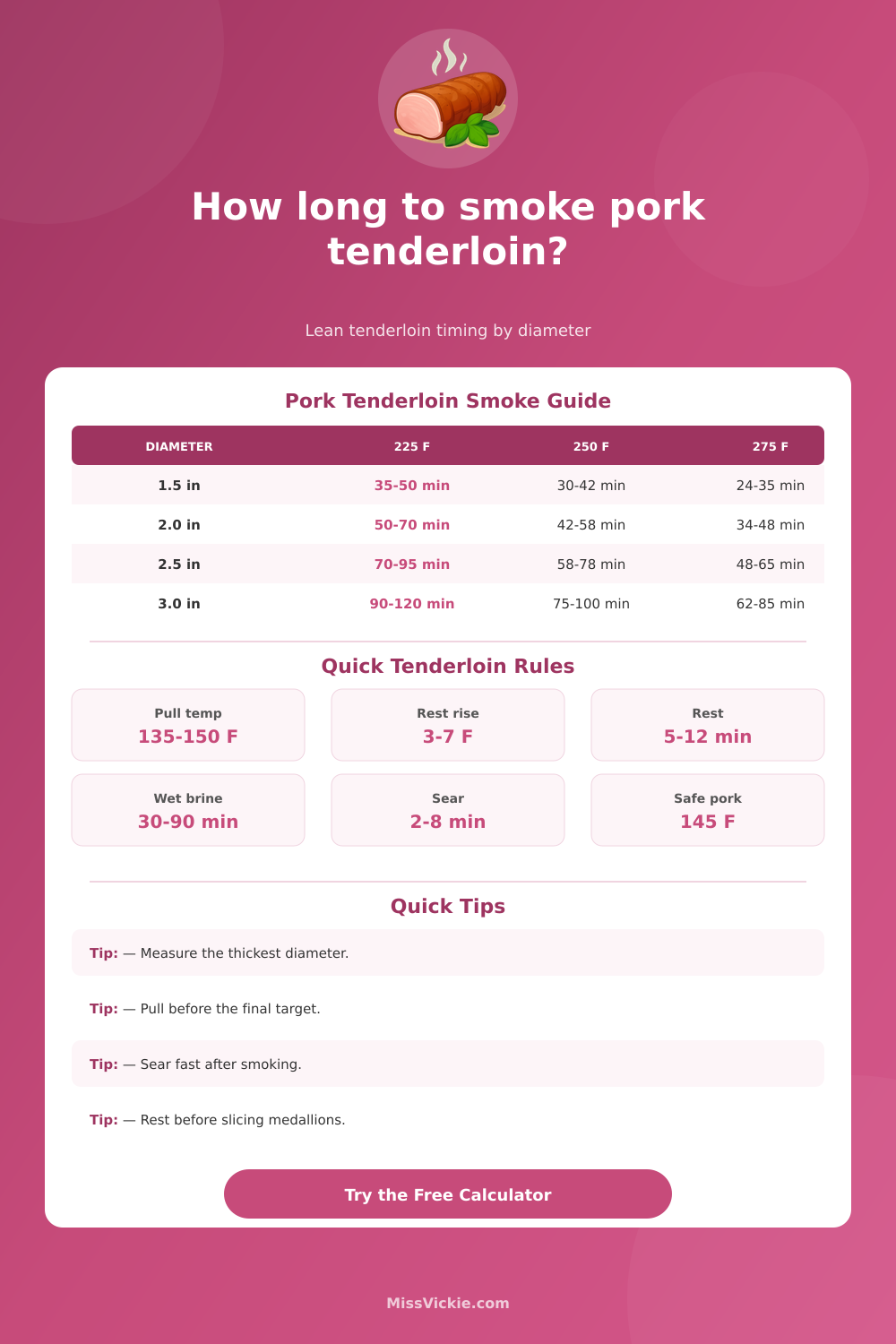
| Thickest diameter | 225 F smoker | 250 F smoker | 275 F smoker | Best use |
|---|---|---|---|---|
| 1.5 in / 3.8 cm | 35-50 min | 30-42 min | 24-35 min | Small trimmed tenderloin or thick medallions |
| 2.0 in / 5.1 cm | 50-70 min | 42-58 min | 34-48 min | Most grocery-store pork tenderloins |
| 2.5 in / 6.4 cm | 70-95 min | 58-78 min | 48-65 min | Large tenderloin, tied pair, or thicker center |
| 3.0 in / 7.6 cm | 90-120 min | 75-100 min | 62-85 min | Stuffed, bacon-wrapped, or crowded grate |
The table assumes a pull around 137-142 F before sear and rest. Smoke-only cooks aiming for 145 F may sit near the high end.
🌡Pull temperature and finish table
| Serving goal | Serve temp | Smoker pull with sear | Smoker pull no sear | Texture cue |
|---|---|---|---|---|
| Juicy blush | 145 F / 63 C | 136-139 F | 141-143 F | Moist slices with a faint blush |
| Medium | 150 F / 66 C | 141-144 F | 146-148 F | Still tender, less pink center |
| Firm | 155 F / 68 C | 146-149 F | 151-153 F | Firm slices, less juice loss if brined |
| Stuffed | 160 F / 71 C | 151-154 F | 156-158 F | Use the center of the filling as the check point |
🧂Brine and smoke adjustment table
| Choice | Timing effect | Moisture effect | Smoke effect | Best move |
|---|---|---|---|---|
| No brine | Fast surface heat | Lower cushion | Rub sets quickly | Pull early and rest well |
| Wet brine | Adds slight surface lag | Best cushion | Dry surface before smoke | Pat dry and use a hot sear |
| Dry brine | Neutral to slightly faster | Good slice texture | Bark forms cleanly | Leave uncovered before cooking |
| Marinade | Can brown faster | Good if not over-acidic | Sugars darken | Watch the sear closely |
🍽Comparison grid
2 inch tenderloin at 250 F with fruit wood, short brine, and a quick grill sear.
Lower smoke temperature, pull early, then finish hard and fast for crust without drying the center.
Extra surface fat slows heat and needs a longer finish to render the wrap.
Diameter and filling temperature matter more than weight; verify the center before resting.
📋Sear finish reference
| Sear style | Typical time | Carryover add | Crust level | Pull strategy |
|---|---|---|---|---|
| Hot grill grate | 3-5 min | 4-6 F | Striped crust | Pull 6-8 F below serve temp |
| Cast iron pan | 4-6 min | 5-7 F | Deep browned surface | Pull 7-9 F below serve temp |
| Broiler | 4-8 min | 4-7 F | Top-side browning | Rotate once and watch sugars |
| No sear | 0 min | 2-4 F | Soft smoke exterior | Smoke closer to final target |
💡Two tenderloin tips
Because pork tenderloins is a very low-fat piece of meat, there’s very little margin for error. A rib or shoulder has plenty of fat to protect the meat from drying out, or connective tissue to help hold moisture. A tenderloin has barely any space between its outside and inside. The dry heat will suck moisture right out of the meat.
And I’ve seen many home smokers over-cook this meat because they rely on time as if they were smoking a brisket. That is not good. In this instance, time are just a function of temperature and thickness. No one is cooking by the hour here. You’re cooking according to the rate at which heat passes through a cylindrical hunk of protein.
How to Cook Pork Tenderloin Perfectly
Your job is to get the middle hot enough to kill anything nasty while leaving the outside juicy but not dried out. When estimating how long something will take to smoke, don’t base it off weight, base it on diameter. When cooking any sort of tube-shaped food (i.e., tenderloins), the heat travels inwards from the outer surface, so a shorter and thicker piece of the same size as a longer but thinner piece will be different than. So if it’s a tenderloin, measure across middle at its widest point to get an idea of thickness. Then feed it into the calculator above along with your exact measurements, and you won’t have to worry about guessing anymore: You know exactly how far the thermal gradient has to go.
Pork has a tendency to gets overcooked. When you pull it off the grill, its surface will be much warmer than the center; that leftover heat move into the middle, raising the internal temperature another few degrees before settling down. By the time you take it off the grill when the digital readout says one-forty-five degrees Fahrenheit, the tenderloin is past prime. Letting it sit gives the remaining heat time to complete the job. Five to ten minutes are plenty of time for the juices to settle back in place, and not so long as to chill the meat out completely. And it makes all the difference between a tender piece and a tough piece of dinnner.
The texture is where the brines make the most difference: Salt transforms the protein’s structure, so when it heats up, there’s more water held within. A dry brine pulls some of the liquid off the surface and allows it to soak deep inside the fibers. A wet brine will weigh down the meat and add moisture, too, giving you a wider safety net as far as overcooking goes, but both treatments alter how the surface browns. If you’re relying on low-and-slow smoke alone, the wetter surface resists getting crispy until the excess moisture cooks away, leaving the outside pale. That’s where adding a quick sear to bridge the gap comes in. It creates a contrast between a tender interior and a crisp exterior. The calculator adjust for this by changing the pull temperature based on whether you choose to sear or finish directly in the smoker.
Because it’s a very lean cut, you have to be careful with amount of smokiness in your pork. If you go really heavy and long on mesquite or hickory, it will overpower the delicate pork taste pretty quickley. Fruit woods that are slightly sweet, like cherry or apple, add just enough sweetness to go with the pork without overpowering it. Smoke is an accent flavor; you don’t want it to become the main ingredient. To avoid phenolic bitterness building up in the meat proteins, keep the exposure time short. As the chart on the page explains, cooking at higher temps with a shorter time preserves better texture.
The last technical challenge is slicing across the grain. After resting, when the juices have resettled, slice crosswise through the meat instead of parallel to the muscle fibers. You’ll find each bite tender in your mouth as it shortens the long strings of protein. If you slice with the grain, those long strands stays intact and are too tough to chew easily. It is a simple mechanical maneuver whose reward is all the thermodynamics planning from before.
Respect the laws of heat transfer, and there’s the rub. Measure the thickness, pull early, rest right, and let the meat finish itself according to its own clock. That attention to detail transforms what could of been a risky cut into an impressive dish every time.