
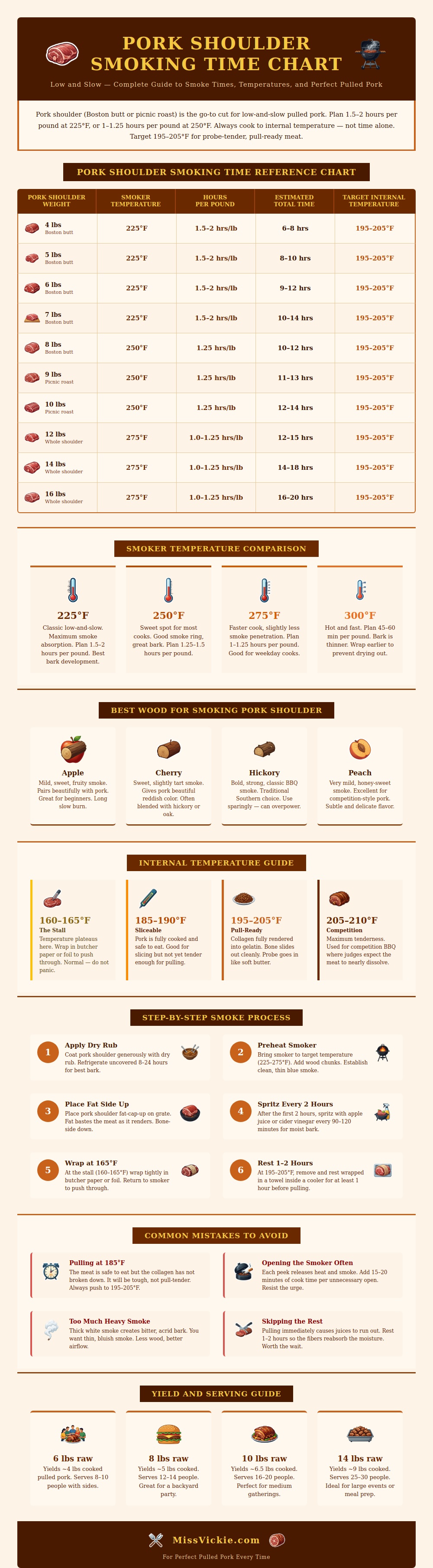
If you treat time like a guarantee instead of a guideline, you’ll get a big ole hunk of dry, chewy pork when you order that eight pound Boston butt. Smoked pork should teach us something about cooking. If we cook pork shoulder right, its tough connective tissue will transform into tender meat given enough heat. But how much? How long?
Here’s the chart (above) giving you some ballpark guesses on temps/weights. It’s more like a map to point you in the right direction. When it comes to real barbeque, the magic ingredient isn’t time; it’s paying attention to what’s happening beneath your hood. So why do most novices obsess about hours per pound instead of realizing that only internal temperature count for tenderization?
Why Temperature Matters More Than Time
The answer lies with collagen, a type of structural protein found in large amounts in pork shoulder that help hold muscle fibers together. When exposed to heat for extended periods (typically several hours), collagen melts into gelatin, giving the resulting meat, such as pulled pork, an ultra-moist, velvety texture. Don’t pull the meat too soon. Since this is a chemical change, pulling the pork too early means you will eat undercooked jerky.
Air temperature, humidity, and how well your smoker seals all affects cook time. Sometimes a four-pound butt might take six hours, but other times it can takes up to eight hours to reach same internal temp. The key to all of this is choosing your smoking temperature.
At two hundred twenty-five degrees Fahrenheit, you’ll get the deepest bark and most smoke absorption, but it require some time. If you’re targeting a mid-day dinner during the week, you can crank it up to two hundred seventy-five or three hundred degrees and shave hours off your cooking time. However, you’ll lose some smokiness and has to be careful not to dry them out on the outside while they stay tough inside. It’s a convenience versus depth-of-flavor tradeoff.
Here’s where most cooks get nervous. At about one hundred sixty degrees, the interior temp stall, often for an hour or more. Why? The heat of the cooking process is consumed by evaporation from the outer surface of the meat which cools it down. It seems like something went wrong, but it’s merely physics at work. To power through the stall, wrap the shoulder tightly in aluminum foil or butcher paper.
Foil will steam the shoulder, which speed things up. Paper lets some evaporation happen, which keeps the bark texture. Both are fine, as long as you don’t freak out and keep opening the lid.
Another variable that plays into overall taste is wood selection. Mild, sweet fruit woods such as cherry or apple impart just enough smokiness to complement pork while adding subtle flavor, perfect for novices looking for a flavor bump without overpowering the meat. Bold hickory imparts a punchy barbeque flavor that holds its own against heavy seasoning rubs, but too much can produce acrid flavors. Consider wood more of an accent spice and not the main ingredient.
If you see thin, blue smoke, it means the wood is burning efficiently and will add clean flavor; thick white smoke signifies incomplete burning and will add a sooty, bitter taste to your meat. When your thermometer reads one hundred ninety-five to two hundred five degrees (the sweet spot for internal temperature), it’s not finished yet.
You must let it rest. If you yank it too soon, all of those delicious juices will run on the cutting board, resulting in chewy strings rather than tasty bites. By resting the meat in a warm oven or cooler, the proteins relaxes and absorb the delicious liquids again. This last step turns good pork into great pork.
You should of kept these factors in mind when planning your timeline, and you’ll enjoy fall-apart tender pork every time. Your thermometer speaks the truth; your timer lies.