🐖 MissVickie pork roast guide
Pork Roast Cooking Temperature Calculator
Set pull temps, finish bands, carryover, and rest windows for loin, shoulder, and leg roasts whether you cook low and slow or hot-roast.
Each preset loads a real roast scenario with the cut profile, cooking model, roast size, rest window, and finish style already matched.
Use the thickest point as your probe target. Weight, thickness, oven temp, and rest time all shift carryover and the finish window a little.
Breakdown
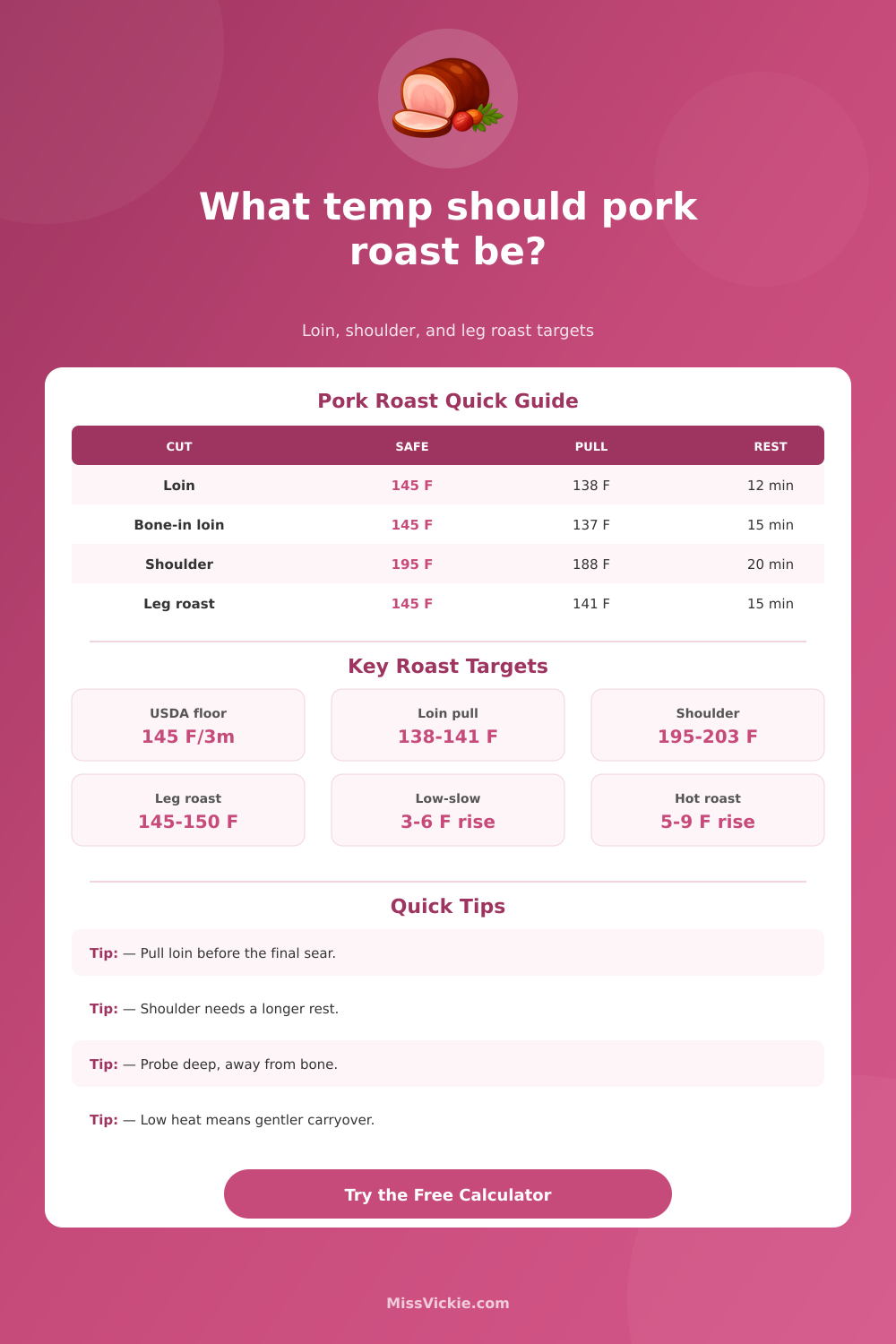
These roast profiles anchor the pull temp math. Loin stays lean and quick, shoulder likes more heat, and leg roasts sit between the two.
| Profile | Safe | Pull | Rest |
|---|---|---|---|
| Center-cut loin | 145 F | 138-141 F | 12 min |
| Bone-in loin | 145 F | 137-140 F | 15 min |
| Sliceable shoulder | 160-165 F | 154-160 F | 18 min |
| Fresh leg roast | 145-150 F | 141-146 F | 15 min |
Use low-and-slow for forgiving shoulder work and hot-roast for a tighter, browner loin finish. Reverse sear splits the difference.
| Method | Carry | Best fit | Note |
|---|---|---|---|
| Low and slow | 1-3 F | Shoulder | Gentle rise |
| Hot roast | 4-7 F | Loin | Fast crust |
| Reverse sear | 3-5 F | Loin | Even finish |
| Smoker | 2-4 F | Shoulder | Slow climb |
Bigger roasts store more heat. That means more carryover, a slower fade, and a longer rest before you carve.
| Weight | Thickness | Carry | Rest |
|---|---|---|---|
| 2-3 lb | 1.25-2 in | 3-5 F | 10-12 min |
| 4-5 lb | 2-3 in | 4-6 F | 12-15 min |
| 6-7 lb | 3-4 in | 5-8 F | 15-20 min |
| 8+ lb | 4+ in | 6-9 F | 20-30 min |
Use the size guide to match the roast shape to a cooking model and avoid overcooking lean cuts.
| Roast | Serves | Model | Why |
|---|---|---|---|
| Loin roast | 4-6 | Hot roast | Lean and juicy |
| Bone-in loin | 5-8 | Reverse sear | Bone slows center |
| Shoulder roast | 8-12 | Low and slow | Best for shredding |
| Leg roast | 6-10 | Hot roast | Sliceable finish |
Compare the cooking models at a glance so you can choose the one that matches your cut profile and carryover goal.
Best for shoulder and picnic roasts.
Best for loin and leg roasts.
Balancing low heat and a fast finish.
Slow, steady, and very forgiving.
Many peoples has difficulty cooking pork roasts such that teh pork roast is either undercooked in the center of the roast or the pork roast is overcooked and dry. The reason for this difficulty is that pork roasts is actualy thermal batteries, meaning that the roast will store heat in its outer layers. The heat will continue to cook the roast even after the roast is removed from the oven; this process is known as carryover cooking.
Because carryover cooking will continue to raise the internal temperature of the roast, cooks should not cook until the roast reaches the target temperature. If the roast is allowed to continue to cook until it reaches the target temperature, the carryover cooking will continue to cook the roast beyond the target temperature; this will result in an overcook roast. The cook must determine the pull temperature for the roast; the pull temperature is the temperature at which the cook should pull the roast from the heat source.
When to Take a Pork Roast Out of the Oven
The pull temperature will vary according to the specific cut of pork that is being used. For instance, one cut of pork may be leaner than other cut of pork. Pork that is leaner will have less fat than other cuts of pork.
Less fat mean that the proteins in the pork will tend to tighten and squeeze out the moisture if the temperature of the roast rises to too high a level. An alternative cut of pork may be higher in fat. The fat in pork contains connective tissue and collagen; these elements will only soften into gelatin if the roast reach a high temperature.
Therefore, roasts that contain more connective tissue will require a higher cooking temperature to allow for proper cooking of the roast than a loin roast, for instance. The method by which the cook cooks the pork roast will also affect the temperature at which it is pulled from the heat source. For instance, hot roast methods involve heating the roast to a high temperature in the oven.
High temperatures create steep gradient in the temperature of the roast. High temperatures applied to the roast will result in the heat rushing toward the center of the roast after it is removed from the oven. This results in a large carryover cooking effect.
However, using the low and slow method with a low oven temperature will create a flatter temperature gradient in the meat. A flat temperature gradient will result in a smaller carryover cooking effect. Another factor that affects carryover cooking is the weight and thickness of the pork roast.
An eight pound pork roast will have more thermal mass than a three pound pork roast. The more thermal mass that an object possesses, the longer that it will retain heat. Because the eight pound pork roast will retain heat for a longer period of time, an eight pound pork roast will require a longer resting period.
During the resting period, the pork roast will be able to reach an even temperature throughout the roast, and the juices will be able to redistribute within the roast. If the roast is carved while hot, the juices will escape from the roast, but if the roast is allowed to rest, the juices will remain within the roast. The starting temperature of the pork roast will also play a role in the cooking process.
Taking a pork roast out of the refrigerator will ensure that the pork roast starts at approximately thirty-eight degrees. Starting at this temperature will create a different cooking process than if the pork roast started at room temperature. Because the pork roast starts at a colder temperature, the roast will have a slightly smaller carryover cooking effect.
Additionally, the correct placement of the thermometer probe will also affect the temperature of the roast. If the probe is placed too close to a bone, it may register the wrong temperature. The thermometer should be placed in the thickest part of the pork roast.
This will ensure that the temperature that is recorded with the thermometer is the correct temperature of the roast. Finally, the chef should aim for the finish band of the roasts temperature. The finish band is a small range of roast temperatures that will provide a buffer for the chef in case the pork roast is carried over cook to the desired temperature.
By managing the momentum of the heat applied to the pork roast, the chef will ensure that the roast reaches the desired temperature. By calculating the pull temperature and allowing for the resting period, the pork roast will reach an even temperature from the edge to the center. You should of used a thermometer to make sure.