🐖 MissVickie pork roast math
Pork Roast Cooking Time Calculator
Estimate pork roast cooking time from cut, raw weight, oven temperature, bone-in setup, fat cap, starting temperature, target temperature, and planned rest.
Choose a real roast scenario, then adjust the cut, oven heat, target temperature, fat cap, and rest to match the pork on your counter.
Your Pork Roast Plan
Cook time, pull temperature, rest, and yield update as you change the roast.
Roast Setup
Timing Math
Temperature Plan
Yield Plan
Cooking Notes
- Use time as a planning estimate and confirm with a thermometer.
Safe finish for pork loin, rib, sirloin, and tenderloin with rest.
The USDA minimum rest for whole pork cuts after reaching 145 F.
A shoulder or picnic roast slices more firmly around this range.
Collagen-rich shoulder turns shred-ready well above slicing temps.
These tables are planning references. Roast shape, probe placement, oven accuracy, and fat coverage can move the real finish earlier or later.
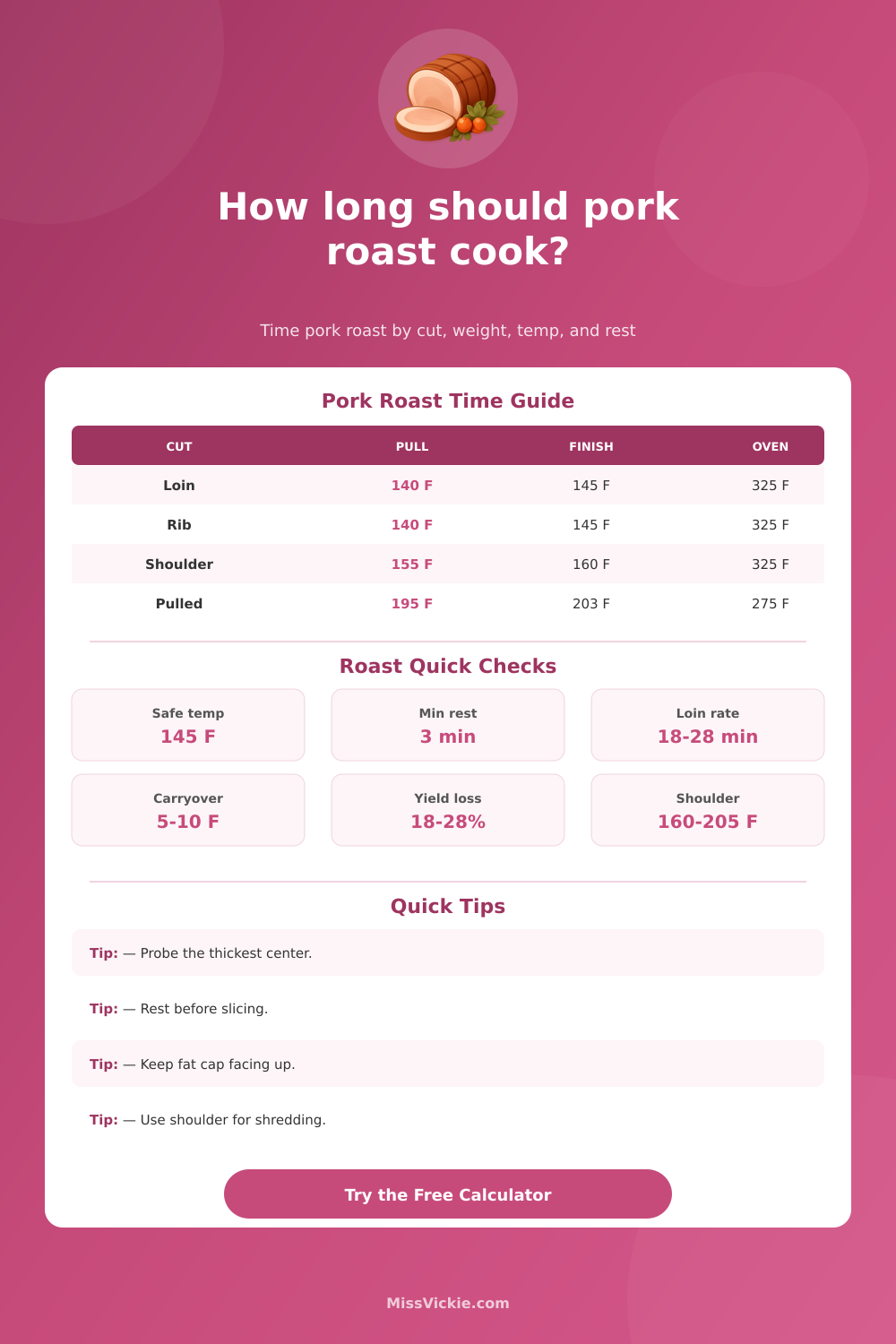
| Roast Cut | Typical Weight | Oven Range | Finish Temp | Planning Time |
|---|---|---|---|---|
| Center-cut pork loin | 2 to 5 lb / 0.9 to 2.3 kg | 300 to 375 F | 145 to 150 F | 18 to 28 min per lb, start checking early |
| Pork tenderloin | 0.75 to 1.5 lb / 340 to 680 g | 375 to 425 F | 145 F | 18 to 30 min total for most pieces |
| Pork rib roast | 3 to 8 lb / 1.4 to 3.6 kg | 300 to 350 F | 145 to 150 F | 22 to 32 min per lb depending on bones |
| Pork sirloin roast | 2 to 4 lb / 0.9 to 1.8 kg | 300 to 350 F | 145 to 155 F | 24 to 34 min per lb for a sliceable center |
| Shoulder or Boston butt | 4 to 10 lb / 1.8 to 4.5 kg | 250 to 325 F | 160 F sliced, 195+ F pulled | Long collagen timing; thermometer decides |
| Target Result | Finish Temp | Approx Pull Temp | Rest | Best Cuts |
|---|---|---|---|---|
| Juicy slice | 145 F / 63 C | 138 to 142 F | 10 to 20 min | Loin, tenderloin, rib, sirloin |
| Less pink center | 150 to 155 F / 66 to 68 C | 143 to 150 F | 12 to 20 min | Loin, rib, sirloin |
| Firm shoulder slice | 160 to 170 F / 71 to 77 C | 154 to 164 F | 20 to 30 min | Shoulder, picnic |
| Shreddable shoulder | 195 to 205 F / 91 to 96 C | 188 to 198 F | 25 to 45 min | Boston butt, picnic shoulder |
| Raw Roast | Sliced Yield | Pulled Yield | Serving Estimate | Planning Note |
|---|---|---|---|---|
| 2 lb / 0.9 kg | 1.5 to 1.6 lb | 1.3 to 1.4 lb | 5 to 6 sliced servings | Good for tenderloin or a small loin roast. |
| 4 lb / 1.8 kg | 2.9 to 3.2 lb | 2.5 to 2.8 lb | 9 to 11 sliced servings | Common family roast size. |
| 6 lb / 2.7 kg | 4.3 to 4.8 lb | 3.8 to 4.2 lb | 14 to 16 sliced servings | Bone-in roasts feed fewer slices. |
| 8 lb / 3.6 kg | 5.7 to 6.4 lb | 5.0 to 5.6 lb | 18 to 20 sliced servings | Shoulder size for a crowd or leftovers. |
| Oven Temperature | Best Use | Timing Effect | Carryover | Watch Point |
|---|---|---|---|---|
| 250 to 275 F / 120 to 135 C | Shoulder, picnic, reverse sear | Slowest and most even | Moderate | Surface browning may need a finish blast. |
| 300 to 325 F / 150 to 165 C | Loin, rib, sirloin, shoulder | Balanced baseline | Moderate to high | Probe before the printed timetable ends. |
| 350 to 375 F / 175 to 190 C | Smaller loin or sirloin roasts | Faster edges | Higher | Lean pork can overshoot quickly. |
| 400 to 450 F / 205 to 230 C | Tenderloin, sear finish, crackling | Fastest surface heat | Highest | Use short intervals and a probe thermometer. |
Best pulled near 140 F and rested to 145 F so the slices stay juicy.
Bones protect the roast but make the center slower than boneless loin.
Cook to slicing temps for roast pork or much higher for pulled pork.
A thick cap protects the surface and can delay heat reaching the center.
Food safety note: whole pork cuts should reach at least 145 F with a 3-minute rest. Ground pork and sausage need 160 F.
A lot of people think that a pork roast is something they can just throw in the oven and let it cook as long as necessary, but that’s generally where things go wrong: meat isn’t bread. Meat has layers of fat, bones, and interior temperatures that vary based on what temperature the roast started at. Once you input your own parameters, the calculator crunches complicated numbers for you and saves you from guessing whether your 4-lb loin needs 20 mins/lb or 40 mins/lb. No more guesswork here! It take into account factors that other recipe cards don’t and will save you from second-guessing yourself.
Because there’s such variation between types of meat. A lean center-cut loin will cook much more differntly than a collagen-rich shoulder, it use the cut of meat (rather than just its weight) as a factor. Because of how connective tissue and dense muscle fiber behave under heat, tool has different baselines for when to time things based on type of cut. You might be able to get away with roasting a loin quickly enough to keep it moist without drying it out, whereas a shoulder need patience no matter what your oven’s set to. Rushing a shoulder like you would a tenderloin doesn’t yield fork-tender shreds; it yields tough meat. This is the kind of difference that calculator knows, and it moves its timing estimates to account for it.
Why You Need a Roast Calculator
The way heat moves within the roast is changed by its bone structure which acts as an insulator slowing down heat conduction into its center. Because of this, a similar-weighted boneless cut will roast faster then one with bone; the bone shields meat from directly heating the center. While this helps ensure even cooking, failure to account for this difference will make your timer inaccurate. Shape affect how quickly the outer edges brown compared to when the interior reaches temperature. The tool also accounts for tying, netting, and standing on a naked rack versus resting on a roasting rack.
The biggest margin of error in home cooking happens at the beginning: When we drop a fridge-cold roast into a piping-hot oven, there’s a huge temperature gradient. While the exterior is already starting to cook, the interior is just thawing out, resulting in gray bands of overcooking surrounding a medium-rare core. Thirty minutes on the counter will help, but you have to tell the calculator what starting state the roast was in so that it can account for that in overall time. Even if you don’t change the oven temperature, a very cold core will add many minutes to your timetable.
Also, don’t dismiss the fat cap: A good piece of fat will insulate meat from direct heat and maintain moisture; but it will also slow down the thermometers rise to the target temperature at the center of the cut. If you score that fat, you’ll speed up its rendering, altering the course just a bit. The tool has the option to choose whether you’ve trimmed your fat thin or left a lot of it intact, which affects estimated time of completion. That little tidbit often accounts for why a roast might be done in 45 minutes one day but require an additional hour next time around.
After removing meat from the heat, carryover cooking is the invisible force working in your favor, even if you can’t see it. When you remove something like loin from oven at precisely 145 degrees Fahrenheit, it’ll reach 150 degrees, or more, by slicing time, leading to an end product that’s dry. To compensate for this residual heat, the calculator recommends a pull temp below your desired target. It’s also important to let meat rest, giving those juices time to redistribute and not drip all over your cutting board. It’s not some sort of tradition, it’s physics.
Another real-world consideration is yield: As a roast loses its fat and moisture, it’ll shrink. You can’t just plan on four pounds of meat, then be disappointed when there are only three after cooking. To account for this, the tool will estimate how much you’ll get out of a cut, as well as recommend how many people you should serve based off that cooked weight. That way, you can ensure you have enough food for your guests.
It’s not a precise timetable; it’s more like getting the temperature of meat across different types of tissue to cook properly. Cook by feel, but listen to thermometer (and heed the rest time). Trust the fat to do its thing; if you do, your meal will have more juice then you thought possible.