🐖 MissVickie pork doneness math
Pork Doneness Temperature Calculator
Set USDA-safe pull temps, carryover, and finish bands for chops, tenderloin, loin roast, shoulder, and ground pork with cut-specific logic.
Each preset maps a real pork cut to a method, thickness, rest, and finish target, then updates the calculator in one tap.
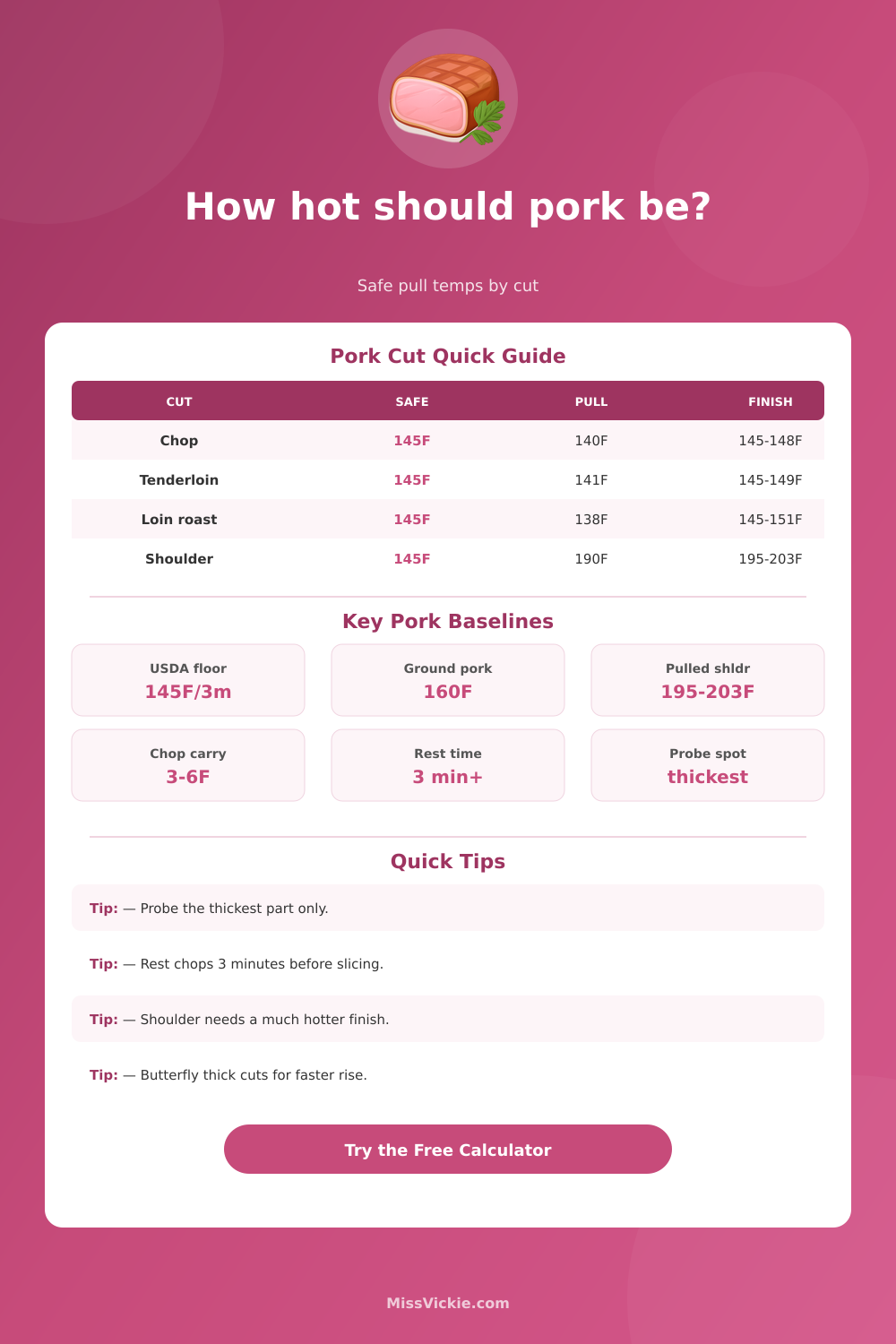
Use weight, thickness, and rest time to tune carryover. Whole-muscle pork uses a 145°F USDA floor with 3 minutes of rest, while shoulder can run hotter for texture.
These tables anchor the calculator to USDA-safe baselines, practical method carryover, and the way pork texture changes when the cut gets thicker or larger.
| Cut | USDA floor | Pull range | Rest |
|---|---|---|---|
| Chop | 145F | 140-142F | 3 min |
| Tenderloin | 145F | 140-143F | 3 min |
| Loin roast | 145F | 138-141F | 3-5m |
| Shoulder | 145F | 190-196F | 10m+ |
| Method | Carry | Speed | Best use |
|---|---|---|---|
| Grill | 3-6F | Fast | Chops |
| Oven | 2-5F | Balanced | Roasts |
| Skillet | 3-7F | Sharp | Lean cuts |
| Smoker | 1-4F | Slow | Shoulder |
| Style | Target | Best cut | Texture |
|---|---|---|---|
| Juicy slice | 145-148F | Chops | Rest 3m |
| Roast juicy | 145-151F | Loin | Use 3m |
| Sliceable shoulder | 160-165F | Shoulder | Long rest |
| Pulled pork | 195-203F | Shoulder | Fork test |
| Profile | Chop | Roast | Shoulder |
|---|---|---|---|
| Thin | 2-3F | 3-4F | 1-2F |
| Standard | 3-5F | 4-6F | 2-3F |
| Thick | 4-7F | 5-8F | 3-5F |
| Roast | 5-8F | 6-10F | 4-6F |
Fastest path to juicy, safe slices. Pull early and rest the full three minutes.
Lean and delicate, so the carryover matters more than the probe color.
A little more mass means more rise after the oven or grill comes off.
Texture, not pinkness, is the finish goal when you want clean pull-apart pork.
Pork can be a meat that is difficult to cook due to the fact that the internal temperature of the pork must be carefuly manage. If the internal temperature of the pork is cooked to too low of a temperature, the pork will be unsafe to eat. However, if the internal temperature of the pork is cooked to too high of a temperature, the pork will become dry and tough.
In 2011, the United States Department of Agriculture (USDA) changed the recommended internal temperature for pork from 160 degrees to 145 degrees Fahrenheit. In addition, the USDA requires that pork products rest for three minutes after they are cooked to that temperature before they are sliced or eaten. This three-minute rest period allows for the pork to gain heat that is trapped within the pork after it has been removed from the heat source; this process is referred to as carryover cooking.
How to Cook Pork to the Right Temperature
The carryover cooking of the pork can be influenced by the thickness of the pork roasting and the cooking method. For instance, the thicker the pork cut, the more heat will be trapped within the cut of pork. The heat trapped within the pork will lead the internal temperature of the pork to rise more significant after it is removed from the heat source.
For instance, a one-inch pork chop may increase in internal temperature by five degrees during the three-minute rest period, but a four-inch pork roast may increase in internal temperature by much less then five degrees. Factors that can reduce the rate of carryover cooking can include the presence of the bone within the pork roast; cuts that are butterflied will lose heat more quick than roasts that include the bone. The impact of the temperature of the pork roast can also impact carryover cooking; if the cook takes the pork directly from the refrigerator to the heat source, the pork will heat unevenly, and the even heating will impact the carryover cooking.
The cut of the pork will impact the target internal temperature that should be used for cooking the pork. For instance, lean cuts of pork, such as pork chops and pork tenderloins, should cook to a minimum internal temperature of 145 degrees Fahrenheit. These cuts should not be cooked to temperatures above 145 degrees F as they will dry out if overcook.
Cuts that contain more fat, such as pork shoulders, can be cooked to an internal temperature of 195 to 203 degrees F as the fat will help to retain moisture within the pork shoulder. Ground pork should be cooked to an internal temperature of 160 degrees as the grinding process can introduce bacteria to the center of the ground pork. Methods, such as skillet cooking, will increase the carryover cooking of the pork due to the formation of the crust.
Sous vide cooking, on the other hand, will not contribute to carryover cooking. To properly cook the pork, a thermometer should be used to measure the internal temperature of the roast. The thermometer should be inserted into the thickest part of the pork roast.
The thermometer should not touch the bone or fat within the roast. If the thermometer is inserted too close to the edge of the pork roast, the pork roast will be cooked to an inaccurate temperature; the edge of the roast is hotter than the center of the roast. One common mistake in cooking pork is to slice the pork roast prior to allowing the roast to rest on the counter for three minutes.
By slicing the pork roast prior to resting, the juices will exit the pork roast; allowing the pork roast to rest allows the juices to redistribute within the roast. Additionally, allowing the pork roast to rest allows for the carryover cooking to continue to cook the roast to the proper internal temperature. The concepts regarding internal temperature and carryover cooking can be applied to various scenarios in the kitchen.
For instance, if the pork chop that is being cooked includes a bone and is one and a quarter inches thick, the pork chop should be removed from the heat at 140 degrees F. After resting for three minutes, the internal temperature of the chop will reach between 145 and 148 degrees F. For pork loin roasts, however, the loin should be removed from the heat at 138 degrees F. The loin will reach 145 degrees F after resting for three minutes. For pulled pork, which is cut from the pork shoulder, the pork roast should reach 190 degrees F when pulled from the heat source; the carryover cooking will ensure that the pork roast reaches 195 degrees F.
The thickness of the pork will impact how much the internal temperature of the pork will rise after removing the roast from the heat source. For instance, thin pork cuts, such as pork chops that is less than one inch thick will rise in internal temperature by two or three degrees.
Thick pork roasts may rise in internal temperature by five or eight degrees. Various cooking techniques may help to improve the quality of the pork roast; dry brining the pork will promote even heat within the roast, and reverse searing will create a crust on the roast. Should the roast be tented with foil during the rest period, the pork should be tented loosely to allow the steam to escape, but not so loosely as to make the roast become soggy.
By knowing the different internal temperatures that various cuts of pork will reach and understanding the concept of carryover cooking, cooks can ensure that the pork that they prepare is safe to eat and moist.