🍞 Poolish Bread Calculator
Calculate exact poolish pre-ferment amounts, yeast quantities, and fermentation timing for any bread recipe
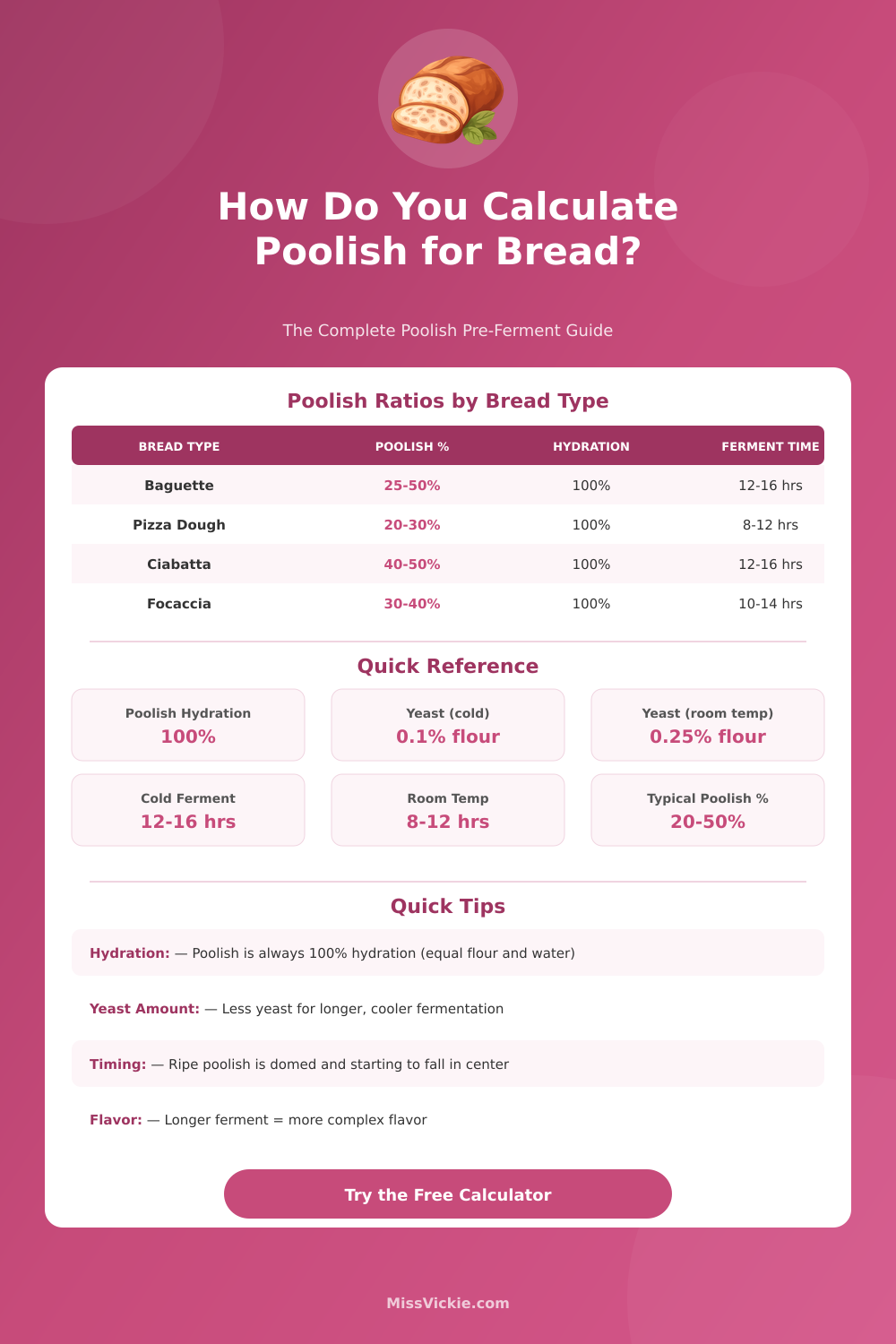
| Poolish % | Poolish Flour | Poolish Water | Yeast (cold) | Yeast (room temp) |
|---|---|---|---|---|
| 20% | 100g | 100g | 0.1g | 0.25g |
| 25% | 125g | 125g | 0.13g | 0.31g |
| 30% | 150g | 150g | 0.15g | 0.38g |
| 35% | 175g | 175g | 0.18g | 0.44g |
| 40% | 200g | 200g | 0.20g | 0.50g |
| 45% | 225g | 225g | 0.23g | 0.56g |
| 50% | 250g | 250g | 0.25g | 0.63g |
| Ingredient | Formula | Example (500g flour, 30% poolish) |
|---|---|---|
| Remaining Flour | Total flour - poolish flour | 500g - 150g = 350g |
| Remaining Water | Total water - poolish water | Depends on recipe hydration |
| Main Dough Yeast | Reduced (poolish adds activity) | Reduce by 20-30% |
| Salt | Based on total flour (2-2.2%) | 10-11g per 500g total flour |
| Mix-in Time | Add poolish at start of mix | Mix poolish into remaining water first |
Poolish is a preferment you make mixing equal parts flour and water with a bit of commercial yeast. It turns into wet sponge if you leave it ferment from 6 to 16 hours The hydration level usually reaches 100%, so flour and water weights are same. That breadmaking method was first made in Poland by Baron Zang during the 1840s.
Making poolish bread is really easy. Combine half of the flour with a bit of yeast and warm water. Mix everything well, cover and leave it ferment from 12 to 14 hours.
What Is Poolish and How to Make It
In the eighth hour the mix already doubled in volmue and has many bubbles. Then it is ready to add to the bread recipe.
Poolish became famous because it gives bread better taste, but without the sour taste of sourdough bread. Both poolish and biga are pre-fermented flour with commercial yeast. You can consider bread from them plain yeast bread.
It is not sourdough, because it does not use lactic acid bacteria.
The idea of poolish is to ferment a little part of dough to grow taste, later mix it with more flour for strong dough. Much flour of the recipe ferments before the final dough is ready. That helps to convert flour into sugar and improve the taste overall.
Long slow fermentation in low temperatures give the best taste. Room temperature of 21 to 27 degrees Celsius give the most delicious bread.
Poolish helps to strengthen the extensibility of the dough. Its runniness does not matter, because you mix it in a bigger dough body. Think about it as a fast sourdough starter for adding taste.
However the flour and water in the poolish must be taken from the whole recipe amount.
Typical process for poolish bread extends across several days. Mix the poolish overnight before with very little dry yeast. The next day start baking in the afternoon using cold water and extra bit of yeast.
The dough rises for about four hours, while you fold it as needed. After shaping it rests in bannetons before entering the refrigerator. You bake the bread in the morning.
In artisan baking you commonly use poolish for baguettes and French boules. French boule from poolish has perfectly chewy, soft and fluffy inside with dark brown crust outside.