🍳 MissVickie poached egg timing
Poached Egg Time Calculator
Dial in yolk set level, egg size, altitude, acidity, and simmer intensity for poached eggs that land runny, jammy, or fully set on cue.
Each preset loads a real poached-egg scenario and recalculates the time, water target, and yolk cue instantly.
Use the fields below to reflect the egg, the pot, and the water behavior before the eggs go in.
Your Poached Egg Timing Plan
This plan balances yolk set, altitude, acidity, and simmer motion so you can pull the eggs at the right second.
Timing Breakdown
Use these references to sanity-check the final timing before you crack the eggs into the water.
Larger eggs need a longer set.
Fully set takes the longest.
Higher ground slows the boil.
Gentle water keeps shape best.
The right pot shape, spoon, and strainer make a cleaner poach and a more predictable finish.
Each table isolates one variable so you can see which change is really moving the timer.
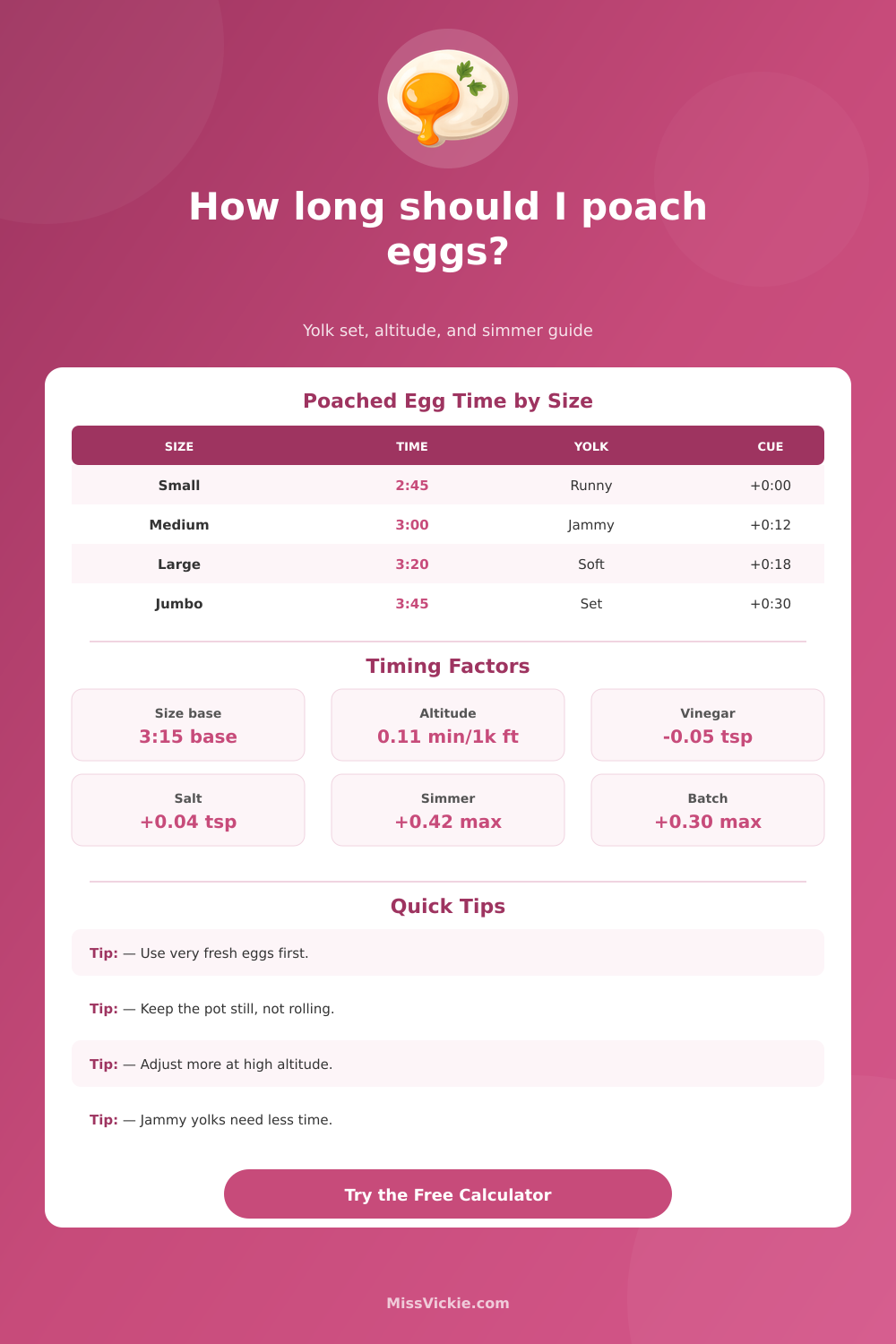
Typical size shifts the base time before any altitude or simmer adjustment.
| Size | Time | Weight | Note |
|---|---|---|---|
| Small | 2:40 | 1.5-1.75 oz | fastest set |
| Medium | 2:55 | 1.75-2 oz | clean whites |
| Large | 3:15 | 2-2.25 oz | most common |
| Jumbo | 3:35 | 2.25 oz+ | needs more time |
Choose the texture you want, then var the calculator add the right timing offset.
| Level | Delta | Center | Cue |
|---|---|---|---|
| Runny | -0:20 | liquid center | best at 3 min |
| Jammy | 0:00 | thick middle | classic brunch |
| Soft-set | +0:18 | soft core | holds together |
| Medium-set | +0:40 | creamy center | slice proof |
| Fully set | +1:05 | firm yolk | least molten |
Higher altitude lowers the boil point and nudges the poach timer upward.
| Altitude | Offset | Boil | Cue |
|---|---|---|---|
| Sea level | 0:00 | 212 F boil | base simmer |
| 1,000 ft | +0:12 | 210 F boil | slight lift |
| 3,000 ft | +0:34 | 206 F boil | gentler heat |
| 5,000 ft | +0:58 | 202 F boil | longer set |
Acid helps the whites tighten while salt changes the timing just a little.
| Mix | Delta | White | Note |
|---|---|---|---|
| No vinegar | 0:00 | looser whites | neutral pot |
| Light vinegar | -0:08 | firmer wrap | clean shape |
| Balanced salt | +0:05 | slight delay | season water |
| Heavy salt | +0:14 | tougher edge | use lightly |
Poaching an egg require managing several differents variables, including the size of the egg, the altitude at which the egg is being poached, and the temperature of the water in which the egg is poached. Many individual attempt to poach an egg with a standard timer, but standard timers does not account for the volume of the egg that is being poached. The volume of a large egg is not the same than the volume of a small egg, and therefore, it takes longer for the heat to reach the center of a large egg relative to a small egg.
Thus, depending upon the size of the egg that is to be poached, you must make adjustments to the recipe to allow the yolk of the egg to reach the desired level of firmness. The use of a calculator can assist in determining the amount of time that is required to poach an egg of a certain size and to allow the yolk of the egg to reach a certain desired texture. In addition to the size of the egg, another variable that must be accounted for is the altitude at which the egg is being poached.
How to Poach an Egg: Simple Tips on Time, Water and Size
The boiling point of water decreases as the altitude from sea level increases. Thus, the proteins in the egg will require more time to coagulate in boiling water at high altitudes relative to locations that are near sea level. Therefore, the cook must make adjustments to the recipe according to the altitude at which the eggs are being poached.
Recipes that are successful at sea level may not yield the same results at high altitudes due to the difference in boiling point of water at these differents altitudes. The chemistry of the water in which the eggs is being poached can also have an impact upon the poaching of the eggs. The addition of vinegar to the water helps to set the egg whites more quick so that the eggs remain closer to the center (yolk) of the egg rather than spreading within the water.
The addition of salt to the water can also impact the poaching of the eggs, although it may have the opposite effect of the vinegar, it may delay the setting of the egg whites. Thus, you can make adjustments to the chemistry of the water to allow for the desired shape of the poached egg. In addition to the altitude and the chemistry of the water, the temperature and the freshness of the eggs to be poached can also impact the poaching process.
Cold eggs will lower the temperature of the water in which the eggs are poached, while eggs that are at room temperature will begin to cook once they is introduced to the boiling water. Additionally, the freshness of the egg impacts the poaching of the eggs; proteins in old eggs is weaker than those in fresh eggs. Thus, the whites of old eggs will spread out more within the water relative to fresh eggs.
One way to avoid the whites of the egg from spreading out in the water is to use a fine sieve to remove some of the thick part of the egg white prior to poaching the egg. The intensity of the simmer in which the eggs are poached will also impact the poaching process. Boiling water can tear the egg whites apart.
Therefore, it is necessary to use a gentle simmer rather than a rolling boil in which the water is violently boiling. A gentle simmer will move the water enough to prevent the egg from sticking to the bottom of the poaching pot, yet will not tear the egg white. If the simmer is too quiet, the egg may flatten on the bottom of the pot; however, if the simmer is too active, the egg whites will break apart within the water.
If many eggs are to be poached at the same time, the cook will have to account for the drop in the temperature of the water. The addition of many eggs will lower the temperature of the water. Thus, the eggs will require more time to coagulate in the water.
Adjustments to the recipe will have to be made to account for the additional number of eggs that is to be poached. Finally, carryover cooking will have to be accounted for in the poaching of the eggs. After the eggs are removed from the water, the eggs will continue to cook.
You must make adjustments to the recipe so that the eggs are removed from the water slightly before the yolk reaches the desired firmness. Thus, accounting for each of these different variables will ensure the success of the poaching process.