Poached Whole Chicken Cooking Time Calculator
Estimate whole chicken poaching time from bird weight, cavity fill, liquid temperature, simmer level, starting temperature, altitude, pot fit, lid position, and carryover rest.
🍜 Whole Chicken Poaching Presets
Choose a real poaching setup, then fine-tune the bird, pot, liquid, altitude, and rest time before cooking.
⚖ Poaching Inputs
Your Whole Chicken Poaching Plan
Estimate updates as you adjust the bird and pot.
Time Breakdown
Setup Details
Thermometer Checkpoints
- Start checking about 10 minutes before the estimate.
- The thickest breast and innermost thigh should reach the target after rest.
- If any area is below target, return the chicken to simmering liquid and recheck.
📌 Quick Poaching Reference
🌡 Poultry Temperature and Timing Table
| Poaching Goal | Internal Target | Suggested Pull Range | Rest Time | Best Use |
|---|---|---|---|---|
| Juicy safe whole chicken | 165°F / 74°C | 158-162°F / 70-72°C | 10-15 minutes | Sliced chicken, salads, sandwiches |
| More tender dark meat | 170°F / 77°C | 164-167°F / 73-75°C | 15-20 minutes | Family dinner, noodle bowls, rice plates |
| Shredding texture | 175°F / 79°C | 169-172°F / 76-78°C | 15-25 minutes | Soup chicken, enchiladas, meal prep |
| Stuffed or packed cavity | 165°F / 74°C in filling | Do not pull early | 10-20 minutes | Only when stuffing is verified with a thermometer |
The calculator estimates timing, but poultry safety still depends on thermometer readings in the thickest breast, innermost thigh, and any cavity filling.
⏱ Weight-Based Poaching Time Table
| Raw Bird Weight | Gentle Simmer From Hot Liquid | Start Checking | Expected Meat Yield | Cooked Servings |
|---|---|---|---|---|
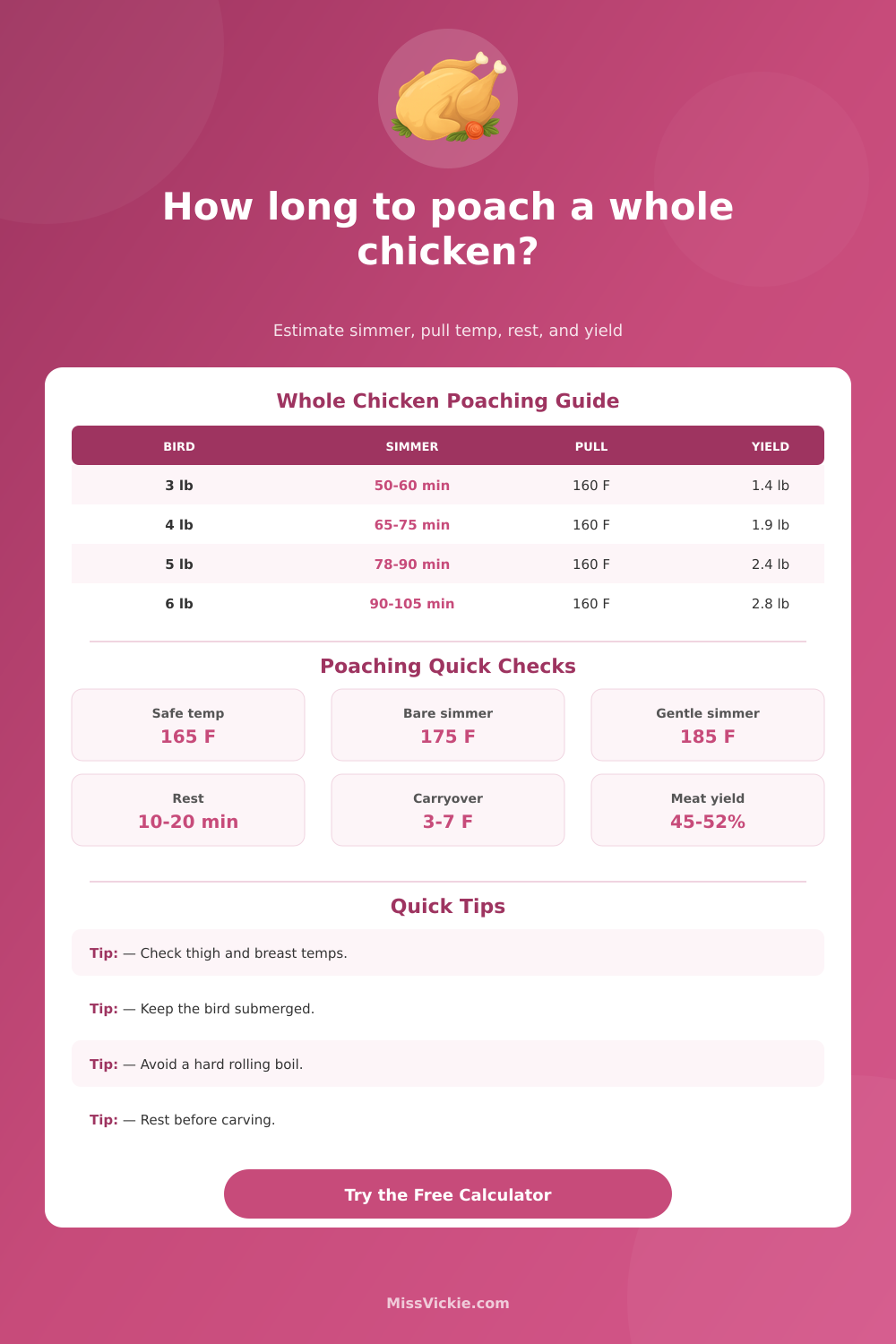
| 2.5-3 lb / 1.1-1.4 kg | 48-60 minutes | 40 minutes | 1.2-1.5 lb / 540-680 g | 4-5 servings |
| 3.5-4 lb / 1.6-1.8 kg | 60-75 minutes | 52 minutes | 1.7-2.0 lb / 770-910 g | 5-7 servings |
| 4.5-5 lb / 2.0-2.3 kg | 72-90 minutes | 64 minutes | 2.1-2.5 lb / 950-1130 g | 7-8 servings |
| 5.5-6.5 lb / 2.5-2.9 kg | 88-110 minutes | 78 minutes | 2.6-3.2 lb / 1.2-1.5 kg | 8-10 servings |
🛒 Yield and Broth Planning Table
| Planning Item | Typical Range | Calculator Assumption | Kitchen Meaning | When To Adjust |
|---|---|---|---|---|
| Boned cooked meat yield | 45-52% of raw weight | 48%, adjusted by bird type | Edible meat after skin and bones are removed | Use lower yield for older hens or heavy bones |
| Serving size | 4-5 oz cooked meat | 4.5 oz per serving | Enough for rice bowls, salads, or sandwiches | Increase for main-dish platters |
| Poaching liquid loss | 6-18% | Based on lid and simmer | Evaporation plus liquid held by the chicken | Use more for uncovered or steady simmering |
| Liquid coverage | 1 inch / 2.5 cm above bird | Checked through pot fit and volume | Promotes even cooking around the breast and back | Add hot broth if the breast emerges |
⛰ Altitude and Simmer Behavior Table
| Altitude | Approx. Boil Point | Poaching Effect | Time Adjustment | Best Simmer Choice |
|---|---|---|---|---|
| 0-2,000 ft / 0-610 m | 212-208°F / 100-98°C | All simmer settings available | Baseline | Gentle simmer |
| 2,000-4,000 ft / 610-1,220 m | 208-204°F / 98-96°C | Near-boil setting is slightly capped | Add 1-3% | Gentle or steady simmer |
| 4,000-6,000 ft / 1,220-1,830 m | 204-201°F / 96-94°C | Steady simmer behaves softer | Add 3-6% | Steady simmer |
| 6,000-10,000 ft / 1,830-3,050 m | 201-194°F / 94-90°C | Hard boil is not much hotter than simmer | Add 6-12% | Covered steady simmer |
🧪 Poaching Method Comparison
Chicken enters already-hot liquid, so total pot time stays close to active poach time.
Chicken warms gradually with the liquid; add heat-up time and monitor the simmer carefully.
Best for large birds, high altitude, and kitchens where the simmer drops quickly.
Easier to skim, but evaporation and heat loss usually lengthen the total cook.
💡 Poaching Tips
You shouldn’t rely on a clock when poaching an entire chicken. It’s all about controlling the flow of heat around and through muscle and bone. The recipe says twenty minutes, but it is raw. Add ten more: Tough thigh, rubbery breast.
Plug in your own setup into calculator up top. Let it do the math. Stop guessing which variables matter (does the fridge temperature realy affect anything?) and save yourself from having to adjust for how altitude changes your water’s boiling point. Variables becomes a plan. But knowing why they’re there, that’ll get you dinner on the table.
Why You Should Use the Calculator
First, start with the bird itself. What kind of bird? There’s a big difference between a kosher air-chilled bird and a heritage hen, and an even bigger difference than a standard supermarket broiler. They differs in both their skin thickness and especially their muscle density. Is this an old, stewing hen? That baby will requires far more gentle treatment, and a lot more time, breaking down connective tissue. Is it a young fryer? It’ll cook through much quicker. To take all that into account, the tool request both type and weight of your bird, allowing it to adjust its initial guess to match.
Where did the chicken come from? Plunking down a frozen block of poultry into a pot of hot water isn’t just unsafe. It’ll crash the temperature of liquid and stall out the cooking entirely. Acknowledge that a cold center means more time, or let the bird sit out for a bit so you won’t be shocked with undercooking later on.
Finally, there is fluid surrounding it all. You may be surprised to learn that many cooks mistakenly believe that poaching is just another term for boiling. However, a rolling boil are the enemy of tender chicken. It agitates and tears fibers while also clouding up the broth. Instead, a gentle simmer (about 185 degrees Fahrenheit) penetrates evenly without toughening proteins on the outside. Whether or not your pot is covered is also included by calculator. Covering the pot keeps heat in place when you add your cold chicken. Leaving it uncovered will cause some drying out and evaporation.
High altitude? Water boils at a lower temperature, which slightly changes your “simmer” into something cooler than what’s considered normal from sea level. Since it take longer to get to desired internal threshold, this calls for even more cooking time. With an entered elevation, the tool automatically adjust for this.
The other thing not to forget: Don’t stuff that cavity! Putting dense fragrant items such as onion halves and chunks of ginger inside the bird will slow down the rate at which heat flow inward toward the middle. So what happens is that meat on the outside (the breast) will come up to temp before what’s closer to the stuffing. Leave it empty, or fill it loosely, and the heat can circulate through better.
When the desired internal temperature is reached (typically about 165 degrees Fahrenheit for a safe, cooked bird), remove it promptly from the pot. And don’t skip the waiting time! Carryover cooking keep going during the rest period, raising the interior temperature several degree as the juices return to their proper places within meat fibers. Otherwise, even if you were careful to simmer it just so, your meat will be dry.
Use the yield tables on the page for realistic portion planning, as they take into consideration lost skin and bones. Every pound of raw bird isn’t going to yield a pound of meat. Plan on a bit less, closer to forty-five to fifty percent edible yield. If you’re having company over or doing meal prep, this can matter.
In the end, poaching requires precision and patience. Go by the clock if you need to, but rely on your thermometer above all else. The digital probe inserted deep into the thigh and thickest part of the breast will tell the truth, but timers never will. Intuition can be your enemy in cooking: particularly so when working with something as high-stakes as raw chicken. But knowledge, specifically about how temperature travels through proteins. Is your friend here. It takes away the worry and lets you trust the process. You should of known that. Time stops being an issue.
It’s not you anymore, it’s the chicken. And you’re simply controlling the environment. It’s the difference between a ho-hum Sunday dinner and a truly special meal, one whose memory will stay and inspire multiple requests for seconds.