Pizza Size Calculator
Compare pizza diameter, square-inch area, slice count, appetite, crust thickness, and pan style so you can order enough pizza without guessing from slice counts alone.
Pick a Size or Party Scenario
These presets load common party orders. You can still adjust diameter, crust thickness, appetite, slices, and crust style for your actual pizzeria.
Pizza Size and Crowd Inputs
Pizza Details
Party Details
Your Pizza Size Plan
Breakdown
- Enter your pizza and party details, then calculate to see the breakdown.
Pizza Area and Slice Reference
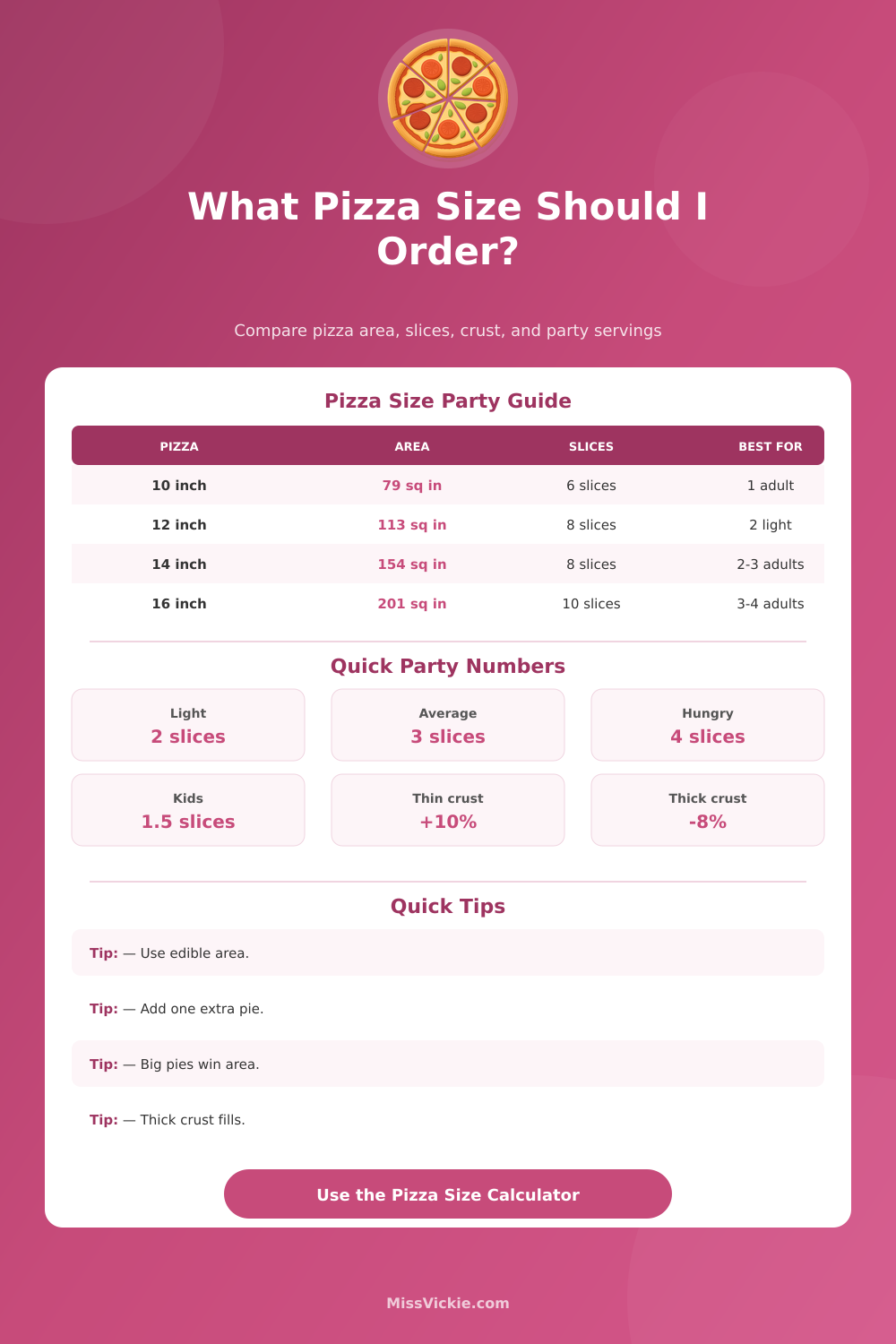
| Diameter | Full area | Vs 12 inch | Best use |
|---|---|---|---|
| 8 inch personal | 50 sq in | 44% of a 12 inch | One light eater or a lunch combo. |
| 10 inch small | 79 sq in | 69% of a 12 inch | One hungry adult or two snack portions. |
| 12 inch medium | 113 sq in | Baseline | Two light eaters or one very hungry adult. |
| 14 inch large | 154 sq in | 136% of a 12 inch | Two to three adults depending on appetite. |
| 16 inch extra large | 201 sq in | 178% of a 12 inch | Three to four adults, especially thin crust. |
| 18 inch party | 254 sq in | 225% of a 12 inch | Four to five adults or a mixed table. |
| 20 inch giant | 314 sq in | 278% of a 12 inch | Buffet style parties and office lunches. |
| Slice cut | 12 inch area per slice | 14 inch area per slice | 16 inch area per slice |
|---|---|---|---|
| 6 slices | 18.9 sq in | 25.7 sq in | 33.5 sq in |
| 8 slices | 14.1 sq in | 19.2 sq in | 25.1 sq in |
| 10 slices | 11.3 sq in | 15.4 sq in | 20.1 sq in |
| 12 slices | 9.4 sq in | 12.8 sq in | 16.8 sq in |
| Appetite setting | Slices per adult | Suggested use | Ordering note |
|---|---|---|---|
| Light | 2 slices | Lunch, appetizers, or salad on the side. | Use less buffer when more food is available. |
| Average | 3 slices | Most casual dinners and family nights. | Good default for mixed adults. |
| Hungry | 4 slices | Game day, teens, late dinners, or drinks. | Add at least one extra pizza for groups over 8. |
| Very hungry | 5 slices | Sports teams, heavy appetites, or no sides. | Order by area, not by menu labels. |
| Crust style | Area adjustment | Fullness adjustment | What it means |
|---|---|---|---|
| Thin crust | More edible center | Guests may eat about 10% more | Thin slices disappear quickly, especially as appetizers. |
| Hand-stretched | Balanced rim and center | Use normal appetite settings | Best baseline for most delivery pizza. |
| Pan pizza | Slightly smaller exposed top area | Guests may eat about 8% less | Thicker base is more filling even if slice count looks small. |
| Neapolitan | Puffy rim reduces topping center | Keep a moderate buffer | Beautiful large diameter, but the cornicione takes more edge space. |
Why Diameter Changes the Order
Two 10 inch pizzas vs one 14 inch
Two 10 inch pizzas give about 157 square inches. One 14 inch pizza gives about 154 square inches, so the order is nearly equal before crust loss. The two smaller pizzas may offer more topping variety.
One 16 inch vs two 12 inch pizzas
One 16 inch pizza gives about 201 square inches. Two 12 inch pizzas give about 226 square inches, so two mediums win on total area but may cost more.
One 18 inch vs two 14 inch pizzas
One 18 inch pizza gives about 254 square inches. Two 14 inch pizzas give about 308 square inches, which is better for bigger groups and multiple toppings.
Pan pizza changes the math
Pan pizza can feel more filling even when the top surface is smaller. If the crust is thick and oily, reduce the slice demand slightly, especially for kids.
Slice count can mislead
A 12 inch pizza cut into 8 slices and a 16 inch pizza cut into 8 slices do not feed the same. The larger pie has much bigger slices because the area is larger.
Parties need a buffer
Mixed groups rarely eat evenly. Add 10% to 25% when there are teens, late arrivals, limited sides, or several topping preferences that split the table.
Pizza Ordering Tips
A larger diameter often delivers more food per dollar because pizza area grows faster than the diameter number. If two sizes are close in price, the larger one may be a much better value.
Calculate total pies first, then divide between cheese, pepperoni, veggie, and specialty options. For picky groups, one plain cheese pizza is usually the safest backup.
This calculator estimates ordering quantity from geometry and common appetite rules. Real results vary by pizzeria, crust height, cheese load, toppings, side dishes, and how generously the pizza is cut.
Ordering pizza for a large group is a mathematical task. When ordering pizza for a large group of people, an understanding of geometry are required. While many people look at the diameter of a pizza when they order it, the diameter doesnt accurately represent the amount of food that the pizza contains.
People may order pizza based on the diameter that is advertised, but the measurement that is important to ordering enough pizza for a group is the area of the pizza. Since the area of a circle increase faster than its diameter increases, the difference in the amount of food that is present in pizza of different diameters is much more significant then the numbers on the pizza menu might suggest. In order to order enough pizza for everyone who will dine, you must consider the area of the pizza in the ordering process.
How to Decide How Many Pizzas to Order for a Group
There are three specific inputs that can be used in a calculator to determine the correct amount of pizza that should be ordered for a large group of people. These three inputs are the diameter of the pizza, the thickness of the crust, and the number of pizzas that will be purchased. The thickness of the crust is one of the factors that must be considered because the crust of the pizza takes up some of the same area as the pizza but is an area that most people dont eat.
The thicker the crust of the pizza, the more area is removed from the pizza that the individuals who are to consume the pizza would otherwise eat. Therefore, you should consider the thickness of the crust in the calculation of how many pizzas should be ordered for a group. The appetite level of the individuals who will be eating the pizza should also be considered when determining how many pizzas to order.
The calculator will ask for the number of slices of pizza that each adult and each child will eat. The appetite levels of different groups of individuals can be different from one another. For instance, a group of teenagers will eat more pizza than a group of coworkers.
Additionally, a group of teenagers will eat the pizza at a faster rate than a group of coworkers. In the calculator, the calculator provides for each group of individuals and calculates the number of slices that each group will eat. A buffer is also added to this number.
The buffer allows for the inclusion of extra pizza for those who may arrive late for the meal or for those who want to eat a second slice of pizza. This buffer is essential in calculating the proper amount of pizza to order because if it isnt included, there may not be enough pizza for all of the individuals in the group. The type of crust that is used in the pizza can also affect the amount of food that the individuals consume.
Thin crust pizzas allow for the individuals to eat more slices of pizza because there is less weight to each slice. Pan pizzas are the opposite of thin crust pizzas; pan pizzas contain more food and are more filling. Therefore, you can decrease the number of pizzas that should be ordered if pan pizzas are ordered.
The number of pizzas that would be ordered with thin crust pizzas would be higher than the number for pan pizzas of the same size. The pizza calculator also makes an adjustment for crust styles so that the different crusts are accounted for in the total number of pizzas that are recommended to be ordered for a group of individuals. The area of the pizza is a number that individuals often overlook when they order pizza.
The area of a pizza is an essential number for those who want to order pizza for a large group of individuals. For instance, two pizzas with a diameter of ten inches each will contain almost the same area of pizza as one pizza with a diameter of fourteen inches, but two ten-inch pizzas allow for different toppings to be provided to the eaters. Additionally, one sixteen-inch pizza may be cheaper than two twelve-inch pizzas at the same rate, but the sixteen-inch pizza will require everyone in the group to eat the same toppings as the other members of the group.
The number of slices that a pizza is cut into can also cause some confusion when ordering pizza. For instance, a sixteen-inch pizza cut into eight slices will have larger servings of pizza than a twelve-inch pizza that is also cut into eight servings. Therefore, if the individuals who will eat the pizza prefer to eat one large slice at a time, ordering a larger pizza is an option.
However, if the individuals prefer to eat many small portions of pizza, more pizzas will have to be ordered for the group. Many people may order pizza without considering most of these factors because they believe that if the diameter of the pizzas are the same, then the pizzas are equal in terms of the amount of food that they contain. A pizza that is hand-stretched will contain different amounts of food than a pan pizza that may have the same diameter.
Pan pizzas contain more dough and more cheese. People must take this into consideration when ordering pizza for a group of individuals. Another mistake that may be made when ordering pizza is in the number of slices of pizza that is printed on the receipt that is provided to the customer.
For instance, a pizza of fourteen inches in diameter may be sliced into ten portions instead of eight. While the number of portions may be increased, the total amount of food is the same. It is important for the number of pizza slices to be separated from the area of the pizza in the calculation that is made with the pizza calculator.
There are some variables in the pizza eating process that a pizza calculator could never measure. For instance, the amount of pizza that individuals will eat will change based on a variety of factors. Some individuals may skip certain toppings on the pizza.
Others may eat more because they skipped a meal prior to eating the pizza. Additionally, the number of side dishes that are provided with the pizza will affect the amount of pizza that is eaten. If a salad is provided with the pizza, the individuals will eat less of the pizza.
However, if there are no side dishes provided with the pizza, the individuals will eat more of the pizza. The pizza calculator can perform a calculation of the amount of pizza that is needed. Additionally, you can add a buffer to this calculation to provide extra pizza should the individual order allow for it.
However, because of these variables, it is best to calculate the amount of pizza needed for the individuals, add a buffer for the extra pizza that may be needed, and then round up to the next whole pizza for the group of individuals that will be eating the pizza. Finally, the pizza calculator will compare the total number of pizzas that are calculated to the total number that was originally planned to be ordered. If the calculated total for the number of pizzas that should be ordered is only slightly higher than the number that was originally planned, only one extra pizza needs to be ordered.
However, if the number of pizzas that are calculated is much higher than the number that was originally planned to be ordered, you should examine the number of pizzas that were ordered. It is possible that the size of the pizzas, the appetite levels of the individuals, or the number of people that will be eating the pizza were the issues that caused the difference between the calculated and planned number of pizzas. By adjusting the number of pizzas that are ordered according to the factors that could impact the number of pizzas that will be eaten by the group, you can order the number of pizzas with confidence.