How Much Sauce for Pizza Calculator
Calculate pizza sauce by diameter, sauced area, crust rim, sauce style, thickness, and batch size so every pie gets the right spread.
Choose a common pizza plan, then adjust the sauce style, rim, and thickness for your own dough and toppings.
Sauce Breakdown
| Sauce Style | Best Use | Fluid Ounces per 100 sq in | Adjustment Note |
|---|---|---|---|
| Classic tomato | Hand tossed and NY-style pies | 4.6 fl oz | Balanced for cheese and pepperoni |
| Crushed tomato | Neapolitan and high heat pizza | 4.1 fl oz | Use a lighter hand to avoid wet centers |
| Thick cooked sauce | Pan pizza and loaded pies | 5.0 fl oz | Holds shape and spreads slower |
| White sauce | Chicken, spinach, mushroom, or garlic pies | 4.3 fl oz | Richer sauces usually need less volume |
| Pesto or herb sauce | Flatbreads and appetizer pizzas | 3.0 fl oz | Strong flavor, thin layer preferred |
| Barbecue or buffalo | Chicken and smoky topping combinations | 3.6 fl oz | Sweeter or sharper sauces overpower fast |
| Pizza Size | Sauced Area with Rim | Classic Sauce | Metric Equivalent |
|---|---|---|---|
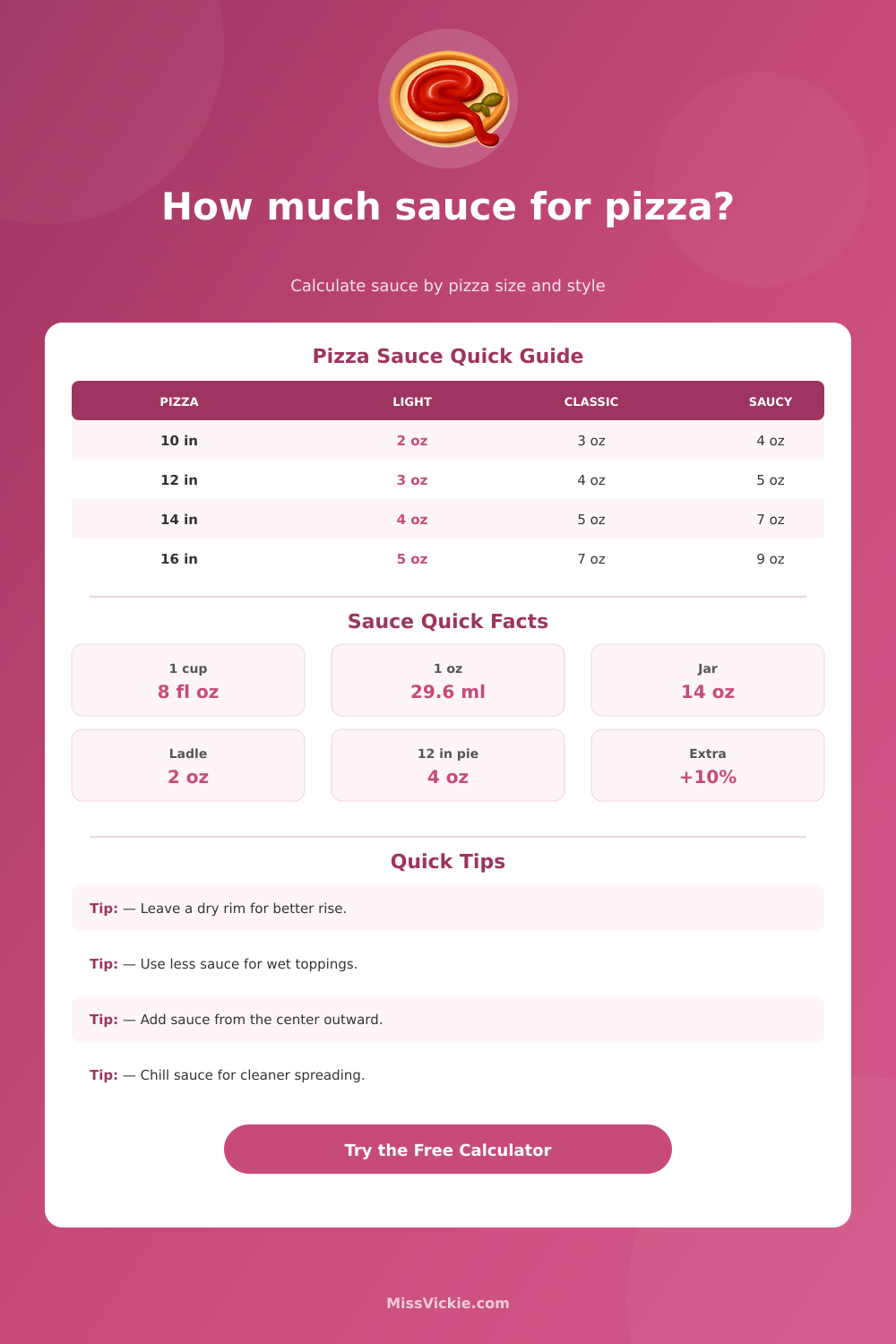
| 8 inch personal | 38 sq in | 1.75 to 2.25 fl oz | 52 to 67 ml |
| 10 inch small | 60 sq in | 2.5 to 3.5 fl oz | 74 to 104 ml |
| 12 inch medium | 87 sq in | 3.5 to 4.5 fl oz | 104 to 133 ml |
| 14 inch large | 122 sq in | 5 to 6 fl oz | 148 to 177 ml |
| 16 inch extra large | 165 sq in | 6.5 to 8 fl oz | 192 to 237 ml |
| Detroit 10 by 14 | 117 sq in | 5 to 6.5 fl oz | 148 to 192 ml |
| Batch Plan | Pizza Count | Total Sauce | Container Planning |
|---|---|---|---|
| Weeknight dinner | 2 medium pizzas | 1 to 1.25 cups | One 14 oz jar is enough |
| Family pizza night | 3 large pizzas | 2 to 2.5 cups | Use a 24 oz jar or two cans |
| Small party | 6 large pizzas | 4 to 5 cups | Plan one quart plus backup |
| Freezer prep | 12 personal pizzas | 3 to 4 cups | Portion into half-cup packs |
| Deep dish meal | 2 deep pizzas | 2.5 to 3 cups | Keep extra for top sauce |
| Sheet pan service | 4 trays | 5 to 6 cups | Use two quart containers |
Use a light layer so the center bakes crisp instead of steaming.
Most pizzas land around 3 to 5 fluid ounces for a 12-inch pie.
Thicker dough can handle a fuller layer and heavier toppings.
Deep dish often needs extra sauce because some goes above the cheese.
Calculating the correct amount of pizza sauce is a necessary step in the process of making a consistencies pizza. The amount of pizza sauce that is used directly determine whether the pizza crust will become too wet from the sauce, or whether the crust will be too dry due to the lack of sauce. Using too little sauce will cause the cheese to sit on the bare dough, while using to much sauce will lead to a wet patch in the center of the pizza.
While the diameter of the pizza can be used as a method for approximating the amount of sauce that should be used, the diameter is not the most important measurement of the pizza that are used to determine the amount of sauce that is needed. The most important measurement of the pizza is the sauce area of the pizza; this area is smaller than the diameter of the pizza due to the outer ring of the pizza that is made of crust. That outer ring of the pizza does not receive any pizza sauce, so a 14-inch pizza do not require twice as much sauce as a 10-inch pizza.
How to Calculate the Right Amount of Sauce for Pizza
To account for the dimensions of the pizza and the amount of sauce that is needed, one should use a tool that accounts for the rim width and the shape of the pizza to calculate the amount of sauce that is necessary for each pizzas. Another factor that affect the pizza and the amount of sauce that is used is the thickness of the pizza sauce. Thin pizza sauce is required for pizzas with thin crusts, like Neapolitan pizzas, but thick sauce is required for thick pan crusts.
A sauce thickness calculator can be used to adjust for the different types of crust that is to be used in the pizza. Another variable that can change the amount of sauce for the pizza is the coverage level of the sauce. Some people prefer their pizzas has a light coverage of sauce, while other individuals may prefer the sauce to be heavily with the toppings.
Additionally, the type of pizza sauce that will be used also has an effect upon the sauce coverage; thick cooked sauce will behave differently than thin marinara sauce. The sauce coverage calculation must account for the type of sauce. The number of pizzas that are to be made will also affect the total amount of sauce that is required.
If an individual is making many pizzas, he or she will need more sauce than if they were making just a single pizza. When making many pizzas, he or she will have to account for an extra buffer for sauce losses during the pizza making process. Additionally, if the individual prepares only a small amount of sauce, it is also possible that he or she may find themselves out of sauce should a customer desire more sauce on there pizza.
Thus, the individual will have to calculate the total amount of sauce necessary based on the total number of pizzas that is to be made. The shape of the tray upon which the pizzas will be made is another factor that will impact the sauce calculation. Whereas round pizzas will fit nicely onto round pans, square or rectangular pans will have different areas than the pizzas that is to be made.
An individual will have to take into account the dimensions of the tray; a calculator that calculates the amount of sauce that is needed for each pizza will account for the shape of the tray. One way in which the sauce calculator accounts for the shape of the tray is in the recalculating of the inner area of that tray. By recalculating the inner area of the tray, the sauce calculation tool ensure that the pizzas will not be under-sauced.
The amount of moisture contained within the toppings will also factor into the sauce calculation. Many toppings will release moisture when heated in the oven. Vegetables and fresh mozzarella contains moisture, as do meat-heavy toppings.
These different types of moisture must be accounted for in the sauce preparation. A sauce calculator will account for these different types of moisture in the toppings, preventing the sauce amount from having to be adjusted for each pizza that is made. The last factor to consider when calculating the amount of sauce that will be used for the pizzas is the containers in which the sauce will be stored.
While the total volume of sauce will tell an individual how much sauce will be needed for the pizzas, he or she will also need to know how many container of sauce will be required to provide that volume. The output of a sauce calculator will display how many containers of sauce are required based on the size of the containers of sauce that are to be purchased. By calculating the amount of sauce that is necessary for each pizza, one can purchase sauce containers in advance to avoid running out of sauce while preparing the pizzas.
The primary goal of calculating the amount of sauce that will be used in the making of the pizzas is to ensure the consistency in each pizza that is made. A sauce calculation calculator will allow individuals to understand how the various parameters will affect the total amount of sauce that is required. By using such a calculator, individuals will learn the amount of sauce that should be used for each type of pizza.
By using such a calculator, the individual will be able to ensure that each pizza contains the same amount of sauce as each of the other pizzas that is made.