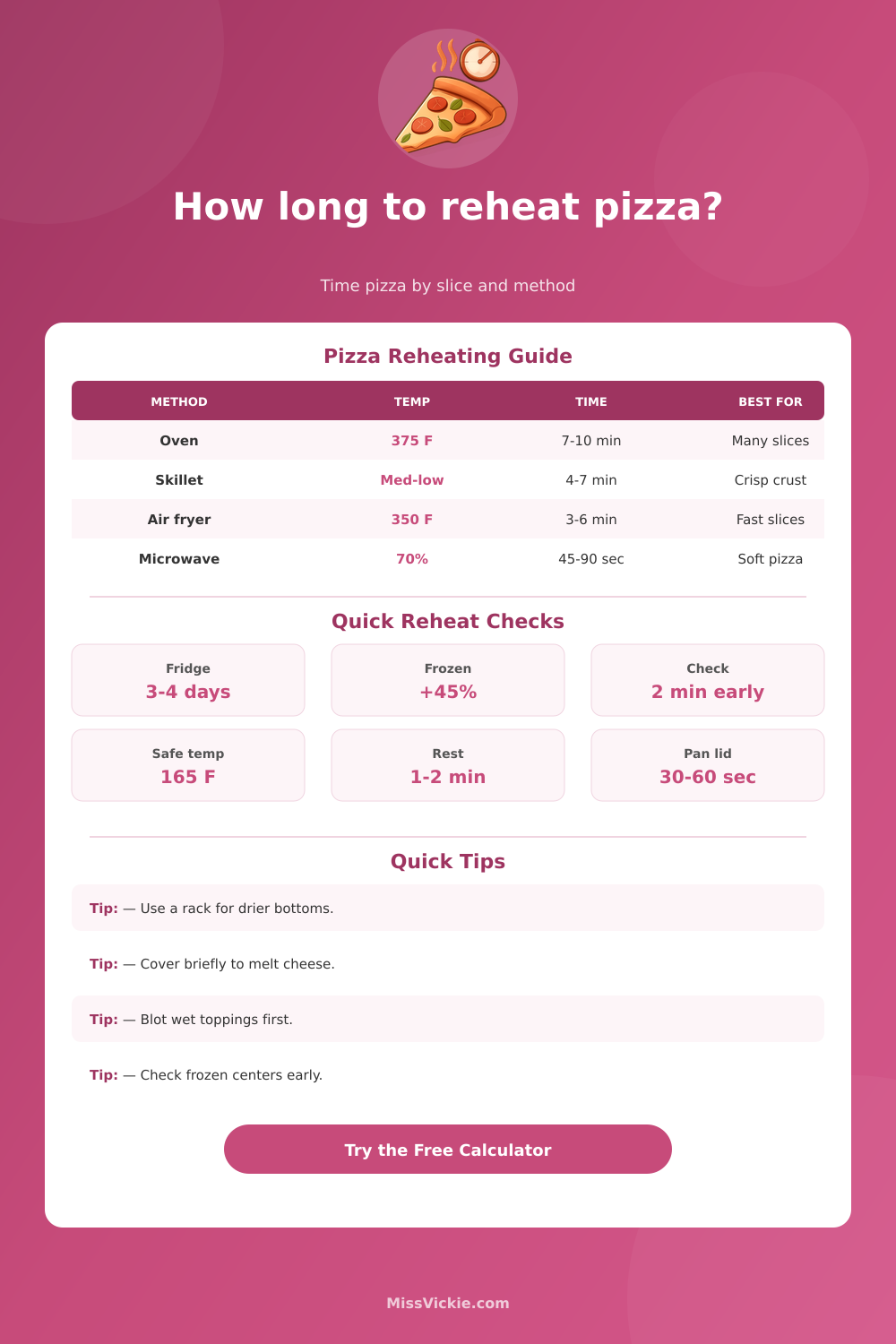
Pizza Reheating Time Calculator
Estimate pizza reheating time from slice thickness, crust style, topping load, fridge or frozen start, heating method, temperature, crispness target, and slice count.
🍕 Pizza Reheating Presets
Choose a leftover pizza scenario, then adjust crust, slice thickness, topping weight, method, temperature, crispness, start temperature, and how many slices you are reheating.
🧮 Pizza And Reheating Inputs
Pizza timing
Choose your pizza details to estimate reheating time.
Timing Breakdown
Pizza Setup
Step Timing
⏱ Reheating Benchmarks
Best for 1 to 3 slices with a crisp bottom and fast cheese melt.
Best for multiple slices, thicker crust, and more even heating.
Best for crisping the crust while a lid helps cheese soften.
Use for leftovers when checking a dense or heavily topped center.
📊 Method Comparison Grid
Great for thick pizza, many slices, and reheating from frozen without scorching.
Best single-slice method when the crust is soft but the toppings are already cooked.
Excellent for thin to medium slices, but crowded baskets over-brown edges quickly.
Fastest for a snack, though the crust stays flexible unless finished in a pan.
📘 Pizza Reheating And Safety Tables
| Method | Usual Heat | Fridge Slice Time | Frozen Slice Time | Texture Result |
|---|---|---|---|---|
| Oven or toaster oven | 350 to 400°F | 7 to 10 min | 11 to 16 min | Even melt, moderate crisp |
| Covered skillet | Medium-low surface | 4 to 7 min | 7 to 11 min | Crisp base, soft cheese |
| Air fryer | 325 to 375°F | 3 to 6 min | 6 to 10 min | Fast crisping, dry edge |
| Microwave | 60 to 80% power | 45 to 90 sec | 2 to 4 min in pulses | Soft crust, quick melt |
| Pizza Style | Thickness Cue | Best Method | Timing Adjustment | Watch For |
|---|---|---|---|---|
| Thin crust | Under 0.30 in | Air fryer or skillet | Shorten 10 to 20% | Fast edge browning |
| New York style | 0.35 to 0.55 in | Skillet or oven | Use baseline time | Cheese melt before drying |
| Pan or Sicilian | 0.75 to 1.25 in | Oven on rack or pan | Add 15 to 35% | Cold center under sauce |
| Deep dish | 1.25 in or more | Oven, lower heat | Add 35 to 60% | Hot rim, cool middle |
| Leftover Condition | Storage Limit | Reheat Goal | Calculator Setting | Food Safety Note |
|---|---|---|---|---|
| Room temperature | Under 2 hours | Hot and melted | Room-temp start | Do not reheat pizza left out too long. |
| Refrigerated | 3 to 4 days | 165°F center for leftovers | Fridge or cold dense | Refrigerate leftovers promptly in shallow containers. |
| Frozen cooked pizza | Best within 1 to 2 months | Hot center, crisp bottom | Frozen solid | Use lower heat first for thick slices. |
| Extra meat or seafood | Use sooner | 165°F throughout | Meat-heavy toppings | Check the thickest topping area. |
| Problem | Likely Cause | Best Fix | Add Time? | Next Time |
|---|---|---|---|---|
| Cheese hot, crust limp | Too much top heat or plate reheating | Finish on skillet or hot pan | 1 to 2 min | Use rack, stone, or pan |
| Crust dark, center cold | Heat too high for thickness | Lower heat and cover loosely | 2 to 5 min | Start frozen slices lower |
| Toppings watery | Vegetables or extra sauce released steam | Blot first, uncover near end | 1 to 3 min | Choose veggie-heavy setting |
| Edges dry | Air fryer or broiler ran too long | Pull earlier and rest briefly | No | Use balanced crispness |
Timing is an estimate for already cooked pizza. For food safety, discard pizza left at room temperature too long, and reheat leftovers thoroughly when needed.
💡 Reheating Tips
Leftover pizza is rarely about hunger; it’s more about texture. Yesterdays good slice has now became a rubbery crust and congealed cheese in fridge. How do you reheat it without messing up moisture and heat? It seems impossible.
You know that most people use the microwave for convenience, which will likely end up as a soft, soggy disaster. Or they just toss it out because heating up pizza sound like too much trouble. The calculator takes away the guesswork and makes process clear.
How to Reheat Pizza Perfectly
That’s the tricky part, how can it get both the center hot and the cheese all melty without drying out the toppings or burning the bottom? Thick slices react different than thin crust pizzas; the heat travel faster or slower depending on thickness of the crust. If you put a thin slice under high heat, the outside will crisp while the interior still stay cold. On the other hand, a thicker slice could of been burned around the edges well before the inside gets even warm.
To account for that, the tool also ask what kind of pizza you have (style) and where it started off in relation to oven. One important variable here is how thick the crust is. Depending on whether it’s a Sicilian square or New York style thin slice, the system will time accordingally. Even though top of a thicker slice may feel warm to the touch, the middle of it is still holding onto some cool air between the cheese and crust. Using super-hot temps to try to hurry along a thick slice results in a cold interior and burned exterior. The calculator takes this starting state into account. For example, a frozen slice isn’t the same as a slice that has been resting on the counter for an hour.
While the timing depends on the method you use, it will yield a different result depending on which one you choose. Using an air fryer will make the crust nice and crisp by circulating hot air around the slice of pizza, pulling all the moisture off fast. But if it’s left in there too long, it’ll dry out any toppings, especially more delicat ones. On a skillet you have direct control over how brown/crispy the bottom crust becomes, but you can use a lid to help melt the cheese while steaming the top. And finally, microwaving it is the quickest way to get it done, but results in a still-soft crust. Knowing these trade-offs allows you to select the method based off what you need that night.
The time it takes to heat is also affected by topping load. When watery veggies and heavier meats gets hot, they emit steam, maintaining the surrounding crust’s softness. For example, if your pie has lots of onion and peppers on top, the moisture will prolong the crisping time. The calculator accounts for this too, increasing the energy needed to evaporate any liquids from certain toppings. It’s not simply heating up food; it’s manipulating the water content while ensuring the crust stay firm.
But first and foremost, you need safe food, whatever your taste goals are. To kill any bacteria that could be lingering in stored leftovers, they should reaches 165 degrees Fahrenheit inside. This is especially important with anything containing more than a few days’ worth of life, meaning either some meaty slices or something that’s been sitting in the fridge for a while. That means it doesn’t want to wait too long. Thankfullly, the time estimates are based on food safety. This is good because who knows what kind of guesses people make about when the pizza can be eaten?
The trick of reheating pizza is to strike a balance between getting hot enough to fix whatever has gotten cool, while maintaining the integrity of the initial pie. This means thinking simultaneously about method, toppings, and thickness; nobody wants their center lukewarm and their crust burnt. When faced with leftover pizza in your refrigerator, consider this: usually the more you plan ahead, the better off you’ll be. Heat will do what heat does if you use it right.